Flights Cancelled Throughout Europe As 2,365 Delays And 85 Cancellations Affect Travel Across Vienna, Rome, And 15 Major Airports

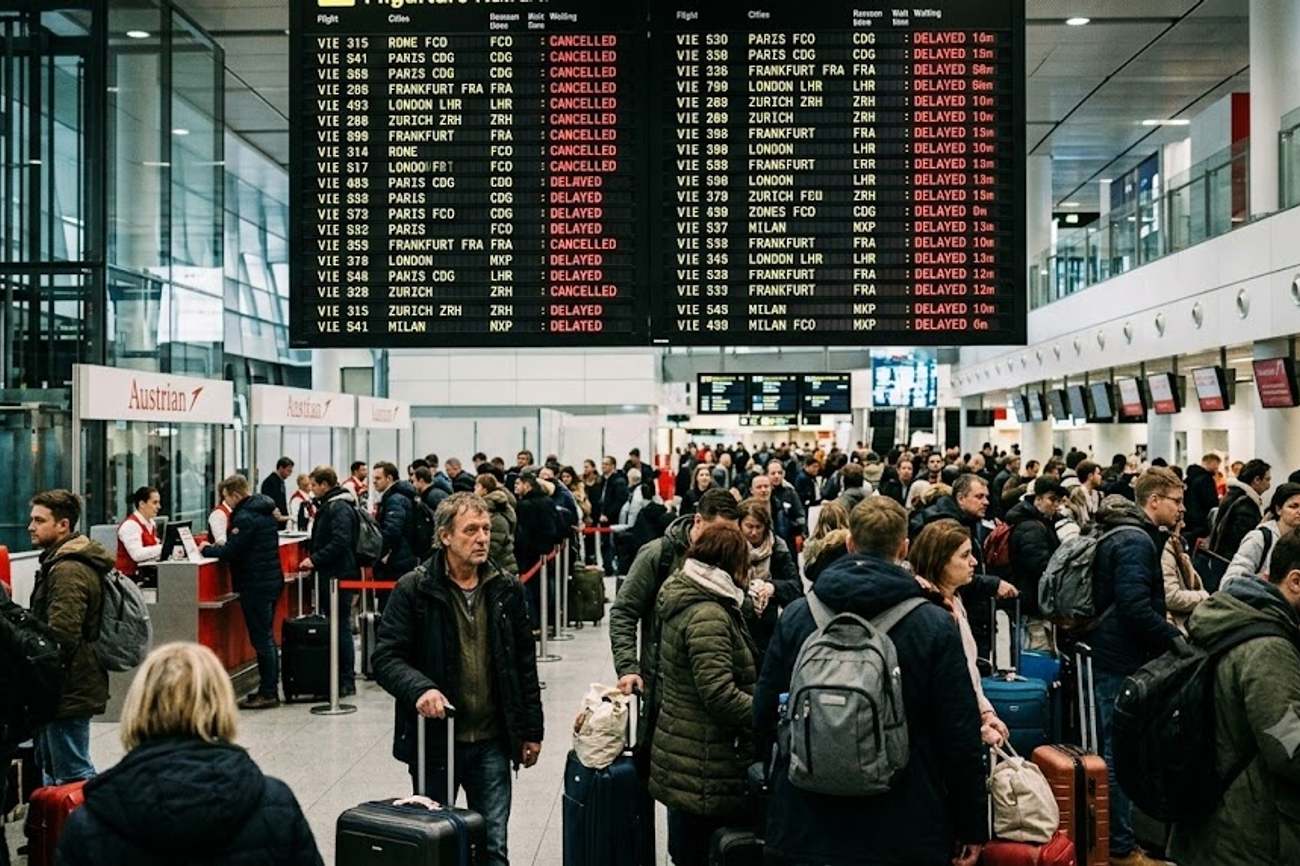
Image generated by AI
European aviation hubs are currently experiencing a systemic volatility spike, with 2,365 delays and 85 cancellations recorded across major gateways on September 24, 2026. This level of disruption highlights a widening gap between scheduled capacity and operational reliability, particularly at primary hubs where destination flight delay rates are now hitting 20% to 22%.
The European Volatility Index: September 2026 Data
The current operational data reveals a high concentration of failure points within the "Big Five" European hubs. Amsterdam Schiphol stands as the primary epicenter of instability, recording 337 delays and 19 cancellations. The data shows a specific vulnerability in destination flights at Schiphol, where 20% of arrivals were delayed.
Frankfurt Airport follows closely with 293 delays and three cancellations. The data here reveals a critical trend in origin flights, which saw a 22% delay rate, while destination flights remained nearly identical at 21%. This suggests a systemic issue with aircraft rotation and turnaround times rather than isolated weather or ATC events.
In Southern Europe, the volatility is equally pronounced. Rome Fiumicino and Athens International Airport both recorded 261 delays. However, the origin flight delay rates at these airports—27% for Rome and 28% for Athens—are significantly higher than those seen in Northern Europe, indicating a regional struggle with departure efficiency.
Paris Charles de Gaulle reported 269 delays and four cancellations, with a 16% delay rate for destination flights. Madrid-Barajas recorded 200 delays and one cancellation, maintaining a lower origin flight delay rate of 16%.
Beyond the primary hubs, leisure-centric airports are showing extreme instability in cancellation metrics. While the raw number of delays is lower, the ratio of cancellations to total flights is higher in the Canary Islands and Iceland. Gran Canaria recorded 63 delays but a staggering 13 cancellations, while Air Iceland Connect saw 12 cancellations across Reykjavik, Isafjordur, and Vagar.
Comparative Operational Analysis: Hubs vs. Regional Gateways
When analyzing the data, a clear pattern emerges: major hubs suffer from high-volume delays, while regional or leisure airports suffer from total flight collapses (cancellations). This suggests that while hubs can "absorb" delays by shifting schedules, regional airports lack the backup capacity to do so.
The following table breaks down the operational performance across the most affected European airports on September 24, 2026.
| Airport | Total Delays | Total Cancellations | Origin Flight Delay % | Destination Flight Delay % |
|---|---|---|---|---|
| Amsterdam Schiphol | 337 | 19 | N/A | 20% |
| Frankfurt | 293 | 3 | 22% | 21% |
| Paris CDG | 269 | 4 | N/A | 16% |
| Rome Fiumicino | 261 | 2 | 27% | N/A |
| Athens Intl | 261 | 1 | 28% | N/A |
| Madrid-Barajas | 200 | 1 | 16% | N/A |
| Palma de Mallorca | 161 | 4 | 23% | 10% |
| Zurich | 144 | 2 | 16% | 16% |
| Paris Orly | 121 | 3 | N/A | N/A |
| Sheremetyevo | 106 | 5 | N/A | N/A |
This data aligns with broader industry reports from IATA, which have frequently highlighted the fragility of European airspace due to staffing shortages and aging infrastructure. The disparity between Palma de Mallorca's origin delays (23%) and destination delays (10%) suggests a bottleneck in outbound processing that is not mirrored in inbound arrivals.
Practical Traveler Advisory and Strategic Insights
The current data indicates that "hub-and-spoke" travel is currently high-risk. For passengers utilizing KLM, Lufthansa, or Air France, the probability of a delay is significantly higher than the industry average. KLM, in particular, is the highest-risk carrier in this dataset, recording 202 delays and 20 cancellations across Schiphol, CDG, and Fiumicino.
Actionable Booking and Travel Advice:
- The Connection Buffer Rule: If you are connecting through Amsterdam, Frankfurt, or Rome, a standard 60-to-90-minute connection window is no longer sufficient. Given that origin delays in Athens and Rome are hitting 27-28%, travelers should aim for a minimum 3-hour buffer to avoid missing onward flights.
- Carrier Selection: Data shows that flag carriers (KLM, Lufthansa, Air France) are currently absorbing the bulk of the delays. If reliability is the priority over loyalty points, travelers should cross-reference current OAG on-time performance metrics before booking.
- Leisure Route Caution: Travelers heading to the Canary Islands or Iceland should be aware that cancellations are more frequent than delays. With Canarias Airlines recording 15 cancellations and Air Iceland Connect recording 12, these routes have lower operational redundancy. Ensure you have comprehensive travel insurance that covers "trip interruption."
- Pre-Departure Verification: Because 20-22% of destination flights at major hubs are delayed, travelers should not rely on "estimated arrival" times provided by third-party apps. Check the airline's direct status feed 4 hours before departure.
Projecting the Stability Curve
The concentration of delays among the top carriers—KLM (202), Lufthansa (149), and Air France (123)—suggests that the issue is not merely airport-based but carrier-based. This indicates a potential crisis in crew scheduling or aircraft maintenance cycles within the European airline groups.
Looking forward, if the origin flight delay rates in Athens (28%) and Rome (27%) do not normalize, we can expect a "ripple effect" across the continent. Because these aircraft rotate through other hubs, a delay in Athens often becomes a delay in Frankfurt four hours later.
We are seeing a shift toward "operational fragility," where a single disruption at a hub like Schiphol (337 delays) creates a systemic failure across the network. According to data trends often tracked by Statista, this pattern typically precedes a seasonal adjustment in flight schedules, where airlines reduce frequency to regain reliability. Travelers should expect potential schedule "optimizations" (hidden flight cuts) in the coming quarter as carriers attempt to lower these delay percentages.
FAQ: European Flight Disruptions 2026
Are flight prices expected to rise due to these disruptions? Not directly. However, as airlines reduce capacity to improve on-time performance, the decrease in available seats may drive up fares on high-demand routes like London-Amsterdam or Paris-Rome.
Which airlines are currently the most reliable in Europe? Based on the September 24 data, regional carriers and low-cost options like Ryanair (97 delays) and easyJet (92 delays) showed lower total disruption volumes compared to hub-centric carriers like KLM (202 delays).
Is it a good time to book connecting flights through major hubs? It is high-risk. With origin delays reaching 28% in some hubs, the probability of a missed connection is elevated. Book direct flights where possible or allow for an overnight layover.
Why are cancellations higher in regional airports than in hubs? Hubs have more aircraft and crew available to swap in when a flight is canceled. Regional airports, like those in the Canary Islands, have limited backup assets, meaning a technical failure often results in a total cancellation.
The data is clear: European aviation is currently operating at the edge of its capacity, and the burden of reliability has shifted from the carrier to the passenger.
Related Travel Guides
- Greece Joins Italy And More As Athens Unveils Heritage Events To Connect Travellers With Living Culture
- Greece Moves With Egypt as Aegean Airlines Starts Direct Thessaloniki Cairo Flights Driving Travel Growth
- Switzerland Joins Netherlands And More As Explora Expands Luxury River Cruising Across Europe
This article is for informational purposes. Flight routes, passenger regulations, visa rules, and transit advisories are subject to change by airlines and aviation authorities. Readers are advised to verify schedules and travel documentation with relevant carriers and border agencies before departure.
Related Stories

New Zealand Visa Changes Delayed to Nov 23 2026 Amid South Island Weather Warnings

Spain Tourism Boom 2026: US Spending Surges 13% as Madrid and Barcelona Anchor Visitor Economy