Miami International Airport Flight Disruptions Mount After Fatal Prime Air Boeing 767 Cargo Crash 2026

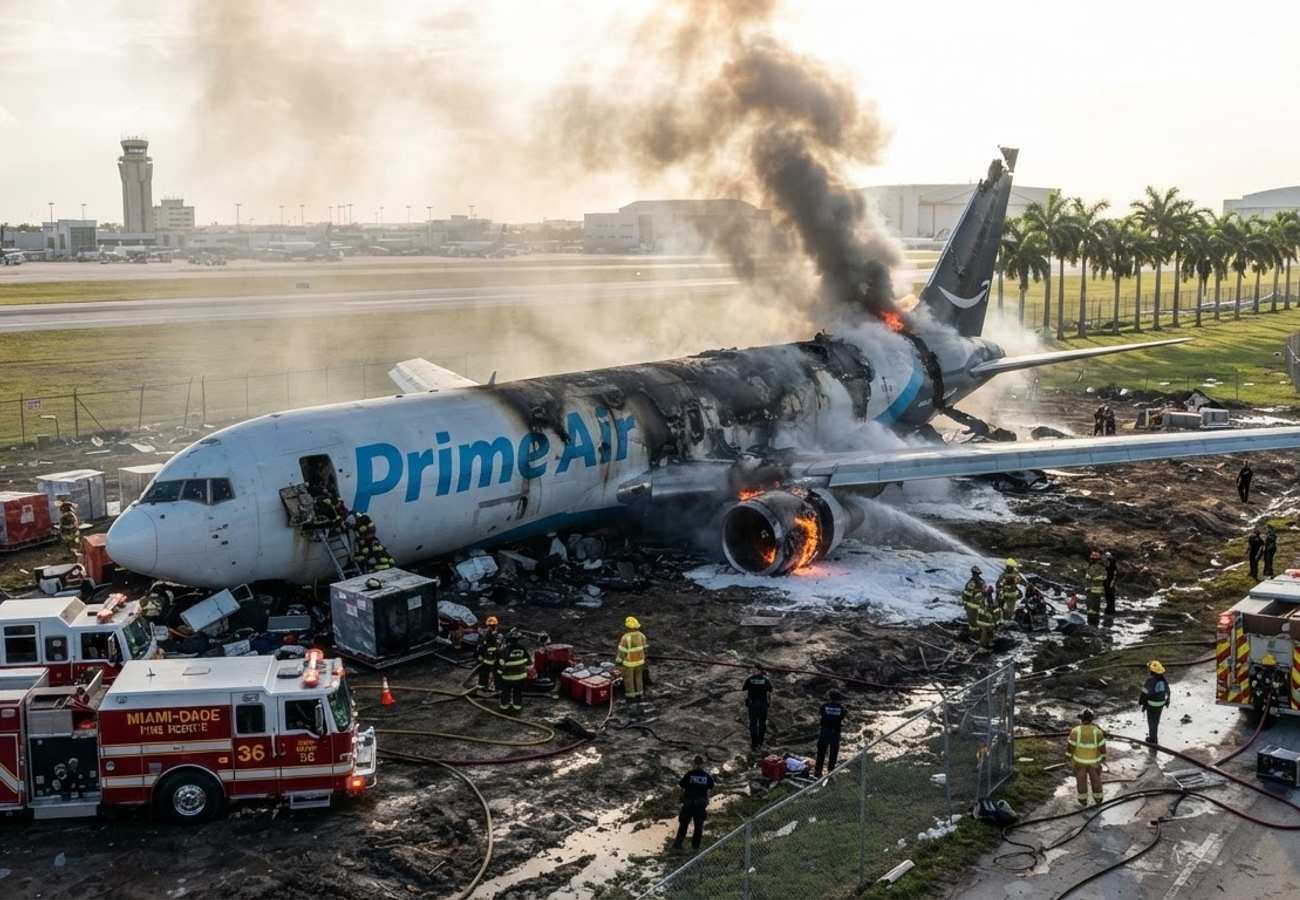
Image generated by AI
Flight delays and cancellations are mounting at Miami International Airport (MIA) after an Amazon-branded cargo jet overran a runway, resulting in five fatalities and widespread operational chaos.
The incident occurred early Sunday afternoon, September 6, when Prime Air Flight 7598, a Boeing 767-300F, failed to stop during its landing sequence. The aircraft, operated by North Carolina-based carrier 21 Air on behalf of Amazon, breached the airport perimeter and collided with multiple vehicles on a road near the northwest end of the airfield.
The crash triggered an immediate full ground stop ordered by the Federal Aviation Administration (FAA) as the aircraft was engulfed in flames. Emergency crews battled the blaze while the fuselage, which suffered significant scorching and structural failure, remained on the scene.
Critical Incident Breakdown
- Flight Number: Prime Air Flight 7598
- Aircraft Model: Boeing 767-300F
- Operator: 21 Air (on behalf of Amazon)
- Route: San Juan, Puerto Rico (Luis Muñoz Marín International Airport) to Miami International Airport
- Casualties: 5 confirmed dead; 5 injured (including occupants of struck vehicles)
- Time of Incident: Approximately 2:00 p.m. local time, September 6, 2026
- Primary Cause (Under Investigation): Runway overrun on the airport's diagonal runway
Operational Impact and Flight Data
Despite the initial ground stop lasting approximately three hours, the ripple effects extended deep into Monday. The closure of a primary runway created a bottleneck that displaced aircraft and crews across the southeastern United States.
Flight Disruption Statistics (as of late Sunday):
- Cancellations: 160+ flights
- Delays: Nearly 325 flights
By Monday morning, airport officials confirmed that only two of Miami's four runways were operational. This 50% reduction in runway capacity led to rolling delays, missed connections, and last-minute schedule changes for domestic services.
Cargo vs. Passenger Recovery
Our analysis of the recovery timeline indicates a stark divide between freight and passenger operations. While passenger terminals remained crowded with frustrated travelers on Monday, cargo flows stabilized more rapidly.
Trade data suggests that cargo operations returned to near-normal levels within 24 hours. This was facilitated by the rapid reopening of specific taxiways and runways dedicated to the cargo side of the airfield. Given Miami's status as a premier hub for perishables, pharmaceuticals, and e-commerce linking the U.S. to Latin America, the priority to restore freight movement was evident.
Investigation Focus
Federal safety investigators are currently analyzing the landing sequence to determine why the Boeing 767-300F overran the pavement. The inquiry is centering on three primary variables:
- Touchdown Point: Early reports suggest the aircraft may have touched down too late in the available landing distance.
- Mechanical Systems: Inspection of braking systems and thrust reversers.
- Environmental Factors: Review of runway friction measurements and weather conditions at the time of the 2 p.m. landing.
Flight data recorders and cockpit voice recorders have been recovered to provide a second-by-second account of the crew's actions and the aircraft's performance.
Why This Matters: Industry Implication
From a logistical perspective, this incident exposes the fragility of "just-in-time" e-commerce networks. The use of third-party operators like 21 Air to scale Amazon's Prime Air network allows for rapid growth, but it also complicates the safety oversight chain.
For travelers, the real impact is the "cascade effect." When a major hub like MIA loses 50% of its runway capacity, the disruption is not contained to Florida. Aircraft diverted from Miami are now missing their next scheduled legs in other cities, meaning passengers in unrelated markets may experience delays today because of a crash that happened in Miami yesterday.
Forward Outlook
Full normalization of operations at Miami International Airport is expected to take several days. While the FAA and airport authorities work to clear the wreckage and reopen the remaining runways, passengers should expect:
- Continued Flexibility: Airlines are currently waiving change fees and fare differences for affected routes.
- Rerouting: Increased traffic through alternate southeastern hubs as carriers bypass MIA bottlenecks.
- Extended Processing Times: Travelers are advised to allow extra time for security and check-in as airlines struggle to reposition crews.
The investigation into Prime Air Flight 7598 will likely lead to revised landing protocols for heavy cargo aircraft at high-traffic regional hubs.
Related Travel Guides
This article is for informational purposes. Flight routes, passenger regulations, visa rules, and transit advisories are subject to change by airlines and aviation authorities. Readers are advised to verify schedules and travel documentation with relevant carriers and border agencies before departure.
Related Stories

South America Emerges as Premier Long-Haul Choice for European Travelers in 2026: Cultural and Luxury Travel Guide

United Airlines Launches Nonstop Newark to St. Croix Flights: US Virgin Islands Travel Guide and Crucian Heritage