
Why Double-Boarded Flights Are Changing Holiday Travel: Inside American and United Airline Crew Pay Rules

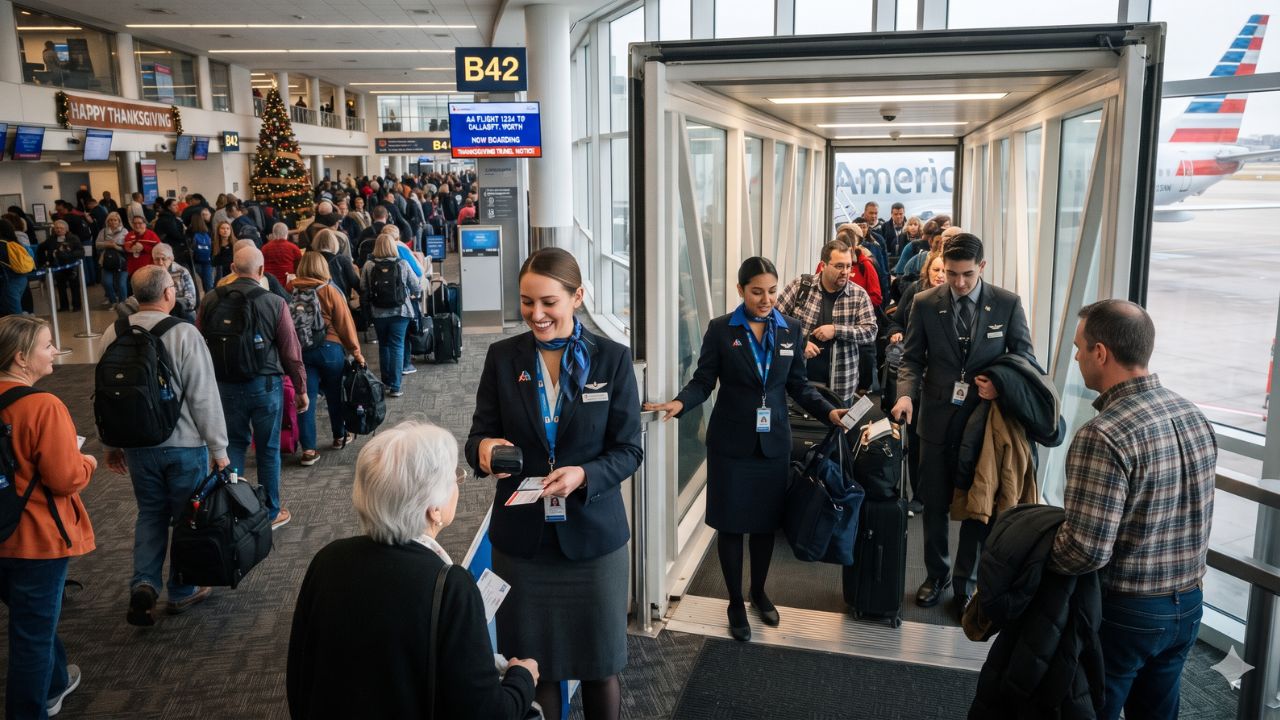
For decades across the American aviation sector, flight attendants received zero hourly compensation while managing carry-on bags and seating lines until the main cabin door swung shut. Following recently enacted collective bargaining agreements across American Airlines and United Airlines, a mechanical fault or air traffic ground hold that prompts a complete deplaning creates two distinct compensable boarding events for flight attendants, even when travelers complete only a single journey to their final holiday stop.
As record numbers of vacationers head toward airport terminals for Thanksgiving travel in November 2026, understanding this operational line explains what takes place on the aircraft during extended terminal holds. While cabin crews now receive formal contractual recognition for the physical labor of reseating a packed aircraft, travelers often confuse flight crew compensation rules with passenger statutory rights, leading to mistaken assumptions regarding cash vouchers and refunds.
The Gate Hold Reality: How Holiday Disruptions Trigger Multiple Pay Cycles
The commercial aviation model long treated pre-departure boarding as uncompensated auxiliary time. Flight crews were traditionally paid exclusively on "block-to-block" time, calculated from the moment an aircraft pushes back from the gate until it blocks in at the arrival gate. That historical structure left cabin workers uncompensated during boarding chaos, baggage restowage, and pre-departure de-icing delays.
Change took hold at American Airlines when the Association of Professional Flight Attendants finalized contractual terms that officially activated dedicated boarding compensation on April 1, 2025. Under this contract update, flight attendants earn 50% of their established hourly rate for scheduled boarding periods. Crucially, the contractual language balances operational realities: commencing boarding earlier than scheduled does not inflate that baseline boarding payout, and securing the cabin door ahead of schedule does not dock crew earnings.
Where holiday delays intensify, the rules provide clear compensation for repeated physical labor. If a fully boarded narrowbody or widebody aircraft suffers a ground stop, air-conditioning malfunction, or crew paperwork delay requiring all passengers to exit into the concourse, the subsequent boarding cycle counts as a separate qualifying event. Each time passengers clear the jet bridge doors and reload into the cabin, a fresh boarding compensation block applies to the working crew.
Contractual Mechanics: American Airlines Versus United Airlines Boarding Compensation
While American Airlines established its baseline framework in early 2025, United Airlines has fine-tuned its implementation procedures throughout 2026. On September 9, 2026, the United Joint Implementation Team released a dedicated payroll update governing how repeat boardings and cancellations appear on pay slips.
Under United's transitional schedule, retroactive payments covering qualifying reboardings and unexpected cancellations for the June, July, and August bid months of 2026 were processed as isolated accounting disbursements. Commencing with the September bid month, these qualifying disruption events transitioned into standard monthly pay registers. Crew members are advised to allow two calendar days following the completion of an assigned trip for automated payroll systems to reconcile the logs. When extraordinary schedule disruptions occur—such as mid-sequence crew replacements or an entire trip cancellation executed after passengers have already boarded—crew members file manual administrative exception requests to ensure full compensation.
A decisive operational difference exists between mandatory aircraft clearances and optional concourse visits. If airline dispatch issues a directive requiring every customer to step off the plane, United's repeat-boarding compensation clause is triggered. Conversely, if flight deck crew announces an extended tarmac ground delay and informs travelers that anyone wishing to stretch their legs may step off into the gate lounge voluntarily, additional boarding pay does not apply. In those voluntary scenarios, standard ground holding-pay rules take effect instead of repeat boarding fees.
Comparative Overview of US Airline Boarding Pay Protocols
The contractual parameters governing ground holds demonstrate why identical-looking disruptions produce different payroll and passenger outcomes:
| Airline & Governing Body | Primary Compensation Metric | Repeat Boarding Trigger | Voluntary Exit Provision | Pay Cycle Processing Timeline |
|---|---|---|---|---|
| American Airlines (APFA) | 50% of applicable hourly pay rate for scheduled boarding | Mandatory total deplaning followed by complete cabin reload | Excluded from repeat boarding rate; holding clauses govern | Calculated on scheduled boarding window |
| United Airlines (JIT / AFA) | Contractual boarding rate tied to aircraft type and schedule | Mandatory full cabin deplaning directed by operations | Optional customer departures fall under standard holding-pay | Integrated into regular registers from Sept bid month; 2-day record lag |
| Passenger Rights Benchmark (DOT) | Not linked to crew pay; governed by itinerary delivery | No automatic cash compensation for deplaning alone | Passenger choosing to leave risks missing rapid boarding calls | Immediate refund eligibility upon confirmed trip cancellation |
Dissecting the Boundary Between Crew Pay and Passenger Refunds
When a flight boards twice, frustrated passengers frequently deduce that because airline personnel received dual compensation for the service, travelers must be entitled to immediate compensation or ticket vouchers. However, federal aviation law draws an absolute boundary between labor agreements and consumer protection statutes.
Under established US Department of Transportation Aviation Consumer Protection Regulations, passenger refund eligibility hinges upon whether the carrier canceled the flight or executed a significant schedule change that the passenger rejected. If your flight is delayed three hours, emptied back into the terminal, reboarded, and safely transported to your destination, you completed the contracted air transit. In the eyes of federal regulators, accepting onward travel on that delayed aircraft removes entitlement to a statutory ticket refund.
Travelers must separate ground discomfort from regulatory breach. While gate-side customer service agents may distribute meal vouchers during four-hour delays, the mere act of deplaning and reboarding does not generate statutory financial penalties against the airline.
Visitor Insider Tips for Surviving Holiday Gate Disruptions
Holiday journeys through busy transit hubs like Chicago O'Hare, Dallas/Fort Worth, Atlanta Hartsfield-Jackson, and Denver require proactive preparation when operations encounter severe weather:
- Track Inbound Aircraft Registration: Do not rely solely on gate monitors displaying departure times. Enter the specific tail number of your aircraft into flight-tracking apps. If the incoming airframe is stuck on a taxiway in another state, boarding announcements will inevitably slide backward.
- Stay Within Gate Sightlines During Optional Deplaning: If the captain announces a rolling delay and permits optional exit, remain within direct eyesight of the boarding podium. Gate agents do not page individual passenger names across concourse food courts when unexpected departure slots clear.
- Carry Essential Medications in Personal Bags: Never store daily prescriptions or contact lens solutions in rolling overhead carry-ons that could be gate-checked. If a quick turnaround turns into an unexpected three-hour terminal hold, accessing cargo holds is impossible.
- Understand the Two-Hour Rule for Food Vouchers: While DOT rules do not mandate cash payouts for domestic weather delays, most network carriers maintain internal customer commitments providing snack or meal vouchers once terminal delays pass two to three hours. Approach the service desk politely with your boarding pass.
- Maintain Hotel and Rental Grace Period Contacts: Save direct phone numbers for your destination car rental agency and lodging provider. Many car rental counters automatically cancel reservations if vehicles are not claimed within two hours of the original reservation time during peak holiday travel dates.
Cultural and Labor Context: The Modern Realities of In-Flight Hospitality
The evolution of boarding compensation reflects a profound shift in how aviation labor is valued. For generations, the public perceived flight attendants through outdated mid-century marketing stereotypes of glamorous world travelers. In truth, modern cabin crews operate primarily as first responders trained in emergency evacuation, high-altitude medical trauma, and conflict de-escalation.
The pre-departure boarding sequence represents the most physically demanding segment of any flight attendant's shift. Crew members lift heavy baggage into overhead bins, verify seatbelt compliance, identify able-bodied passengers at exit rows, and address anxious or unruly travelers. Experiencing that high-stress environment twice on a single flight without compensation caused decades of labor friction.
By codifying boarding pay, major airlines have established a more transparent economic foundation for inflight personnel. Yet as airline schedules compress during peak Thanksgiving and winter holiday windows, the strain on airport gate areas remains acute. Recognizing that your cabin crew is navigating rigorous contractual rules and tight turnaround windows fosters mutual patience when seasonal weather throws schedules off course.
FAQ: US Flight Attendant Boarding Pay and Travel Disruptions 2026
Does a second boarding mean flight attendants get paid twice?
Yes. Under current American Airlines and United Airlines contractual terms, when an entire flight is deplaned and reboarded by company direction, cabin crew members receive distinct compensation for each qualifying boarding sequence.
Can travelers demand a ticket refund if forced to deplane?
No. Federal regulations do not grant automatic ticket refunds simply because an aircraft deplanes. A passenger qualifies for a refund only if the airline cancels the flight entirely or changes the schedule significantly and the customer declines onward transit.
How quickly do United flight attendants see reboarding pay?
United flight attendants see approved reboarding compensation appear in regular monthly pay registers starting with the September 2026 bid month, with automated payroll records typically reflecting changes within two calendar days following trip completion.
What happens if I voluntarily leave the plane during a ground hold?
If the captain permits voluntary passenger exit during a ground hold, you may step into the gate area. However, this does not count as a formal company deplaning, and missing an unannounced boarding call forfeits your seat.
True travel resilience begins on the tarmac, where understanding the quiet mechanics of crew labor turns holiday airport delays into manageable transit.
Related Travel Guides
- Swiss Airline Middle East Flight Suspensions: Dubai Advisories and Route Rerouting 2026
- Saudi Arabia Travel Disruptions: Managing Hotel Refunds and Passenger Rights 2026
- US Holiday Airfare Surges: Rising Fuel Costs, Capacity Cuts, and Carrier Guidance 2026
- American Airlines Wheelchair Damage Penalty: DOT Enforcement and Mobility Rights 2026
Disclaimer
This article is for informational and educational purposes only. It does not constitute legal, financial, or professional advice. While we strive to provide accurate and up-to-date information, travel policies, regulations, and conditions change rapidly. Always verify information with official sources before making travel decisions. Nomad Lawyer makes no representations about the accuracy, reliability, completeness, or suitability of the information provided. Readers should consult qualified professionals for advice specific to their circumstances. The views expressed in this article are those of the author and do not necessarily reflect the views of Nomad Lawyer.
Naina Thakur
Contributor & Travel Specialist
Travel enthusiast and legal writer covering visa regulations, responsible tourism, and cultural journeys across global destinations.
Learn more about our team →