
Finnair Selects Starlink or Amazon Leo for Next-Gen In-Flight WiFi by End 2026
Finnair eyes SpaceX Starlink and Amazon Leo satellite internet to compete with British Airways, Lufthansa, and Singapore Airlines. Decision coming by December 2026.

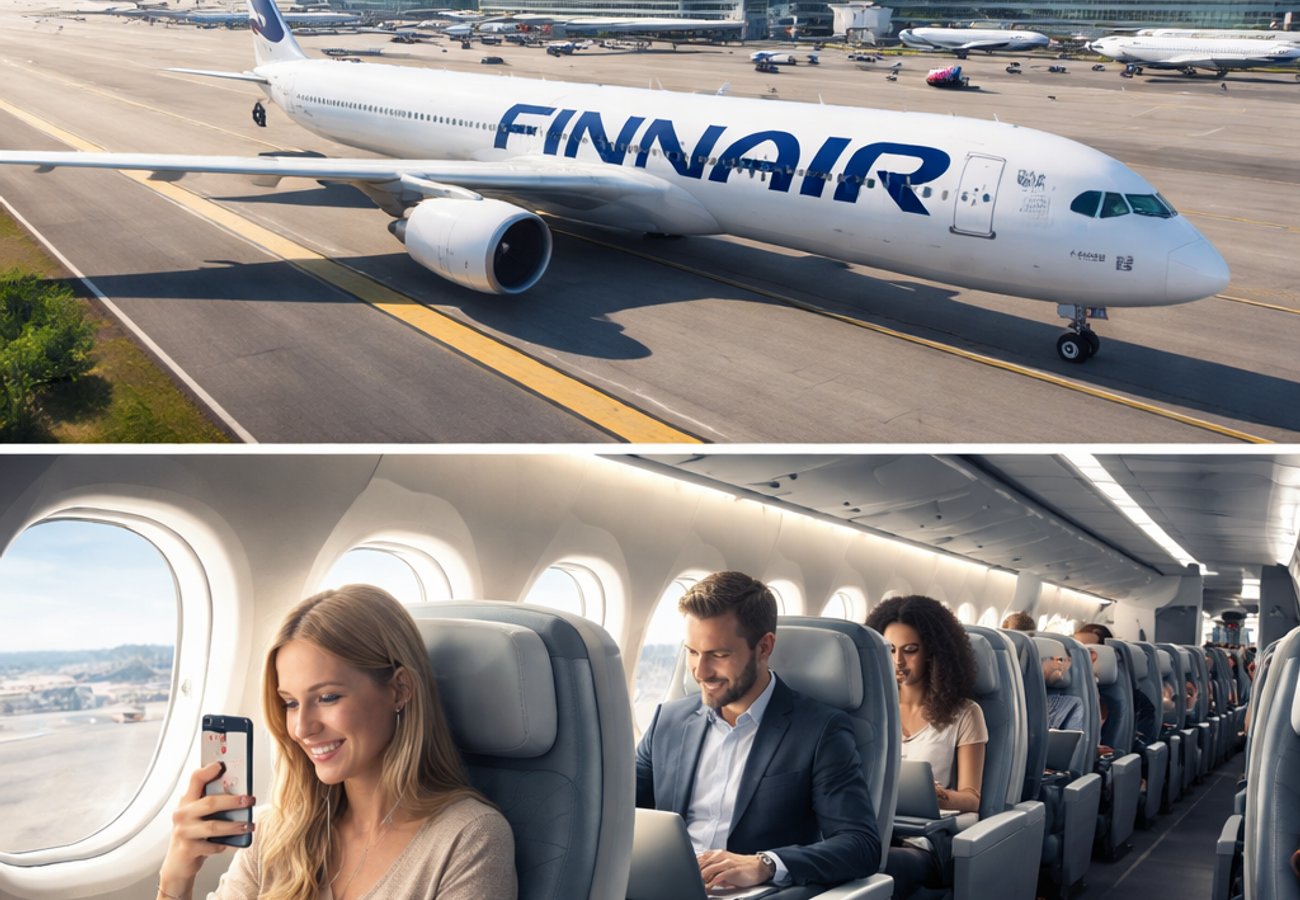
Image generated by AI
The WiFi Race Just Got Personal for Nordic Travelers
Finnair is making a bold move to shake up in-flight connectivity in the Nordic region. By the end of 2026, the Finnish carrier will decide between SpaceX's Starlink and Amazon's Leo (Low Earth Orbit) satellite internet systems—two competing technologies that are fundamentally transforming how passengers stay connected at 35,000 feet.
This isn't a minor software update. This is a total reset of what passengers expect from modern air travel.
Why Finnair Can't Afford to Wait
The pressure is real. British Airways, Lufthansa, and Singapore Airlines have already moved aggressively into next-generation satellite WiFi. Meanwhile, United Airlines, Emirates, and Qatar Airways are actively rolling out Starlink across their fleets. In 2027, Singapore Airlines will launch high-speed Starlink on its entire Airbus A350 and A380 fleet—essentially setting the new gold standard for premium long-haul travel.
Finnair faces a decision with massive implications. Helsinki Airport recorded 20.6 million passengers in 2025—a 4% increase year-over-year—with 82% of that traffic classified as international. That means the airline's reputation now depends on matching the connectivity expectations of globally mobile travelers.
Reddit: "Finnair's WiFi is decent but laughable compared to what United and Emirates offer now. If they don't upgrade soon, I'm switching to Lufthansa for Europe-Asia routes." — r/travel
The Starlink vs Amazon Leo Showdown
Both systems operate on the same principle: low Earth orbit (LEO) satellite constellations that deliver faster speeds and lower latency than traditional geostationary satellites. But the deployment timelines differ dramatically.
Starlink's Current Advantage:
- Already operational on United, Emirates, Qatar Airways, airBaltic, and British Airways (IAG group rollout 2026-2029)
- Proven track record across multiple aircraft types
- First-mover advantage in airline partnerships
- Expanding globally with minimal delays
Amazon Leo's Strategy:
- Major partnership with Delta Air Lines: first 500 aircraft equipped starting 2028
- Still in testing phases with select carriers
- Potentially competitive pricing and differentiated service models
- Later deployment timeline means refinements before launch
The competition itself is driving innovation. Airlines cannot afford to fall behind on connectivity—passengers now view in-flight WiFi as essential infrastructure, not a luxury amenity.
What This Means for Helsinki Airport and Nordic Travel
Finnair's connectivity upgrade targets three specific travel flow categories:
1. Business Travel Acceleration
High-speed internet on long-haul flights transforms work patterns. Remote workers and executives can now attend video calls, manage spreadsheets, and respond to urgent emails without the painful lag that plagued previous systems. This alone drives demand for premium cabin bookings.
2. Europe-Asia Route Competition
Finnair sustains consistent demand for the Europe-Asia-North America travel triangle despite ongoing geopolitical tensions. Superior WiFi becomes a differentiator for routing passengers through Helsinki's emerging Nordic hub status, rather than traditional gateways like London or Frankfurt.
3. Transfer Passenger Growth
Better connectivity attracts connecting passengers. A traveler from New York heading to Bangkok can now comfortably work a 3-hour layover in Helsinki rather than finding a hotel. This extends Finnair's value proposition beyond origin-destination pairs.
Finnish passenger traffic data shows sustained growth projections, suggesting airlines investing in connectivity infrastructure will capture this expanding demand.
The Technology Deployment Timeline
Here's where every carrier stands:
| Airline | WiFi Provider | Deployment Window |
|---|---|---|
| British Airways | Starlink | 2026–2029 |
| Singapore Airlines | Starlink | Q1 2027 |
| United Airlines | Starlink | Ongoing |
| Emirates | Starlink | 2025–2026 |
| airBaltic | Starlink | Complete (All European routes) |
| Delta Air Lines | Amazon Leo | From 2028 |
| Finnair | Starlink / Leo (TBD) | Decision by December 2026 |
Notice the pattern: Starlink dominates the 2026-2027 window, but Amazon Leo's 2028 timeline gives Delta—and potentially other carriers—more time to evaluate, test, and customize solutions before deployment.
What Passengers Need to Know Right Now
If you're booking Finnair flights before the WiFi decision lands, here's what matters:
Check Before Booking: Airlines typically promote new WiFi deployments prominently in their marketing. If Finnair hasn't announced Starlink/Leo integration on your specific route, assume current connectivity levels apply.
Loyalty Program Benefits: Many carriers provide free or premium WiFi access to frequent flyer members. Confirm tier eligibility before purchasing tickets.
Route Selection Matters: Initially, airlines deploy LEO satellites on select aircraft and long-haul routes before fleet-wide rollouts. A Stockholm-to-Bangkok flight may have superior connectivity compared to Helsinki-to-London regional service during the early 2027-2028 phase.
Consider Gateway Alternatives: If Finnair's timeline slips, connecting through London Heathrow (British Airways Starlink coming 2026) or Singapore's hub (full Starlink by Q1 2027) provides immediate access to next-gen connectivity.
The Hospitality Ripple Effect
Finnair's WiFi upgrade doesn't exist in isolation. Tourism boards, hotel chains, and ground transportation operators all benefit from improved connectivity:
- Online Booking Momentum: Travelers confident in pre-arrival research book more hotel packages and tours directly
- Digital Wayfinding Adoption: Better WiFi enables airport apps, mobile ticketing, and real-time baggage tracking
- Social Media Marketing: Passengers with reliable connectivity share destination content in real-time, generating organic tourism promotion
This is why tourism ministries and hospitality groups should care deeply about airline WiFi investments. Connected passengers are engaged passengers—and engagement drives spend.
The Verdict Approaches
By December 2026, Finnair will announce its decision. This isn't just a technical specification; it's a strategic bet on how the airline positions itself in the Nordic market for the next decade.
The window for Starlink deployment is open now. Amazon Leo offers later flexibility. Both paths strengthen Finnair's competitive position, but execution speed matters.
Helsinki Airport's growth trajectory demands it. Nordic travelers expect it. Global competitors are already delivering it.
The race for seamless connectivity just entered its final lap—and Finnair is accelerating into the curve.
Related Travel Guides
Disclaimer
This article is for informational and educational purposes only. It does not constitute legal, financial, or professional advice. While we strive to provide accurate and up-to-date information, travel policies, regulations, and conditions change rapidly. Always verify information with official sources before making travel decisions. Nomad Lawyer makes no representations about the accuracy, reliability, completeness, or suitability of the information provided. Readers should consult qualified professionals for advice specific to their circumstances. The views expressed in this article are those of the author and do not necessarily reflect the views of Nomad Lawyer.
Kunal K Choudhary
Co-Founder & Contributor
A passionate traveller and tech enthusiast. Kunal contributes to the vision and growth of Nomad Lawyer, bringing fresh perspectives and driving the community forward.
Learn more about our team →