
Finland Summer Tourism Revenue Reaches €1 Billion as Longer Stays Offset 19% Decline in Foreign Visitor Arrivals in 2026
Finland records €1 billion in foreign visitor spending during summer 2026 as average stays increase to four nights, counterbalancing a 19% decline in arrivals.

Finland generated €1 billion in foreign visitor spending during summer 2026, maintaining solid revenue parity with the previous year despite a 19% contraction in international arrivals across the June-to-August quarter.
Official survey data compiled by national promotion agency Business Finland and Statistics Finland demonstrates that international travelers lengthened their average duration of stay to four nights and expanded leisure expenditure by 14%, neutralizing the financial impact of reduced cross-border foot traffic.
Capturing insights from more than 1.3 million foreign trips originating across 85 countries, the results reveal a structural transition toward high-yield experiential travel centered on Finnish lake districts, archipelago coastal routes, and traditional wellness culture.
===================================================================================
        FINLAND SUMMER TOURISM 2026: ECONOMIC AND OPERATIONAL BENCHMARKS
===================================================================================

 [MACROECONOMIC PERFORMANCE (JUNE–AUGUST 2026)]
  * Total In-Country Foreign Spending: €1 Billion (Excludes Flights and Ferries)
  * Total Foreign Trips Recorded: 1.3+ Million Trips (From 85 Nations)
  * Year-on-Year Arrival Change: 19% Decline Compared to Summer 2025
  * Average Length of Stay: 4 Nights (Increased from 3 Nights in Summer 2025)
  * Leisure Segment Spend Growth: +14% Year-on-Year Increase
  * Overall Visitor Satisfaction Score: 4.7 out of 5.0

 [VISITATION PURPOSE COMPOSITION]
  * Leisure Holidaymakers: 64% of Total International Arrivals
  * Visiting Friends and Relatives (VFR): 18% of Inbound Travelers
  * Business and Professional Conferences: 12% of Total Inbound Volume

 [TOP 6 INTERNATIONAL SOURCE MARKETS]
  * #1 Germany | #2 Sweden | #3 Estonia | #4 Japan | #5 United States | #6 Poland
  * Highest Total Leisure Spend: Germany, United States, Sweden, and Japan
===================================================================================
The Core Tourism Update: Foreign Spending Holds at €1 Billion Despite Arrival Contraction
Finland's inbound travel sector navigated an unprecedented divergence between traveler volume and financial yield during the summer of 2026.
According to findings released by Business Finland and national tourism arm Visit Finland, total international tourist expenditure reached €1 billion across the peak summer months of June, July, and August.
This financial performance matched summer 2025 levels, despite total inbound border crossings dropping by 19%.
The primary catalyst preserving tourism revenue was an extension of time spent within the country.
International visitors averaged four nights per trip in summer 2026, compared to three nights during the corresponding period in 2025.
Furthermore, per-trip expenditures among holidaymakers increased by 14%, injecting vital liquidity into regional hotels, vacation cabin operators, culinary establishments, transport networks, and outdoor excursion providers.
The €1 billion figure reflects purchases made within Finnish borders, excluding international airline tickets and Baltic Sea ferry passages.
Katarina Wakonen, a tourism specialist at Visit Finland, attributed the contraction in total arrivals to shifting travel patterns rather than systemic weakness in holiday demand.
The decline was driven primarily by reductions in non-leisure travel, softer cross-gulf visitor volumes from neighboring Estonia, and variations in Helsinki's international congress calendar.
Conversely, vacationing travelers demonstrated strong resilience, investing more capital in extended stays and guided outdoor experiences.
FINLAND SUMMER INBOUND TOURISM METRICS (2025 VS. 2026)
| Entity / Route | Metrics | Operational Status |
|---|---|---|
| PERFORMANCE INDICATOR | SUMMER 2025 BENCHMARK | SUMMER 2026 RECORDED |
| Total In-Country Foreign Spend | €1.0 Billion | €1.0 Billion (Stable) |
| Inbound Trip Volume | Base Benchmark | -19% Year-on-Year Drop |
| Total Summer Foreign Trips | ~1.6 Million Trips | 1.3+ Million Trips |
| Average Duration of Stay | 3 Nights | 4 Nights (+33% Gain) |
| Leisure Traveler Spend Change | Baseline Level | +14% Expansion |
| Visitor Satisfaction Rating | 4.6 out of 5.0 | 4.7 out of 5.0 |
| Global Source Markets Monitored | 80+ Nations | 85 Sovereign Nations |
Visitor Demographics and Market Sourcing: Germany, Sweden, and High-Yield Long-Haul Influx
Holidaymakers formed the backbone of Finland's summer travel economy, representing 64% of all international arrivals between June and August.
Travelers visiting friends and relatives (VFR) accounted for 18%, while business executives and conference delegates contributed 12%.
INBOUND TRAVEL PURPOSE DISTRIBUTION (2026)
| Entity / Route | Metrics | Operational Status |
|---|---|---|
| SEGMENT / PURPOSE | PERCENTAGE SHARE | PRIMARY ECONOMIC DRIVER |
| Pure Leisure & Holidays | 64% of Inbound Volume | Hotels, Cabins, Dining |
| Visiting Friends & Relatives | 18% of Inbound Volume | Regional Transit, Retail |
| Business & Corporate MICE | 12% of Inbound Volume | Urban Venues, Transport |
| Other Travel Motivations | 6% of Inbound Volume | Specialized Educational |
Source Market Breakdown
European short-haul neighbors and affluent long-haul travelers underpinned the country's tourism balance sheet:
- The Top Six Origin Markets: Germany, Sweden, and Estonia maintained their positions as the three largest origin countries for vacation travelers. Japan, the United States, and Poland completed the top six outbound source markets.
- Expenditure Increases Across Core Nations: Tourist spending expanded across five of the six leading markets, with Estonia serving as the sole exception due to domestic economic tightening and altered short-stay day-trip frequencies.
- Leisure Spending Leaders: Travelers from Germany, the United States, Sweden, and Japan generated the highest aggregate leisure spending, offsetting reduced commuter travel from the Baltic states.
TOP INBOUND TOURISM MARKETS AND EXPENDITURE PROFILE
| Entity / Route | Metrics | Operational Status |
|---|---|---|
| SOURCE MARKET RANKING | REGIONAL CLASSIFICATION | HOLIDAY EXPENDITURE TREND |
| 1. Germany | Western Europe | Increased Expenditure |
| 2. Sweden | Nordic Region | Increased Expenditure |
| 3. Estonia | Baltic Region | Decreased Expenditure |
| 4. Japan | Asia-Pacific | Increased Expenditure |
| 5. United States | North America | Increased Expenditure |
| 6. Poland | Central Europe | Increased Expenditure |
Traveler Satisfaction and Experiences: Sauna Culture, Lakes, and Nordic Gastronomy
Despite lower aggregate visitor volumes, guest satisfaction reached historic highs.
Departing foreign travelers awarded Finland an overall satisfaction rating of 4.7 out of 5.0 in the official Finnish Visitor Survey, jointly administered by Visit Finland and Statistics Finland.
The survey, which gathered exit interviews from international passengers departing Helsinki Airport, the Port of Helsinki, and the Port of Turku, revealed that travelers from the United States, the United Kingdom, Japan, and the Netherlands recorded the highest personal satisfaction.
American and German vacationers reported the strongest willingness to recommend Finland to colleagues and family.
TRAVEL MOTIVATIONS AND PREFERENCES BY SOURCE MARKET
| Category / Entity | Details / Impact |
|---|---|
| SOURCE NATIONALITY | PRIMARY HOLIDAY PURSUITS & VALUED EXPERIENCES |
| German Visitors | Forest hiking, nature trails, canoeing, and |
| independent outdoor cottage living. | |
| Japanese Travelers | Authentic sauna culture, Finnish glassware, |
| modern architecture, and design shopping. | |
| American Holidaymakers | New Nordic culinary experiences, city culture in |
| Helsinki, archipelago cruises, and saunas. | |
| Swedish Travelers | Coastal maritime exploration, culinary weekends, |
| and short regional island-hopping tours. |
Cultural Immersion: Saunas and the Archipelago
The combination of untouched nature and distinct social rituals formed the cornerstone of foreign visitor feedback:
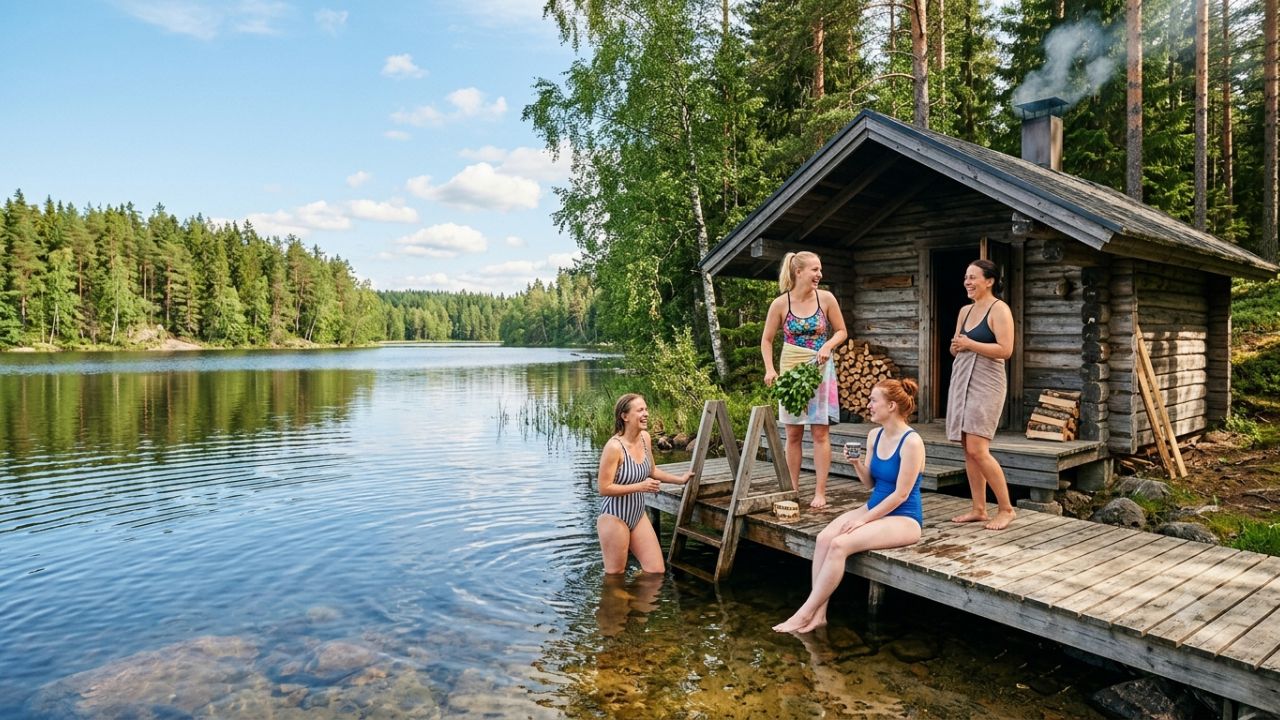
- The Finnish Sauna Tradition: Celebrated on UNESCO's Intangible Cultural Heritage list, the traditional wood-fired sauna remains an essential Finnish ritual. Travelers embraced public urban saunas like Löyly in Helsinki and Rajaportti in Tampere, as well as private lakeside saunas paired with wild swimming.
- Waterways and Pine Forests: Finland's network of 188,000 lakes provided an ideal setting for low-impact recreation, including paddleboarding, kayaking, and fishing under the extended daylight of the Midnight Sun (yötön yö).
- New Nordic Gastronomy: International interest in seasonal local ingredients—such as fresh chanterelles, Arctic lingonberries, smoked Baltic herring, and sourdough rye bread (ruisleipä)—drove restaurant spending across Helsinki, Turku, and Tampere.
Comparative Summer Tourism Benchmarks: 2025 vs. 2026 Statistical Matrix
Evaluating the data highlights how quality of stay has eclipsed raw headcount in driving tourism value.
FINLAND TOURISM OPERATIONAL BENCHMARKS SUMMARY MATRIX
| OPERATIONAL METRIC | STATISTICAL OUTCOME | ECONOMIC SIGNIFICANCE |
|---|---|---|
| Aggregate Foreign Spending | €1 Billion | Fully preserved year- |
| on-year revenue yield | ||
| Summer Trip Volume | 1.3+ Million Trips | Represents 19% drop in |
| physical border arrivals | ||
| Average Holiday Duration | 4 Nights per traveler | Extended from 3 nights; |
| +33% increase in stays | ||
| Leisure Sector Spending Growth | +14% Year-on-Year | Elevated spend across |
| hotels, dining, and rail | ||
| Overall Guest Satisfaction | 4.7 out of 5.0 Score | Sustained global brand |
| advocacy and loyalty | ||
| Peak Outbound Spending Markets | Germany, USA, Sweden, | High-income origins with |
| and Japan | long-stay travel habits |
Nordic Traveler Logistics and Country Guide: Ferries, High-Speed Rail, and Mökki Cabins
Planning an extended holiday in Finland requires coordination across maritime entries, high-speed rail corridors, and rural accommodations.
===================================================================================
             TRAVELER LOGISTICS: FINLAND TRANSIT & EXPLORATION GUIDE
===================================================================================

 [GATEWAYS & ARRIVAL PROTOCOLS]
  * Air Arrivals: Helsinki-Vantaa Airport (HEL):
    - Automated passport e-gates for EU, UK, US, Canadian, and Japanese passports.
    - Rail Transit: Ring Rail Line (I and P trains) connects HEL directly to
      Helsinki Central Station (Helsingin päärautatieasema) in 30 minutes.
  * Sea Crossings:
    - Port of Helsinki: West Harbour Terminal 2 (Tallink / Eckerö ferries from
      Tallinn, 2-hour crossing) and Olympia Terminal (Viking Line from Stockholm).
    - Port of Turku: Daily overnight ferry services connecting to Stockholm.

 [HIGH-SPEED RAILWAY TRANSIT: VR NATIONAL NETWORK]
  * Operators: VR (Valtionrautatiet) operates fast Pendolino and InterCity trains.
  * Key Corridors:
    - Helsinki to Tampere: 1 hour 30 minutes (Sauna Capital of the World).
    - Helsinki to Turku: 1 hour 50 minutes (Historic coastal capital & castle).
    - Helsinki to Mikkeli / Kuopio: 2.5 to 4 hours (Heart of the Finnish Lakeland).
  * Onboard Amenities: Free high-speed Wi-Fi, power outlets, quiet working cabins,
    bistro restaurant cars (*Ravintolavaunu*), and bicycle storage racks.

 [LAKESIDE CABIN (MÖKKI) ETIQUETTE & OUTDOOR RULES]
  * Everyman's Right (Jokamiehenoikeus): Legal freedom to roam forests and pick
    wild berries and mushrooms, provided travelers respect private cottage zones.
  * Cashless Commerce: Finland operates virtually 100% cashless. Contactless cards
    and mobile wallets (Apple Pay, Google Pay) are accepted everywhere.
===================================================================================
Navigating Helsinki-Vantaa and Maritime Gateways
Helsinki serves as northern Europe's primary transit interface, offering streamlined air and ferry connections:
- Helsinki-Vantaa Airport (HEL): Consistently ranked among Europe's most efficient hubs, HEL features single-terminal operations with advanced 3D computed tomography (CT) security scanners that permit passengers to leave liquids and electronics inside carry-on luggage.
- Baltic Sea Ferry Network: The two-hour catamaran ferry route between Tallinn (Estonia) and Helsinki operates multiple departures daily. Travelers should note that ferries dock at West Harbour (Länsisatama), where tram lines 7 and 9 provide direct 15-minute transfers to the central railway station.
- Cashless Simplicity: From municipal HSL transit passes in Helsinki to rural farm stands in Savonlinna, cash is rarely required. International travelers should carry chip-and-PIN credit cards or use smartphone digital wallets.
Exploring the Lakeland via VR Rail
Finland's state-owned railway network, VR (Valtionrautatiet), provides an efficient alternative to car rentals:
- The Pendolino Network: Tilting high-speed trains operate from Helsinki Central Station, connecting travelers to regional hubs like Tampere, Jyväskylä, and Oulu.
- The Lake Saimaa Corridor: Travelers seeking tranquil lake retreats can board direct InterCity services to Lappeenranta, Mikkeli, and Savonlinna, where connecting regional buses and lake steamers provide direct access to forest cabins.
- Luggage and Pet Accommodation: InterCity double-decker carriages offer dedicated spaces for oversized sporting luggage, canoes, and hiking gear, making multi-day outdoor expeditions straightforward.
Cottage Culture: The Mökki and Public Sauna Etiquette
Renting a traditional lakeside cottage (mökki) represents the quintessence of Finnish summer living:
- Sauna Protocols: Saunas are traditionally enjoyed unclothed, though swimwear is standard in mixed-gender commercial facilities. Before entering the hot room (löylyhuone), wash thoroughly in the shower area. Pour clean water over the heated stones (kiuas) to generate steam (löyly).
- Nature Access: Under Finland's historic Everyman's Right (Jokamiehenoikeus), visitors are legally permitted to walk, cycle, canoe, and forage for wild bilberries, lingonberries, and edible mushrooms across all forests and lakes, provided they cause no damage and maintain privacy around residential dwellings.
Economic Resilience and Sustainable Tourism: Longer Stays Beyond Helsinki
The financial results of summer 2026 underscore a strategic transition within Nordic tourism economics.
STRUCTURAL SHIFTS IN FINNISH TOURISM ECONOMICS
| Category / Entity | Details / Impact |
|---|---|
| TRADITIONAL HEADCOUNT MODEL | HIGH-YIELD REGENERATIVE MODEL (2026) |
| Focused on high volume of short- | Focuses on extended stays (4+ nights) with |
| stay day-trippers and transit stops | deeper regional immersion and higher spend. |
| Economic revenue concentrated | Spending dispersed into rural lake districts, |
| heavily around Helsinki center | local restaurants, and family cottage rentals. |
| Higher carbon footprint per euro | Lower transport emissions per day; greater |
| of in-country tourist revenue | local economic retention for host communities. |
Decentralizing Revenue Across Regional Municipalities
When international travelers extend their stays from three to four nights, their geographic footprint expands.
Rather than confining their spending to hotels and souvenir shops within central Helsinki, travelers take day excursions or multi-night stays in regional destinations:
- The Lakeland (Järvi-Suomi): Rental revenues for lakeside villas and guided fishing trips support seasonal family enterprises across central and eastern Finland.
- The Coastal Archipelago: The historic wooden towns of Porvoo, Naantali, and Rauma experience increased foot traffic in local bakeries, craft studios, and boutique hotels.
- Tampere (The Sauna Capital): Renowned for having over 50 public saunas, Tampere has successfully positioned itself as a major wellness hub, attracting high-spending visitors from Japan and North America.
Aligning Yield with Carbon Efficiency
Visit Finland's sustainable tourism strategy aligns directly with the summer 2026 economic findings.
Encouraging international travelers to stay longer reduces the environmental footprint per travel day, lowering aviation emissions relative to total visitor expenditure.
By prioritizing experiential depth, authentic cultural traditions, and high service quality over raw arrival volumes, Finland demonstrates that destination sustainability and robust economic performance can reinforce one another.
Frequently Asked Questions
How did Finland maintain €1 billion in tourism revenue despite a 19% drop in arrivals?
Finland sustained €1 billion in summer foreign visitor revenue because international travelers extended their average stay from three nights to four nights and increased leisure spending by 14%, compensating for the drop in total arrival numbers.
Which countries were the top source markets for Finland in summer 2026?
The top six foreign origin markets were Germany, Sweden, Estonia, Japan, the United States, and Poland. Germany, the US, Sweden, and Japan generated the highest total leisure spending.
What visitor satisfaction score did Finland achieve in summer 2026?
According to the Finnish Visitor Survey conducted by Visit Finland and Statistics Finland, foreign holidaymakers awarded the country an average satisfaction rating of 4.7 out of 5.0.
What are the main attractions driving foreign visitor spending in Finland?
Travelers highlighted traditional wood-fired saunas, pristine lakes, forest hiking, local culinary gastronomy, and coastal archipelago exploration as the primary attractions of their Finnish summer holidays.
Related Travel Guides
Disclaimer
This article is for informational and educational purposes only. It does not constitute legal, financial, or professional advice. While we strive to provide accurate and up-to-date information, travel policies, regulations, and conditions change rapidly. Always verify information with official sources before making travel decisions. Nomad Lawyer makes no representations about the accuracy, reliability, completeness, or suitability of the information provided. Readers should consult qualified professionals for advice specific to their circumstances. The views expressed in this article are those of the author and do not necessarily reflect the views of Nomad Lawyer.
Kunal K Choudhary
Co-Founder & Contributor
A passionate traveller and tech enthusiast. Kunal contributes to the vision and growth of Nomad Lawyer, bringing fresh perspectives and driving the community forward.
Learn more about our team →