
Fiji's Floating Island Eco-Tourism Plan Reaches Milestone as Mataqali Bukawaqa Grants Unanimous Approval in Macuata: Latest Update
Mataqali Bukawaqa unanimously approves the Floating Island Eco-Tourism Project in Macuata, Vanua Levu, advancing community-led tourism under Fiji's Na Vualiku plan.

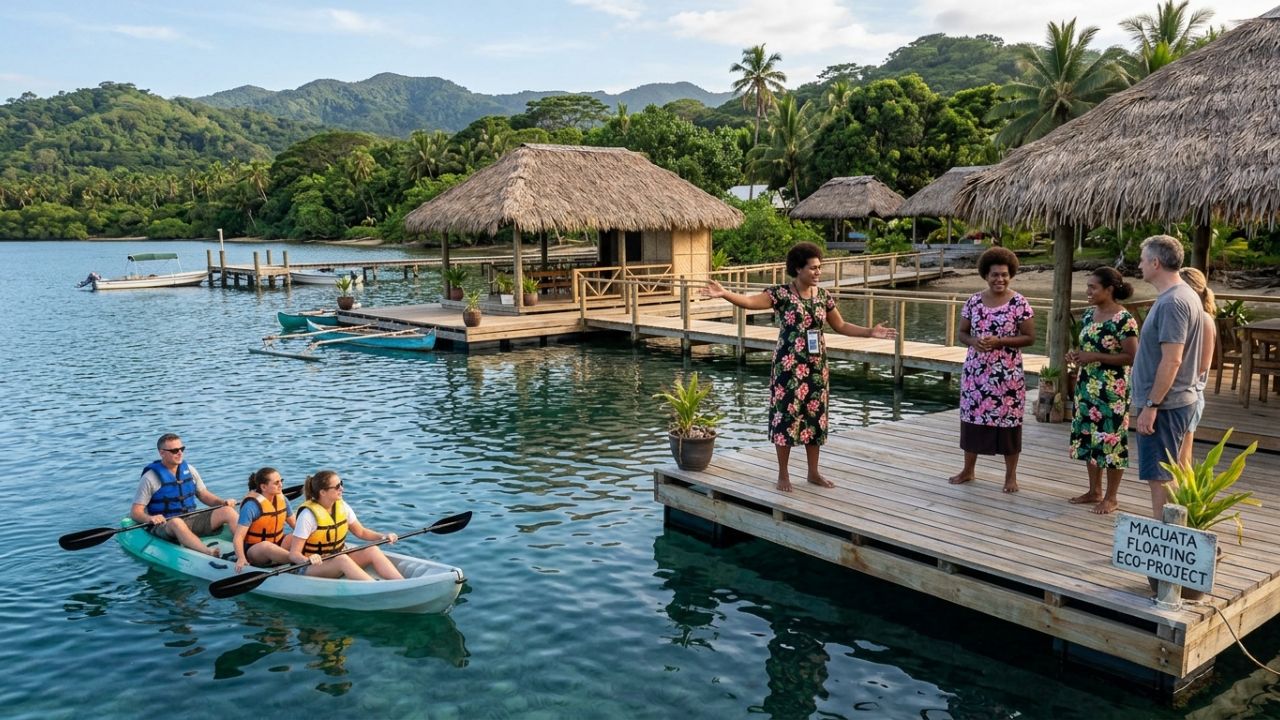
Mataqali Bukawaqa of Wainidrua Village granted unanimous endorsement for the Floating Island Eco-Tourism Project in Macuata Province.
Marking a transformative breakthrough for community-led sustainable tourism across northern Fiji, the proposed Floating Island Eco-Tourism Project has secured unanimous formal approval from Mataqali Bukawaqa, the traditional indigenous landowning clan of Wainidrua Village in Macuata Province. The historic endorsement establishes a strong grassroots foundation for the initiative, which is spearheaded by the newly inaugurated Macuata Tourism Association (MTA) to generate sustainable local employment, protect pristine marine ecosystems, and channel high-yield international travelers directly into Vanua Levu’s underexplored Northern Division.
Rather than replicating conventional capital-intensive resort models that often marginalize indigenous communities, the Floating Island initiative anchors long-term stewardship within traditional landholding structures. The project is being evaluated as a prospective pilot venture under the Fijian government’s ambitious Na Vualiku Tourism Development Programme—a comprehensive initiative backed by a US$200 million World Bank financing framework aimed at decentralizing Fiji's tourism economy. With traditional landowners firmly at the center of decision-making, the project enters an active administrative phase focusing on statutory land agreements, dedicated community committees, and comprehensive hospitality upskilling.
Unanimous Indigenous Backing: Mataqali Bukawaqa Champions Sustainable Tourism
In indigenous Fijian society, landownership (iTaukei) is held collectively by clan units known as mataqali. Securing the unanimous consent of Mataqali Bukawaqa ensures that the cultural heritage, customary fishing grounds (qoliqoli), and ancestral land rights of Wainidrua Village are embedded into the project’s foundational design.
The consensus achieved among village elders, women's groups, and youth representatives reflects a conscious shift away from passive observation toward active commercial equity. Under the agreed framework:
- Cultural Sovereignty: Traditional customs, ceremonial protocols, and spiritual sites remain strictly safeguarded, preventing unauthorized commercial disruption.
- Direct Revenue Sharing: Lease agreements and activity concessions will flow directly to clan trust accounts, supporting village healthcare, educational scholarships, and civic amenities.
- Ecological Stewardship: Development plans incorporate customary marine conservation practices (tabu zones) alongside modern low-impact floating architecture that minimizes seabed disruption.
Institutional Machinery: The Macuata Tourism Association and Land Trust Board
To translate village approval into operational reality, stakeholders are deploying a structured multi-agency governance model. Central to this coordination is the Macuata Tourism Association (MTA), which was formally launched on 18 September 2026 by the Fiji Ministry of Tourism and Civil Aviation (MTCA). The association unites hoteliers, dive operators, artisanal transport providers, and traditional landowning clans across the province.
The immediate implementation roadmap encompasses several key administrative workstreams:
- Formation of the Mataqali Project Committee: A dedicated local committee is being constituted in Wainidrua Village to serve as the official liaison between community elders, provincial administrators, and commercial planners, ensuring transparent bi-directional communication.
- Engagement with the iTaukei Land Trust Board (TLTB): Formal consultations are underway with the TLTB, the statutory body responsible for administering customary land in Fiji. The discussions aim to structure legal agricultural and commercial tourism leases that guarantee long-term security of tenure for investors while safeguarding indigenous clan rights.
- Environmental and Social Impact Audits: In alignment with World Bank and national environmental directives, comprehensive marine baseline surveys are being commissioned to assess tidal currents, mangrove health, and reef fish habitats surrounding the proposed floating installation sites.
Bridging Regional Tourism Disparities: Northern Division vs. Western Gateway
The strategic significance of the Floating Island Eco-Tourism Project is underscored by the sharp economic contrast between Fiji’s western and northern regions. While Fiji’s national tourism sector is enjoying record-breaking international arrivals, the geographic distribution of visitor spending remains heavily skewed.
Official data compiled by the Ministry of Tourism and Civil Aviation and Tourism Fiji reveals the acute structural divide:
| Regional Tourism Metric | Western Division (Nadi, Denarau, Mamanucas) | Northern Division (Vanua Levu, Taveuni, Macuata) | Strategic Policy Implication |
|---|---|---|---|
| Share of International Arrivals | Approximately 80%–85% of total entries | Approximately 4% of total visitors | Northern Fiji possesses immense untapped capacity |
| Visitor Bed-Night Concentration | ~66.7% (two-thirds) of total visitor nights | Less than 8% of national guest nights | Severe geographical imbalance in hospitality revenue |
| Visitor Spending Profile | Standard leisure and package resort spending | 70% to 200% higher than national average | High-yield adventurers, divers, and nature travelers |
| Primary Tourism Assets | Integrated luxury resorts, marinas, nightlife | Pristine coral atolls, Great Sea Reef, rainforest trekking | Prime territory for low-impact, regenerative eco-tourism |
| Infrastructural Landscape | Advanced international airports & 4-lane highways | Developing regional jetties, rural roads, & mini-grids | Focus of World Bank infrastructure upgrades |
Despite capturing only 4% of total foreign visitors, northern Fiji attracts an elite demographic of specialized travelers—including scuba divers exploring the world-famous Cakaulevu (Great Sea Reef), cruising yachtsmen, and cultural connoisseurs. Because these visitors stay longer and explore off-grid locations, their per-capita daily expenditure is 70% to 200% higher than the national visitor average. Unlocking Macuata through curated eco-initiatives allows the province to capture high-margin returns without subjecting fragile island ecosystems to mass-market strain.
Synergy with the Na Vualiku Program: $200M World Bank Tourism Investment
The Floating Island initiative’s momentum is accelerated by its potential alignment with Fiji's flagship tourism strategy: the Na Vualiku Tourism Development Programme. Financed through a landmark US$200 million investment framework from The World Bank, Na Vualiku is structured across three distinct phases over a ten-year implementation horizon.
FIJI NA VUALIKU TOURISM DEVELOPMENT ROADMAP (VANUA LEVU)
| Column 1 |
|---|
| PHASE 1 (2024–2029) --> Essential Infrastructure, Regional Jetties, & Services |
| --> Tourism Enterprise Grants & Capacity Building |
| --> Institutional Coordination & Environmental Safeguards |
| PHASE 2 (2029–2032) --> Secondary Transport Corridors & Green Energy Expansion |
| PHASE 3 (2032–2034) --> Advanced Commercial Destination Marketing & Private FDI |
Phase 1 (2024–2029) focuses on laying critical foundational infrastructure across Vanua Levu and Taveuni: upgrading rural road corridors, improving maritime passenger jetties, expanding clean drinking water systems, extending telecommunications, and building modern solid waste and sewage facilities. By positioning the Floating Island Eco-Tourism Project as a potential pilot within Na Vualiku, the Macuata Tourism Association aims to tap into institutional funding, enterprise incubation support, and rigorous international environmental safeguards.
Community Upskilling: Tourism Training and Economic Diversification
A pivotal pillar of the Wainidrua initiative is community human capital development. To ensure that local villagers are not relegated to menial roles while technical positions are filled by external contractors, the Macuata Tourism Association is developing comprehensive vocational training programs.
Planned training curriculums will focus on:
- Accredited Eco-Guiding and Marine Interpretation: Training young villagers in marine biology, local biodiversity tracking, and storytelling to deliver interpretive tours across the Great Sea Reef and surrounding mangrove lagoons.
- Hospitality Management and Culinary Arts: Equipping village households with food hygiene standards, traditional Fijian culinary preparation using locally sourced root crops and freshly caught seafood, and guest management skills.
- Small Business Administration: Providing foundational financial literacy, bookkeeping, and digital booking administration to enable families to operate village homestays, craft cooperatives, and boat transport services independently.
- First Aid and Maritime Safety: Certifying local boat captains and guides in advanced maritime search-and-rescue, wilderness first response, and emergency communications.
Navigating Vanua Levu: Essential Logistics for Future Eco-Travelers
For adventurous international travelers and eco-tourists planning to explore Macuata Province and Vanua Levu in 2026 and 2027, practical logistics require thoughtful preparation:
- Transit Gateways: Vanua Levu is serviced primarily through Labasa Airport (LBS) in the north and Savusavu Airport (SVU) in the south. Domestic flights operated by Fiji Airways’ regional subsidiary, Fiji Link, connect both airstrips to Nadi International Airport (NAN) and Nausori International Airport (SUV) in Suva multiple times daily.
- Maritime Crossings: Inter-island passenger and vehicle ferries operate regular crossings between Suva/Natovi and Nabouwalu in southwestern Vanua Levu, providing scenic overland access along the picturesque Nabouwalu-Labasa highway.
- Cultural Etiquette (Sevusevu): Independent travelers visiting traditional villages such as Wainidrua must observe customary Fijian protocols. It is customary to present a sevusevu—a gift of ceremonial kava root (yaqona)—to the village headman (Turaga ni Koro) before entering village grounds, and to dress modestly by wearing a sulu (sarong) covering the knees.
- Cash and Connectivity: While regional hubs like Labasa offer commercial banking and ATMs, rural villages across Macuata operate primarily on cash. Travelers should carry sufficient Fijian Dollars (FJD) for local purchases, guides, and community contributions.
Frequently Asked Questions
What is the Floating Island Eco-Tourism Project in Fiji?
It is a sustainable community-led eco-tourism development proposed for Macuata Province on Vanua Levu, featuring low-impact floating facilities and cultural experiences managed in partnership with indigenous landowners.
Who are the traditional landowners of the project site?
The project site belongs to Mataqali Bukawaqa, the indigenous landowning clan of Wainidrua Village, who unanimously approved the eco-tourism proposal.
What is the Na Vualiku Tourism Development Programme?
Na Vualiku is a Fijian government initiative backed by a US$200 million World Bank investment framework spanning ten years to upgrade infrastructure, develop enterprises, and expand sustainable tourism across Vanua Levu and Taveuni.
How much do travelers to northern Fiji spend compared to the national average?
Government-cited research indicates that visitors to northern Fiji spend 70% to 200% more than the national visitor average, drawn by high-value activities like diving, yachting, and wilderness adventures.
Related Travel Guides
- Fiji's Floating Island Eco-Tourism Project to Drive Economic Growth in Macuata Vanua Levu 2026
- Fiji Sustainable Tourism Shift 2026: Savusavu and Taveuni Lead Eco-Adventure Expansion
- China and Fiji Partner to Accelerate Climate Resilience, Tourism Growth, and Infrastructure Corridors Across the South Pacific
Disclaimer
This article is for informational and educational purposes only. It does not constitute legal, financial, or professional advice. While we strive to provide accurate and up-to-date information, travel policies, regulations, and conditions change rapidly. Always verify information with official sources before making travel decisions. Nomad Lawyer makes no representations about the accuracy, reliability, completeness, or suitability of the information provided. Readers should consult qualified professionals for advice specific to their circumstances. The views expressed in this article are those of the author and do not necessarily reflect the views of Nomad Lawyer.
Kunal K Choudhary
Co-Founder & Contributor
A passionate traveller and tech enthusiast. Kunal contributes to the vision and growth of Nomad Lawyer, bringing fresh perspectives and driving the community forward.
Learn more about our team →