
EVA Air's Revolutionary 42-Inch Premium Economy Now the Most Spacious Mid-Tier Cabin in Global Aviation
EVA Air reclaims premium economy leadership with industry-leading 42-inch seat pitch on Boeing 787-9, revolutionizing mid-tier comfort and setting new global benchmarks for long-haul travel.

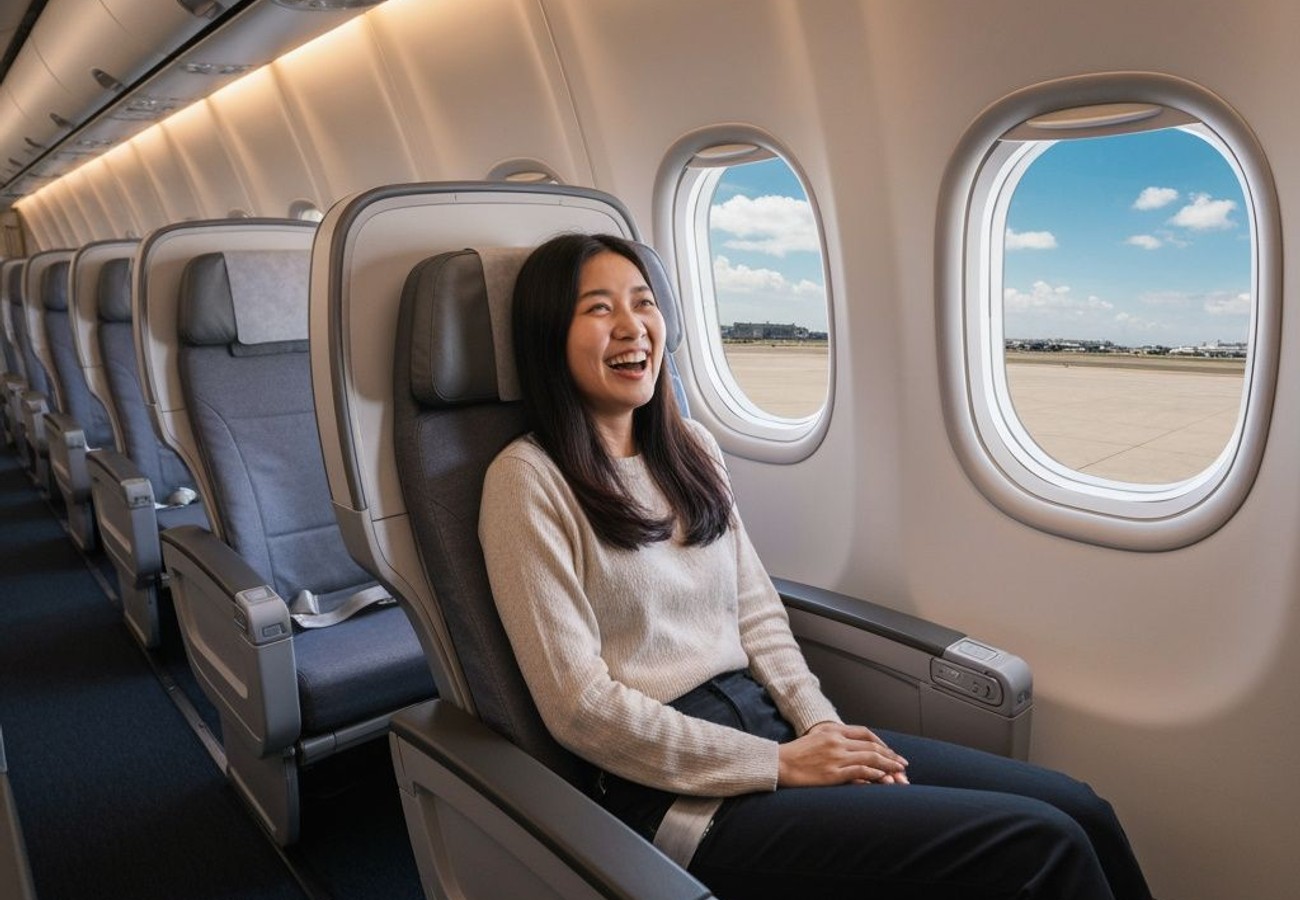
Image generated by AI
The Cabin Class That Changed Aviation Forever
The global airline industry has spent the last three decades watching a single concept transform from risky experiment into essential revenue stream. Premium economy — that critical middle ground between cramped economy rows and ultra-premium business class suites — has become the most profitable per-square-foot cabin space on international widebodies. And the airline that invented it just proved why.
EVA Air, the Taiwan-based carrier that quietly launched this entire cabin category in 1992, has reclaimed its position at the apex of mid-tier comfort with a stunning technological leap. The airline's newly configured Boeing 787-9 Dreamliner fleet now features a revolutionary 42-inch seat pitch arranged in a spacious 2-3-2 configuration — delivering what industry experts are calling the most generously proportioned premium economy product ever deployed.
Reddit: "EVA Air premium economy is legitimately a game-changer. You get business-class legroom for premium economy prices. Worth every penny on transpacific routes." — r/travel
How One Airline Invented an Entire Cabin Class
When EVA Air introduced Evergreen Deluxe Class in 1992, the aviation market was brutally binary. You flew economy or you paid corporate rates for business class. Nothing existed between them.
The Taiwanese carrier saw an opportunity no one else had noticed. Millions of long-haul travelers were willing to pay a modest premium for genuine comfort without funding a fully flat lie-flat pod. EVA Air's answer: a dedicated mid-tier cabin with a revolutionary 38-inch (96.5 cm) seat pitch arranged in a 2-4-2 configuration on their then-new Boeing 747-400 aircraft.
That inaugural service between Taipei and Los Angeles in 1992 introduced amenities that would have seemed luxurious just years earlier: wider seats, enhanced meal service, and individual seatback entertainment screens when industry-standard cabin monitors were still shared across entire rows.
A parallel timeline unfolded simultaneously across the Atlantic. Virgin Atlantic launched an identical mid-tier product the same year, initially branded as Mid Class. Historical debate persists over which airline truly deserves "inventor" status, but both carriers had identified the exact same market gap and solved it nearly identically.
The dual launch transformed industry expectations forever. What seemed like a niche product in 1992 would eventually reshape the entire economics of long-haul air travel.
The 42-Inch Revolution: Redefining Premium Economy Standards
Fast forward to 2025. EVA Air hasn't merely rested on inventing the category — it has dramatically advanced the original concept with fourth-generation cabin hardware that no competitor currently matches.
The airline's latest Boeing 787-9 configuration introduces the industry's first 42-inch (106.7 cm) seat pitch in premium economy. This represents a remarkable four-inch increase from the original 38-inch baseline established three decades ago. More importantly, it delivers significantly more legroom than what many international carriers offer in their short-haul business class products.
The cabin achieves this expansion through a deliberate architectural decision: EVA Air reduced the traditional seven-abreast Dreamliner density to accommodate a luxuriously spacious 2-3-2 seating layout. The actual seats employ an advanced cradle motion system — a technological innovation that simultaneously slides the seat cushion forward and upward during recline, delivering an effective eight-inch recline while completely preserving the personal space of the passenger seated directly behind.
This engineering distinction matters profoundly. Most premium economy seats recline into the space of the person behind them, creating friction and discomfort. EVA Air's cradle motion eliminates that problem entirely.
The generational leap tells the story clearly:
First-Generation Premium Economy (1992): 38-inch pitch, 2-4-2 layout, standard mechanical recline
Fourth-Generation Premium Economy (2025): 42-inch pitch, 2-3-2 layout, eight-inch cradle motion recline
How Premium Economy Became an $8.2 Billion Market
The global adoption of premium economy was frustratingly slow for years. Major full-service network carriers actively resisted adding a third cabin tier, genuinely concerned it would cannibalize their highly profitable business class ticket sales. Corporate travel departments had budgets for either economy or business — nothing in between seemed to fit their expense policies.
Then everything changed.
Changing corporate travel policies combined with explosive premium leisure demand eventually forced even the most stubborn carriers to recalculate. The market expansion has been staggering: the number of international carriers offering dedicated premium economy expanded from 42 in 2017 to 63 by 2022 — an 84% increase in equipped widebody aircraft operating globally.
The financial valuations explain why holdouts eventually capitulated. The global premium economy market reached $8.2 billion in 2024 and projections suggest expansion to $18.7 billion by 2033. The cabin occupies dramatically less floor space than a fully flat business class pod while commanding price points that generate some of the highest revenue margins per square foot on the entire aircraft.
Emirates, historically a notable anti-premium-economy holdout, completely reversed course and now aggressively deploys the cabin across its Airbus A380, Boeing 777, and new Airbus A350 fleets. When an airline the scale of Emirates capitulates, industry-wide transformation becomes inevitable.
The Competitive Landscape Gets Fiercer
EVA Air's 42-inch pitch has firmly established a new benchmark that very few competitors are willing to match. The Taiwanese airline has effectively drawn a line in competitive sand.
Examining the current transpacific landscape reveals uniform product standards among most top-tier operators. Japan Airlines offers a standard 38-inch (96.5 cm) pitch in a tighter 2-4-2 configuration. Singapore Airlines provides a solid 38-inch (96.5 cm) pitch with a 2-3-2 layout. These remain respectable products by historical standards, but they pale against EVA Air's technological advancement.
The aviation consulting community now recognizes that premium economy has transitioned from optional revenue enhancement into absolute financial necessity for any carrier operating genuine long-haul international networks. The cabin class that seemed like a niche experiment in 1992 has become the most strategically important product tier in modern aviation.
EVA Air's gambit is extraordinarily clear: by refusing to compress cabin density like every other carrier, the airline is placing a bet that premium leisure travelers — the fastest-growing long-haul demographic — will pay modest premiums to avoid the physical degradation of standard economy seating without requiring the financial commitment of business class.
That bet appears to be working.
EVA Air just proved that inventing a market category means you can redefine it whenever you choose.
Related Travel Guides
Disclaimer
This article is for informational and educational purposes only. It does not constitute legal, financial, or professional advice. While we strive to provide accurate and up-to-date information, travel policies, regulations, and conditions change rapidly. Always verify information with official sources before making travel decisions. Nomad Lawyer makes no representations about the accuracy, reliability, completeness, or suitability of the information provided. Readers should consult qualified professionals for advice specific to their circumstances. The views expressed in this article are those of the author and do not necessarily reflect the views of Nomad Lawyer.
Preeti Gunjan
Contributor & Community Manager
A passionate traveller and community builder. Preeti helps grow the Nomad Lawyer community, fostering engagement and bringing the reader experience to life.
Learn more about our team →