
United Airlines Stowaway Case Exposes Fake Ticket Scandal—Man Claims He Was Victim of Fraudulent Boarding Pass Sale
A 25-year-old man arrested after boarding a United Airlines flight with a fake ticket claims he was duped by a fraudster. His attorney says the entire Houston incident was a misunderstanding, raising fresh questions about airline security vulnerabilities.

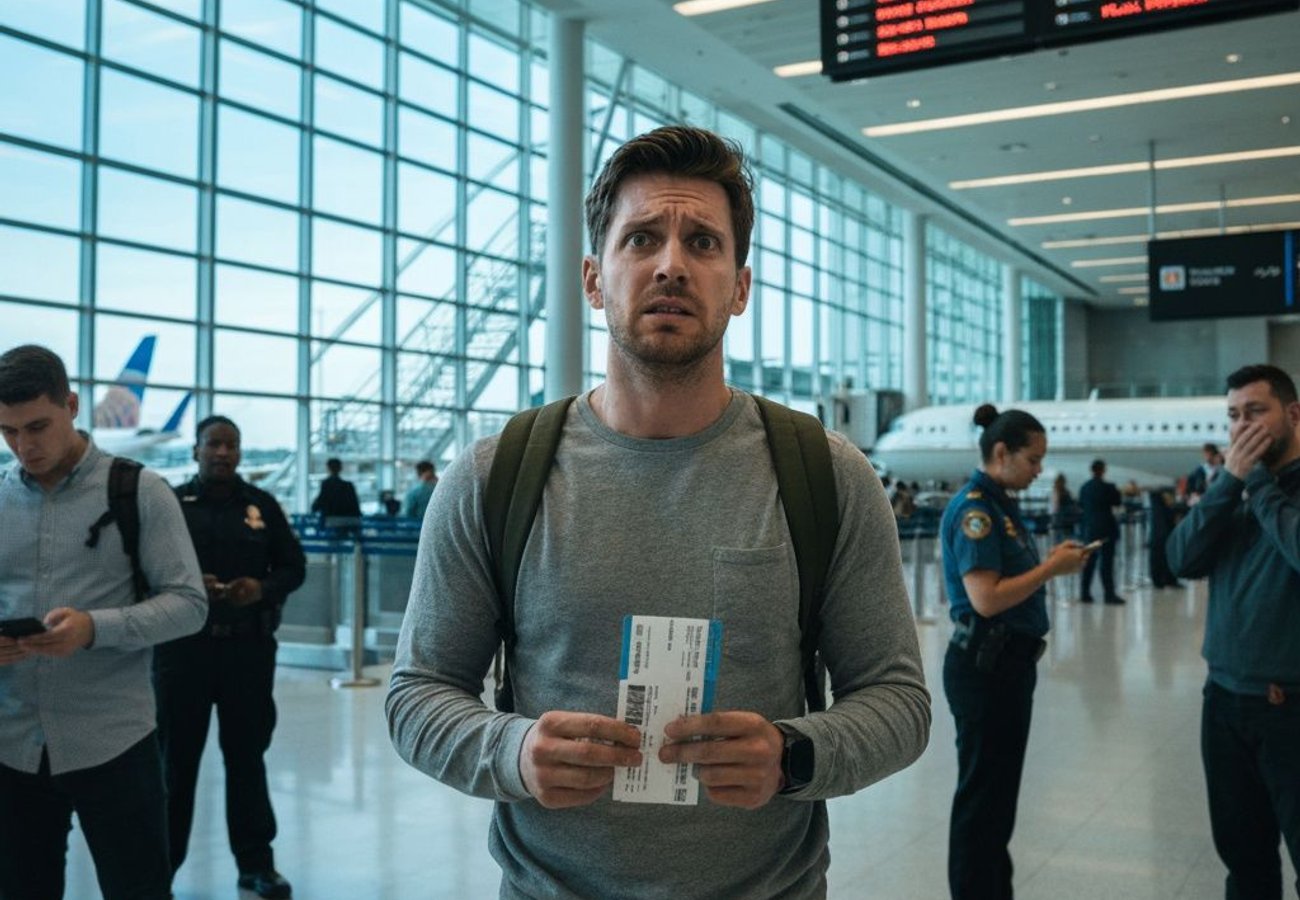
Image generated by AI
When A Fake Boarding Pass Becomes A Federal Case
Picture this: May 18, 2026. A 25-year-old man named Abdulrahman Oriyomi walks into Houston George Bush Intercontinental Airport (IAH) with what he believes is a legitimate boarding pass. What unfolds over the next few hours becomes a textbook example of how thin the line between victim and criminal can be—and how airline security systems fail in real time.
The story that's now going viral didn't make headlines when it happened. It only exploded weeks later after his arrest.
But here's what his attorney wants everyone to know: Oriyomi never knew the ticket was fake.
How A Fake Pass Slipped Through TSA Security
The sequence of events, according to court documents, reveals a security system with alarming gaps.
Oriyomi arrived at IAH and presented what prosecutors describe as a fraudulent boarding pass at the TSA security checkpoint. The pass failed to scan. Instead of being flagged for further investigation, an agent simply directed him to another podium and let him through.
He was now inside the secure airside of the airport.
The real problems started at the gates. Oriyomi first attempted to board a United Airlines flight to Los Angeles (LAX) at Gate E16. He scanned his pass twice. Both times: rejected. After a brief altercation with a United gate agent, he walked away and began wandering the concourse.
About 60 minutes later, Oriyomi spotted another United Airlines flight to LAX boarding at Gate D4. He watched the boarding flow for a few minutes, then joined the line and displayed his boarding pass—without scanning it this time.
The gate agents never caught the skip. He boarded.
Reddit: "How does someone board twice without a real ticket? This screams systemic failure at the airline level, not the passenger level." — r/aviation
The Inflight Discovery That Changed Everything
Once aboard the aircraft, reality hit hard. The flight was completely full. Oriyomi had no assigned seat.
He spent time in a lavatory. When he emerged and realized every seat was occupied, panic likely set in. As the aircraft began taxing for departure, he retreated into another lavatory.
Flight attendants grew suspicious. They asked for his name. Oriyomi claimed to be "Lopez" and even requested a flight attendant jumpseat—a desperation move that sealed his fate.
The crew checked the passenger manifest. No Lopez. No match. The aircraft was ordered back to the gate immediately.
Houston Police Department brought in a K9 explosive detection dog to sweep the entire aircraft. The all-clear came roughly three hours later, after which the flight eventually departed.
The Shocking Part: He Wasn't Arrested Immediately
Here's where the case takes an unexpected turn.
Officers cited Oriyomi for trespass. Then they let him leave the airport. No handcuffs. No federal charges—not yet, anyway.
An investigation unfolded quietly over the following weeks. When authorities finally arrested him, the story went public and immediately caught media attention.
In another twist, TSA later claimed that Oriyomi did present a valid boarding pass at the security checkpoint—though it's still unclear which flight it was actually issued for.
The Attorney's Defense: Victim, Not Criminal
Oriyomi's legal team took a bold stance in Houston court on Monday.
His attorney argued that his client had been sold a fake ticket by a third party and had no knowledge the boarding pass was fraudulent. The entire incident, they claim, is a tragic misunderstanding rooted in someone else's criminal deception.
Oriyomi was initially held on a $15,000 bond. His attorney confirmed he intends to post it. The court issued strict release conditions, including a requirement to wear an ankle monitor while the case moves forward.
He's being charged under a federal statute for impairing or interrupting the operation of a critical infrastructure facility—a serious felony that carries significant prison time.
A Broader Pattern: Fake Tickets Are A Real Problem
This isn't an isolated incident. The fake ticket crisis extends globally.
In August 2024, a similar situation exploded at Arturo Merino Benítez International Airport (SCL) in Santiago, Chile. An American Airlines passenger arrived at check-in only to be told he had been sold a fake ticket for a Miami (MIA) flight.
When airport staff informed him they couldn't locate his reservation, the man lost control. He allegedly pulled a hammer from his bag and smashed check-in computers and large display screens while stunned travelers watched.
The incidents illustrate a critical vulnerability: third-party ticket sellers operating in gray markets continue to defraud unsuspecting travelers. Airlines have struggled to combat the secondary market for years, and enforcement remains patchy across different jurisdictions.
What This Case Means For Travelers
The Oriyomi case raises uncomfortable questions about liability and due diligence.
If someone purchases a ticket through an unauthorized vendor and boards believing it's valid, who bears responsibility—the airline, TSA, or the buyer? Current law appears to shift blame onto the passenger, even if they were genuinely deceived.
Travelers should verify all ticket purchases directly through airline websites or authorized agents to avoid becoming victims of fraud schemes. A bargain-priced ticket from an unfamiliar third party is often a red flag.
The financial consequences are severe. Beyond criminal charges, fraudulent boarding creates operational chaos: delayed flights, security rescans, and diverted resources.
The Legal Limbo Ahead
As Oriyomi awaits trial, his case could set precedent for how courts treat defrauded passengers who unknowingly board planes on fake tickets.
If his attorney successfully proves that Oriyomi genuinely believed his boarding pass was legitimate—and that he purchased it from someone misrepresenting themselves as an authorized seller—the prosecution's case weakens considerably.
Conversely, if the court determines Oriyomi should have verified his ticket's authenticity before approaching security, conviction becomes more likely.
The outcome will matter far beyond Houston. It could influence how airlines, TSA, and law enforcement treat passengers caught in similar circumstances.
The line between perpetrator and victim just got a lot blurrier.
Related Travel Guides
Disclaimer
This article is for informational and educational purposes only. It does not constitute legal, financial, or professional advice. While we strive to provide accurate and up-to-date information, travel policies, regulations, and conditions change rapidly. Always verify information with official sources before making travel decisions. Nomad Lawyer makes no representations about the accuracy, reliability, completeness, or suitability of the information provided. Readers should consult qualified professionals for advice specific to their circumstances. The views expressed in this article are those of the author and do not necessarily reflect the views of Nomad Lawyer.
Preeti Gunjan
Contributor & Community Manager
A passionate traveller and community builder. Preeti helps grow the Nomad Lawyer community, fostering engagement and bringing the reader experience to life.
Learn more about our team →