
Europe Redesigns Rail Timetables to Slash Cross-Border Travel Times and Challenge Short-Haul Flights by 2026
A coordinated EU-wide overhaul of rail infrastructure and integrated timetables is drastically reducing journey times on key cross-border corridors to compete with aviation.
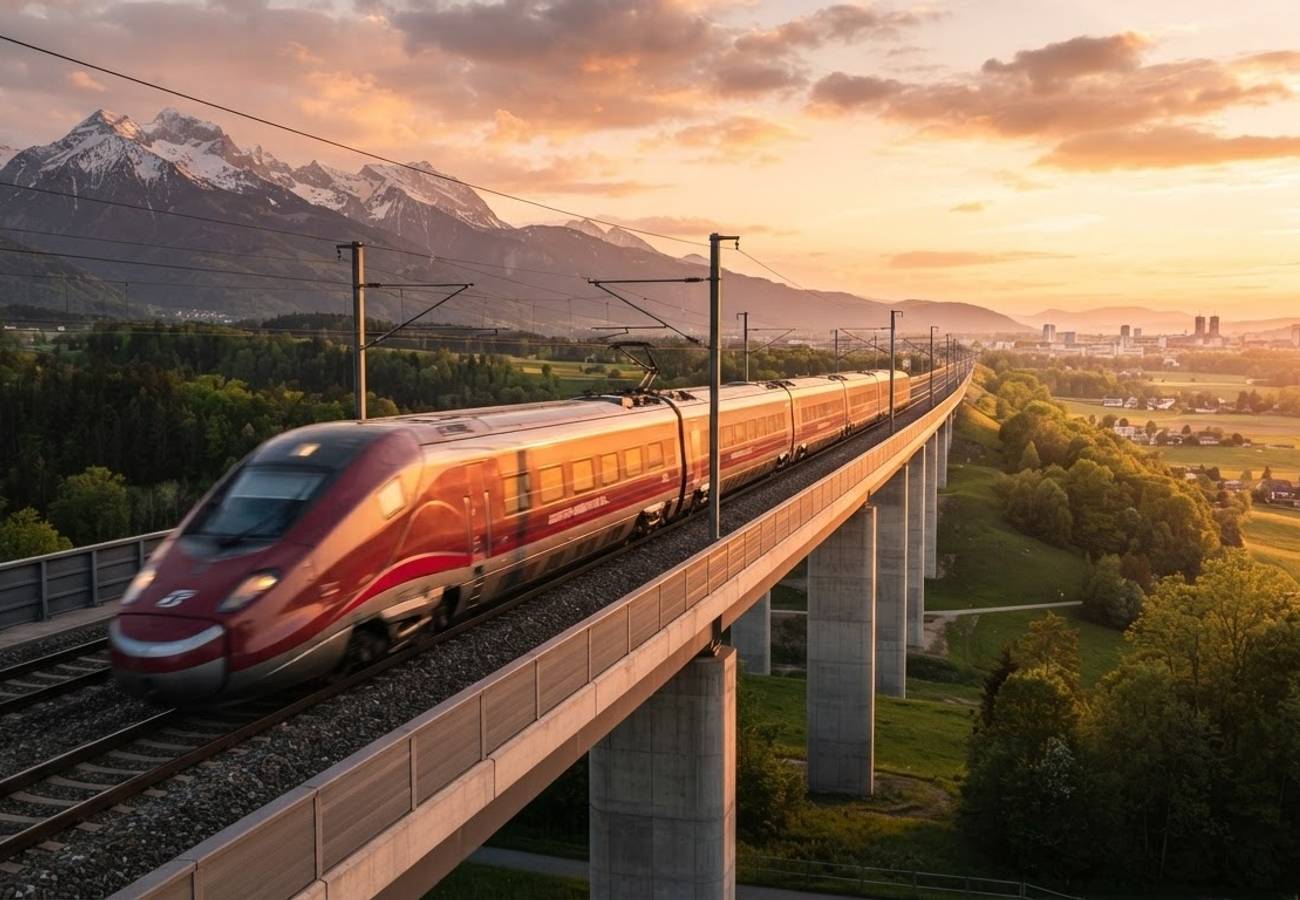
Image generated by AI
European governments and EU institutions are synchronizing infrastructure upgrades with a massive redesign of rail schedules to drastically shorten travel times across national borders. This strategic alignment aims to make rail a competitive alternative to short-haul aviation by treating the continent's tracks as a single, integrated mobility grid.
The shift represents a fundamental change in how European transport is planned. Rather than simply adding trains where demand is highest, planners are now utilizing a "backward-design" philosophy. By setting specific target arrival times between major cities first, they are then determining exactly what infrastructure upgrades, rolling stock deployments, and stopping patterns are required to meet those benchmarks.
High-Speed Rail Action Plan Targets Massive Time Reductions
A primary catalyst for this transformation is the European Commission’s high-speed rail action plan, unveiled in late 2025. The initiative focuses on developing a network of lines capable of speeds exceeding 200 km/h, specifically targeting routes that have historically been slow or inefficient.
The impact of this planning is most evident in Southeast Europe. Reports indicate that the journey from Sofia to Athens, which currently takes approximately 13 hours and 40 minutes, is projected to drop to roughly 6 hours once the planned infrastructure and service enhancements are fully operational. This reduction is not an isolated improvement but part of a broader EU-wide effort to harmonize travel times across Central and Southern Europe.
National Networks Adopting Integrated Regular-Interval Scheduling
Individual nations are integrating these EU goals into their own domestic strategies to ensure seamless transitions at borders. Germany is leading this effort with the "Deutschlandtakt," a nationwide integrated regular-interval timetable. This system synchronizes long-distance, regional, and local services at specific hubs every 30 or 60 minutes.
Under the Deutschlandtakt, infrastructure investments are dictated by the needs of the timetable. For instance, in North Rhine-Westphalia, state-level service concepts for 2030 and 2040 are being built directly upon this federal target timetable. The goal is to minimize dwell times at stations and eliminate the "dead time" often associated with transfers, making the total door-to-door journey faster even if the train's top speed remains the same.
Similarly, in the Alpine region, SBB (Swiss Federal Railways) is preparing for significant timetable switches in December 2026 and December 2027. These updates follow a major service expansion in northwestern Switzerland and are designed to optimize connectivity rather than simply increasing the number of trains on the tracks.
New Direct Corridors and High-Speed Point-to-Point Services
Beyond systemic changes, specific new routes are launching to provide direct, high-speed alternatives to flying. Italian operator Frecciarossa is set to deploy high-speed services connecting Munich, Innsbruck, and Milan, with some extensions reaching Rome. Starting at the end of 2026, these services will provide direct, no-change transit on corridors spanning approximately 600 kilometers (Munich to Milan) and 900 kilometers (Munich to Rome).
These routes serve as EU-backed pilot programs to prove that removing border dwell times and matching schedules can make rail more attractive than air travel. Further improvements are expected on the France-Germany axis, with a proposed direct Paris-Munich connection slated for the end of 2026.
Even the sleeper train sector is evolving. European Sleeper is expanding its routes from the Benelux region toward Southern Europe, carefully timing overnight arrivals to sync with the new high-speed daytime networks, creating a more cohesive multi-modal travel experience.
Infrastructure Bottlenecks and Rolling Stock Modernization
The transition to faster timetables is not without short-term friction. SBB and other operators have reported intensive engineering works throughout 2026, including full weekend closures and diversions on routes connecting Switzerland to its neighbors. While these works temporarily increase travel times, they are essential for removing the bottlenecks—such as single-track sections and outdated signaling—that prevent higher speeds.
Parallel to track work, fleets are being modernized. Germany is introducing the new ICE L long-distance trains starting with the 2026 timetable. These trains allow operators to increase frequency and exploit higher line speeds while maintaining punctuality, shifting the network from a few "flagship" fast trains to a broad system where the average traveler experiences faster transit.
Digital Integration and Unified Ticketing Rules
To ensure that faster journeys are actually accessible, the European Commission proposed new rules in May 2026 to simplify cross-border ticketing. The goal is to eliminate the need for travelers to buy separate tickets from multiple national operators for a single trip.
The proposed framework requires member states and rail companies to share timetable and fare data using common standards. This transparency allows third-party platforms to offer reliable, door-to-door rail itineraries. By linking digital booking ease with physical speed increases, the EU aims to create a feedback loop: faster, easier-to-book trains attract more passengers, which in turn justifies further infrastructure investment.
Why This Matters for the Modern Traveler
For the frequent traveler or digital nomad, this shift transforms the European continent into a more accessible workspace. The move toward "regular-interval" scheduling means that the anxiety of missing a single, once-daily cross-border train is disappearing. When trains arrive and depart in predictable 30- or 60-minute cycles, the rail network begins to function more like a metro system on a continental scale.
From a logistical standpoint, the reduction of the Sofia-Athens route by over 7 hours or the introduction of a direct Paris-Munich line removes the primary advantage of short-haul flights: time. When the time spent traveling to an airport, clearing security, and waiting for luggage is factored in, these new rail timetables make the train the objectively faster and more productive choice.
Furthermore, the push for unified ticketing solves one of the greatest pain points of European rail—the fragmented booking process. The ability to book a single ticket from a Benelux city to Italy, with guaranteed connections and unified passenger rights, removes the legal and financial risk previously associated with multi-operator journeys.
The era of the fragmented European railway is ending, replaced by a synchronized grid designed for speed and simplicity.
Related Travel Guides
Disclaimer
This article is for informational and educational purposes only. It does not constitute legal, financial, or professional advice. While we strive to provide accurate and up-to-date information, travel policies, regulations, and conditions change rapidly. Always verify information with official sources before making travel decisions. Nomad Lawyer makes no representations about the accuracy, reliability, completeness, or suitability of the information provided. Readers should consult qualified professionals for advice specific to their circumstances. The views expressed in this article are those of the author and do not necessarily reflect the views of Nomad Lawyer.