

id: 37098 title: "Guatemala and Canada Expand Multi-Nation Tourism Partnerships with El Salvador as Security Overhaul Drives Historic Regional Travel Growth in 2026" slug: "el-salvador-guatemala-canada-cross-border-tourism-corridor-2026" date: "2026-10-23" updatedDate: "2026-10-23" category: "travel-news" author: "Raushan Kumar" coverImage: "https://images.nomadlawyer.org/images/blog/travel-news/2026/10/el-salvador-guatemala-canada-cross-border-tourism-corridor-2026.jpg" coverImageAlt: "Scenic Pacific coastline and modern highway infrastructure connecting Surf City in El Salvador" coverImageCaption: "Image generated by AI" excerpt: "Guatemala, Canada, and the United States expand multi-nation tourism initiatives with El Salvador as national security reforms spark record cross-border arrivals." metaTitle: "El Salvador Cross-Border Tourism Surge: Guatemala & Canada 2026" metaDescription: "Guatemala and Canada partner with El Salvador on binational tourism corridors as security reforms drive record arrivals across North and Central America." tags:
- "El Salvador Tourism"
- "Guatemala Cross-Border Travel"
- "Central America Tourism Corridor"
- "Surf City El Salvador"
- "Avianca San Salvador Hub"
- "CA-4 Border Transit"
Guatemala, Canada, and the United States have expanded coordinated cross-border tourism corridors and air routes with El Salvador, accelerating a record influx of international travelers following nationwide security reforms that established the nation as the safest jurisdiction in Latin America. Bolstered by downgrades in formal travel advisories from the United States Department of State and Global Affairs Canada, bilateral transit partnerships are linking overland shuttle networks, expanding direct flights, and establishing multi-nation eco-tourism circuits across Central and North America.
Announced on 23 October 2026, the diplomatic and commercial travel alignment reflects a profound realignment across Central American tourism corridors. For decades, pervasive gang violence hindered overland mobility and constrained foreign tourism. The administration's comprehensive security overhaul dismantled illicit networks, dramatically lowering violent crime rates and reclaiming public spaces across urban centres, coastal surfing hubs, and highland national parks. This public safety dividend has provided regional partners with the stability required to invest in long-term binational transit infrastructure.
The Security-First Transformation: Border Modernization and Binational Transit Corridors
The national tourism turnaround operates through a four-stage development model: Stage 01 established a nationwide security crackdown that reclaimed public safety; Stage 02 triggered formal travel advisory downgrades from primary outbound governments; Stage 03 produced an immediate influx of international leisure travelers and returning diaspora families; and Stage 04 activated multi-nation strategic alliances with immediate neighbors and North American partners.
Guatemala anchors the western overland corridor, functioning as El Salvador's second-largest tourism source market and generating between 20% and 25% of total international arrivals. Both governments have modernized frontier crossings through the Central American Single Window for Digital Customs (FYDUCA) and unified customs operations, eliminating extensive administrative delays for commercial shuttles, tour buses, and private vehicles. A primary operational success is the "Centroamérica Shuttle" corridor, which connects the colonial highland hub of Antigua Guatemala directly to the Pacific beaches of Surf City in La Libertad, allowing travelers to hike active volcanic trails in the morning and reach coastal point breaks by late afternoon.
Canada represents the fastest-expanding long-haul market, accounting for 4% to 6% of inbound travelers. Major Canadian airlines and charter operators have expanded seasonal and year-round non-stop air links connecting Toronto Pearson (YYZ) and Montreal-Trudeau (YUL) directly to El Salvador International Airport (SAL). Canadian vacationers—historically concentrated in Costa Rica and Mexico—are shifting toward independent road trips across the coffee plantations of the Ruta de las Flores and the volcanic cloud forests of Cerro Verde National Park, supported by direct Canadian institutional investments in boutique coastal eco-lodges.
The United States remains El Salvador's dominant tourism partner, generating 38% to 40% of all international visitor volume and the highest proportion of foreign exchange. This market is propelled by two distinct traveler segments: an affluent Salvadoran diaspora exceeding 2.5 million residents who regularly visit extended families and invest in vacation real estate, alongside mainstream vacationers drawn to international surf championships organized by the World Surf League (WSL) and the International Surfing Association (ISA) at Punta Roca and El Sunzal. Daily non-stop flights from more than eight major American hubs—including Los Angeles, Houston, Miami, New York, Washington D.C., and Atlanta—ensure steady year-round arrivals. In addition, the legal tender status of Bitcoin alongside the US Dollar has established coastal hubs like El Zonte (Bitcoin Beach) as leading centers for remote technology professionals and digital nomads.
Honduras provides 10% to 12% of arrivals, driven by seasonal holiday travel during Easter and Semana Morazánica across modernized overland border facilities such as El Amatillo and Anguiatú. Together with Guatemala, El Salvador and Honduras jointly promote the UNESCO-recognized Trifinio-Fraternidad Biosphere Reserve, establishing cross-border hiking and coffee farm itineraries. Concurrently, Colombia and South American markets supply 3% to 5% of arrivals, utilizing Avianca connections through San Salvador to access convention venues, explore the restored historic core of San Salvador, and tour highland attractions like Lake Coatepeque.
Inbound Tourism Source Markets and Regional Transit Corridors
The international partnership network is organized around specific transit conduits, source market shares, and passenger profiles across the Western Hemisphere:
| Inbound Source Market | Estimated Share of Inbound Tourism | Primary Transport Mechanism & Ports of Entry | Dominant Traveler Demographic | Key Destination Hubs in El Salvador | Strategic Operational Role |
|---|---|---|---|---|---|
| United States | 38%–40% (Dominant market) | Non-stop commercial flights via 8+ gateway hubs into San Salvador (SAL) | Diaspora families, professional surfers, remote digital nomads, backpackers | Surf City (La Libertad), Historic San Salvador, El Zonte (Bitcoin Beach) | Generates the highest foreign currency expenditure and sustained hotel occupancy |
| Guatemala | 20%–25% (Second-largest market) | Overland binational shuttles, private cars via FYDUCA digital border posts | Weekend leisure travelers, shopping visitors, multi-country eco-tourists | Ruta de las Flores, La Libertad, San Salvador Metropolitan Area | Drives continuous overland border crossings and integrated Northern Triangle itineraries |
| Honduras | 10%–12% (Regional neighbor) | Overland border checkpoints at El Amatillo and Anguiatú | Holiday vacationers, family visitors, cross-border commercial travelers | Eastern Surf City (Usulután), San Salvador, Santa Ana, Trifinio Reserve | Sustains peak holiday visitor surges via modernized integrated customs |
| Canada | 4%–6% (Fastest-growing long-haul) | Direct seasonal and year-round air links from Toronto (YYZ) and Montreal (YUL) | Eco-adventurers, winter sun-seekers, independent retirees, road-trippers | Lake Coatepeque, Cerro Verde National Park, El Zonte, Ruta de las Flores | Drives extended length-of-stay metrics and capital investments in sustainable lodging |
| Colombia & South America | 3%–5% (Emerging regional market) | Direct scheduled air transit through Avianca San Salvador hub | Urban explorers, MICE convention delegates, multi-country vacationers | San Salvador Historic District, Suchitoto, Volcano Circuit | Expands south-to-north corporate and cultural transit traffic |
Traveler Logistics Guide: Border Formalities, Currency Systems, and Highway Transit
Navigating El Salvador and its neighboring Northern Triangle territories requires specific logistical preparation:
- Central America-4 (CA-4) Border Mobility: El Salvador, Guatemala, Honduras, and Nicaragua operate under the Central America-4 Border Control Agreement. Foreign tourists entering any of these four nations receive a standard 90-day tourist permit valid across the entire zone. Overland travelers crossing between Guatemala and El Salvador (via Las Chinamas or San Cristóbal) or Honduras and El Salvador (via El Amatillo) do not undergo full immigration entry processing, provided their 90-day CA-4 allocation remains valid. However, cross-border rental cars require formal notarized permits (Permiso de Salida) issued by the rental company to cross frontiers.
- Airport Arrival Protocols at San Salvador (SAL): International travelers landing at El Salvador International Airport San Óscar Arnulfo Romero y Galdámez must purchase a tourist card (Tarjeta de Turismo) costing $12 at the immigration hall, payable via credit card or cash US Dollars. Nationals from CA-4 member countries and select bilateral exemption treaty states are exempt from this fee.
- Coastal Highway Transit & Drive Times: The flagship Surf City coastal corridor is anchored by modernized divided highways. The trip from the international airport (SAL) to the primary surf breaks of La Libertad takes under 30 minutes via the direct coastal bypass. Independent travelers exploring the western coffee belt along the Ruta de las Flores (Juayúa, Apaneca, Concepción de Ataco) should allow 1 hour and 45 minutes from San Salvador, with paved primary routes accessible by standard compact vehicles.
- Currency and Payment Infrastructure: The legal currencies of El Salvador are the United States Dollar (USD) and Bitcoin. Physical cash in USD remains the standard medium of exchange for public transport, markets, and rural restaurants. Travelers should carry clean banknotes in denominations of $1, $5, $10, and $20, as local vendors routinely refuse $50 and $100 notes due to counterfeit verification procedures. In coastal tech hubs like El Zonte, lodging, dining, and surf rentals accept Bitcoin via the Lightning Network and mobile wallets.
- San Salvador Historic Center Walking Regulations: The renovated Historic Center of San Salvador—encompassing the restored National Palace, National Theater, and El Rosario Church—operates as a pedestrian-exclusive zone patrolled by municipal tourism police. Travelers visiting the historic core at night can safely walk along illuminated plazas, boutique eateries, and rooftop venues, with secure parking garages available near the Plaza Gerardo Barrios.
Infrastructure Impact Assessment: Regional Modernization and Tourism Expansion
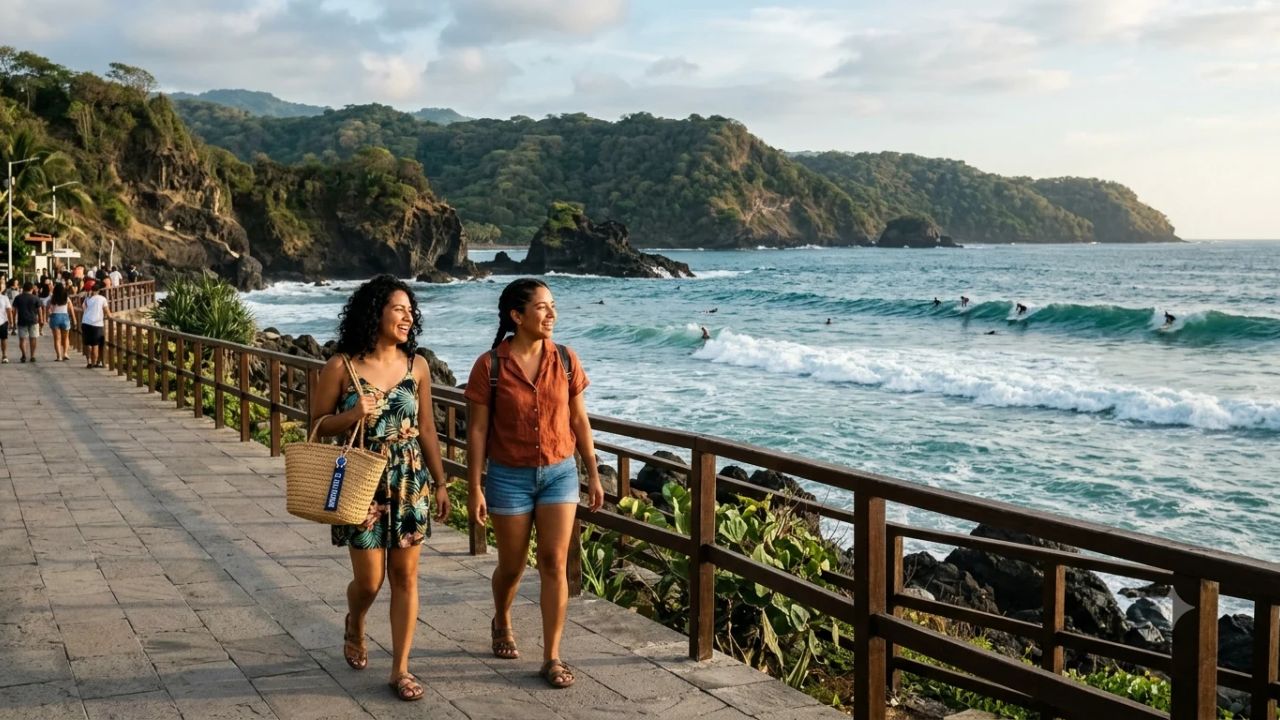
The expansion of multi-nation travel partnerships is driving major capital investments overseen by the Ministry of Tourism of El Salvador (MITUR). The original Surf City Phase 1 investments concentrated primarily on La Libertad, establishing a continuous coastal boardwalk (Malecón), specialized wastewater treatment plants, and designated scenic viewpoints.
To prevent tourism saturation in central surf breaks, national planning has shifted eastward into Surf City Phase 2 across the departments of Usulután and San Miguel. High-grade paved coastal roads now link previously isolated world-class surf breaks like Punta Mango and Las Flores, distributing economic benefits directly to coastal farming and fishing villages.
Regional aviation is experiencing a parallel transformation. The continuous expansion of Avianca's hub operations at San Salvador positions the airport as an international interchange connecting South America with North America, competing directly with Copa Airlines' hub in Panama City.
Nevertheless, rapid visitor growth presents structural challenges. High seasonal hotel occupancy rates have exposed a supply deficit in certified boutique accommodations, prompting the government to issue fast-tracked tax exemptions for international and domestic hospitality developers. Simultaneously, regional municipal authorities are investing in potable water networks and coastal marine conservation zones to protect delicate Pacific ecosystems from the pressures of expanding tourism infrastructure.
FAQ: El Salvador Cross-Border Tourism and Security Strategy 2026
Why has international tourism to El Salvador increased rapidly?
Tourism has surged due to comprehensive security reforms that eliminated gang violence and lowered national homicide rates, leading foreign governments like the US and Canada to downgrade travel advisories.
How does the CA-4 border agreement benefit travelers visiting El Salvador and Guatemala?
The CA-4 agreement allows tourists to travel freely between El Salvador, Guatemala, Honduras, and Nicaragua on a single 90-day visa without paying intermediate border entry fees.
What currencies are accepted for travel expenses in El Salvador?
The US Dollar is the standard physical currency used nationwide. Bitcoin is also legal tender and widely accepted at hotels, restaurants, and shops across coastal centers like El Zonte.
Which airlines operate direct flights between North America and El Salvador?
Major international carriers and regional flag carrier Avianca operate daily non-stop flights connecting San Salvador with Toronto, Montreal, Los Angeles, Houston, Miami, New York, Washington D.C., and Atlanta.
Related Travel Guides
El Salvador Expands Cross-Border Land Tourism with Guatemala and Regional Central American Routes
The 10 Best Surf Towns and Eco-Lodges in Central America, According to Reddit
Disclaimer
This article is for informational and educational purposes only. It does not constitute legal, financial, or professional advice. While we strive to provide accurate and up-to-date information, travel policies, regulations, and conditions change rapidly. Always verify information with official sources before making travel decisions. Nomad Lawyer makes no representations about the accuracy, reliability, completeness, or suitability of the information provided. Readers should consult qualified professionals for advice specific to their circumstances. The views expressed in this article are those of the author and do not necessarily reflect the views of Nomad Lawyer.