
European Travel Chaos Implodes: Biometric EU Entry Rules Trigger 4-Hour Airport Disruptions and Flight Cancellations
Breaking airline news: The EU's new biometric Entry/Exit System triggers massive travel chaos across Europe, resulting in 4-hour queues, airport disruptions, and flight cancellations.

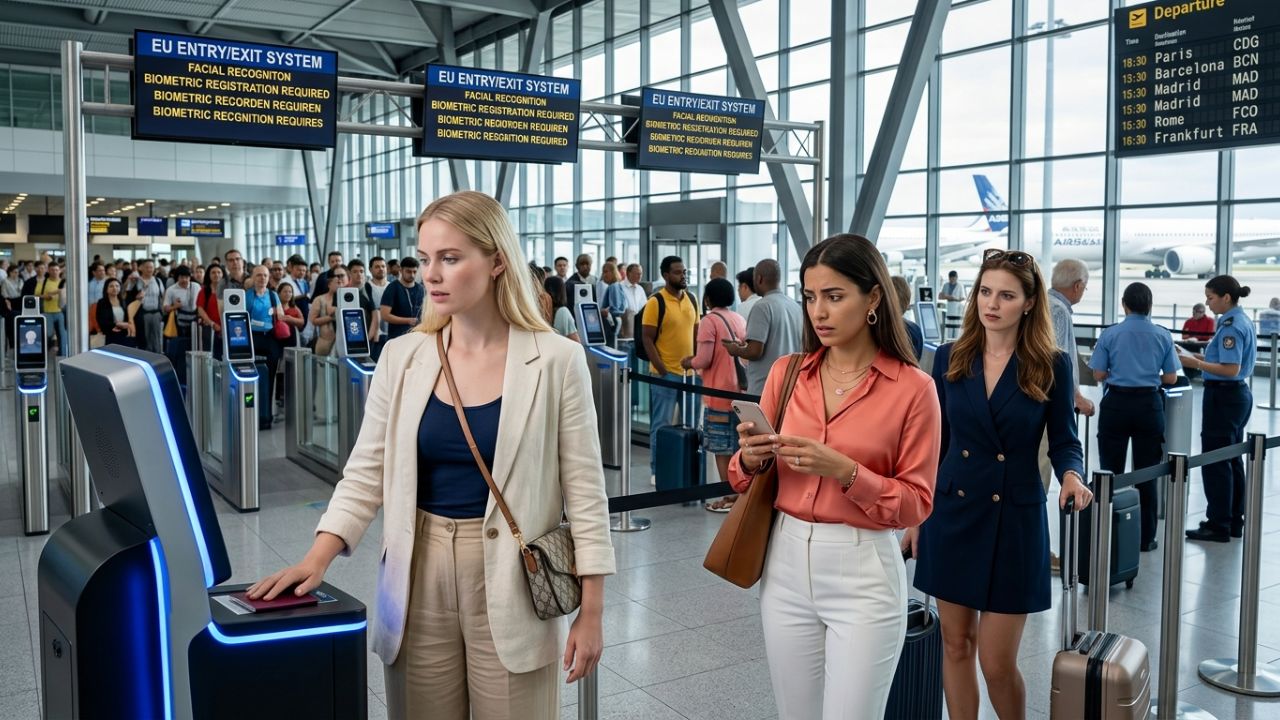
Image representing the severe travel chaos currently suffocating European airports due to the implementation of the new biometric EU Entry/Exit System.
European Travel Chaos Implodes: Biometric EU Entry Rules Trigger 4-Hour Airport Disruptions and Flight Cancellations
A Digital Mandate Cripples the Continental Aviation Grid
An absolute logistical nightmare is currently tearing through the European aviation network. According to the latest breaking airline news, the European Union’s newly implemented biometric Entry/Exit System has triggered an immense wave of unrecoverable travel chaos across prominent continental gateways. This automated data framework legally requires all non-EU nationals to submit extensive fingerprinting scans and real-time facial photographic mapping upon arrival. Unfortunately, the software infrastructure supporting these specialized electronic kiosks has catastrophically buckled under the weight of peak-season passenger volume. The resulting procedural gridlock has stranded tens of thousands of passengers in colossal terminal queues, directly sparking severe airport disruptions and triggering cascading flight cancellations as major wide-body aircraft are forced to depart empty.
This sweeping mandate currently applies to twenty-nine separate continental nations operating collectively inside the integrated European open border zone. Because these intricate data capturing mechanisms require pristine conditions to properly register human metrics, individual processing times have multiplied dramatically. As standard airline turnaround times completely collapse due to missing passengers trapped at immigration desks, the European aviation sector is facing its most severe structural crisis in a decade.
The Anatomy of the Terminal Gridlock
The root cause of this massive travel chaos lies in the rigid nature of the biometric hardware. When massive long-haul aircraft land simultaneously during highly congested morning arrival windows, the terminal infrastructure cannot process the sudden influx of bodies. Standard administrative workflows are utterly failing to accommodate the multi-layered biometric identity verification requirements efficiently.
Holidaymakers are being forced to stand in densely packed queues while automated scanning machines routinely fail to register facial coordinates instantly. When a single terminal gate experiences an interactive data lag, the entire airport layout faces quick, cascading pedestrian blockages. This unprecedented structural gridlock highlights severe friction between regional security ambitions and the daily logistical limitations of the modern airline industry.
Section-Wise Breakdown: Ground Zero of the Crisis
The localized impact of this continent-wide digital transition is overwhelmingly concentrated within historically high-volume leisure and business travel destinations. Live border tracking data reveals exactly where the system is breaking down:
Paris and Geneva: The Urban Choke Points At the epicenter of the disruption, Charles de Gaulle Airport in Paris is suffering from severe operational stagnation. The sheer volume of international arrivals has overwhelmed the newly installed kiosks, completely stalling passenger flow. Commuters navigating through Switzerland via Geneva are reporting identical structural hurdles, with waiting queues frequently and terrifyingly hitting the four-hour mark. This localized breakdown occurs because older, legacy terminal infrastructure cannot be easily remodeled to incorporate the bulky electronic screening banks required by the new mandate.
Spain and the Mediterranean: The Leisure Collapse As the critical summer season accelerates, prominent Mediterranean holiday regions are experiencing unprecedented line build-ups. Both Barcelona and Madrid are seeing passport control queues stretch effortlessly toward three hours during peak operational hours. Even smaller, highly specialized regional transport facilities like Palma de Mallorca are actively struggling to process heavy charter flight arrivals. This massive influx of tourists against a lagging digital system is creating a perfect storm for localized airport disruptions.
Operational Disruption Data: The European Queue Matrix
To fully comprehend the sheer scale of this continent-wide collapse, aviation analysts track the precise queuing metrics at the most severely impacted hubs. The following factual matrix details the exact delays currently suffocating the European aviation sector:
Factual European Airport Biometric Disruption Matrix
| Affected European Gateway | Operational Status & Disruption Impact |
|---|---|
| Paris Charles de Gaulle (CDG) | Severe operational stagnation |
| Geneva Airport (GVA) | Waiting queues frequently hitting the 4-hour mark |
| Madrid-Barajas (MAD) | Passport control queues stretching toward 3 hours |
| Barcelona-El Prat (BCN) | Passport control queues stretching toward 3 hours |
| Palma de Mallorca (PMI) | Severe delays processing heavy charter flight arrivals |
| Dover Channel Crossings | Biometrics temporarily suspended to prevent gridlock |
| Mandate Scope | Applies to 29 integrated European open border nations |
| Target Demographic | All non-EU national arrivals |
Passenger Impact: The Four-Hour Survival Buffer
For international travelers, the immediate reality of this rollout is brutal. Security experts now strongly recommend adjusting standard airport arrival timelines to account for unpredictable biometric registration delays. Arriving at least four hours prior to departure is no longer a suggestion; it is a mandatory safety buffer to avoid devastating flight cancellations.
Passengers caught in these queues are missing critical, tightly scheduled connecting transport arrangements, racking up thousands of dollars in rebooking fees and lost hotel nights. Maintaining a focused composure during intense biometric registration remains absolutely vital to prevent repetitive software reading errors. Families traveling with young children are being urged to pack extra provisions simply to survive the excruciating periods spent standing inside hot, densely packed immigration halls.
Industry Analysis: Global Aviation Authorities Push Back
The escalating severity of these airport disruptions has forced a highly coordinated institutional intervention from the world's most powerful aviation bodies. According to recent aviation updates, a powerful coalition consisting of the International Air Transport Association (IATA) and Airlines for Europe has issued urgent warnings to regional policymakers.
Their collective documentation points to critical, undeniable flaws within the software architecture deployed at these automated border verification gates. They argue fiercely that rushing complex automated data collection during high-volume periods risks permanently damaging the broader international tourism economy. Concurrently, European airport operators are desperately scrambling to deploy additional customer service personnel directly onto the terminal floors to manually verify physical passports. However, structural limitations within the IT infrastructure prevent immediate, systemic throughput improvements.
Conclusion: A Flawed Digital Transition
The ongoing rollout of the biometric Entry/Exit System stands as a stark warning about the dangers of prioritizing digital security mandates over human logistical reality. While temporary government interventions—such as British border officials suspending biometric screening protocols during extreme localized heatwaves at Dover—offer brief relief, they cannot solve the systemic problem. As four-hour queues continue to dominate Paris, Geneva, and Madrid, the European aviation sector is effectively paralyzed by its own technology. Until central software protocols undergo radical optimization, non-EU travelers must prepare for a grueling summer defined by relentless travel chaos and the ever-present threat of flight cancellations.
Key Takeaways
- Massive Queue Times: Non-EU nationals are facing grueling, four-hour passport control lines at major hubs like Geneva and Paris Charles de Gaulle due to the new EU Entry/Exit System.
- Widespread Disruptions: The digital mandate is triggering severe airport disruptions and causing cascading flight cancellations across 29 continental nations.
- The Mediterranean Collapse: Summer charter hubs, including Madrid, Barcelona, and Palma de Mallorca, are suffering massive line build-ups reaching up to three hours.
- Industry Backlash: The International Air Transport Association (IATA) and Airlines for Europe have issued urgent warnings, demanding emergency processing workarounds to fix flawed software architecture.
- Passenger Survival Tactics: Travelers are strongly advised to arrive at least four hours early, monitor real-time queue apps, and keep physical documents ready to survive the terminal travel chaos.
🌍 Related Travel Guides & Flight Resources
- Navigate Airport Disruptions Like a Pro Master the art of surviving unexpected travel chaos with our expert strategies.
- Breaking Airline News & Evasion Routes Stay ahead of the delays with our real-time aviation updates and route intelligence.
- Global Flight Cancellation Defense Grid Essential legal rights and compensation tactics when your flight goes down.
⚖️ Disclaimer
The aviation infrastructure intelligence, border control wait times, and biometric screening protocols provided in this report are for informational purposes only. European entry requirements, airport operational statuses, and immigration software capabilities are highly volatile and subject to immediate change based on governmental mandates or severe IT outages. NomadLawyer does not guarantee the absolute accuracy or current validity of the information provided and assumes no liability for travel disruptions, flight cancellations, denied entries, or any financial consequences resulting from the use of this content. Passengers are strongly advised to independently verify all border entry regulations, visa requirements, and real-time airport queue conditions directly with their respective embassies and airlines prior to travel.
Disclaimer
This article is for informational and educational purposes only. It does not constitute legal, financial, or professional advice. While we strive to provide accurate and up-to-date information, travel policies, regulations, and conditions change rapidly. Always verify information with official sources before making travel decisions. Nomad Lawyer makes no representations about the accuracy, reliability, completeness, or suitability of the information provided. Readers should consult qualified professionals for advice specific to their circumstances. The views expressed in this article are those of the author and do not necessarily reflect the views of Nomad Lawyer.
Kunal K Choudhary
Co-Founder & Contributor
A passionate traveller and tech enthusiast. Kunal contributes to the vision and growth of Nomad Lawyer, bringing fresh perspectives and driving the community forward.
Learn more about our team →