
EES launch triggers long queues at Schengen airports on day one
Europe's Entry/Exit System goes fully live April 10, 2026, causing massive airport queues and missed flights across the Schengen zone. Biometric border checks delay thousands of travelers.

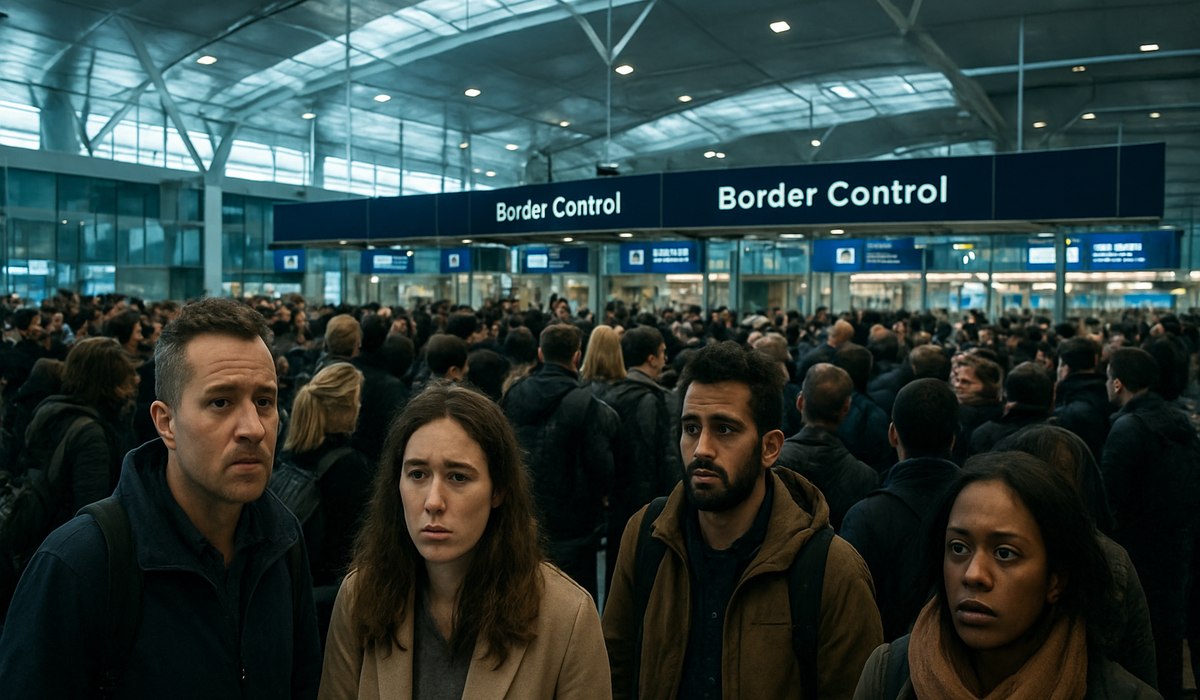
Image generated by AI
Europe's Biometric Border Revolution Begins—With Immediate Chaos
Europe's Entry/Exit System (EES) went fully live on April 10, 2026, across 29 Schengen countries, triggering unprecedented airport congestion and widespread flight delays on day one. The mandatory biometric border-screening system—replacing traditional passport stamps with fingerprint and facial-image enrollment—created queues stretching up to two hours at major European gateways, leaving thousands of travelers stranded and missing connections. The rollout marks the biggest single change to Schengen border procedures since the passport-free zone's creation, fundamentally transforming how non-EU visitors enter Europe.
First-Day Chaos: Queues, Delays and Missed Connections
From Lisbon to Milan, Madrid to Paris, and Rome to Barcelona, airports across the Schengen zone reported severe processing bottlenecks within hours of the EES mandate taking effect. At Lisbon Humberto Delgado Airport, Portugal's main international hub, immigration queues snaked through arrival halls and back into connecting corridors as border officers struggled to manage the surge of first-time biometric enrollments. Spain's busiest airports—Madrid-Barajas and Barcelona-El Prat—saw wait times exceed two hours despite pre-emptive increases to minimum connection windows. Airlines had anticipated delays but underestimated the scale.
Italy's major gateways—Rome-Fiumicino, Milan-Malpensa, and Venice—all reported system-wide congestion as 00:01 on April 10 made EES mandatory at every external border crossing. Mobile registration stations and additional e-gates deployed ahead of launch proved insufficient when fingerprint-capture technology experienced intermittent failures and staff required retraining on new workflows. France's immigration hubs experienced comparable disruption, with connecting passengers missing onward flights within the Schengen zone at rates not seen during the previous phased rollout since October 2025.
The Technology Behind Biometric Border Checks
The EES represents a seismic shift in European border administration. Under the new system, first-time non-EU arrivals must undergo extended processing: border police or automated kiosks capture four fingerprints, a live facial image, and passport data before clearance is granted. Repeat visitors theoretically move through faster—but industry analyses predicted that during the initial rollout months, an overwhelming majority of travelers would still require first-enrollment processing, creating exactly the bottleneck now unfolding.
Each biometric transaction can extend border-control time per passenger by up to 70 percent during this phase, according to analysis from Airports Council International Europe. The system aims to enhance security, curb visa overstays, and accelerate checks long-term. For now, however, European airports are absorbing the worst of both worlds: slower processing meets peak Easter and spring holiday traffic, followed by approaching summer season peaks.
Affected Airlines, Routes, and Real-Time Impact
Major carriers operating transatlantic, Middle Eastern, and Asian routes experienced cascading delays. Overnight arrivals from New York, London, and Dubai into Paris-Charles de Gaulle, London Heathrow connections onward to continental hubs, and evening flights from the Gulf saw passengers systematically miss tight connections. Budget airlines operating high-frequency European networks—rebooked passengers flooding connecting flights—report secondary disruption spreading through April 11 schedules.
For live flight tracking and real-time delay information, consult FlightAware, which displays current status, gate changes, and revised arrival times across affected airports. Check your airline's website directly for rebooking options and compensation eligibility under EU261/2004 passenger-rights regulations.
What Travelers Need to Know About EES Enrollment
Non-EU citizens entering the Schengen zone for short stays under 90 days are now subject to mandatory EES registration on first entry. The system captures biometric data—four fingerprints and a facial photograph—alongside passport information, storing records for 99 months. This enrollment happens at border control, not in advance.
Key facts for travelers:
- First-time entrants face 15–45 minute waits per person during peak hours
- Biometric data is stored digitally; no passport stamp is issued
- Repeat visitors should experience faster processing after initial enrollment
- Children under 6 and certain exempted categories bypass fingerprint capture
- The system applies at airports, land borders, and seaports across 29 countries
EU, EEA, and Swiss citizens are exempt from EES but still require a valid travel document for entry.
Capacity Gaps Meet Peak-Season Timing
Airports and airlines had warned publicly for months that the transition from partial (October 2025 onward) to full EES deployment would be the most vulnerable operational moment. The problem: when a large proportion of all arriving passengers must complete first-enrollment, existing border-control staffing proves insufficient. Many major European airports entered April with chronic understaffing, limited contingency capacity, and brand-new biometric technology still being mastered by personnel.
When equipment fails, travelers unfamiliar with fingerprint kiosks struggle, or flights arrive in tight clusters, the system has no slack. The timing compounds the crisis: EES full launch coincides with Easter break travel, spring holidays, and the approach to peak summer season. A 15-minute delay at passport control cascades into hall overflow, missed connections, rebooking bottlenecks, and exponential disruption.
How Long Will Airport Disruptions Last?
Industry experts project that operational stability will take 6–8 weeks to establish, as border staff master new workflows, travelers become familiar with biometric enrollment, and airports optimize gate-to-booth staffing ratios. However, disruption severity will likely spike again during peak summer travel (June–August 2026). Some member states have prepared contingency measures, including temporary staffing surges and modified check procedures during critical peak windows.
Nomad workers, business travelers, and digital professionals should allow extra buffer time—consider arriving 4+ hours before transatlantic or long-haul departures, and 3+ hours for intra-Schengen connections. Book flights with generous layover windows until mid-June 2026.
Traveler Action Checklist
If you're flying to or within Europe during this disruption window, follow these steps to minimize risk:
-
Arrive earlier than usual: Book flights with 4-hour buffer before long-haul departures; 3+ hours for intra-Schengen connections.
-
Check your airline's EES guidance: Visit your carrier's website for updated minimum connection times and rebooking policies.
-
Review passenger rights: Under EU261/2004, delays exceeding 3 hours qualify for compensation (€250–€600). Consult US DOT for non-EU carrier rules.
-
Monitor real-time flight status: Use FlightAware to track delays and gate changes on the day of travel.
-
Prepare biometric data in advance: Have a clear, recent passport photo and clean fingerprints ready; avoid excessive hand lotion before border control.
-
Document delays: Collect boarding passes, gate information, and timestamps if you miss a connection; you may be entitled to compensation.
-
Contact your airline immediately if disrupted: Request rebooking on next available flight and collect written evidence of the delay.
-
Consider travel insurance: Short-term policies covering missed connections and rebooking costs are available through InsureMyTrip and similar providers.
Key Data: EES Impact by the Numbers
| Metric | Figure | Source |
Disclaimer
This article is for informational and educational purposes only. It does not constitute legal, financial, or professional advice. While we strive to provide accurate and up-to-date information, travel policies, regulations, and conditions change rapidly. Always verify information with official sources before making travel decisions. Nomad Lawyer makes no representations about the accuracy, reliability, completeness, or suitability of the information provided. Readers should consult qualified professionals for advice specific to their circumstances. The views expressed in this article are those of the author and do not necessarily reflect the views of Nomad Lawyer.
Raushan Kumar
Founder & Lead Developer
Full-stack developer with 11+ years of experience and a passionate traveller. Raushan built Nomad Lawyer from the ground up with a vision to create the best travel and law experience on the web.
Learn more about our team →