
Dubai International Airport Braces for 3.7 Million Summer Return Passengers at 222,000 Per Day With Transit Traffic Forming 46% of Total Load
Dubai International Airport (DXB) is preparing for an influx of up to 3.7 million passengers during the post-summer return period, with daily traffic forecast to reach approximately 222,000 and transit travelers expected to account for about 46% of total volume — placing simultaneous pressure on baggage reclaim, immigration, ground transportation, and road access as returning residents and connecting international passengers converge on one of the world's busiest aviation hubs.

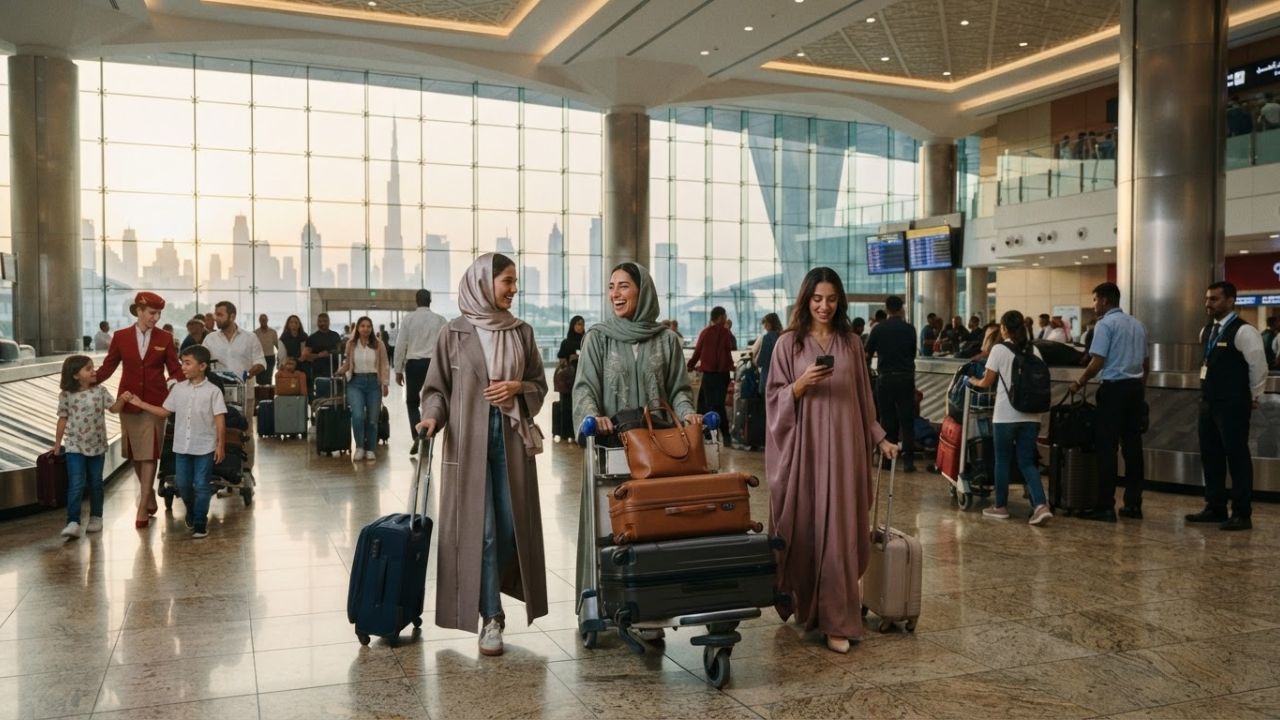
Image generated by AI
Dubai International Airport (DXB) is preparing for up to 3.7 million passengers during the summer return rush — at a daily rate of approximately 222,000 — with transit travelers projected to account for about 46% of total traffic, making this post-summer return period one of the most operationally intensive the airport has faced, with baggage handling, immigration, ground transportation, and road access all identified as critical pressure points.
The 46% transit share is the figure that most clearly defines DXB's operational challenge during this period. Nearly half of the 3.7 million passengers moving through the airport during the peak window are not beginning or ending their journeys in Dubai — they are connecting between intercontinental flights, which means DXB must simultaneously process arrivals, manage departures, and maintain smooth transfer flows across its terminals, all under conditions where any delay in one process rapidly compounds pressure in the others.
DXB's 3.7 Million Summer Return Forecast: What 222,000 Daily Passengers Means at One of the World's Busiest Airports
DUBAI, August 22, 2026 — Dubai International Airport (DXB) is entering the post-summer return period with daily passenger traffic forecast to reach approximately 222,000, as up to 3.7 million travelers — a mix of returning Dubai residents and international transit passengers — are expected to move through the airport during the summer return window.
The daily figure of approximately 222,000 passengers provides the operational context that the headline total does not fully capture. At that volume, DXB is processing the equivalent of a mid-sized city's population every single day across its arrivals, baggage, immigration, and ground transport infrastructure. Flight waves arriving within concentrated windows — common during the post-midnight and early-morning periods that long-haul intercontinental services favor — can push local hourly throughput well above the daily average, creating the queue and congestion patterns that airport operations teams specifically plan for during peak periods.
Transit Travelers at 46% of Projected Volume: Why DXB's Connecting Hub Function Amplifies the Operational Challenge
Of the projected 3.7 million passengers, transit travelers are expected to represent approximately 46% of total traffic. That proportion matters operationally because transit passengers generate a different and more complex movement pattern than origin-destination travelers.
A passenger arriving in Dubai as their final destination moves through immigration, collects baggage, and exits to ground transport — a linear sequence that the airport can process in stages. A transit passenger arriving from Europe to connect to a South Asia or East Africa flight must clear transit security, navigate between terminals or concourses, and board a departing aircraft within a defined connection window — all without leaving the controlled airside environment. Any delay at the aircraft door, on the taxiway, at a transit security checkpoint, or in the transfer bus service between terminals directly affects whether that passenger makes their onward connection.
At 46% of 3.7 million passengers — approximately 1.7 million transit travelers — DXB's transfer operation during this period is itself equivalent to the total passenger volumes of many mid-tier international airports over the same timeframe.
DXB's geographic position is what generates this transit proportion. Situated at the intersection of the Europe-South Asia corridor and the East-West transcontinental route between the Americas and Asia-Pacific, Dubai sits within the 8-hour flying radius of approximately two-thirds of the world's population — a positioning that makes it structurally necessary as a connecting hub for intercontinental routes that lack the demand to support direct services.
Baggage Reclaim and Ground Transport Identified as the Two Primary Congestion Points
Airport operations teams are placing particular emphasis on two stages of the passenger journey during the surge period: baggage reclaim and ground transportation.
Baggage reclaim accumulates pressure during post-summer return periods for a specific reason: returning holidaymakers travel with more luggage than transit or business passengers. A family returning to Dubai after a month abroad carries significantly more checked baggage than the same passengers on a business trip — more bags per person, larger bags, and more frequent oversized items. This increases the physical volume of luggage flowing through the baggage handling system per flight, extends the time belts must run, and concentrates demand on reclaim facilities in the periods immediately after heavy family-oriented long-haul flights land.
Ground transportation — including taxis, ride-hail services, airport buses, and the Dubai Metro's Red Line — faces a secondary surge effect: as passengers clear baggage and immigration and exit the terminal, all of them need to reach their final destinations across Dubai and the wider UAE simultaneously. The road access infrastructure serving DXB, particularly the main arterial connections to the Sheikh Zayed Road and Al Khail Road networks, is susceptible to congestion during concentrated arrival waves that are not distributed evenly across the day.
Both pressure points share a characteristic that makes them difficult to manage through simple capacity scaling: they are downstream of aircraft arrival and cannot be pre-positioned in the same way that departure hall staffing can. The airport must react to the actual distribution of arriving passengers rather than planning on a theoretical average.
What DXB's Operations Teams Are Doing During the Peak Period
Airport teams are maintaining close monitoring across every stage of the passenger journey — from the aircraft to the terminal exit — with particular attention to the sequences where congestion in one area generates downstream delays in the next.
The operational approach prioritizes coordination over capacity alone: the ability to shift staff between baggage belts, open additional immigration lanes, or redirect passengers between taxi ranks and bus connections based on real-time conditions is more valuable during concentrated arrival waves than fixed infrastructure additions that cannot be dynamically redeployed.
Operational flexibility — the capacity to adjust responses as actual passenger flows deviate from the forecast pattern — is explicitly identified as a priority. At an airport where flight schedules from dozens of airlines across time zones in multiple continents interact with ground operations, the actual distribution of arrival waves on any given day can differ meaningfully from the aggregate forecast.
Regular schedules and services across all terminals are being maintained throughout the peak period, with the planning emphasis on response speed when operational conditions change rather than on pre-emptive restriction of services.
Practical Guidance for Passengers Traveling Through DXB During the Summer Return Surge
For passengers arriving at or connecting through DXB during the summer return period, several practical factors are worth anticipating.
On check-in flight information before departure: DXB handles arrivals from time zones spanning approximately 12 hours of the global clock. Flight status can change in the hours before departure from origin airports, and confirming gate and terminal information before leaving for the airport reduces the impact of last-minute changes on connection timing.
On baggage collection: During peak arrival waves, baggage belt allocation for specific flights can change in real time as belt capacity is redistributed. Monitoring the baggage information displays — rather than proceeding directly to a specific belt based on advance information — reduces the risk of waiting at the wrong belt while luggage is delivered elsewhere.
On ground transport: The Dubai Metro's Red Line, which serves DXB Terminal 1 and Terminal 3 via dedicated airport stations, is the ground transport option least affected by road congestion during peak arrival periods. For passengers traveling to destinations on or near the Red Line corridor — including Dubai Marina, Downtown Dubai, and Deira — the metro provides a predictable journey time that road-based options cannot guarantee during concentrated arrival windows.
On connection time at DXB: Transit passengers with tight connections during the peak period should be aware that immigration-free landside transit may still involve security re-screening at transfer checkpoints and physical distance between concourses. Connections that meet minimum connection time requirements under normal conditions can become marginal when arrival waves increase the density of passengers at transfer security and inter-terminal transport points.
FAQ: Dubai Airport Summer 2026 Passenger Surge
How many passengers is Dubai Airport expecting for the summer return period? Dubai International Airport (DXB) is preparing for up to 3.7 million passengers during the summer return period, with daily traffic forecast to reach approximately 222,000 passengers per day.
What percentage of DXB's summer return passengers are transit travelers? Transit travelers are expected to account for approximately 46% of total projected passenger traffic during the summer return period — representing DXB's function as a global connecting hub between Europe, Asia, Africa, the Middle East, and other international markets.
What are the main operational pressure points at DXB during the summer return surge? Airport operations teams have identified baggage reclaim and ground transportation as the two primary pressure points during the summer return surge, alongside immigration facilities and road access. These are the stages of the passenger journey most directly affected by concentrated arrival waves of returning holiday travelers carrying large amounts of luggage.
Related Travel Guides
Disclaimer
This article is for informational and educational purposes only. It does not constitute legal, financial, or professional advice. While we strive to provide accurate and up-to-date information, travel policies, regulations, and conditions change rapidly. Always verify information with official sources before making travel decisions. Nomad Lawyer makes no representations about the accuracy, reliability, completeness, or suitability of the information provided. Readers should consult qualified professionals for advice specific to their circumstances. The views expressed in this article are those of the author and do not necessarily reflect the views of Nomad Lawyer.
Preeti Gunjan
Contributor & Community Manager
A passionate traveller and community builder. Preeti helps grow the Nomad Lawyer community, fostering engagement and bringing the reader experience to life.
Learn more about our team →