
Drone Sighting and Weather Balloon Trigger Major Ground Stops at San Diego International Airport in 2026
A drone incursion and a high-altitude weather balloon caused cascading delays and ground stops at San Diego International Airport during the 2026 Labor Day travel peak.

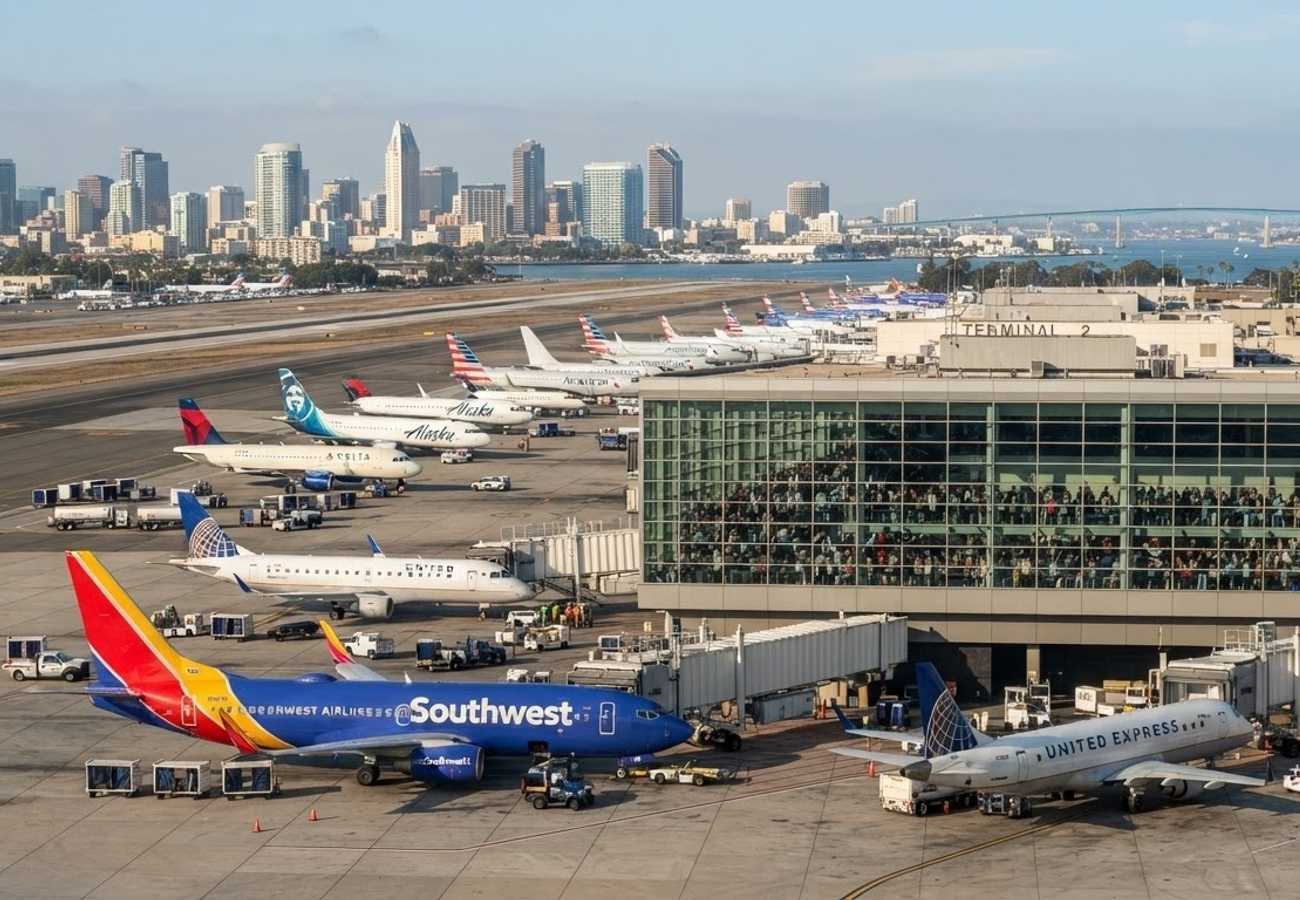
Image generated by AI
San Diego International Airport experienced severe operational paralysis on Friday, September 4, 2026, as a drone sighting and a high-altitude weather balloon triggered temporary ground stops and widespread flight rerouting during the Labor Day peak.
Airspace Disruptions and Operational Impact
On the afternoon of September 4, federal air-traffic data and flight tracking metrics confirmed that arrivals and departures at San Diego International Airport were repeatedly paused. The disruption was triggered by the sighting of at least one drone operating near the airport's approach and departure corridors. Simultaneously, a tracked high-altitude weather balloon was reported in the broader regional airspace, creating a compounding security concern for air traffic controllers.
The Federal Aviation Administration (FAA) listed the airport as facing "other/security" related delays. During the peak of the disruption in the afternoon and early evening, average departure holdups reached approximately two hours. Arrival delays exceeded 90 minutes, with inbound aircraft either held at their origin airports or placed into holding patterns over the Pacific.
Because these events coincided with the Labor Day holiday weekend, the impact was magnified. Airlines operating at near-maximum capacity saw immediate knock-on effects, resulting in congested gate areas and backed-up security checkpoints.
Flight Delay and Impact Specifications
The following table outlines the specific operational metrics recorded during the incident:
| Metric | Reported Impact | Cause/Detail |
|---|---|---|
| Avg. Departure Delay | ~2 Hours | Security-related ground stops |
| Avg. Arrival Delay | 90+ Minutes | Holding patterns and origin holds |
| Primary Trigger | Drone Sighting | Incursion in approach/departure corridors |
| Secondary Trigger | Weather Balloon | High-altitude object causing public confusion |
| Operational Constraint | Single-Runway Layout | Limited capacity for recovery and sequencing |
| Date of Incident | September 4, 2026 | Labor Day travel window |
Traveler Logistics Guide: Navigating Airport Disruptions
From a ground-level perspective, the best way to navigate sudden ground stops at single-runway facilities like San Diego is to bypass official terminal screens and rely on real-time telemetry.
1. Use Third-Party Tracking Over Terminal Boards During security events, airport departure boards often use generic terms like "Air Traffic Control" or "Security Issue." Use apps like FlightAware or Flightradar24 to see if your inbound aircraft is actually in the air or if it is still grounded at the origin. This prevents you from waiting at the gate for a plane that hasn't even departed.
2. Monitor Crew Duty-Time Limits A critical but overlooked detail in these delays is the "crew timeout." When delays exceed a few hours, flight crews may hit their legal duty-time limits. If you see a delay creeping past the three-hour mark, proactively contact your airline to check if a crew swap is planned; otherwise, the flight may be canceled entirely despite the airspace being cleared.
3. Digital Transit Policies Ensure your airline notifications are set to "Push" rather than email. In high-congestion scenarios, email updates often lag by 30-60 minutes, whereas app notifications are triggered the moment the FAA lifts a ground stop.
Infrastructure Impact Assessment
The incident highlights a significant vulnerability in San Diego International Airport's infrastructure: its reliance on a single main runway. Unlike hubs with parallel runways, San Diego has no flexibility to divert traffic to an alternate strip during a security incursion. Any pause in flow creates a linear backlog that takes hours to clear, regardless of how quickly the intruder (drone or balloon) is removed.
The presence of a transponder-equipped weather balloon, while operating at a safe altitude, added to the atmospheric confusion. This underscores a growing challenge for the FAA: the integration of unmanned aerial systems (UAS) and research balloons into high-density commercial corridors. As these objects become more common, the likelihood of "precautionary" ground stops—which cause massive economic and logistical ripples—is expected to increase.
Residual disruptions continued into the weekend as airlines worked to reposition aircraft and crews across the national network.
Related Travel Guides
Disclaimer
This article is for informational and educational purposes only. It does not constitute legal, financial, or professional advice. While we strive to provide accurate and up-to-date information, travel policies, regulations, and conditions change rapidly. Always verify information with official sources before making travel decisions. Nomad Lawyer makes no representations about the accuracy, reliability, completeness, or suitability of the information provided. Readers should consult qualified professionals for advice specific to their circumstances. The views expressed in this article are those of the author and do not necessarily reflect the views of Nomad Lawyer.
Kunal K Choudhary
Co-Founder & Contributor
A passionate traveller and tech enthusiast. Kunal contributes to the vision and growth of Nomad Lawyer, bringing fresh perspectives and driving the community forward.
Learn more about our team →