
Portugal Luxury Travel and Investment: Algarve, Lisbon, and Porto Guide Following the 2026 National Forum

When Portuguese big-wave waterman Hugo Vau rode an enormous wave measuring approximately 35 metres at Nazaré's Praia do Norte in 2018, it demanded years of meticulous offshore tracking, jet-ski team coordination, and relentless discipline to conquer what seemed impossible. That exact ethos of collective resilience, physical preparation, and long-term vision took center stage from 1 to 9 October 2026, as the first-ever Portugal Investment Forum completed a nine-day nationwide progression connecting the southern sands of the Algarve, the royal coast of Estoril, the capital avenues of Lisbon, and the granite cellars of Porto. Bringing together more than 300 prominent participants—including over 150 international investors and representatives of family offices—the summit illuminated a fundamental truth for discerning travelers: global capital follows authentic quality of life.
The Nine-Day Trans-Portugal Forum: From Algarve Fairways to Porto's Wine Lodges
The forum, organized by Portugal Pathways and the Portugal Investment Owners Club, approached national economic development through an unconventional, multi-destination route. The nine-day circuit opened on 1 October 2026 in the south, hosting delegates across Lagos and the exclusive private enclave of Quinta do Lago in the Algarve. The delegation then progressed northward through the seaside elegance of Estoril and the financial quarters of Lisbon, before concluding its final sessions in Porto on 9 October 2026.
Across each stop, attendees engaged in 15 specially organized panel discussions, with every session followed by an expert-led round-table designed to turn conceptual dialogue into direct commercial partnerships. At the Lisbon gathering, Rogério Fernandes Ferreira, founder of RFF Lawyers and former Secretary of State for Fiscal Affairs, emphasized that long-term commitments require regulatory predictability and mutual trust, observing: "Portugal has the ingredients. Its next challenge is making sure they work together."
Addressing the direct connection between lifestyle migration and capital deployment, Ricardo Assunção, board member of Amorim Luxury Group, crystallized the primary driver behind Portugal's sustained popularity: "Investors first choose where they want to live, then the investment comes." In Porto, the closing session featured prominent corporate leaders including Sílvia Mota, who serves as CEO of MEXT, chairwoman and CEO of Emerge, and co-founder of Moon Capital, alongside Peter Villax, chief executive of Mediceus, partner at Biovance Capital, and former president of the Family Business Association.
Paul Stannard, chairman and founder of Portugal Pathways and the Portugal Investment Owners Club, noted that Portugal has experienced gradual, consistent economic uplift spanning more than a decade. To share the findings with the wider public, recordings of all 15 panels alongside more than 100 participant interviews will be published via Portugal Pathways and the Portugal Investment Owners Club, with initial updates appearing by the end of the week beginning 12 October 2026. Furthermore, organizers revealed plans to stage the first-ever Portugal Investment Summit in 2027, projecting attendance of over 1,000 institutional and experienced global investors.
Regional Travel and Investment Hubs: The Nine-Day Forum Circuit
The forum's geographical progression mapped directly onto Portugal's most distinctive travel corridors:
| Forum Destination | Dates & Primary Focus | Regional Specialty & Environment | Key Travel & Lifestyle Character |
|---|---|---|---|
| Algarve (Lagos & Quinta do Lago) | 1–3 October: Luxury leisure, golf estates, coastal hospitality | Golden limestone sea arches, Ria Formosa lagoon, pine-fringed fairways | Premier year-round outdoor sports, Michelin dining, and secluded coastal villas. |
| Estoril & Cascais Coast | 4–5 October: Heritage coastal estates, maritime wealth management | Belle Époque mansions, sandy Atlantic coves, oceanfront promenade | Aristocratic charm, seaside microclimates, and direct commuter rail into central Lisbon. |
| Lisbon (Capital Core) | 6–7 October: Fiscal policy, tech enterprise, urban regeneration | Seven historic hills, yellow streetcars, miradouro viewpoints over the Tagus | Dynamic urban culture, rooftop dining, centuries-old tiled facades, and fiscal advisory hubs. |
| Nazaré (Coastline Anchor) | Cultural & athletic showcase featuring big-wave surfer Hugo Vau | Underwater canyon generating record-breaking North Atlantic surf breaks | Authentic fishing traditions, dried cod racks along the beach, and extreme ocean swells. |
| Porto & Douro Gateway | 8–9 October: Industrial innovation, venture funds, biotech summits | Medieval granite alleys, iron bridges, historic port wine lodges in Gaia | Deep merchant traditions, dramatic river gorges, and world-class northern gastronomy. |
What Makes Portugal Different: Three Distinct Provincial Rhythms
For visitors traveling through mainland Portugal, the country offers stark regional transitions within a four-hour drive, guided by official resources from Visit Portugal.
In the south, the Algarve is defined by warm Mediterranean weather softened by Atlantic tides. Beyond Quinta do Lago's manicured fairways and the maritime grottos of Ponta da Piedade in Lagos, the region shelters quiet whitewashed inland hamlets like Silves, where Moorish sandstone fortresses rise above sweet orange orchards.
Travel ninety minutes north, and the Estoril-Cascais corridor reveals the sophisticated coastal refuge favored by European royalty during World War II, situated along the train line that hugs the Tagus estuary into Lisbon. In the capital, the historic neighborhoods of Alfama, Mouraria, and Bairro Alto pulse to the haunting melodies of fado, echoing through stone alleys lined with cobalt-blue azulejo ceramic tiles.
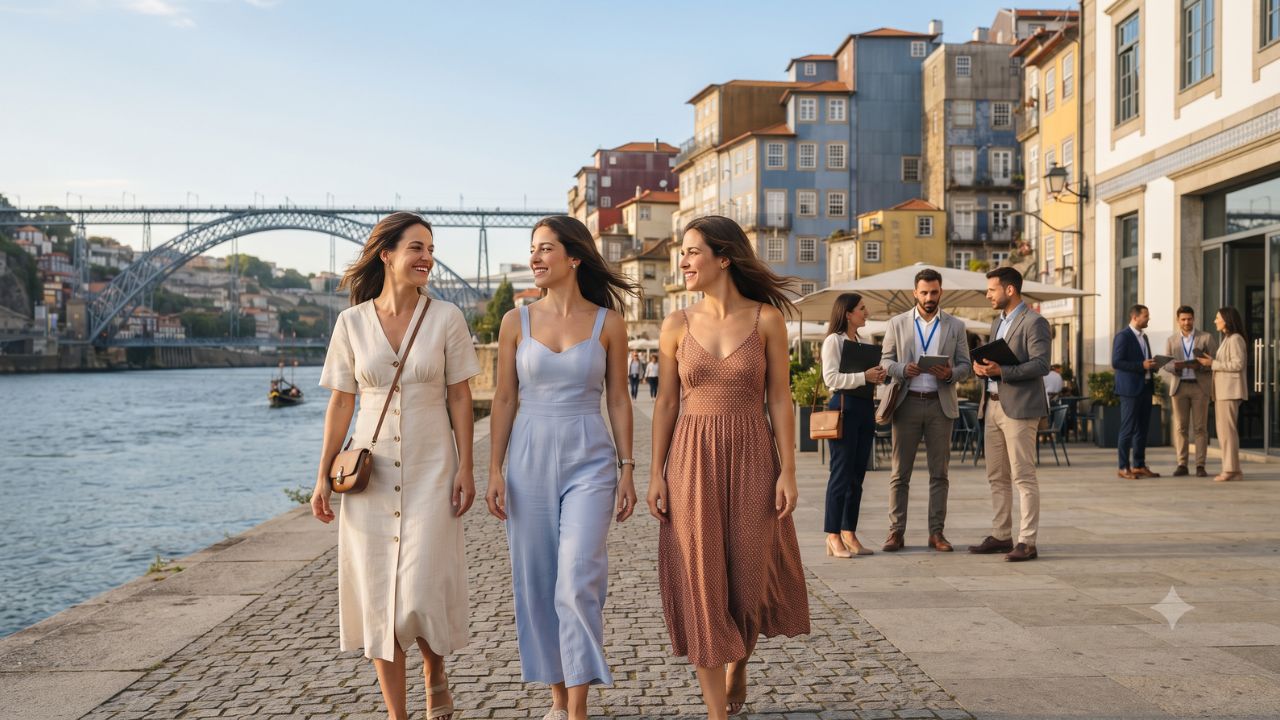
Further north, Porto presents an entirely different cultural texture. Anchored around the Historic Centre of Porto and the Luiz I Bridge, protected through the UNESCO World Heritage Centre, the northern capital is defined by dark granite architecture, azulejo-clad churches like São Bento, and the centuries-old port wine lodges of Vila Nova de Gaia. Upstream lies the Alto Douro Wine Region, where steep terraced vineyards have produced fortified wines since 1756.
Visitor Insider Tips for Traversing Portugal
- High-Speed Rail Transit: Skip domestic flights and highway toll plazas between Lisbon and Porto. Book the express Alfa Pendular train operated by Comboios de Portugal. The journey links Lisbon's Santa Apolónia or Oriente stations to Porto's Campanhã terminal in just 2 hours and 50 minutes, providing first-class carriages (Conforto) with power sockets, quiet cars, and coastal scenery.
- Timing the Nazaré Big Wave Season: To witness the massive Atlantic swells celebrated by Hugo Vau, visit Praia do Norte between November and February. The underwater Nazaré Canyon funnels deep-sea storm energy into monster waves exceeding 20 meters, best viewed from the cliff edge by the Farol da Nazaré lighthouse.
- Algarve Cliff Etiquette: When exploring coastal walking paths like the Seven Hanging Valleys Trail near Carvoeiro, stay strictly behind wooden fences and marked trail stones. The porous calcarenite cliffs suffer from severe coastal erosion, especially following winter rainstorms.
- Regional Gastronomy Beyond Bacalhau: While salted cod (bacalhau) is ubiquitous, taste hyper-local regional plates: fresh grilled sardines and goose barnacles (percebes) along the Costa Vicentina; slow-braised pork with clams (carne de porco à alentejana) in southern taverns; and Porto's decadent francesinha—a toasted sandwich packed with steak, linguiça, and melted cheese, submerged in a spicy beer and tomato sauce.
Cultural and Environmental Context: Sustainable Communities and Living Heritage
As the forum participants highlighted throughout their sessions, Portugal's rapid economic and tourism growth brings real-world social responsibilities. Discussions led by business leaders and community advocates emphasized that sustaining foreign capital requires protecting the local social contract.
A central issue raised during the panels was the mounting pressure on residential housing availability and affordability across Lisbon, Porto, and prime Algarve municipalities. Over the past decade, the rapid conversion of long-term family apartments into short-stay holiday rentals has priced local teachers, healthcare workers, and younger generations out of historic urban centers.
Sustainable tourism development in Portugal now focuses on regional dispersal. By guiding international travelers and property buyers beyond overcrowded urban epicenters into interior districts like the Alentejo plains, the granite villages of the Beira Alta, and the terraced Douro valleys, Portugal aims to preserve living cultural heritage while ensuring local communities directly benefit from economic expansion.
FAQ: Visiting Portugal 2026
What is the ideal time of year to visit Portugal?
Spring (April to June) and autumn (September to October) provide ideal weather conditions, with warm daytime temperatures around 20°C to 25°C, fewer crowds across historic sights, and pleasant water conditions for coastal walking.
Do international travelers need a visa to enter Portugal?
Citizens of the European Union, United States, Canada, and the United Kingdom can enter Portugal for tourism stays up to 90 days within any 180-day window without a visa under Schengen Area regulations. Ensure your passport remains valid for at least three months beyond your planned departure.
How do I travel between the Algarve, Lisbon, and Porto?
The most efficient option is the national rail network (Comboios de Portugal), which connects Faro in the Algarve to Lisbon in three hours, and Lisbon to Porto in under three hours aboard high-speed Alfa Pendular trains.
Is Portugal safe for solo and family travelers?
Portugal consistently ranks among the top ten most peaceful countries worldwide. Standard common-sense precautions apply: guard valuables against opportunistic pickpocketing on crowded public transit, such as Lisbon's Tram 28, and obey ocean safety warning flags on Atlantic beaches.
[From the colossal Atlantic swells of Nazaré to the quiet granite quays of Porto, Portugal demonstrates that true sustainable progress begins by cherishing the places we choose to call home.]
Related Travel Guides
Disclaimer
This article is for informational and educational purposes only. It does not constitute legal, financial, or professional advice. While we strive to provide accurate and up-to-date information, travel policies, regulations, and conditions change rapidly. Always verify information with official sources before making travel decisions. Nomad Lawyer makes no representations about the accuracy, reliability, completeness, or suitability of the information provided. Readers should consult qualified professionals for advice specific to their circumstances. The views expressed in this article are those of the author and do not necessarily reflect the views of Nomad Lawyer.
Kunal K Choudhary
Co-Founder & Contributor
A passionate traveller and tech enthusiast. Kunal contributes to the vision and growth of Nomad Lawyer, bringing fresh perspectives and driving the community forward.
Learn more about our team →