
Drone and Weather Balloon Trigger Ground Stop and Massive Delays at San Diego International Airport 2026
A drone and weather balloon caused a total halt of arrivals and departures at San Diego International Airport on September 4, leading to cascading delays and diversions during the Labor Day weekend.

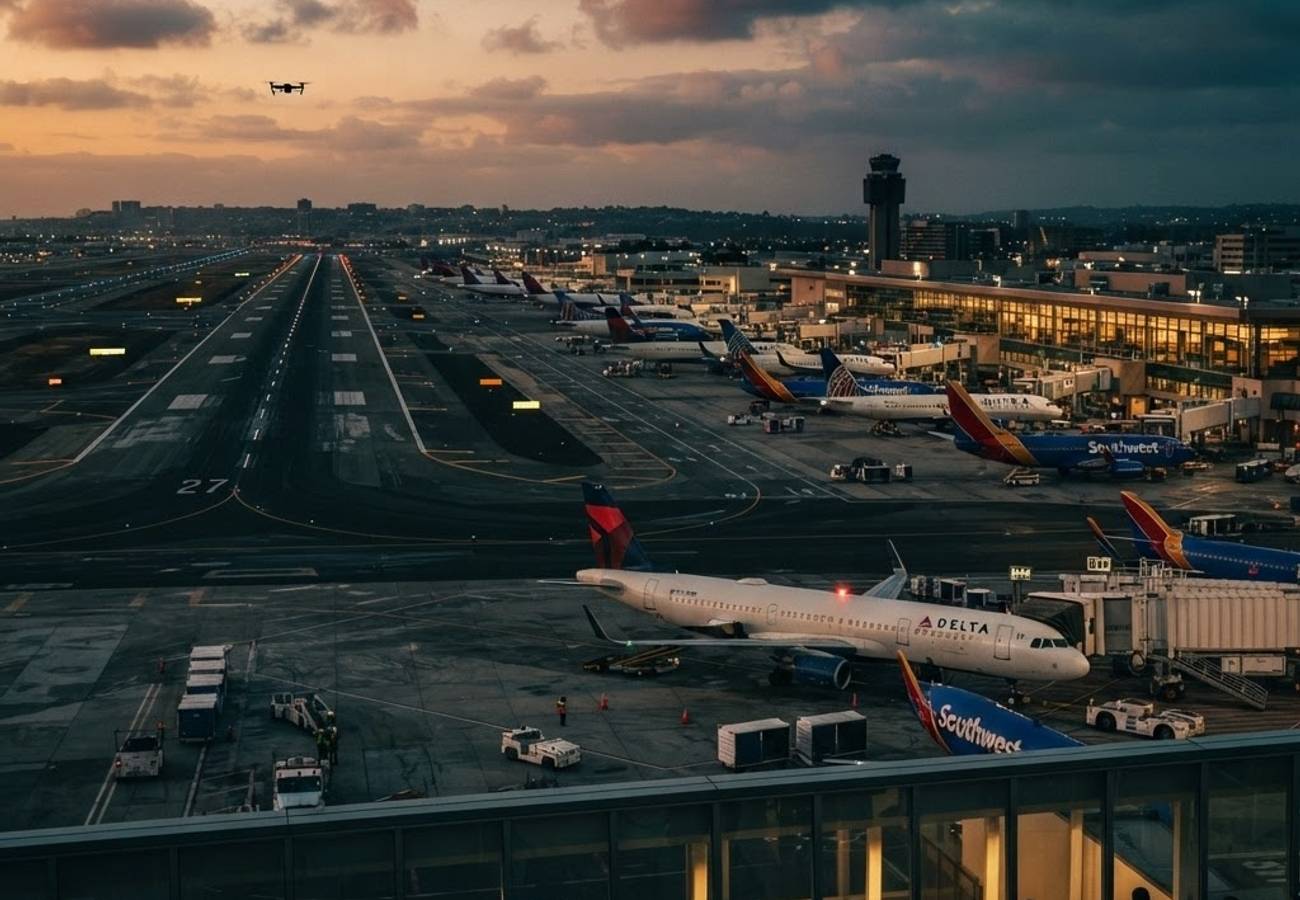
Image generated by AI
San Diego International Airport experienced a total operational freeze on Friday, September 4, 2026, after the detection of a drone and a weather balloon. The resulting ground stop triggered hours of cascading delays and diversions for hundreds of passengers at the start of the Labor Day holiday weekend.
The Federal Aviation Administration (FAA) intervened on Friday afternoon, halting all arrivals and departures at San Diego International (SAN). The disruption was caused by two distinct unauthorized aerial objects: a drone operating at low altitude near approach and departure paths, and a weather balloon tracked at a higher altitude.
Flight-tracking data confirms that departing aircraft were held at gates or on taxiways, while inbound flights were forced into extended holding patterns over Southern California or diverted to alternate airports.
Operational Breakdown: September 4 Disruptions
The security-related constraints caused immediate instability across the regional network. The following key facts outline the scale of the incident:
- Primary Triggers: A low-altitude drone and a separate weather balloon.
- Immediate Action: FAA-mandated ground stop for all arrivals and departures.
- Passenger Impact: Holding patterns lasting 25 to 30 minutes or more for multiple flights.
- Network Delays: Average delays of approximately two hours for certain departures bound for San Diego.
- Diversion Hubs: Aircraft from Denver, Phoenix, Sacramento, and Calgary were diverted primarily to Los Angeles.
- Crew Impacts: Reports of "timed-out" crews, where flights were canceled because pilots reached maximum allowable duty hours during the delay.
Airspace Complexity and Misidentification
The situation was further complicated by the presence of a third object: a high-altitude, reflective, blimp-like research or communications craft. While this craft operated with an active transponder and followed a preplanned track roughly 10 miles above the surface, it caused significant confusion among passengers and observers on social media.
Official reports clarify that while the stratospheric airship was visible, the low-level drone and the weather balloon were the specific triggers for the operational pause.
San Diego International Airport: The Single-Runway Vulnerability
The incident highlights a critical structural weakness of San Diego International Airport. Because the facility relies on a single main runway for all commercial traffic, there is zero redundancy. Any safety-related pause creates an immediate bottleneck.
Our analysis of the flight data indicates that when a ground stop occurs at a single-runway hub, the recovery period is exponentially longer than at multi-runway airports. Airlines must not only clear the backlog of diverted flights but also reposition aircraft and crews that were displaced across the network.
Why This Matters: Industry Implications
From a logistical perspective, this event demonstrates the escalating threat that small Unmanned Aircraft Systems (UAS) pose to urban aviation hubs. For travelers on this route, the real impact is a lack of resilience; a single hobbyist drone can effectively paralyze one of the busiest single-runway airports in the United States.
Market trends suggest a growing tension between the proliferation of consumer drones and aviation security. This incident likely accelerates the push for more aggressive counter-UAS (C-UAS) technology deployments at regional airports. For the aviation industry, the "ripple effect" seen here—where a local San Diego disruption caused cancellations in Calgary and Denver—proves that airspace security is a global supply chain issue.
Forward Outlook
Expect tighter enforcement and potentially new Temporary Flight Restrictions (TFRs) around Southern California's airport corridors. As the FAA investigates the drone operator, there will likely be a push for increased criminal penalties for unauthorized flights in controlled airspace.
Airlines are now under pressure to refine "irregular-operations" plans to better handle crew duty-hour limits during security-related ground stops to prevent the secondary wave of cancellations seen during this Labor Day weekend.
The vulnerability of single-runway hubs remains a primary risk factor for regional travel stability.
Related Travel Guides
Disclaimer
This article is for informational and educational purposes only. It does not constitute legal, financial, or professional advice. While we strive to provide accurate and up-to-date information, travel policies, regulations, and conditions change rapidly. Always verify information with official sources before making travel decisions. Nomad Lawyer makes no representations about the accuracy, reliability, completeness, or suitability of the information provided. Readers should consult qualified professionals for advice specific to their circumstances. The views expressed in this article are those of the author and do not necessarily reflect the views of Nomad Lawyer.
Preeti Gunjan
Contributor & Community Manager
A passionate traveller and community builder. Preeti helps grow the Nomad Lawyer community, fostering engagement and bringing the reader experience to life.
Learn more about our team →