
Massive Travel Chaos Engulfs Denver International Airport as 316 Delays and 21 Flight Cancellations Strand Hundreds Across the US: Latest Airline News
Severe operational disruptions and massive flight cancellations paralyze Denver International Airport, triggering travel chaos across Southwest, American, and United Airlines networks.

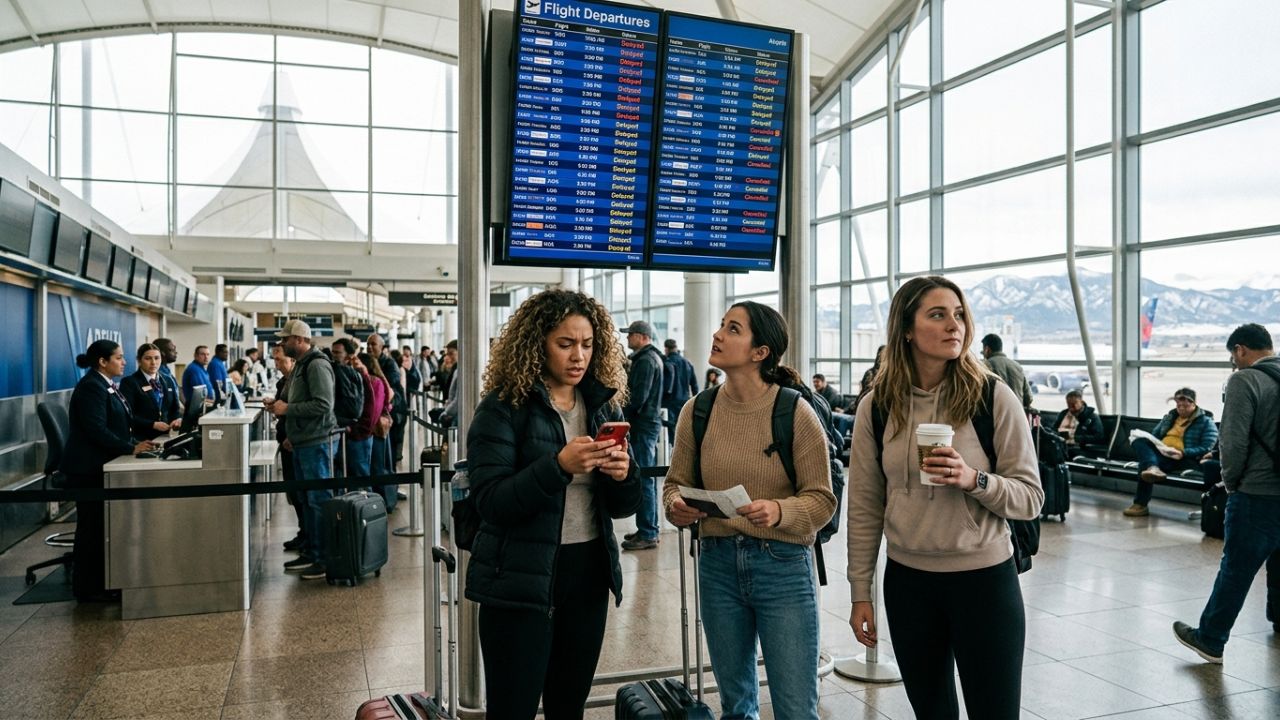
Image generated by AI
In a devastating operational breakdown that rapidly paralyzed one of the most critical transit hubs in the United States, massive, compounding travel chaos has violently engulfed Denver International Airport (DEN). Reported on June 20, 2026, hundreds of domestic and international travelers were left entirely stranded as the massive facility suffered a severe wave of rolling delays and sudden flight cancellations. With official data confirming exactly 316 flights delayed and 21 flights completely canceled, the immediate terminal gridlock heavily disrupted operations across a massive roster of carriers, including Southwest Airlines, American Airlines, Frontier Airlines, United Airlines, and Delta Air Lines. As the crisis severely impedes the flow of business travel and tourism linking major corridors like Dallas, Seattle, New York City, Cancún, and Montreal, the severe terminal gridlock explicitly highlights the extreme fragility of modern US aviation networks, dominating today's most crucial headline in breaking airline news and essential global aviation updates.
By introducing direct passenger coordination and dynamic scheduling backups, the regional aviation hubs target growing passenger demand across vital commerce sectors. The choice to coordinate flight departures in phases helps to manage gate capacity, supporting the country's broader regional transportation network.
Context: The Collapse of the Western Gateway
For the global aviation industry, the rapid operational collapse at Denver International Airport represents a nightmare scenario regarding the vulnerability of high-volume transfer hubs.
Historically, DEN serves as a massive, high-yield gateway connecting the western and central flight corridors of the United States. When the airport suffers from 316 delayed flights and 21 outright cancellations in a single operational cycle, the resulting travel chaos is instantaneous and financially devastating. The sheer volume of delayed outbound flights forces airlines to rapidly alter crew allocations and aircraft rotations, causing extended waiting periods for inbound traffic. The cancellations, in particular, force travelers to seek alternate flights during a peak travel period when load factors are historically high, meaning there are virtually zero empty seats available for immediate rebooking. Because aircraft and flight crews operate on highly interconnected schedules, these localized Denver disruptions are currently radiating outward, severely infecting operations across the entire North American continent, from anchorage to the Caribbean.
To view live flight schedules, verify the active departure status of your specific Denver itinerary, or to track potential route restorations, travelers must consult official aviation directories. For direct updates regarding how this massive operational failure impacts your current flight cancellations out of DEN, travelers should aggressively utilize the official portals of Southwest Airlines, United, and Frontier. To explore live flight tracking and monitor the exact severity of the cascading bottlenecks paralyzing the broader National Airspace System, passengers can consult the official FlightAware tracking service.
Section-Wise Breakdown: The Geographic Impact
Routes Destroyed by Outright Cancellations
The most severe damage to the travel network was inflicted upon high-frequency domestic trunk routes. Passengers attempting to fly out of Denver faced sudden, total flight cancellations on routes destined for Dallas, Seattle, Minneapolis, Indianapolis, Charlotte, and Austin. These outright cancellations instantly severed the connecting infrastructure, leaving business travelers and tourists completely stranded with no immediate path to their final destinations.
The Massive Blanket of Rolling Delays
While 21 flights were canceled, an astonishing 316 flights suffered severe, rolling delays. This massive blanket of operational friction impacted a staggering number of destinations, including Allentown, Albuquerque, Alliance, Atlanta, Asheville, Birmingham, Billings, Nashville, Burbank, Baltimore, Cedar Rapids, Columbus, Moab, Cody, Colorado Springs, Casper, Carlsbad, Des Moines, Detroit, El Paso, Fort Lauderdale, Hayden, Houston, Washington, Idaho Falls, Jackson, New York City, Las Vegas, Los Angeles, Little Rock, Midland, Kansas City, Orlando, Miami, Milwaukee, Minot, Monterey, Missoula, New Orleans, Montrose, Oakland, Oklahoma City, Omaha, Ontario, Chicago, North Bend, Portland, Philadelphia, Phoenix, Pittsburgh, Palm Springs, Rock Springs, Reno, Roswell, Fort Myers, San Diego, San Antonio, Santa Barbara, San Francisco, St George, Shreveport, San Jose, Salt Lake City, Sacramento, Santa Ana, Tampa, Tucson, Tulsa, and West Yellowstone.
International and Leisure Corridors Severed
The delays also violently impacted massive international and high-yield leisure routes. Passengers attempting to reach San José del Cabo, Cancún, Anchorage, Honolulu, Kauai, Maui, Montreal, Vancouver, Calgary, and Toronto found their vacation and international travel timelines completely destroyed by the Denver gridlock.
Technical Roster: The Cancellation Matrix
To ensure absolute factual accuracy regarding the exact severity of the terminal gridlock and the specific airlines forced into operational paralysis, the following matrix details the verified FlightAware disruption data:
Denver International Airport (DEN) Operational Disruption Matrix
| Airline | Cancelled | Cancelled (%) | Delayed | Delayed (%) |
|---|---|---|---|---|
| Southwest Airlines | 7 | 1% | 161 | 27% |
| American Airlines | 5 | 9% | 13 | 24% |
| Frontier Airlines | 4 | 2% | 14 | 8% |
| United Airlines | 3 | 0% | 66 | 9% |
| Delta Air Lines | 2 | 2% | 12 | 16% |
| AeroMéxico | 0 | 0% | 1 | 50% |
| Alaska Airlines | 0 | 0% | 2 | 9% |
| Lufthansa | 0 | 0% | 1 | 25% |
| Icelandair | 0 | 0% | 1 | 25% |
| JetBlue | 0 | 0% | 2 | 20% |
| Key Lime Air | 0 | 0% | 5 | 13% |
| Sun Country Airlines | 0 | 0% | 1 | 20% |
| SkyWest Airlines | 0 | 0% | 30 | 6% |
| Contour Airlines | 0 | 0% | 1 | 14% |
| WestJet | 0 | 0% | 1 | 50% |
| Allegiant Air | 0 | 0% | 2 | 33% |
| Air Canada | 0 | 0% | 3 | 25% |
Data strictly reflects the verified operational collapse reported on June 20, 2026. Southwest Airlines absorbed the heaviest impact, recording a massive 161 delayed flights, effectively crippling its Denver operations.
Passenger Impact: Stranded in the Mile High City
For the hundreds of travelers physically trapped inside the massively congested terminals of Denver International Airport, this operational breakdown triggered a highly stressful, financially devastating logistical nightmare.
The immediate passenger impact of these 316 rolling delays is complete schedule uncertainty and the total destruction of the connecting itinerary. When a passenger flying into DEN from a regional mountain airport experiences a delay, they cannot physically reach their massive widebody connection to London or Frankfurt. With the airport suffering from massive scheduling congestion, ground handling efficiency and gate turnaround times completely buckled under the pressure. Passengers faced grueling, extended waiting times, forced to stand in massive customer service lines simply to discover that their alternate flights were also delayed. This disruption severely impacted regional tourism flow through Colorado, resulting in ruined hotel bookings, expired ski-resort transport reservations, and massive rescheduling costs for corporate travelers who missed essential meetings in Seattle and New York.
Industry Analysis: The Fragility of the Super-Hub
Aviation analysts monitoring the severe travel chaos radiating out of Denver note that the sweeping delays highlight the extreme fragility of overlapping airline schedules at critical super-hubs.
Analysts emphasize that because the disruption was heavily distributed across multiple legacy and low-cost carriers (Southwest, United, Frontier), the root cause is inherently linked to systemic airport congestion. When travel demand remains incredibly strong during a peak period, a minor slowdown—whether caused by weather, air traffic control metering, or localized equipment maintenance—rapidly spirals. Because modern airlines operate with extremely tight turnaround times at the gate, a single delayed arrival instantly guarantees the aircraft will depart late for its next mission. With Southwest Airlines delaying 161 flights and United delaying 66 flights, the mathematical reality is that Denver's tarmac was simply too full to process aircraft efficiently, triggering a rolling delay effect that paralyzed the US travel system for the entire day.
Actionable Advice for Surviving Hub Cancellations
Because passengers cannot force airlines to operate canceled flights or control terminal congestion, you must execute this strategic survival checklist the exact second you learn your flight through Denver has been compromised:
- Never Wait in the Terminal Line: If your Southwest or United flight is abruptly canceled at DEN, absolutely do not join the massive, panicked line at the customer service desk. While you are standing in line, all the remaining available seats on alternate flights are being snatched up by proactive travelers. Immediately open the airline’s mobile app to rebook digitally, or call the international customer service number (e.g., the UK or Australian helpdesk) to bypass the overwhelmed US call centers.
- Know Your Rebooking Rights: Familiarize yourself completely with the airline’s specific Contract of Carriage. If the cancellation is deemed within their control, demand that they rebook you on a competing airline. Legacy carriers like United and American are often contractually obligated to endorse your ticket to a rival carrier if they cannot get you to your destination in a timely manner.
- Aggressively Seek Alternate Routing: If you are stranded in Denver trying to reach New York, do not passively accept a rebooking for 24 hours later. Actively search for alternate routings. Ask the agent to route you through a different mega-hub, such as flying DEN to Detroit (DTW) or Atlanta (ATL) to catch an alternate flight. Proposing a specific, viable alternative routing significantly speeds up the rebooking process.
FAQ: Denver Airport Flight Cancellations
Why are there massive delays at Denver International Airport?
On June 20, 2026, severe operational disruptions triggered a staggering 316 flight delays and 21 cancellations, driven by massive scheduling congestion and overwhelming traffic volume at the critical super-hub.
Which specific airlines were most impacted by the Denver disruptions?
Southwest Airlines absorbed the heaviest impact with 161 delays and 7 cancellations, followed closely by United Airlines (66 delays, 3 cancellations) and American Airlines (13 delays, 5 cancellations).
Did these localized cancellations affect other major US cities?
Yes. The massive volume of delays instantly destroyed connecting itineraries, heavily impacting major domestic corridors like Dallas, Seattle, New York City, and massive international routes to Cancún and Montreal.
The Reality of Navigating the Western Super-Hub
The sudden operational collapse at Denver International Airport proves definitively that the modern US aviation network is incredibly fragile, constantly teetering on the edge of severe travel chaos. By relying heavily on DEN to funnel massive domestic traffic across the western and central flight corridors, airlines ensure that a network-wide operational slowdown can instantly metastasize into a nationwide logistical nightmare. Yet, as travelers desperately attempt to navigate these highly congested terminals to salvage their itineraries, they must accept a critical new reality: surviving an airport meltdown requires extreme digital proactivity, a complete refusal to wait passively in customer service lines, and the tactical awareness to force airlines to provide alternate routing the exact second a rolling delay is announced.
Key Takeaways
- Massive Hub Disruption: Denver International Airport (DEN) suffered a severe operational breakdown on June 20, 2026, stranding hundreds of passengers.
- The Disruption Metrics: The airport officially recorded exactly 316 rolling flight delays and 21 total flight cancellations across multiple carriers.
- The Heavy Hitters: Southwest Airlines suffered catastrophic delays (161 flights), while American Airlines led outright cancellations (5 flights).
- Global Route Infection: The localized Colorado delays instantly destroyed connecting itineraries spanning Dallas, Seattle, New York, Montreal, and Cancún.
- Survival Strategy: Stranded passengers are advised to completely avoid physical customer service lines, rebooking instantly via airline apps or international call centers.
Related Travel Guides
Massive Travel Chaos Paralyzes Chicago O'Hare with 1,425 Disruptions
Disclaimer
This article is for informational and educational purposes only. It does not constitute legal, financial, or professional advice. While we strive to provide accurate and up-to-date information, travel policies, regulations, and conditions change rapidly. Always verify information with official sources before making travel decisions. Nomad Lawyer makes no representations about the accuracy, reliability, completeness, or suitability of the information provided. Readers should consult qualified professionals for advice specific to their circumstances. The views expressed in this article are those of the author and do not necessarily reflect the views of Nomad Lawyer.
Kunal K Choudhary
Co-Founder & Contributor
A passionate traveller and tech enthusiast. Kunal contributes to the vision and growth of Nomad Lawyer, bringing fresh perspectives and driving the community forward.
Learn more about our team →