
US Travel Chaos Ignites as Delta Flight DL2511 Executes Sudden Mid-Air Diversion to Augusta, Abandoning Atlanta Arrival
Breaking airline news: Delta Airlines Flight DL2511 suffers a sudden mid-air diversion to Augusta, plunging passengers into severe travel chaos hundreds of miles from Atlanta.

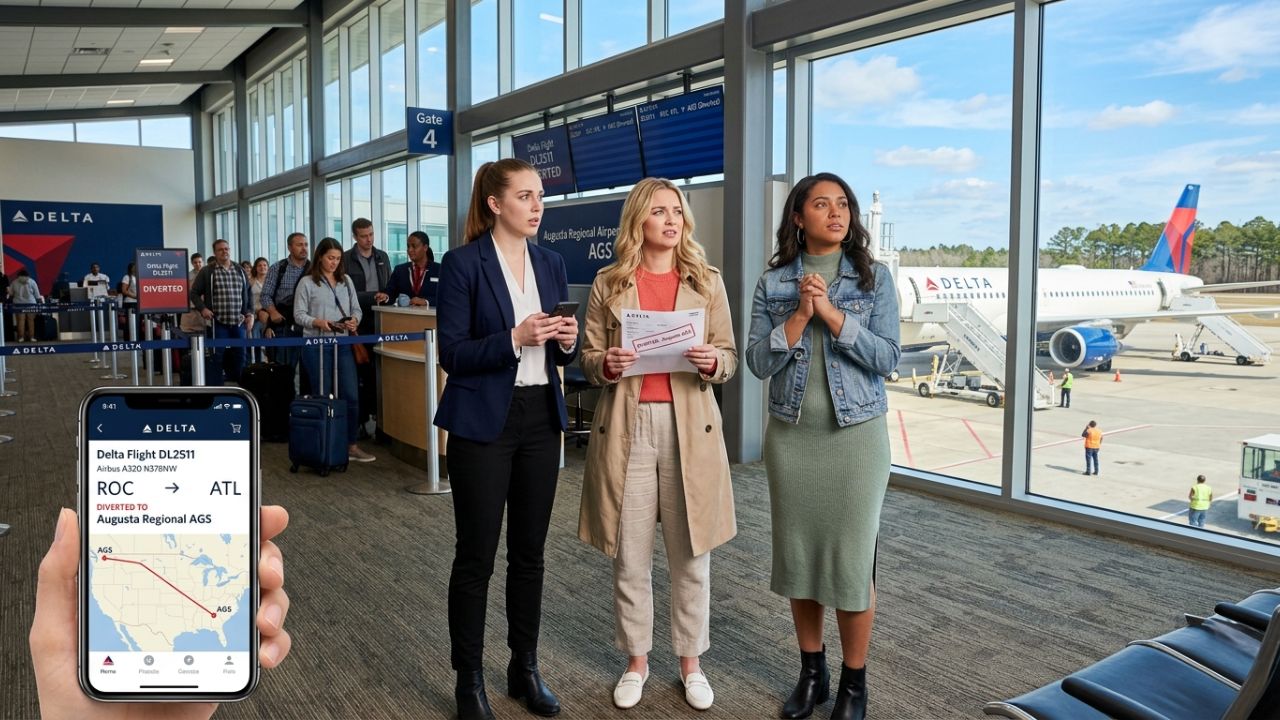
Image representing the highly disruptive mid-air diversion of Delta Airlines Flight DL2511, which abruptly landed at Augusta Regional Airport, triggering severe travel chaos for passengers bound for Atlanta. (Image Credit: Aviation Tracking)
US Travel Chaos Ignites as Delta Flight DL2511 Executes Sudden Mid-Air Diversion to Augusta, Abandoning Atlanta Arrival
A Routine Domestic Flight Spirals Into Severe Terminal Disruption
A completely routine domestic flight has abruptly transformed into a grueling logistical nightmare, triggering severe travel chaos for dozens of unsuspecting passengers. According to the latest breaking airline news, Delta Airlines Flight DL2511—an Airbus A320 operating a scheduled service from Rochester to Atlanta—was forced into a sudden, highly disruptive mid-air diversion. Instead of landing at the massive Hartsfield-Jackson International Airport hub, the aircraft’s flight path was abruptly altered mid-flight, forcing an unexpected landing at Augusta Regional Airport (AGS), hundreds of miles away from its intended destination. This abrupt deviation from the commercial flight plan has instantly plunged passengers into a state of severe terminal anxiety, exposing how rapidly a standard commercial journey can devolve into catastrophic airport disruptions.
This incident brutally exposes the underlying fragility of the domestic aviation network. While mid-air diversions are officially classified as standard precautionary safety protocols, the reality on the ground is pure logistical devastation. Passengers onboard the Airbus A320 were anticipating a straightforward 2:25 p.m. arrival into Atlanta, where the vast majority were likely booked on tight, high-stakes connecting flights across the Delta network. By touching down in Augusta, that entire connecting framework was instantly obliterated. As passengers wait for official clarification regarding the unconfirmed cause of the diversion, they are trapped in operational limbo, facing the immediate, terrifying threat of cascading flight cancellations and agonizing delays as the airline scrambles to regain control of the stranded aircraft.
Section-Wise Breakdown: The Anatomy of an In-Flight Diversion
The operational execution of this sudden diversion highlights the intense, high-speed decision-making required by flight crews when commercial flight plans collapse mid-air:
The Mid-Air Diversion Over Georgia According to recent aviation updates and live tracking data, the operational breakdown occurred while the aircraft was actively en route to Atlanta. Delta Flight DL2511, utilizing the callsign DAL2511, departed Rochester International Airport at 12:16 p.m.—a mere two minutes behind its scheduled 12:14 p.m. departure time. The flight appeared completely routine until tracking systems identified a radical deviation from the filed flight path. Without public warning, the Airbus A320 was redirected by air traffic control toward Augusta Regional Airport. While the exact trigger—whether severe localized weather, a sudden medical emergency, crippling ATC congestion at Atlanta, or an unannounced technical irregularity—remains officially unconfirmed, the immediate consequence was severe travel chaos. The aircraft successfully landed safely in Augusta, but the operational damage to the passengers' itineraries was already catastrophic.
Unraveling the Flight Data The aircraft operating this heavily disrupted service was an Airbus A320, bearing the registration N378NW. As one of the most heavily utilized narrow-body aircraft in the Delta fleet, its sudden diversion represents a significant disruption to the carrier's daily equipment rotations. When an aircraft of this size is grounded at a secondary diversion airport rather than its primary hub, it causes a massive ripple effect across the network. The aircraft is now out of position, meaning whatever flight it was scheduled to operate next out of Atlanta will almost certainly face severe delays or outright flight cancellations. This highlights how a single, isolated mid-air diversion can rapidly metastasize, spreading airport disruptions across multiple states.
Surviving the Diversion Meltdown Inside the cabin, the psychological toll of a sudden diversion is immense. Passengers who were preparing for final descent into Atlanta were instead informed they were landing in Augusta. This instantly triggers mass anxiety regarding missed connections, lost baggage, and shattered travel plans. Airline operational control centers are now forced to execute massive triage. They must determine if the aircraft can be rapidly refueled and cleared to continue to Atlanta, or if the passengers must be forcefully deplaned into the Augusta terminal. If the aircraft requires extended technical inspection or the crew times out, passengers face the grueling reality of being bussed across Georgia or stranded overnight, trapped in the epicenter of localized travel chaos.
Operational Infrastructure Details: The Flight Diversion Matrix
To provide exact, factual clarity on the operational data surrounding this mid-air disruption, aviation analysts have mapped the specific flight parameters. The following factual matrix details the precise breakdown of the Delta Flight DL2511 diversion:
Factual Delta Flight DL2511 Diversion Matrix
| Strategic Flight Element | Operational & Tracking Specification |
|---|---|
| Operating Airline | Delta Air Lines |
| Flight Number / Callsign | DL2511 / DAL2511 |
| Aircraft Type & Registration | Airbus A320 (Registration: N378NW) |
| Scheduled Route | Rochester International Airport to Atlanta Hartsfield-Jackson |
| Departure Time | 12:16 p.m. (Scheduled: 12:14 p.m.) |
| Intended Arrival Time | 2:25 p.m. (Atlanta) |
| Emergency Diversion Point | Augusta Regional Airport (AGS) |
Passenger Impact: The Brutal Reality of Missed Connections
For the passengers trapped aboard Delta Flight DL2511, surviving the safe but unexpected landing in Augusta was only the beginning of a massive logistical nightmare. Atlanta Hartsfield-Jackson is the busiest connecting hub on the planet. By failing to reach this massive distribution node, dozens of passengers instantly missed their onward flights to domestic and international destinations. The resulting airport disruptions are catastrophic for the individual traveler. Families attempting to reach cruise ports and business travelers racing to critical meetings are now entirely at the mercy of Delta's rebooking system. If the airline cannot quickly extract the aircraft from Augusta, these passengers face days of cascading delays, forced hotel stays, and the agonizing friction of navigating a fractured travel itinerary.
Industry Analysis: The Systemic Threat of Diversions
The global aviation sector is incredibly resilient, but it is heavily dependent on absolute predictability. While diversions to alternate airports like Augusta Regional are vital, standardized safety protocols, they are massive catalysts for systemic travel chaos. When a primary hub like Atlanta is bypassed, it proves that the airline's operational control center determined that continuing to the destination posed an unacceptable risk—whether due to weather, mechanical issues, or passenger health. However, the subsequent recovery process brutally exposes the lack of redundancy in the modern aviation grid. Stranded aircraft require specialized maintenance and replacement crews that are rarely stationed at regional diversion airports, guaranteeing extended, agonizing delays for the stranded passengers.
Conclusion: A Sudden Fracture in the Domestic Network
The sudden mid-air diversion of Delta Airlines Flight DL2511 from its Atlanta destination to Augusta Regional Airport serves as a stark reminder of the absolute volatility of modern commercial flight. By suffering an unexpected operational deviation, the Airbus A320 plunged its passengers into deep travel chaos, instantly destroying tightly choreographed connecting itineraries. Leveraging established safety protocols, the flight crew successfully secured the aircraft on the ground in Augusta, prioritizing passenger safety above all else. However, the subsequent logistical meltdown brutally highlights how rapidly a routine domestic flight can unravel, triggering severe airport disruptions and the terrifying threat of cascading flight cancellations across the Delta network.
Key Takeaways
- Sudden Mid-Air Diversion: Delta Flight DL2511 was abruptly diverted mid-flight while en route to Atlanta Hartsfield-Jackson.
- Augusta Grounding: The Airbus A320 made an unexpected, unplanned landing at Augusta Regional Airport (AGS).
- Aircraft Details: The affected flight was operated by an Airbus A320, bearing registration N378NW and callsign DAL2511.
- Unconfirmed Cause: The exact operational trigger—whether weather, medical, ATC, or technical—remains officially unconfirmed by the airline.
- Massive Network Friction: The diversion instantly triggered severe travel chaos, virtually guaranteeing missed connections for passengers bound for the Atlanta mega-hub.
✈️ Frequently Asked Questions (Factual Aviation Data)
What happened to Delta Airlines Flight DL2511? The flight was suddenly diverted mid-air and forced to make an unexpected landing at Augusta Regional Airport instead of reaching its scheduled destination.
What was the intended destination of the flight? The aircraft was operating a scheduled domestic service from Rochester International Airport to Atlanta Hartsfield-Jackson International Airport.
What type of aircraft was operating the diverted flight? The flight was operated by an Airbus A320, an extremely common narrow-body passenger aircraft, carrying the registration N378NW.
When did the flight depart Rochester? Tracking data shows the flight departed Rochester at 12:16 p.m., just two minutes behind its scheduled 12:14 p.m. departure time.
When was the flight supposed to arrive in Atlanta? The original scheduled arrival time at the Atlanta hub was 2:25 p.m.
Why was the flight diverted to Augusta? The exact cause of the diversion has not been publicly confirmed by Delta Air Lines. Diversions can occur due to adverse weather, medical emergencies, technical inspections, or severe airport congestion.
Where was this aviation tracking data officially sourced from? The strategic incident details regarding the diversion of Delta Flight DL2511 were sourced from live aviation tracking systems and industry reporting.
🌍 Related Travel Guides & Flight Resources
- Navigate Airport Disruptions Like a Pro Master the art of surviving unexpected travel chaos with our expert strategies.
- Breaking Airline News & Evasion Routes Stay ahead of the delays with our real-time aviation updates and route intelligence.
- Global Flight Cancellation Defense Grid Essential legal rights and compensation tactics when your flight goes down.
⚖️ Disclaimer
The aviation safety statistics, flight tracking data, and mid-air diversion reports provided in this report are for informational purposes only. Aircraft emergency responses, specific details regarding the Delta Flight DL2511 (Airbus A320, Registration N378NW) diversion to Augusta Regional Airport, and the subsequent operational recovery timeline are highly volatile and subject to ongoing review by airline operational control centers. All data regarding the flight deviation has been officially sourced from live aviation tracking platforms as of June 2026, and remains completely fluid as formal causes are confirmed. NomadLawyer does not guarantee the absolute accuracy or current validity of the information provided and assumes no liability for travel disruptions, sudden flight cancellations, missed connections in Atlanta, altered itineraries, or any financial consequences resulting from the use of this content. Passengers affected by the diversion are strongly advised to coordinate directly with Delta Air Lines for rebooking and compensation.
Disclaimer
This article is for informational and educational purposes only. It does not constitute legal, financial, or professional advice. While we strive to provide accurate and up-to-date information, travel policies, regulations, and conditions change rapidly. Always verify information with official sources before making travel decisions. Nomad Lawyer makes no representations about the accuracy, reliability, completeness, or suitability of the information provided. Readers should consult qualified professionals for advice specific to their circumstances. The views expressed in this article are those of the author and do not necessarily reflect the views of Nomad Lawyer.
Kunal K Choudhary
Co-Founder & Contributor
A passionate traveller and tech enthusiast. Kunal contributes to the vision and growth of Nomad Lawyer, bringing fresh perspectives and driving the community forward.
Learn more about our team →