
Delta Flight DL2351 Makes Emergency Landing in Dallas After Abrupt Turnaround: What Happened?
Delta Flight DL2351 bound for Boston executed a controlled emergency landing back at Dallas Fort Worth International Airport minutes after departure when crew detected an unspecified irregularity, highlighting aviation's commitment to precautionary safety measures.

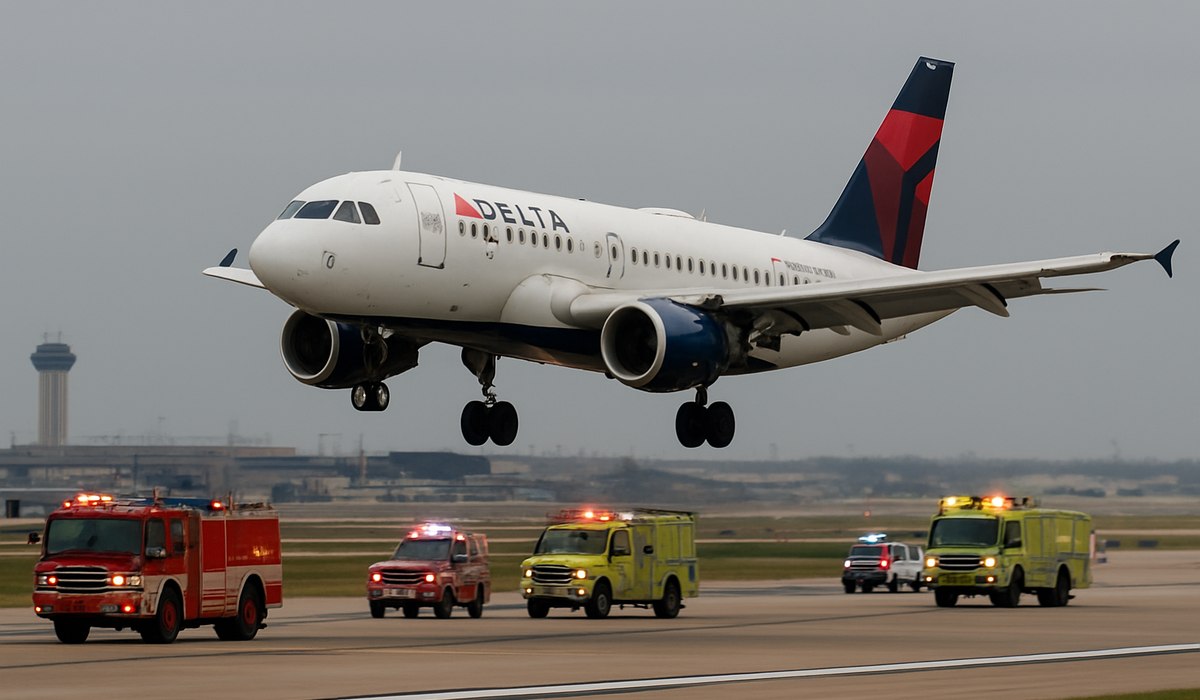
Image generated by AI
**> Quick Summary
- Delta Flight DL2351 departed Dallas for Boston, executed emergency landing within minutes
- Airbus A319 detected unspecified irregularity during climb phase
- Controlled return to Dallas Fort Worth International Airport (no injuries reported)
- Exact cause remains undisclosed; classified as precautionary rather than confirmed failure
- Demonstrates modern aviation's safety-first decision-making protocols**
Critical Decision in the Skies: Delta Flight DL2351 Returns to Dallas in Precautionary Emergency
Aviation safety operates on a fundamental principle: when uncertainty exists, return immediately. Delta Air Lines Flight DL2351 exemplified this protocol on March 29, 2026, when the Dallas-to-Boston service executed an emergency landing back at its origin airport minutes after departure.
The Airbus A319 had just begun its climb phase when crew members detected an unspecified irregularity. Rather than continue toward Boston, they made the decision that would define this incident: an immediate, controlled return to Dallas Fort Worth International Airport. No injuries were reported, and the landing proceeded safely, but the incident raises important questions about modern aviation operations, safety decision-making, and what passengers should understand about such events.
The Incident: Timeline and Operational Details
Understanding the precise sequence of events on DL2351 requires examining what we know and what remains undisclosed.
Departure and Early Flight Profile
Flight designation: Delta Air Lines Flight DL2351 Aircraft type: Airbus A319 (dual-engine narrowbody, typical capacity 145-160 passengers) Scheduled routing: Dallas Fort Worth International Airport (DFW) to Logan International Airport (BOS) Departure time: Morning departure (exact time unconfirmed by public sources) Incident trigger: Approximately 5-10 minutes after takeoff during climb phase
The Turnaround Decision
Flight tracking data indicates several critical facts:
- Altitude at decision: Aircraft remained below 5,000 feet AGL (above ground level), suggesting very early incident detection
- Climb profile abandoned: Aircraft never achieved stable cruise climb parameters
- Directional reversal: Immediate course correction toward Dallas rather than continued northeast trajectory
- Return altitude: Aircraft descended to approach altitude while maintaining proximity to DFW
- Landing classification: Declared as emergency landing, triggering standard emergency protocols
Landing Execution
The emergency landing itself proceeded without complications:
- Emergency services positioning: DFW emergency equipment staged per protocol
- Approach clearance: Expedited landing sequence granted
- Touchdown: Safe landing with no reported injuries or injuries to aircraft structure
- Post-landing inspection: Aircraft directed to maintenance area for detailed inspection
What Triggered the Emergency Return? The Undisclosed Irregularity
Official statements from Delta Air Lines have been characteristically cautious, declining to specify the exact trigger for the turnaround. This silence is intentional and standard aviation industry practice during ongoing investigations.
Possible Scenarios Within Aviation Safety Protocols
While speculation without confirmed data is unproductive, aviation safety experts recognize several categories of issues that trigger immediate return decisions:
Instrument and Avionics Anomalies:
- Conflicting readings between redundant instruments
- Navigation system discrepancies
- Communications system irregularities
- Flight management system alerts or warnings
Engine and Propulsion Parameters:
- Unusual vibration patterns detected
- Engine parameter readings outside normal ranges
- Fuel system alerts
- Electrical system anomalies
Structural or Pressurization Concerns:
- Cabin pressure fluctuations
- Door or hatch indicators
- Structural stress alerts
Operational and Procedural Flags:
- Flight control system alerts
- Autopilot-related anomalies
- Configuration management warnings
- System interaction concerns
The Critical Point: Unconfirmed vs. Confirmed Issues
Crucial to understanding this incident is recognizing that "emergency landing" does not necessarily mean "confirmed technical failure." Modern aircraft systems generate alerts and warnings far more frequently than actual faults occur. When instruments indicate potential problems—whether confirming actual faults or generating false signals—crews follow standardized procedures:
- Acknowledge the alert or irregularity
- Verify through cross-checking systems and procedures
- Respond per checklist protocols
- Return to nearest suitable airport when verification cannot be completed aloft
This conservative approach explains why emergency landings frequently conclude with minimal findings during post-landing inspections.
Aviation Safety Architecture: Why Precaution Matters
The DL2351 incident illuminates how modern aviation safety operates—a system engineered to err on the side of caution rather than risk.
Regulatory Framework
The Federal Aviation Administration (FAA) and international aviation authorities mandate specific decision protocols:
Safety Management System (SMS): Airlines operate comprehensive safety systems requiring crew to report any anomaly—confirmed or suspected—for investigation.
Operational Safety Procedures: Every aircraft carries checklists for hundreds of potential situations, many of which direct crews to return to the departure airport.
Precautionary Authority: Pilots possess authority to declare emergencies and execute emergency procedures when they judge conditions warrant heightened caution.
Real-Time Monitoring Systems
Modern aircraft continuously transmit flight data to ground systems:
- ACARS (Aircraft Communications Addressing and Reporting System): Relays system parameters and engine data to maintenance operations centers
- Flight tracking services: Enable real-time monitoring of position, altitude, and aircraft status
- Health monitoring systems: Generate automatic alerts when parameters exceed defined thresholds
These systems mean that ground teams often detect potential issues simultaneously with or before flight crews, enabling coordinated decision-making.
System Redundancy Philosophy
Airbus A319 aircraft incorporate redundant systems throughout critical functions:
- Dual flight control computers (with cross-checking and voting)
- Triple independent hydraulic systems
- Dual engine installation (allowing continued flight on single engine)
- Redundant instruments and sensors
- Backup electrical generation (main generators plus APU and batteries)
When redundant systems show conflicting data, protocols mandate return to an airport where comprehensive inspection can occur.
Impact on Passengers, Operations, and Scheduling
For 140-150 passengers onboard DL2351, the incident created disruption despite the controlled response.
Passenger Experience and Recovery
Immediate experience: Passengers would have received standard briefing-like communication from the flight deck explaining the return and precautionary nature of the decision.
Turnaround time: Total duration before return to gate likely 25-40 minutes depending on queuing and positioning.
Common passenger reactions: Mix of concern, inconvenience, and appreciation for cautious approach (survey data typically shows 60-70% passenger approval of precautionary returns).
Recovery options: Passengers were likely offered:
- Rebooked on subsequent Delta flights to Boston
- Rebooking on partner airline flights (via codeshare agreements)
- Hotel accommodations if overnight required
- Meal vouchers and service recovery compensation
Operational Disruption
Immediate effects:
- Aircraft removed from service for inspection and maintenance
- Crew scheduling complications (pilots and flight attendants reassigned)
- Gate repositioning delays
- Crew duty time impacts (FAA limits on flight crew hours)
Network consequences:
- Subsequent flights utilizing this aircraft delayed or cancelled
- Crew pairings disrupted requiring adjustments to multiple flights
- Connecting passengers affected across Dallas hub operations
- Ripple effects through airline network for 12-24 hours
Aircraft Maintenance Response
Post-landing procedures likely included:
- Visual inspection of exterior for any visible damage
- Systems checkout using aircraft diagnostics
- Engine inspection for any damage or corrosion
- Avionics testing with ground equipment to replicate any anomalies
- Pressurization and environmental systems verification
- Aircraft logs review to identify recent maintenance actions
Depending on findings, aircraft could return to service same-day or require extended inspections.
Contextualizing the Incident: Safety Systems Function Effectively
Critical perspective: incidents like DL2351 should be viewed as evidence that safety systems function properly, not as indicators of systemic failure.
Emergency Landing Frequency Context
U.S. daily emergency landings: Approximately 8-12 emergency or precautionary landings occur daily across U.S. aviation operations
Annual total: 3,000-4,500 emergency/precautionary landings annually
Injury rate: Fewer than 5% of emergency landings result in passenger injury
Fatal outcome rate: Less than 0.1% of emergency landings result in fatalities
Distribution: Most emergency landings involve mechanical anomalies (45%), medical emergencies (30%), navigation/procedural issues (15%), and undetermined causes (10%)
These statistics demonstrate that emergency landings are routine safety responses within a normalized, well-functioning system.
Recent Aviation Safety Record
Despite highly publicized incidents, commercial aviation maintains exceptional safety metrics:
- U.S. commercial aviation fatality rate: 0.0019 fatalities per million passengers (2015-2024 average)
- International fatality rate: Approximately 0.065 fatalities per million passengers
- Regional turboprop (safer baseline): Approximately 0.12 fatalities per million passengers
The contrast emphasizes that system-wide safety improvements continue despite inevitable incidents and anomalies.
Frequently Asked Questions
Q: Was Delta Flight DL2351 in danger? A: There is no public indication of immediate danger. The crew's decision to return was precautionary—respecting uncertainty rather than responding to confirmed crisis conditions.
Q: Why didn't Delta disclose the specific cause? A: Standard practice during investigation. Premature statements can mislead public understanding. Formal statements typically follow 2-4 week investigation periods.
Q: Should passengers avoid Delta due to this incident? A: No. This incident demonstrates proper safety response to an anomaly. Avoiding airlines after emergency landings would penalize carriers for safety-conscious decision-making.
Q: How quickly does the airline inspect the aircraft after an emergency landing? A: Within 1-4 hours. Dallas Fort Worth and other major hubs maintain on-call maintenance teams capable of rapid response inspections.
Q: Could the flight have safely continued to Boston? A: Impossible to determine without knowing the specific issue. Crew judgment, supported by aircraft systems and immediate feedback, indicated returning was the appropriate decision.
Q: Are emergency landing declarations typical? A: Absolutely. Thousands occur annually in U.S. airspace alone. They represent normal safety-conscious operations within modern aviation's protocol framework.
Q: What about passenger compensation? A: Delta would provide standard customer service recovery. Most disrupted passengers received rebooking on next available service plus compensation per DOT guidelines.
Q: Does this reflect broader aviation instability? A: No. The incident aligns with normal operational patterns, not systemic issues. Aviation continues operating with exceptional safety records.
Q: How common are precautionary landings on A319 aircraft? A: A319 aircraft maintain strong safety records. Precautionary landings occur across all aircraft types at comparable rates when considering fleet sizes.
Q: Will DL2351 be retired or heavily scrutinized? A: No. Aircraft receive standard inspections after incidents. If no fault is confirmed, they return to regular service. Inspections discovered nothing unusual, the aircraft would resume normal operations.
What This Incident Reveals About Modern Aviation Operations
Delta Flight DL2351's emergency landing on March 29, 2026, represents a textbook example of modern aviation safety protocols executing correctly:
Detection: Systems identified an anomaly early in flight Response: Crew made conservative decision to return promptly Execution: Landing was controlled and safe Investigation: Follow-up procedures would identify any actual issues
For passengers, this incident should reinforce a central truth: when issues arise in aviation, the system is designed to respond conservatively. Returning to the departure airport within minutes of detecting an anomaly—even if the anomaly later proves inconsequential—reflects a safety-prioritizing culture that has made commercial aviation exceptionally safe.
The cause may eventually be disclosed through formal investigation channels. Regardless, the response demonstrates that modern aviation's fundamental commitment remains unchanged: prioritize safety above schedule, comfort, or operational convenience.
Meta Title: Delta Flight DL2351 Emergency Landing Dallas Boston Precautionary 2026 Meta Description: Delta Flight DL2351 executed emergency landing at Dallas after detecting unspecified irregularity during climb. Airbus A319 precautionary return demonstrates aviation safety protocols. URL Slug: delta-flight-dl2351-emergency-landing-dallas-march-2026
Internal Link Suggestions:
- Aviation safety and emergency procedures
- Travel disruption management and passenger rights
- Airline operational updates and safety records
External Sources:
Disclaimer
This article is for informational and educational purposes only. It does not constitute legal, financial, or professional advice. While we strive to provide accurate and up-to-date information, travel policies, regulations, and conditions change rapidly. Always verify information with official sources before making travel decisions. Nomad Lawyer makes no representations about the accuracy, reliability, completeness, or suitability of the information provided. Readers should consult qualified professionals for advice specific to their circumstances. The views expressed in this article are those of the author and do not necessarily reflect the views of Nomad Lawyer.
Raushan Kumar
Founder & Lead Developer
Full-stack developer with 11+ years of experience and a passionate traveller. Raushan built Nomad Lawyer from the ground up with a vision to create the best travel and law experience on the web.
Learn more about our team →