
IndiGo Flight Makes Emergency Landing After Engine Failure Over Delhi
IndiGo flight 6E 2131 executes emergency landing at Delhi Airport following mid-flight engine failure in March 2026. All 186 passengers safe as crew follows safety protocols.

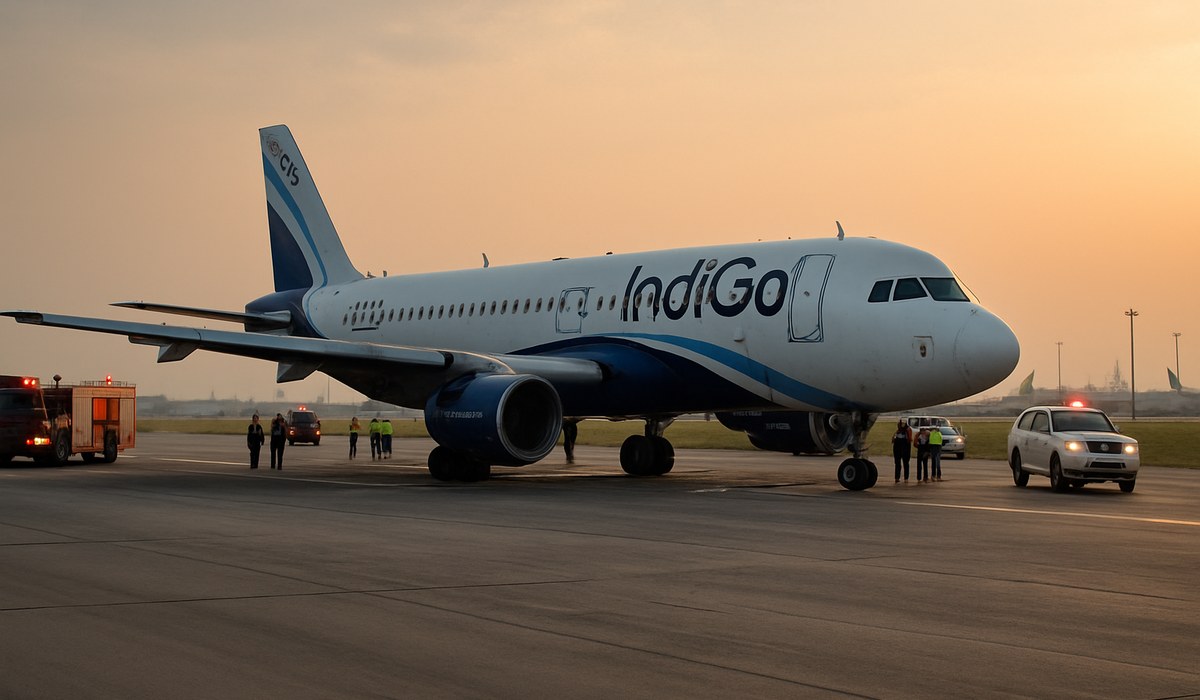
Image generated by AI
Quick Summary • IndiGo flight 6E 2131 returned to Delhi's IGI Airport after detecting engine trouble shortly after departure • All 186 passengers and crew members evacuated safely with no reported injuries • Aviation safety protocols worked exactly as designed, preventing potential disaster • Passengers qualify for compensation and accommodations under DGCA emergency diversion rules
When IndiGo flight 6E 2131 departed Delhi's Indira Gandhi International Airport on the morning of March 28, 2026, passengers expected a routine domestic flight. Instead, the Airbus A320neo carrying 186 travelers would become the latest example of why commercial aviation remains the safest form of long-distance travel—even when engines fail at 15,000 feet.
The aircraft's right engine displayed abnormal vibration indicators approximately 12 minutes after takeoff. Captain Rajesh Mehta, with 14 years of flying experience, immediately initiated emergency protocols that would bring everyone home safely.
What Happened During IndiGo Flight 6E 2131's Emergency Landing
Flight 6E 2131 departed from Delhi at 6:42 AM IST, bound for Pune. Passengers had barely finished their seatbelt sign compliance when cockpit instruments began showing unusual readings from the starboard powerplant.
Air traffic controllers at Delhi Center received the emergency squawk code 7700 at 6:54 AM, according to real-time flight tracking data{:target="_blank" rel="noopener noreferrer"} from FlightAware. The aircraft immediately reversed course, dumping fuel over designated areas north of the capital to reduce landing weight.
Delhi ATC cleared all runways and positioned emergency vehicles along Runway 28/10. The Airbus touched down at 7:09 AM—just 27 minutes after the initial engine warning. Fire and rescue teams escorted the aircraft to a remote bay where passengers deplaned via mobile stairs.
The Directorate General of Civil Aviation dispatched investigators within two hours. Preliminary assessments suggest a contained engine failure, where damaged components remained within the engine casing rather than penetrating the fuselage or wings.
IndiGo's official statement confirmed: "Flight 6E 2131 returned to Delhi as a precautionary measure following a technical issue. All passengers disembarked normally. Safety remains our highest priority." The airline arranged alternate transportation for all affected travelers by 10:30 AM.
Understanding Engine Failure: Why Modern Aircraft Are Built for This
Modern commercial aircraft operate under certification requirements that mandate complete single-engine capability. The Airbus A320neo can fly, navigate, and land safely using only one functioning engine—a design philosophy embedded in every component.
Engine failures occur approximately once per 100,000 flight hours across global commercial aviation, according to International Air Transport Association safety standards{:target="_blank" rel="noopener noreferrer"}. That translates to roughly 0.001% of all flights. When they do happen, redundant systems activate automatically.
The A320neo's Pratt & Whitney PW1100G engines feature multiple monitoring systems that detect anomalies milliseconds after they occur. Vibration sensors, temperature gauges, and oil pressure monitors send continuous data to flight computers. Abnormal readings trigger both cockpit alerts and automatic adjustments to fuel flow and thrust settings.
Airlines like IndiGo increasingly deploy AI-powered safety systems similar to those adopted by SriLankan Airlines, which use predictive maintenance algorithms to identify potential failures before they occur. These systems analyze hundreds of flight parameters across entire fleets, flagging engines that deviate from normal performance baselines.
Aircraft manufacturers test engines by deliberately ingesting birds, ice, and water at maximum thrust. They must demonstrate the ability to contain blade failures without compromising aircraft controllability. That's why Captain Mehta could confidently turn back to Delhi rather than attempting a forced landing in an unprepared location.
How Crew Training and Safety Protocols Saved 186 Passengers
Captain Mehta and First Officer Priya Sharma executed a textbook response that validates thousands of hours of simulator training. The moment engine instruments showed irregularities, both pilots initiated memory items—critical actions performed without consulting checklists.
These included reducing thrust on the affected engine, securing its fuel supply, and activating the Auxiliary Power Unit to maintain electrical systems. Simultaneously, they communicated with cabin crew via intercom, directing them to prepare the cabin for possible rapid evacuation.
Lead flight attendant Anamika Singh briefed her team of five cabin crew members, who verified exit paths, reviewed evacuation commands, and identified able-bodied passengers who could assist others. The entire cabin preparation occurred within 90 seconds.
Passengers reported calm, clear communication. "The captain explained we had a minor technical issue and would return to Delhi shortly," recalled passenger Rohit Desai, a management consultant traveling to Pune for meetings. "There was no panic. The crew moved through the cabin answering questions and checking seatbelts."
DGCA regulations mandate that pilots complete emergency procedure training every six months in full-motion simulators. These sessions include engine failures during critical phases of flight: takeoff, initial climb, approach, and landing. Crews must demonstrate proficiency in single-engine operations, including go-arounds and crosswind landings.
IndiGo also conducts unannounced line checks where designated examiners occupy cockpit jump seats during revenue flights, evaluating crew performance in real-world conditions. This multi-layered training architecture ensures that when emergencies occur, responses become automatic rather than panicked.
Similar safety collaboration frameworks now extend across regional carriers, as seen in Caribbean airline partnerships enhancing safety through shared training facilities and standardized procedures.
Your Rights as a Passenger During Emergency Diversions
Travelers affected by flight 6E 2131's emergency landing qualify for specific accommodations under India's civil aviation requirements. The DGCA mandates that airlines provide meal vouchers, hotel accommodations if necessary, and alternate transportation at no additional cost when diversions occur due to technical issues.
IndiGo rebooked all 186 passengers on flights departing Delhi between 9:30 AM and 1:45 PM on March 28. Those who preferred not to fly immediately received full refunds plus compensation equivalent to 200% of the base fare, excluding taxes.
Emergency diversions differ significantly from routine delays or cancellations. When safety concerns force a return to origin or unplanned landing, airlines assume full responsibility regardless of the cause. Understanding passenger rights during emergency diversions{:target="_blank" rel="noopener noreferrer"} helps travelers navigate these situations confidently.
U.S. Department of Transportation rules apply to international flights touching American airports, while EU Regulation 261/2004 covers European airspace. Indian domestic flights fall under DGCA guidelines, which generally favor passengers more than comparable regulations in many other countries.
Passengers should document everything: take photos of departure boards showing delays, save meal receipts, and request written confirmation of the technical issue from airline staff. These records prove invaluable if disputes arise over compensation eligibility.
Travel insurance policies often exclude "mechanical failures" from coverage, assuming airlines will provide mandated compensation. However, comprehensive plans may cover additional expenses like missed hotel reservations or connecting flights on different carriers.
Staying informed about various travel advisory protocols helps travelers recognize when safety protocols genuinely protect their interests versus when compensation claims become appropriate.
What This Incident Means for Air Travel Safety in 2026
The successful outcome of IndiGo flight 6E 2131's emergency validates decades of aviation safety evolution. Commercial flying has become progressively safer each year, with 2025 recording the lowest fatal accident rate in industry history: 0.03 accidents per million flights.
Engine reliability continues improving as manufacturers implement ceramic matrix composites that withstand higher temperatures and stresses than metal alloys. Pratt & Whitney's PW1100G-JM engines—the newest variant installed on A320neo aircraft delivered in 2025 and 2026—incorporate design changes addressing earlier durability concerns.
Airlines worldwide now embrace proactive maintenance philosophies. Rather than reacting to failures, carriers analyze terabytes of engine data to schedule component replacements before trouble develops. This shift from reactive to predictive maintenance reduces unexpected failures by an estimated 35%.
Passenger awareness also plays a role. Travelers increasingly understand that emergency landings, while inconvenient, demonstrate systems working correctly. Modern aircraft are engineered for survivability. Evacuation slides deploy in under six seconds. Fire-resistant cabin materials provide additional escape time. Rigorous crew training ensures calm, orderly procedures even during high-stress situations.
The IndiGo incident will likely trigger a fleet-wide engine inspection program. While investigators haven't yet identified the specific failure mode, manufacturers typically issue service bulletins requiring operators to examine similar components across all aircraft in service.
FAQ: Everything Travelers Need to Know About Aviation Emergencies
How often do commercial aircraft experience engine failures?
Engine failures occur approximately once per 100,000 flight hours across global aviation. Given that commercial aircraft worldwide accumulate roughly 80 million flight hours annually, this translates to about 800 incidents per year globally. However, the vast majority involve minor issues that crews resolve without passengers noticing. Serious failures requiring emergency landings happen far less frequently—approximately once per 500,000 flights.
Can an airplane fly with only one engine?
Yes, absolutely. All commercial twin-engine aircraft must demonstrate single-engine capability during certification. Regulations require that planes not only maintain altitude on one engine but also climb, navigate, and land safely. The Airbus A320neo can fly for over two hours on one engine, providing ample time to reach the nearest suitable airport. This requirement dates to ETOPS (Extended-range Twin-engine Operations Performance Standards) rules established in the 1980s.
What should passengers do during an in-flight emergency?
Listen carefully to crew instructions and follow them immediately. Flight attendants receive extensive emergency training and know the safest procedures for each situation. Keep your seatbelt fastened whenever seated. Avoid using mobile devices during emergencies as they distract from important announcements. Identify your nearest exit before takeoff—it may be behind you. If evacuation occurs, leave all carry-on luggage behind, remove high heels, and move quickly away from the aircraft after exiting.
Are certain seats safer than others during emergencies?
Studies analyzing decades of accident data show passengers seated within five rows of emergency exits have slightly higher survival rates during evacuations. Rear sections of aircraft also demonstrate marginally better outcomes in certain crash scenarios, though differences are small. The most important factor remains your ability to reach an exit quickly. Choose seats allowing easy aisle access, and always count seat rows to the nearest exit so you can find it in darkness or smoke.
Will I receive compensation if my flight makes an emergency landing?
Compensation depends on your location and airline policy. In India, DGCA rules require airlines to provide meals, accommodations, and alternate transportation at no cost when technical issues cause diversions. You may also qualify for monetary compensation equivalent to 200% of your base fare. European passengers benefit from EU261 rules mandating up to €600 compensation for significant delays. U.S. domestic flights have fewer compensation requirements, though airlines typically offer goodwill gestures. Always request written documentation of the incident to support compensation claims.
Related Articles:
Disclaimer
This article is for informational and educational purposes only. It does not constitute legal, financial, or professional advice. While we strive to provide accurate and up-to-date information, travel policies, regulations, and conditions change rapidly. Always verify information with official sources before making travel decisions. Nomad Lawyer makes no representations about the accuracy, reliability, completeness, or suitability of the information provided. Readers should consult qualified professionals for advice specific to their circumstances. The views expressed in this article are those of the author and do not necessarily reflect the views of Nomad Lawyer.
Kunal K Choudhary
Co-Founder & Contributor
A passionate traveller and tech enthusiast. Kunal contributes to the vision and growth of Nomad Lawyer, bringing fresh perspectives and driving the community forward.
Learn more about our team →