
American Airlines Flight AA1360: Emergency Diversion from Chicago to Pittsburgh After Mid-Flight Mechanical Issue
An American Airlines Boeing 737-800 en route from Chicago O'Hare to Pittsburgh made an urgent emergency landing in Chicago after detecting a critical mechanical issue mid-flight. All 156 passengers and crew were safely evacuated.

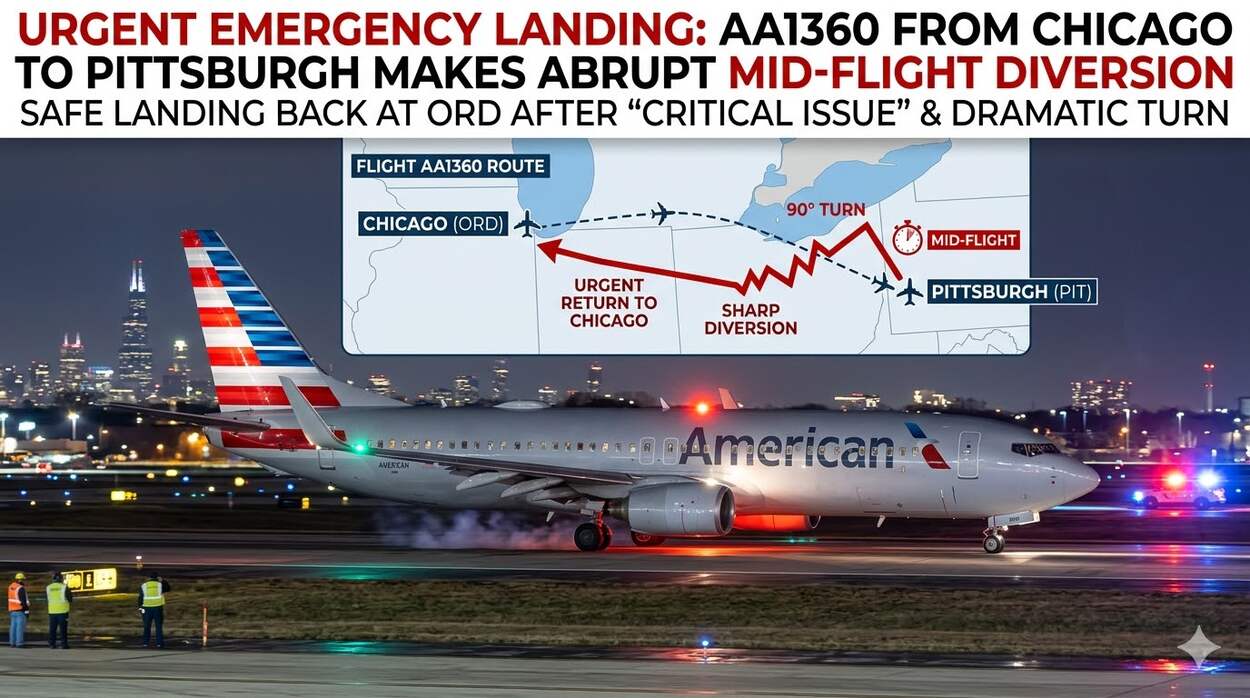
Image generated by AI
Quick Summary
- American Airlines Flight AA1360 (Boeing 737-800) diverted back to Chicago O'Hare on March 23, 2026, after approximately 45 minutes of flight time toward Pittsburgh International Airport.
- The crew detected a critical mechanical issue and made the decision to turn the aircraft around immediately.
- The emergency landing was executed safely at 11:43 PM local time with all 156 passengers and crew members disembarking without injury.
- American Airlines has launched an investigation into the technical failure; specific details have not yet been disclosed.
American Airlines Flight AA1360: A Mid-Flight Emergency Turns into Safe Diversion
Commercial aviation's greatest strength lies in its safety protocols and crew training. On March 23, 2026, American Airlines Flight AA1360 demonstrated this principle when pilots and crew responded swiftly to a critical mid-flight emergency. The Boeing 737-800, operating from Chicago O'Hare International Airport (ORD) to Pittsburgh International Airport (PIT), had to execute an unexpected diversion that turned a routine domestic flight into a high-stakes emergency situation — one that was ultimately handled with professionalism and precision.
The flight, which carried 156 passengers and crew members, departed Chicago at 10:20 PM local time. For approximately 45 minutes, the aircraft climbed to cruising altitude and maintained its course toward Pittsburgh. Then, without warning, the flight crew detected a critical technical anomaly that would force them to make one of aviation's most important decisions: ensuring the immediate safety of everyone on board.
Key Facts at a Glance
| Detail | Information |
|---|---|
| Flight Number | American Airlines AA1360 |
| Aircraft Type | Boeing 737-800 |
| Route | Chicago O'Hare (ORD) → Pittsburgh (PIT) |
| Departure Time | 10:20 PM local time, March 23, 2026 |
| Emergency Detection | Approximately 45 minutes into flight |
| Diversion Decision | Immediate turnaround toward Chicago |
| Emergency Landing Time | 11:43 PM local time, March 23, 2026 |
| Time Aloft | ~83 minutes total (including return) |
| Passengers & Crew | 156 total onboard |
| Injuries Reported | None |
| Investigation Status | Ongoing by American Airlines |
The Emergency Unfolds: From Routine Flight to Crisis
American Airlines Flight AA1360 began as an ordinary domestic service. Passengers settled into their seats expecting a one-hour flight to Pittsburgh. The flight attendants conducted their pre-flight safety demonstrations. The pilots received their clearance from air traffic control. Everything pointed to a standard evening flight on one of America's busiest domestic corridors.
Approximately 45 minutes after departure, while the aircraft was cruising at altitude, the flight crew detected a serious technical issue. Aviation regulations require pilots to act decisively when safety is compromised. The crew made the critical decision: immediately divert the aircraft back to Chicago O'Hare, its point of origin, rather than continue the additional hour to Pittsburgh.
This decision was communicated to air traffic control, which provided immediate vectors and clearance for the return flight. The aircraft, at this point approximately halfway to Pittsburgh, executed a sharp 90-degree turn and began descent procedures back toward Chicago.
The Challenge of Emergency Operations at 35,000 Feet
Mid-flight emergencies present unique challenges. The aircraft was at cruise altitude, flying at approximately 450 knots ground speed, when the decision was made to divert. The crew faced several simultaneous demands:
- Managing the Aircraft — Ensuring the mechanical issue did not deteriorate further during the return flight
- Communicating with ATC — Providing accurate information about the emergency and expected landing time
- Managing Passengers — Maintaining calm while dealing with an unexpected situation
- Calculating Descent & Landing — Plotting the optimal descent profile and landing approach
The flight data from AA1360 captured these details precisely. The aircraft was recorded at approximately 0 feet altitude during the final approach, indicating a normal descent profile and glide path. The sharp 90-degree turn in the flight's track was executed with precision — a maneuver that in emergency situations demands skilled handling.
The Safe Return: Landing at Chicago O'Hare
After the mid-flight diversion and approximately 38 minutes of return flight time, American Airlines Flight AA1360 touched down safely at Chicago O'Hare International Airport at 11:43 PM local time on March 23, 2026. Emergency vehicles were positioned on the tarmac as a precautionary measure, but the aircraft touched down without incident.
All 156 passengers and crew members disembarked safely. No injuries were reported, and no emergency evacuation procedures were necessary. The flight crew's calm professionalism and the aircraft's safety systems had successfully resolved what could have been a catastrophic situation.
Passengers, many of whom had experienced the anxiety of an unexpected emergency, were deplaned and provided with ground support. American Airlines immediately began rebooking affected passengers on alternative flights to Pittsburgh for the following day.
What Went Wrong? The Investigation Begins
As of March 24, 2026, American Airlines has not disclosed the specific technical issue that prompted the emergency diversion. The airline stated that the crew detected a "critical mechanical anomaly" but has deferred to the ongoing investigation before providing specific technical details.
Aviation experts speculate on potential causes:
- Hydraulic System Malfunction — Critical to flight control
- Engine Anomaly — Pressure, temperature, or performance indicators
- Flight Control Issue — Unexpected handling characteristics or instrument failures
- Pressurization Concern — Cabin or fuselage integrity
- Electrical or Avionics Failure — Navigation or communication systems
Each of these scenarios would trigger immediate crew response and diversion protocols. The Federal Aviation Administration (FAA) and National Transportation Safety Board (NTSB) are expected to participate in the investigation, which will examine flight data recorded in the aircraft's black boxes.
Why Emergency Diversions Matter: A Broader Perspective
Emergency diversions are rare but critical safety procedures in modern aviation. They represent the aviation industry's commitment to zero-tolerance for potential danger. A mid-flight diversion is not taken lightly — it disrupts schedules, affects hundreds of passengers, and requires coordination across multiple agencies.
However, the alternative — continuing flight with a known mechanical issue — is far too dangerous. Modern aviation culture prioritizes safety above all other considerations, including schedule adherence and passenger convenience.
This flight demonstrates why:
- Crew Training Works — The pilots and flight attendants responded exactly as trained
- Safety Systems Function — Aircraft detection systems identified the problem
- Coordination is Effective — Air traffic control and emergency services were coordinated
- Passenger Safety Outcomes are Excellent — 156 people returned safely to the ground
Passenger Support & Rebooking
American Airlines provided the following support to affected passengers:
- Ground Transportation — Hotel accommodations for overnight passengers
- Meal Vouchers — Complimentary dining while waiting for rebooking
- Alternative Flight Options — Rebooking on next available flights to Pittsburgh or other connecting cities
- Communication — Direct updates regarding investigation status and compensation eligibility
Passengers may be eligible for compensation under U.S. Department of Transportation regulations, depending on the final determination of whether the diversion was caused by mechanical failure (airline responsibility) or extraordinary circumstances.
Related News & Resources
- Major Airlines Reroute Flights Across Europe, Middle East & US Amid Price Surge
- Gulf Air Cancels 100 Flights at Bahrain Hub: Major Routes Disrupted
- Cape Town's Airport Just Changed Everything for African Travel
- BWI Security Crisis: 3-Hour Arrival Window as TSA Staffing Drops 34%
FAQ
What is a mid-flight emergency diversion? A mid-flight emergency diversion occurs when a pilot decides to land at an alternate airport instead of the originally planned destination due to a safety-critical issue. This is a standard procedure that prioritizes passenger and crew safety over schedule adherence.
Why didn't the crew continue to Pittsburgh? The crew detected a critical mechanical issue that made continued flight unsafe. Aviation regulations require pilots to divert immediately when a known hazard exists. Attempting to reach a more distant airport would have extended exposure to the mechanical problem.
Are emergency landings dangerous? Emergency landings involve higher stress than routine landings, but modern aircraft and trained crews are designed specifically to handle them. The fact that AA1360 landed without incident demonstrates the effectiveness of these systems and training.
How do I know if I can get compensation? Under DOT regulations, passengers may be entitled to compensation if the airline caused the cancellation/diversion. If the mechanical failure is deemed an "extraordinary circumstance" beyond the airline's control, compensation may not apply. Check directly with American Airlines or consult DOT guidelines at transportation.gov/airconsumer.
Were there injuries from the emergency landing? No injuries were reported. The aircraft landed normally, and all emergency procedures were precautionary rather than actual emergency evacuations.
How long will the investigation take? FAA/NTSB investigations into mechanical incidents typically take 30–90 days for preliminary findings, with final reports taking 6–12 months. American Airlines will provide updates as investigation results become available.
Can I sue American Airlines for damages? You may have legal options depending on the outcome of the investigation. Consult with an aviation attorney to understand your specific rights and potential remedies.
Disclaimer: Information accurate as of March 24, 2026. Investigation findings and compensation eligibility are subject to change as the FAA/NTSB completes their review.
Disclaimer
This article is for informational and educational purposes only. It does not constitute legal, financial, or professional advice. While we strive to provide accurate and up-to-date information, travel policies, regulations, and conditions change rapidly. Always verify information with official sources before making travel decisions. Nomad Lawyer makes no representations about the accuracy, reliability, completeness, or suitability of the information provided. Readers should consult qualified professionals for advice specific to their circumstances. The views expressed in this article are those of the author and do not necessarily reflect the views of Nomad Lawyer.
Preeti Gunjan
Contributor & Community Manager
A passionate traveller and community builder. Preeti helps grow the Nomad Lawyer community, fostering engagement and bringing the reader experience to life.
Learn more about our team →