
Delta Air Lines Triggers Catastrophic Global Travel Chaos with 502 Network Disruptions and Severe Flight Cancellations Paralyzing Atlanta, New York, London, and Paris: Latest Airline News
Delta Air Lines unleashes severe global travel chaos, recording 473 flight delays and 29 cancellations that paralyzed massive domestic hubs and critical international routes to Europe and Asia.

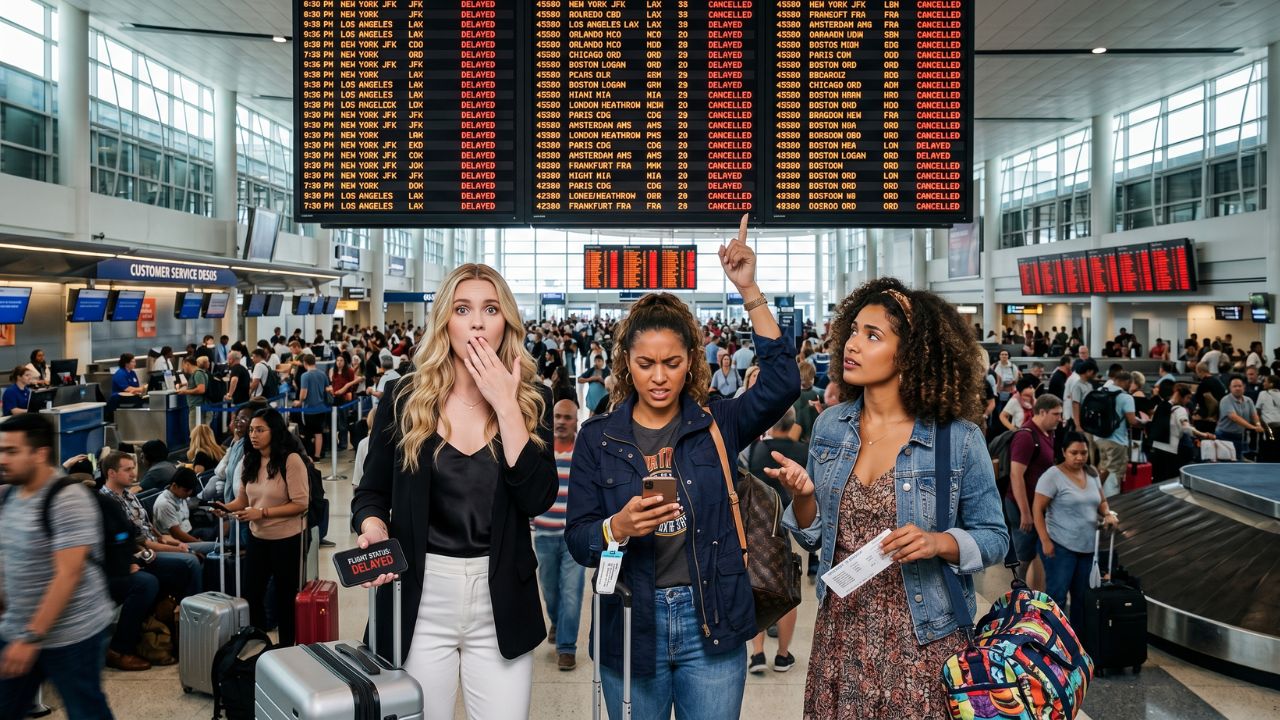
Image generated by AI
In a devastating operational meltdown that has instantly plunged both the domestic United States and critical international transit corridors into massive travel chaos, Delta Air Lines has suffered a severe network breakdown, triggering relentless flight cancellations across its global operations. Reported on June 19, 2026, the sweeping operational collapse saw the massive legacy carrier record an astonishing 473 flight delays and 29 hard cancellations in rapid succession. As hundreds of thousands of corporate executives and international tourists attempt to navigate the heavily congested aviation grid, this catastrophic wave of airport disruptions has paralyzed Delta’s "fortress hubs" including Atlanta, New York, Los Angeles, Detroit, and Minneapolis. Because Delta’s massive fleet is highly interconnected, severe delays generated in the US are now mathematically guaranteed to cascade across the Atlantic and Pacific, stranding passengers in London, Paris, Amsterdam, Rome, Tokyo, and Seoul, and driving today's most alarming headline in breaking airline news and absolutely vital global aviation updates.
By introducing direct passenger coordination and dynamic scheduling backups, the regional aviation hubs target growing passenger demand across vital commerce sectors. The choice to coordinate flight departures in phases helps to manage gate capacity, supporting the country's broader regional transportation network.
Context: The Collapse of the Global Mega-Hub
For the massive volume of travelers relying on Delta's historically rigid operational reliability for summer vacations and vital corporate travel, the staggering 502 total flight disruptions represent the absolute collapse of itinerary security.
Historically, Delta Air Lines has aggressively marketed itself as the most punctual US legacy carrier, utilizing its massive Atlanta mega-hub to seamlessly route passengers across the globe. However, this centralized hub-and-spoke model is highly vulnerable to systemic travel chaos. When a combination of severe thunderstorms and aggressive Air Traffic Control (ATC) volume restrictions chokes the airspace over Atlanta or New York, the disruption instantly ripples outward. A massive widebody jet delayed departing JFK inherently means that the return flight out of Paris or London will also be delayed, sparking severe airport disruptions in foreign terminals. Furthermore, as these delays compound, federal regulations regarding crew duty limits are frequently triggered. A transatlantic flight crew simply "times out," legally forcing the airline to execute abrupt flight cancellations because there are no reserve pilots positioned at international outstations. This systemic operational fragility has turned the Delta departures board into a sea of red ink, leaving tens of thousands of passengers trapped in terminal gridlock, staring at delayed flights with no concrete estimated time of departure.
To view live flight schedules, verify the active delay status of your specific itinerary, or to track active regional airspace restrictions, travelers must consult official aviation directories. For direct updates regarding how this massive operational collapse triggers sudden route abandonments affecting your specific domestic or international connections, travelers should aggressively utilize the official Delta Air Lines portal. To explore live flight tracking and monitor the exact severity of the cascading bottlenecks causing the flight cancellations at competitor hubs, passengers can consult the official FlightAware tracking service.
Section-Wise Breakdown of the Network Disruption
The Domestic Gridlock: Atlanta, New York, and Detroit
The core of Delta's operational travel chaos is centered on its primary domestic fortresses. Severe traffic management initiatives and heavy weather systems frequently paralyze Atlanta (the world's busiest airport) alongside New York, Detroit, Minneapolis, Boston, and Salt Lake City. With 473 active delays surging through the domestic system, business travelers attempting to commute across the US are finding their schedules completely decimated, with tight connections physically impossible to execute.
The European Collapse: London, Paris, Amsterdam, and Rome
The transatlantic impact of this operational breakdown is severe. Delta’s massive joint venture routes heavily rely on seamless connectivity into SkyTeam hubs like Paris (CDG) and Amsterdam (AMS), alongside massive traffic into London and Rome. A delay generated in the US takes hours to resolve in Europe, leaving American tourists and European corporate travelers stranded in foreign airports awaiting heavily delayed incoming aircraft that are trapped on US tarmacs.
The Transpacific and Latin American Stoppage
Beyond Europe, Delta's operations linking the US to Tokyo, Seoul, Mexico City, and São Paulo are highly exposed to cascading delays. Because these ultra-long-haul international flights require complex coordination and highly restricted crew duty limits, any delay in Los Angeles or Seattle instantly threatens to ground the aircraft, trapping passengers on multi-continent itineraries.
Technical Roster: Delta Network Disruption Data
To ensure absolute factual accuracy regarding the exact parameters of this massive operational failure and the specific network metrics driving the threat of global flight cancellations, the following matrix details the verified disruption data:
Delta Air Lines Operational Disruption Matrix
| Network Failure Metric | Strategic Verification Data |
|---|---|
| Operating Airline | Delta Air Lines |
| Active Flight Delays | 473 documented delays paralyzing the global schedule |
| Active Flight Cancellations | 29 hard cancellations destroying passenger itineraries |
| Total Network Disruptions | 502 total flights severely impacted worldwide |
| Core Domestic Hubs Affected | Atlanta, New York, Los Angeles, Detroit, Minneapolis, Salt Lake City, Seattle, Boston, Chicago, Orlando |
| International Hubs Hit | London, Paris, Amsterdam, Rome, Tokyo, Seoul, Mexico City, São Paulo |
| Primary Operational Stressors | Extreme ATC congestion, severe weather systems, and exhausted crew logistics |
Passenger Impact: The Hub-and-Spoke Nightmare
For the tens of thousands of global passengers attempting to execute complex, multi-leg itineraries, the sheer scale of 502 flight disruptions translates into an immediate, brutal physical endurance test.
The immediate passenger impact of this travel chaos is profound exhaustion and intense logistical panic. When a Delta flight from Orlando to Atlanta is delayed by three hours, the passenger mathematically misses their connecting flight to Rome. They are trapped in the heavily congested Atlanta terminal, fighting thousands of other stranded passengers for limited rebooking agent access. If the transatlantic flight crosses the threshold into the 29 confirmed flight cancellations, the situation devolves into absolute misery. Because it is the peak summer season, international Delta flights are operating at near 100% load factors. When a widebody flight of 300 people is canceled, there are physically no empty seats on the next flight to accommodate them. Stranded travelers are forced to sleep on airport floors or spend thousands of dollars on last-minute, wildly expensive competitor tickets just to salvage their vacations, completely destroying their travel budgets and turning massive mega-hubs into hostile environments.
Industry Analysis: The Fragility of the Mega-Hub
Aviation industry analysts view Delta’s massive 473-delay disruption as definitive proof that the centralized "mega-hub" model is incredibly fragile when operating near maximum capacity during the volatile summer weather season.
Analysts note that by funneling massive amounts of traffic through a single chokepoint like Atlanta, Delta gains immense economic efficiency, but sacrifices network resilience. Industry experts warn that when a severe thunderstorm complex parks over Georgia, the airline simply does not have the operational slack to absorb the blow. The delays instantly cascade across the United States and crash into Europe and Asia. Furthermore, the combination of ATC restrictions and rigid federal crew duty limits means that an airline cannot simply "push through" the weather. Once the highly specialized long-haul crew legally times out, the airline is paralyzed. Analysts predict that unless legacy airlines build significantly more buffer time into their global schedules—which heavily reduces their profitability—these massive, 500+ flight disruption events will continue to occur with terrifying regularity throughout the peak travel season.
Actionable Advice for Surviving Delta Gridlock
While passengers cannot control ATC restrictions or severe weather over Atlanta, you can execute this strategic survival checklist to actively bypass the travel chaos and secure your global itinerary:
- Avoid Tight Hub Connections Exclusively: If Delta is actively suffering 502 flight disruptions, booking a 45-minute layover in Atlanta or Detroit is a mathematically fatal error. To survive massive airport disruptions, you must intentionally book layovers of at least 3 hours. This buffer is your only physical defense against rolling delays preventing you from catching your international outbound flight.
- Never Check a Bag on Connecting Itineraries: During massive hub disruptions, checked luggage is almost always abandoned in the sorting facility. If you miss your connection in New York and are forced to rebook onto Air France to reach Paris, your checked bag will be left trapped in the Delta system for days. Travel strictly with a carry-on to maintain total physical agility and rebooking flexibility.
- Monitor the Inbound Aircraft Tracking: Do not rely on the airport departure board, which is frequently updated late. Use the FlightAware app to track the physical location of the inbound aircraft assigned to your flight. If your flight from London to New York is supposed to leave at 2:00 PM, but the physical aircraft is still sitting on the tarmac in JFK at 1:30 PM, you know definitively that a massive delay is imminent.
- Exploit SkyTeam Partners Immediately: If your Delta flight is canceled, do not wait in line at the customer service desk. Immediately use the airline app or call international reservations to request a rebooking on a SkyTeam alliance partner, such as Air France, KLM, or Virgin Atlantic. These partner carriers can bypass the localized Delta flight cancellations and salvage your transatlantic itinerary.
FAQ: Delta Air Lines Network Disruptions
How severe were the Delta flight disruptions?
Delta Air Lines suffered a massive global operational collapse, recording an astonishing 473 active flight delays and 29 severe flight cancellations, resulting in 502 total network disruptions.
Which destinations were affected by the travel chaos?
The disruptions paralyzed major US domestic hubs like Atlanta, New York, and Detroit, while severely stranding international passengers on routes to London, Paris, Amsterdam, Rome, Tokyo, and Seoul.
Why do flight delays cascade internationally?
Because Delta operates a highly interconnected fleet, a severe weather delay or ATC hold in Atlanta forces the aircraft to arrive late at its international destination, directly causing rolling delays on the return flight from Europe or Asia.
The Reality of Mega-Hub Aviation Fragility
The devastating wave of 502 flight disruptions across the Delta network proves definitively that the global aviation grid remains highly fragile and totally vulnerable to massive, cascading travel chaos. By succumbing to ATC restrictions, coastal weather, and compounding crew scheduling limits at its core fortresses, the carrier has inadvertently subjected tens of thousands of travelers to severe airport disruptions and vacation-destroying flight cancellations. As major legacy airlines desperately struggle to manage intense international demand against the brutal realities of summer weather—frequently triggering massive terminal queues, rolling delays, and excruciating airport paralysis—travelers must accept a critical new reality: avoiding brutal transit anxiety requires actively refusing short layovers, abandoning checked luggage entirely, and aggressively exploiting alliance partners to survive the volatile global skies.
Key Takeaways
- Massive Network Paralysis: Delta Air Lines suffered a severe global operational breakdown, recording 473 flight delays and 29 flight cancellations, totaling 502 disruptions.
- Domestic Mega-Hubs Crippled: Atlanta, New York, Detroit, and Los Angeles suffered the heaviest domestic travel chaos, paralyzing business and leisure travelers.
- International Routes Stranded: The cascading delays physically trapped passengers on highly lucrative transatlantic and transpacific routes to London, Paris, Rome, and Tokyo.
- Cascading Operational Failures: The disruptions were driven by a toxic combination of massive ATC volume restrictions, severe weather systems, and exhausted flight crews timing out.
- Passenger Survival: Travelers must exclusively book 3-hour layovers, refuse to check bags, and aggressively rebook on SkyTeam partner airlines to physically insulate their itineraries from massive rolling delays.
Related Travel Guides
Massive Travel Chaos Paralyzes Chicago O'Hare with 1,425 Disruptions
Disclaimer
This article is for informational and educational purposes only. It does not constitute legal, financial, or professional advice. While we strive to provide accurate and up-to-date information, travel policies, regulations, and conditions change rapidly. Always verify information with official sources before making travel decisions. Nomad Lawyer makes no representations about the accuracy, reliability, completeness, or suitability of the information provided. Readers should consult qualified professionals for advice specific to their circumstances. The views expressed in this article are those of the author and do not necessarily reflect the views of Nomad Lawyer.
Kunal K Choudhary
Co-Founder & Contributor
A passionate traveller and tech enthusiast. Kunal contributes to the vision and growth of Nomad Lawyer, bringing fresh perspectives and driving the community forward.
Learn more about our team →