Cozumel Welcomes Direct Europe Flights: Neos Milan Route, Reef Conservation, and Island Travel Guide

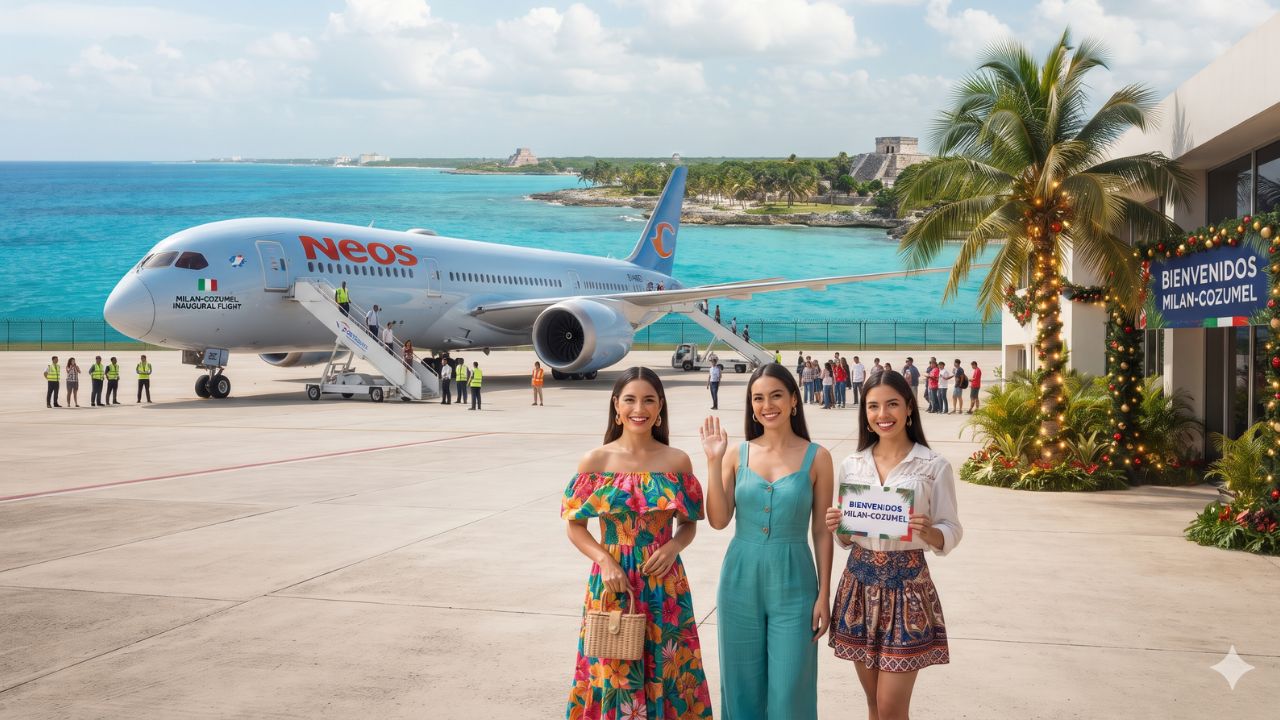
Long revered by scuba divers and maritime navigators, Cozumel is opening its first direct air bridge from Europe on 24 December 2026 as Italian leisure carrier Neos touches down from Milan Malpensa, offering holiday travelers a direct path past mainland transit corridors into the heart of the Mexican Caribbean.
For decades, European travelers traveling to Mexico's largest inhabited Caribbean island faced an unavoidable mainland obstacle: touching down at Cancún International Airport, enduring the crowded taxi or ADO bus transfer down Federal Highway 307 to Playa del Carmen, dragging dive gear down the maritime pier, and boarding a 45-minute passenger ferry across the channel. That routing shifts this winter. Italian airline Neos, an aviation arm of the Alpitour World leisure conglomerate that serves over 3.3 million passengers each year, is introducing weekly scheduled non-stop service connecting Milan Malpensa Airport (MXP) directly to Cozumel International Airport (CZM).
The flight path represents the first nonstop commercial air link between the European continent and Cozumel, establishing an alternative gateway into Quintana Roo's protected waters and ancient Maya pilgrimage sanctuaries.
Flight Route Logistics: Boeing 787 Schedule and Transit Dynamics
The new transatlantic route takes off right on Christmas Eve, scheduled to operate weekly every Thursday utilizing Neos' long-haul widebody fleet of Boeing 787 Dreamliner aircraft.
Outbound travelers departing Milan Malpensa settle into an 11-hour nonstop ocean-crossing flight that touches down directly on Cozumel's 8,858-foot runway, cutting out the entire mainland customs queue and ferry crossing. On the return path toward northern Italy, the flight routing differs: the aircraft operates an approximately 15-hour triangular circuit, making scheduled technical and passenger pickups via Cancún International Airport and Rome Fiumicino before terminating at Milan Malpensa.
The announcement was confirmed by Quintana Roo Governor Mara Lezama during the 38th Cancún Travel Mart, which opened on 22 October 2026 alongside Mexico's federal Tourism Secretary Josefina Rodríguez Zamora. The tradeshow gathered more than 400 industry delegates representing over 20 countries (with official federal records cataloging 18 participating nation delegations), coinciding with a targeted 20 percent expansion in tourism promotion funding apportioned across 12 Quintana Roo municipal travel destinations.
| Flight & Route Specification | Service Details | Travel Context & Logistics |
|---|---|---|
| Operating Carrier | Neos (Alpitour World Group) | Serves >3.3 million passengers globally per year |
| Inaugural Flight Date | 24 December 2026 | Weekly seasonal service departing Thursdays |
| Aircraft Type | Boeing 787 Dreamliner | Twin-aisle transatlantic configuration |
| Outbound Leg (MXP → CZM) | Non-stop (~11 hours) | Arrives directly at Cozumel International Airport |
| Inbound Leg (CZM → MXP) | One-stop/Two-stop (~15 hours) | Scheduled routing via Cancún and Rome |
| Airport Operator | Grupo Aeroportuario del Sureste (ASUR) | Cozumel terminal handled 408,000+ passengers in Jan–Jun 2026 |
| Ferry Comparison | Mainland Transfer (~3–4 hours) | Bypasses 45-minute Playa del Carmen passenger ferry |
Cozumel Airport Growth vs. Cruise Passenger Dynamics
Cozumel occupies a unique position in Caribbean transit infrastructure. Operative under concessionaire Grupo Aeroportuario del Sureste (ASUR), Cozumel International Airport handled upwards of 408,000 commercial air travelers between January and June 2026. While regional air arrivals have maintained steady, regulated numbers, the island's marine piers present an entirely different scale of arrival.
Official port statistics reveal that between January and August 2026, Cozumel welcomed 5,587,000 cruise ship visitors across 1,314 individual cruise vessel calls at its three dedicated deep-water piers (Punta Langosta, International Pier, and Puerta Maya).
For independent long-stay travelers, understanding the split between day-tripping cruise excursions and overnight island travel is the single most valuable logistical tool:
- Morning Harbor Exits: Cruise passengers disembark between 7:30 AM and 9:00 AM, heavily packing waterfront souvenir shops along Avenida Rafael E. Melgar and mass-market beach clubs.
- Quiet Afternoon Sanctuary: By 4:30 PM, the sounding of ship horns prompts an island-wide evacuation back to port. From sunset onward, the town plaza in San Miguel returns completely to island locals, expat dive masters, and overnight hotel guests.
- Direct Air Arrival Advantages: Landing at CZM allows European visitors to base themselves on island time, avoiding the mainland transit fatigue that often cuts into precious reef dive intervals.
Travelers can research broader regional heritage and conservation policies through the official Caribe Mexicano Travel Portal.
Exploring Mesoamerican Reef Ecosystems and Conservation Mandates
The primary draw for incoming travelers remains the crystalline water washing along the island's western shelf. The protected marine zones are managed under the jurisdiction of the National Commission of Natural Protected Areas through CONANP, specifically within the Arrecifes de Cozumel National Park.
Forming a core segment of the Mesoamerican Barrier Reef System—the second-largest barrier reef formation on Earth—the national park encompasses an intricate web of marine life:
- Coral & Marine Flora: Home to 66 stony hard coral species, 39 soft octocoral species, 55 recorded sponge varieties, and 84 identified marine algae types.
- Fish & Marine Fauna: Over 262 distinct fish species patrol these waters, alongside 57 cataloged echinoderm varieties and 3 endangered sea turtle species (hawksbill, loggerhead, and green sea turtles).
- Endemic Highlights: Divers should watch sandy overhangs for the Cozumel splendid toadfish (Sanopus splendidus), a striking blue-striped species found nowhere else on the planet.
To preserve benthic cover and protect against stony coral tissue loss disease, park rangers have monitored six permanent reef tracts continuously since March 2004: Paraíso, Chankanaab, Yucab, Paso del Cedral, Dalila, and Colombia. Additionally, conservation biologists run monthly water quality assays across 11 designated reef sectors.
Visitors planning to snorkel or dive must remember essential sanctuary regulations: chemical sunscreens (even those claiming biodegradable status) are forbidden in park boundaries, non-certified snorkelers must wear buoyancy vests, and dive operations must observe rotating site closures enacted to give fragile spur-and-groove formations time to regenerate.
Between December and March, seasonal water temperatures trigger eagle ray migrations across the southern drop-offs, while calm sandbar flats such as El Cielo—accessible solely by licensed boat charters—host colonies of cushion sea stars resting in waist-deep turquoise shallows.
Maya Sacred Sites: Visiting San Gervasio and East Coast Sanctuaries
Before Spanish galleons anchored off its leeward shores, Cozumel was known to the Maya as Kùutsmil (Island of the Swallows). For more than 17 centuries, women throughout the Maya territory crossed the perilous 12-mile channel in cedar dugout canoes to pay homage to Ixchel, the goddess of fertility, midwifery, medicine, and weaving.
The administrative and ceremonial heart of this sacred network sits inland amidst low dry-tropical forest at the San Gervasio Archaeological Zone, maintained by Mexico's National Institute of Anthropology and History through INAH.
Connected by ancient raised stone causeways (sacbeob), San Gervasio maintained direct spiritual and political ties with the great northern capital of Chichén Itzá.
Planning Your San Gervasio Visit
- Operating Hours: Open Monday through Sunday from 9:00 AM to 3:30 PM, with final site admissions closed promptly at 3:00 PM.
- Admission Pricing: The INAH archaeological entry fee is MXN 105 for Mexican citizens and MXN 210 for international visitors (additional state conservation dues are collected at the main concession gate).
- Field Recommendation: Hire an accredited local Maya guide at the entrance gate before entering the Las Manitas and Ka'na Nah temple groupings. Carry plenty of drinking water and natural mosquito repellent, as inland jungle humidity spikes rapidly past midday.
Beyond San Gervasio, travelers renting a scooter or open-top vehicle can circle south to Punta Sur Eco Beach Park, visiting the historic Celarain Lighthouse and the brackish mangrove channels of Colombia Lagoon, where saltwater crocodiles bask along protected interior shores.
The eastern windward side of the island features wave-battered limestone shelves, open blowholes, and off-grid beachside cantinas operating on solar arrays—a quiet contrast to the developed resorts of the western shore.
Practical Island Logistics for European Travelers
- Best Travel Season: Peak travel conditions run from December through April, characterized by clear skies, dry trade winds, and water temperatures averaging 26°C to 28°C (79°F to 82°F).
- Local Transportation: San Miguel is walkable, but exploring coastal sites requires a licensed taxi, scooter, or car rental. Street taxis do not use meters; inspect official municipal fare rate sheets before boarding.
- Reef Access & Marina Departures: Most reputable dive and snorkel charters leave from Marina Fonatur or the downtown Caleta basin. Verify your vessel carries the official green CONANP park permit sticker.
- Currency Protocols: Mexican Pesos (MXN) are strongly preferred for fuel stations, archaeological admissions, and local street stalls. While US dollars and credit cards are common along the main cruise strip, conversion rates applied in independent shops are often unfavorable.
Frequently Asked Questions
When do direct flights from Milan to Cozumel begin?
Neos launches its direct Boeing 787 service on 24 December 2026, operating weekly flights departing every Thursday from Milan Malpensa Airport (MXP).
How does the flight schedule differ between outbound and return journeys?
The outbound flight runs nonstop from Milan to Cozumel in roughly 11 hours. The inbound return to Italy takes approximately 15 hours, making scheduled stops in Cancún and Rome.
What are the entry fees and opening hours for San Gervasio?
San Gervasio opens daily from 9:00 AM to 3:30 PM (last entry at 3:00 PM). INAH admission costs MXN 105 for Mexican nationals and MXN 210 for international travelers.
What marine rules apply within Arrecifes de Cozumel National Park?
Chemical sunscreens are strictly prohibited across all reef areas. Visitors must use licensed boat operators, avoid touching coral colonies, and adhere to rotational reef resting schedules monitored by CONANP.
Related Travel Guides
- Cancun and Riviera Maya Flight Alerts and Airport Logistics
- Sustainable Marine Tourism and Coral Conservation Standards
- Central America and Caribbean Destination Guides
Direct transatlantic wings now lead straight into the sacred turquoise currents of the swallows' ancient sanctuary.
This article is for informational purposes. Flight routes, passenger regulations, visa rules, and transit advisories are subject to change by airlines and aviation authorities. Readers are advised to verify schedules and travel documentation with relevant carriers and border agencies before departure.
Related Stories
Jeddah to Moscow Direct: Saudia Launches Boeing 787 Flights, Al Balad Heritage Guide, and Red Sea Travel
United Airlines Exits Tulum Airport in January 2027: Riviera Maya Travel Guide and Cancún Transit Alternatives