
Charlotte Douglas International Airport Updates Lightning Detection Systems to Reduce Weather Delays in 2026
Charlotte Douglas International Airport has overhauled its Lightning Detection and Advisory Program (LDAP) to minimize ramp closures and flight disruptions during the Carolinas' peak thunderstorm season.
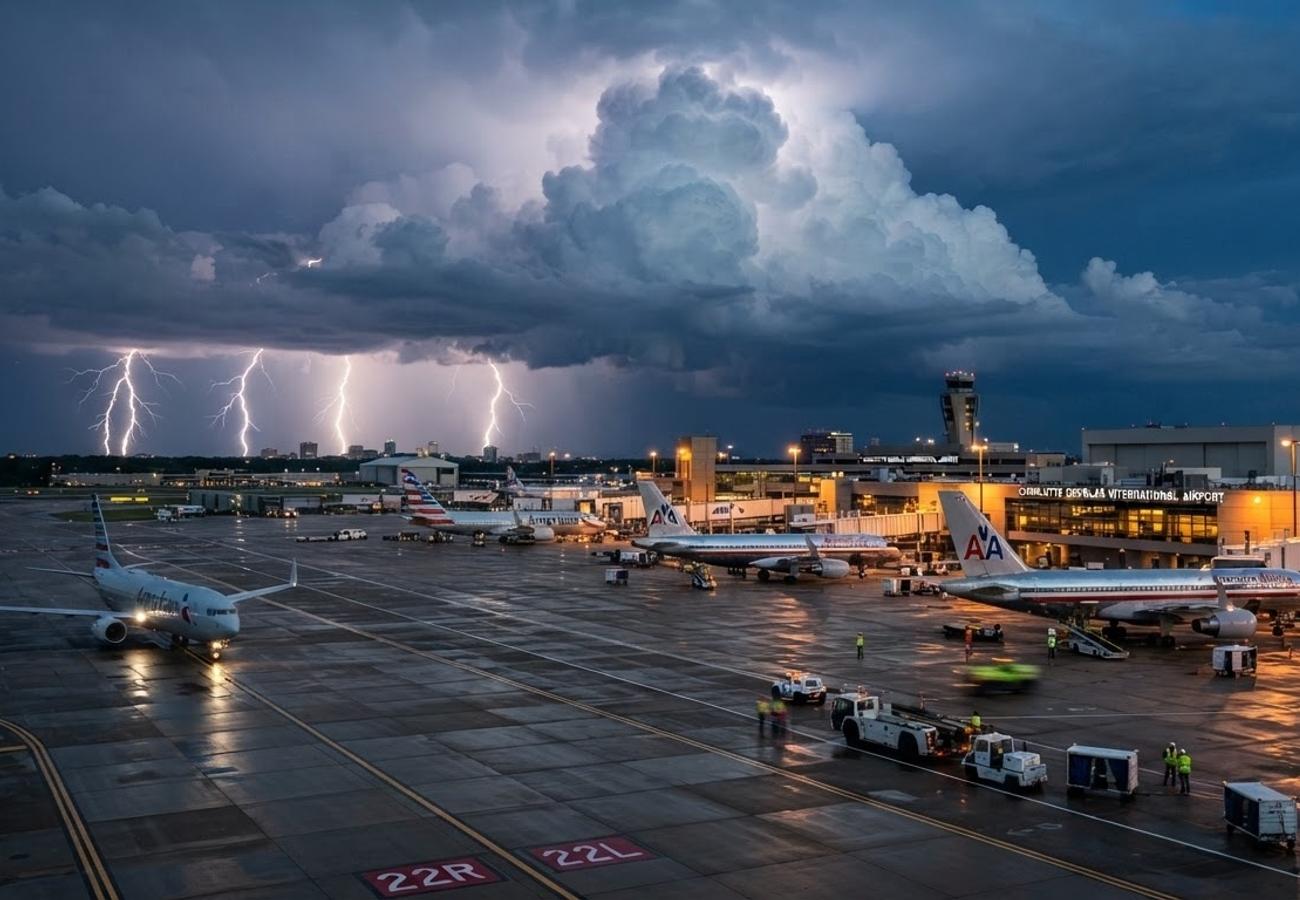
Image generated by AI
Charlotte Douglas International Airport (CLT) is implementing a sophisticated overhaul of its lightning monitoring protocols to prevent cascading flight delays during the high-activity thunderstorm season in the Carolinas.
The technical transition focuses on the Lightning Detection and Advisory Program (LDAP), shifting how the airfield identifies risks to ground crews and aircraft. By refining the triggers that lead to ramp closures, airport officials aim to maintain operational flow without compromising the safety of personnel working on the tarmac.
Precision-Based Overhaul of the LDAP System
The updated Lightning Detection and Advisory Program (LDAP) introduces a more nuanced approach to storm monitoring. Rather than relying on a single central point for measurements, the airport now calculates its inner "alarm" zone based on the actual airfield perimeter. This adjustment effectively expands the monitored radius by approximately 1.4 miles, ensuring that a wider array of taxiways and ramps are covered under the most stringent surveillance.
Crucially, the airport has tightened the criteria for what constitutes a critical threat. The system now distinguishes between different types of lightning strikes. While previous iterations may have triggered alerts based on any electrical activity, the new parameters focus specifically on cloud-to-ground lightning for the highest alert levels. In-cloud pulses, which occur at higher altitudes and pose less immediate risk to ground staff, have been removed from the primary trigger list for the innermost alarm zone.
This shift follows a comprehensive safety risk assessment. Industry reports indicate that CLT compared its internal protocols with those of other major U.S. aviation hubs to ensure alignment with national safety norms. The goal is to account for the specific meteorological patterns of the Charlotte region, where convective storms often produce high volumes of lightning that do not necessarily result in ground-level strikes.
Four-Tiered Alert Structure for Airfield Safety
The revamped LDAP operates through a tiered hierarchy of alerts—advisory, warning, alarm, and all-clear—each triggering different operational responses.
The Advisory Stage The outermost ring now monitors for both in-cloud and cloud-to-ground lightning within a 25-mile radius of the airport perimeter. This is an increase from the previous 20-mile threshold. This expanded zone serves as an early warning system, granting operations teams additional lead time to prepare for potential disruptions as weather cells approach the region.
The Warning Stage When total lightning is detected within approximately 10 miles, the system enters the warning phase. This triggers an "amber" visual signal and an audible alert across the airfield. This stage is designed as a preparatory phase, prompting ground handlers and airline operators to adjust staffing levels, stage necessary equipment, and evaluate flight schedules before conditions become restrictive.
The Alarm Stage The most restrictive phase, the alarm stage, is now exclusively triggered by cloud-to-ground lightning within roughly 3 miles of the airport perimeter. Upon detection, the system switches to "red" status. At this point, many ramp activities may be suspended, and airlines typically halt aircraft pushbacks and reassess the movement of arriving and departing flights.
The All-Clear Stage To expedite the return to normal operations, the "all-clear" is issued under specific time and distance criteria. Operations resume once there has been no cloud-to-ground lightning within 3 miles for at least 10 minutes, or no total lightning within 10 miles for the same duration.
Reducing Ramp Closures and Network Ripple Effects
The decision to reconfigure the LDAP was driven by hard operational data. Analysis of records from American Airlines covering 2024 and 2025 revealed a significant inefficiency: between 75% and 80% of ramp closures were caused by in-cloud lightning rather than cloud-to-ground strikes. In several instances, ramps remained closed for extended periods despite a total absence of ground strikes near the facility.
For a major connecting hub like CLT, these closures create a domino effect. When the ramp enters a prolonged red status, the consequences extend far beyond the local airfield:
- Arriving aircraft are forced to wait for available gates.
- Departing flights stack up on the taxiways.
- Flight crews may hit their maximum legal duty-time limits.
- Missed connections trigger cancellations across the broader national network.
Reports from August 2026 underscore that a single afternoon of volatile weather in Charlotte can disrupt the entire National Airspace System (NAS) due to the airport's role as a primary transit point. By limiting red alerts to actual ground-strike risks, CLT intends to reduce the frequency and duration of these shutdowns.
Integration with Broader Infrastructure Goals
The LDAP update is not an isolated change but part of a multi-year strategy to enhance weather resilience. Federal Aviation Administration (FAA) documentation highlights that the integration of specialized weather radar and advanced air traffic management tools has already helped reduce storm-related accidents at major hubs.
Parallel to these software and protocol updates, CLT has invested in physical infrastructure. Recent federal funding has supported the construction of end-around taxiways and other capacity-boosting projects. These physical improvements are designed to eliminate bottlenecks that typically worsen during weather-induced traffic surges.
Airport financial and planning documents emphasize that because CLT is a critical node in the U.S. aviation network, reliability is a primary development goal. The combination of infrastructure expansion and technical LDAP refinements represents a holistic approach to managing the region's unpredictable summer climate.
Impact on the Passenger Experience
While travelers will not interact with the LDAP system directly, the operational changes should manifest as a reduction in "unnecessary" ground holds. Passengers may find that flights continue to move during storms that would have previously triggered a full ramp shutdown, provided the lightning remains confined to higher clouds or stays outside the 3-mile critical zone.
However, weather delays will not be eliminated entirely. The FAA continues to employ ground stops, flow-control programs, and arrival metering when severe weather patterns impact the wider Southeast region. Furthermore, airlines maintain the authority to implement more conservative safety measures than the LDAP advisory suggests, meaning some carriers may still halt operations based on their own internal risk tolerances.
For those connecting through Charlotte during the summer, the standard precautions remain: potential gate holds, rerouting, and the possibility of compressed schedules leading to missed connections.
The shift toward data-driven, strike-specific alerts marks a new era of precision in aviation weather management.
Related Travel Guides
Disclaimer
This article is for informational and educational purposes only. It does not constitute legal, financial, or professional advice. While we strive to provide accurate and up-to-date information, travel policies, regulations, and conditions change rapidly. Always verify information with official sources before making travel decisions. Nomad Lawyer makes no representations about the accuracy, reliability, completeness, or suitability of the information provided. Readers should consult qualified professionals for advice specific to their circumstances. The views expressed in this article are those of the author and do not necessarily reflect the views of Nomad Lawyer.