Chongqing Secures Ninth Place in China Inbound Tourism Spending as International Receipts Hit $2.48 Billion Amid 68% Visitor Surge

Chongqing has secured ninth place in China's national inbound tourism expenditure rankings, driven by a dramatic 68.2 percent annual surge in international arrivals and a 93 percent increase in foreign visitor spending that reached 2.483 billion US dollars. According to the 2025–2026 Cross-border Tourism Consumption Trends Report jointly published in Hefei by the World Tourism Alliance, Mastercard, and Trip.com Group, the southwestern megacity entered the country’s top ten inbound spending destinations for the first time in history. Propelled by viral international visibility on digital platforms, extensive expansions in cross-border digital payment systems, progressive 240-hour visa-free transit policies, and coordinated regional integration with neighboring Chengdu, Chongqing has established itself as an essential international travel hub that extends global tourism demand well beyond China's traditional coastal gateways.
The comprehensive findings, released at the World Tourism Alliance gathering in Anhui Province, examine cross-border financial transactions and traveler behavior between July 2025 and June 2026. While traditional tier-one gateways continued to anchor the top tiers—with Shanghai retaining the number one spot, followed by Beijing, Guangzhou, and Shenzhen, and Sichuan’s capital Chengdu securing fifth place—Chongqing’s breakthrough into ninth position marks a pivotal structural shift in China’s international visitor economy. During 2025, Chongqing received 2.15 million inbound tourist visits, while early momentum in the first half of 2026 generated an additional 1.45 million international visits, demonstrating that the inland river metropolis has transitioned from an architectural novelty into a major generator of commercial cross-border tourism revenue.
========================================================================================
CHONGQING INBOUND TOURISM & EXPENDITURE PERFORMANCE SCORECARD
========================================================================================
Metric Dimension                  Reported Figure / Status          Growth & Context
----------------------------------------------------------------------------------------
National Spending Rank            9th Position (Top 10 Entry)       First historic appearance
Primary Benchmark Study           2025–2026 Cross-border Trends     Joint WTA, Mastercard, Trip.com
Full-Year 2025 Inbound Arrivals   2.15 Million Foreign Visits       +68.2% Year-on-Year vs 2024
Full-Year 2025 Inbound Spend      US$ 2.483 Billion (Foreign Spend) +93.0% Year-on-Year Growth
First-Half 2026 Inbound Arrivals  1.45 Million Foreign Visits       +56.8% Year-on-Year Growth
Trip.com Inbound Booking Surge    +170.0% Inbound Bookings (2025)   Platform-wide volume expansion
Key Commercial District Growth    Up to 8-Fold Hotel Booking Growth Select core retail hubs
Jiefangbei Retail Spend (5 Months)735 Million Yuan ($110M USD)      Jan–May 2026 commercial spend
Eligible Departure Tax Refunds    113.8 Million Yuan ($17M USD)     H1 2026 (+72.2% YoY increase)
Overseas Bank Card Volume         +54.1% Transaction Expansion      H1 2026 merchant POS terminals
WTA Cultural Heritage Interest    75.2% of Surveyed Foreign Guests  Dominant inbound trip driver
WTA City Walk Activity Preference 53.5% of Surveyed Foreign Guests  Urban exploration priority
WTA Language Friction Factor      61.4% Face Translation Barriers   Primary service challenge
Target Municipal Action Plan      27 Practical Measures (3 Years)   Bilingual transport & smart POS
========================================================================================
Source: World Tourism Alliance (WTA), Chongqing Municipal Commission of Culture & Tourism (2026).
========================================================================================
The National Inbound Hierarchy: Analyzing Chongqing’s Top 10 Breakthrough
The findings compiled in the 2025–2026 Cross-border Tourism Consumption Trends Report present a detailed mapping of where international visitors allocate financial capital across mainland China. For decades, international inbound itineraries were heavily concentrated in the "Golden Triangle" of Beijing, Shanghai, and Xi'an, alongside southern commercial corridors through Guangzhou and Shenzhen.
Chongqing’s ascent to the ninth rank nationwide illustrates the growing decentralization of China’s inbound travel market:
========================================================================================
CHINA TOP 10 INBOUND TOURISM EXPENDITURE DESTINATIONS (2025–2026)
========================================================================================
Rank    Destination City       Regional Economic Cluster         Key Inbound Appeal
----------------------------------------------------------------------------------------
1       Shanghai               Yangtze River Delta Megalopolis   Global finance, culture, transit
2       Beijing                Jing-Jin-Ji Northern Corridor     Imperial heritage, diplomatic hub
3       Guangzhou              Greater Bay Area (GBA)            Trade exhibitions, Lingnan cuisine
4       Shenzhen               Greater Bay Area (GBA)            Tech innovation, cross-border retail
5       Chengdu                Chengdu-Chongqing Twin Circle     Panda conservation, culinary arts
6       Hangzhou               Yangtze River Delta Megalopolis   West Lake heritage, digital economy
7       Xi'an                  Northwest Inland Gateway          Terracotta Army, Silk Road origins
8       Suzhou                 Yangtze River Delta Megalopolis   Classical gardens, heritage canals
9       Chongqing              Chengdu-Chongqing Twin Circle     8D mountain terrain, Yangtze river
10      Xiamen                 Southeastern Maritime Corridor    Coastal leisure, Minnan culture
========================================================================================
Source: World Tourism Alliance / Mastercard / Trip.com Group Analysis (Hefei Release, Nov 2026).
========================================================================================
Entering this elite tier required Chongqing to outpace long-established international tourist centers across southern and eastern China. The data shows that Chongqing’s compound inbound spending growth rate (+93 percent in 2025) outpaced the national average by a wide margin. This financial acceleration was underpinned by expanding international flight frequencies at Chongqing Jiangbei International Airport (CKG), streamlined 144-hour and 240-hour visa-free transit channels, and aggressive promotional campaigns highlighting the city’s unique urban geography.
Alongside Chengdu in fifth place, Chongqing’s arrival in the top ten positions southwestern China as the second most powerful tourism consumption pole in the nation after the Yangtze River Delta. Together, the two metropolises form an integrated regional travel circuit that captures an expanding share of international long-haul itineraries originating across Europe, North America, Southeast Asia, and the Middle East.
The Architecture of Virality: How Digital Platforms Sparked Global Inbound Demand
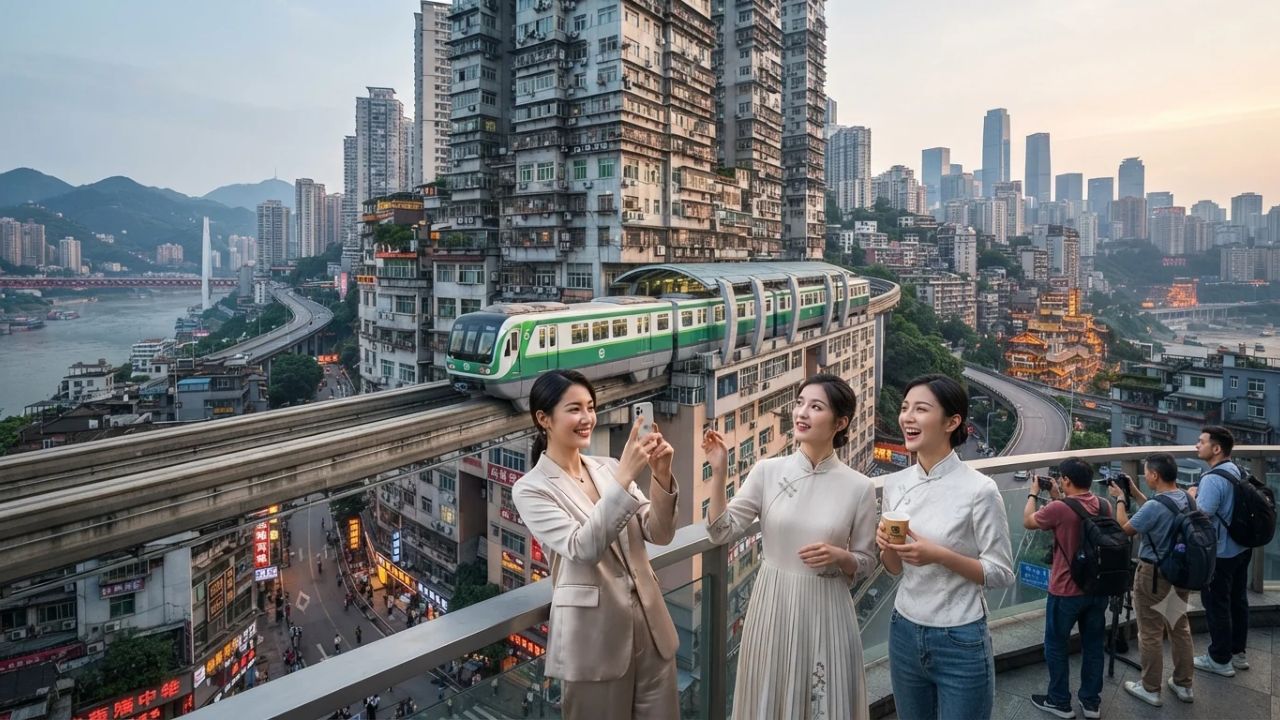
The catalyst behind Chongqing’s rapid international emergence is its distinctive urban topography, which has captivated global social media audiences. Built across steep mountain ridges at the confluence of the Yangtze and Jialing rivers, Chongqing is widely described by international travelers as an "8D cyberpunk metropolis"—a three-dimensional vertical city where ground-level roads often sit atop 20-story residential towers, and pedestrian bridges link skyscrapers hundreds of feet in the air.
Short-form video platforms such as TikTok, Instagram, and YouTube have turned Chongqing’s transportation infrastructure into global viral landmarks:
- Liziba Monorail Station: On Chongqing Rail Transit Line 2, trains pass directly through the middle of a 19-story residential apartment complex. What was engineered as a practical solution to navigate steep riverbank terrain has become an iconic viral sensation, drawing thousands of international travelers daily who gather at observation plazas below to photograph trains disappearing into the building facade.
- Hongyadong Stilt House Complex: Cascading down a vertical cliff along the Jialing River, this 11-story complex built in the traditional Bayu diaojiaolou (stilt house) architectural style resembles scenes from popular animated films. When its exterior is illuminated in golden light each evening, it becomes one of the most photographed nightscapes in the world.
- Yangtze River Cableway: Originally built in 1987 as public transit for local commuters, the 1,166-meter aerial cableway crossing the Yangtze River now serves as a prime vantage point for overseas travelers to experience the scale of the river valley and surrounding high-rises.
- Multi-Layer Skywalks and Bridges: With more than 14,000 bridges spanning its rivers and mountain gullies, Chongqing features dramatic multi-deck crossings—such as the Chaotianmen Bridge and Qiansimen Bridge—that provide panoramic views of illuminated riverbanks and mountain cliffs.
========================================================================================
DIGITAL FOOTPRINT & VIRAL IMPACT MATRIX
========================================================================================
Landmark Asset             Infrastructure Character       Global Social Media Appeal
----------------------------------------------------------------------------------------
Liziba Transit Station     Monorail piercing 19-floor apt Architectural marvel, engineering wonder
Hongyadong Complex         11-tier cliffside stilt houses "Spirited Away" fantasy aesthetic, nightscape
Yangtze River Cableway     Aerial urban cable car transit Retro industrial transit, valley vistas
Kuixinglou Plaza           1st floor ground / 22nd bridge Mind-bending vertical geometry, 8D layout
Raffles City Chaotianmen   "The Crystal" horizontal bridge Modern mega-engineering at river confluence
Ciqikou Ancient Town       Ming-Qing river port alleys    Historic teahouses, artisanal street foods
========================================================================================
Data from Trip.com Group underscores the commercial impact of this digital visibility: inbound tourist bookings through the platform surged by 170 percent year-on-year in 2025. In commercial epicenters like Jiefangbei, Guanyinqiao, and Jiangbeizui, hotel bookings by overseas visitors increased up to eightfold, demonstrating how online curiosity translates directly into room nights and hospitality spend.
Beyond the Skyline: International Interest in Cultural Depth and Natural Wonders
While architectural spectacles attract initial attention on digital feeds, visitor surveys conducted by the World Tourism Alliance reveal that international travelers visiting Chongqing are driven by deep cultural and ecological interests.
According to the WTA’s second-half 2026 sentiment report:
- 75.2 percent of surveyed international visitors prioritized cultural heritage experiences.
- 53.5 percent favored guided or independent city walks through historic neighborhoods.
- 44.8 percent allocated travel budgets to professional theatrical productions and traditional performing arts.
- 43.0 percent purchased cultural and creative merchandise (wenchuang) related to local history and architecture.
========================================================================================
WTA INBOUND VISITOR PREFERENCE & EXPENDITURE ALLOCATION
========================================================================================
Tourism Activity / Category       Inbound Traveler Interest   Commercial Spending Impact
----------------------------------------------------------------------------------------
Cultural Heritage & History       75.2% of respondents        High museum & historic site admissions
Urban City Walks (Street Culture) 53.5% of respondents        Dispersed dining, cafes, artisan retail
Theatrical & Live Performances    44.8% of respondents        Premium evening entertainment tickets
Creative Heritage Products        43.0% of respondents        High-margin souvenir & craft sales
Natural Karst Geological Parks    38.6% of respondents        Multi-day transport & regional lodging
Culinary Tourism (Hot Pot)        82.1% of respondents        Substantial daily food & beverage spend
========================================================================================
Source: World Tourism Alliance Sentiment Survey (H2 2026 Sample).
========================================================================================
Theatrical and Living Heritage
Productions such as Chongqing 1949—an immersive theatrical performance staged in a purpose-built rotating auditorium in Shapingba District—have attracted substantial international attendance. The production utilizes moving multi-tier stages and 360-degree scenery to depict wartime historical events, offering foreign travelers an accessible, visually striking artistic experience that transcends spoken language barriers.
In historic quarters like Ciqikou Ancient Town along the Jialing River, visitors explore century-old cobblestone alleyways, traditional Sichuan opera teahouses where face-changing (bian lian) is performed, and workshops producing handmade Chen-style fried dough twists (mahua) and spicy hot pot seasoning bricks.
Regional Diffusion: Wulong Karst and the Dazu Rock Carvings
Inbound tourism spending is not restricted to the downtown metropolitan core; international travelers are venturing into outer ecological and archaeological districts in record numbers:
========================================================================================
OUTER DISTRICT INBOUND EXPANSION SCORECARD
========================================================================================
District / Site          Primary Attraction               Inbound Volume & Growth Rate
----------------------------------------------------------------------------------------
Wulong Karst             Three Natural Bridges & Fissure  778,900 visits (Jan-Sep 2026, +81.7% YoY)
Dazu Rock Carvings       UNESCO Cliffside Buddhist Art    134,000 visits (Full Year 2025, +90.1% YoY)
Yangtze Three Gorges     Cruise routes departing Chaotianmen High double-digit European & US bookings
Jinfosan Mountain        Karst flora & alpine biodiversity Growing Southeast Asian eco-tourist traffic
========================================================================================
In Wulong District, famous for the UNESCO World Heritage-listed Three Natural Bridges, international visitor numbers climbed to 778,900 in the first nine months of 2026, representing an 81.7 percent year-on-year surge. The dramatic karst limestone gorges, sinkholes (tiankeng), and subterranean rivers attract hikers, nature photographers, and travelers inspired by international film locations.
Similarly, the UNESCO-listed Dazu Rock Carvings—featuring over 50,000 Buddhist, Taoist, and Confucian stone statues dating from the 9th to the 13th centuries—welcomed 134,000 overseas visitors in 2025, up 90.1 percent year-on-year. This geographical dispersion ensures that foreign capital directly supports regional transport, hospitality, and conservation livelihoods across greater Chongqing.
The Retail Revolution: Tax Refunds, Digital Wallets, and Commercial Hubs
A standout metric in the Cross-border Tourism Consumption Trends Report is the rapid rise in shopping expenditure. Across China, international visitor shopping spend surged by 75 percent between July 2025 and June 2026, outpacing overall inbound expenditure growth (+42 percent). Consequently, retail shopping’s share of total international traveler spending expanded from 26 percent to 33 percent.
In Chongqing, this retail expansion is centered in the Jiefangbei Central Business District (CBD) in Yuzhong District. Anchored by the historic People's Liberation Monument, Jiefangbei is one of China's most productive retail zones:
========================================================================================
JIEFANGBEI CBD INTERNATIONAL SPENDING & TAX REFUND METRICS
========================================================================================
Indicator                         Recorded Volume                 Strategic Policy Context
----------------------------------------------------------------------------------------
Inbound Spending (Jan–May 2026)   735 Million Yuan ($110M USD)    Retail, hotels, dining, and transit
H1 2026 Departure Tax Purchases   113.8 Million Yuan ($17M USD)   Eligible merchandise (+72.2% YoY)
Overseas POS Card Volume          +54.1% Transaction Growth       Visa, Mastercard, Amex terminals
Supported Overseas Wallets        13 Digital Wallets (10 Nations) Alipay+ & UnionPay cross-border
Connected Card Schemes            7 Major Global Card Networks    Direct linking to WeChat Pay / Alipay
Departure Tax Refund Scheme       "Buy Now, Refund Now"           Instant cash or electronic rebate at POS
========================================================================================
Source: Yuzhong District Government & Chongqing Municipal Bureau of Commerce (2026).
========================================================================================
Between January and May 2026 alone, international visitors spent 735 million yuan (approximately 110 million US dollars) in Jiefangbei across luxury boutiques, duty-paid shopping malls, heritage craft stores, and culinary establishments.
Modern Payment Infrastructure
A major historical bottleneck for international tourists in China has been the dominance of QR code-based mobile payments, which previously required domestic Chinese bank accounts. Over the past 18 months, Chongqing has modernized its commercial payment ecosystem:
- Overseas Wallet Interoperability: Through partnerships with Alipay+ and UnionPay International, 13 international digital wallets from 10 countries and regions—including KakaoPay (South Korea), Touch 'n Go (Malaysia), TrueMoney (Thailand), and GCash (Philippines)—can scan local payment QR codes directly.
- Global Credit Card Linkage: Foreign travelers can link credit cards issued by seven international card schemes (Visa, Mastercard, American Express, JCB, Diners Club, Discover, and UnionPay) directly to WeChat Pay and Alipay applications for routine micro-payments.
- Card-Accepting Merchant POS Terminals: Major hotels, department stores, scenic ticket booths, and transit stations have installed international POS terminals capable of processing chip-and-pin and contactless overseas bank cards, driving a 54.1 percent jump in overseas card transactions in H1 2026.
"Buy Now, Refund Now" Tax Rebate Policy
Chongqing’s rollout of the instant departure tax refund scheme (ji mai ji tui) has significantly accelerated high-end retail sales. Under this framework, eligible foreign visitors purchasing qualifying items (such as electronics, silk, tea, jewelry, and luxury apparel) at designated tax-free department stores in Jiefangbei receive their tax refund immediately in cash or transferred to their electronic account right at the store checkout, rather than waiting in airport customs queues.
In the first half of 2026, tax-refundable purchases reached 113.8 million yuan (around 17 million US dollars), marking a 72.2 percent year-on-year increase.
Regional Synergy: The Chengdu-Chongqing Twin-City Economic Circle
Chongqing’s inbound tourism boom is closely linked to its economic partnership with Chengdu, the capital of neighboring Sichuan Province. Positioned roughly 300 kilometers apart and connected by high-speed rail running every 10 to 15 minutes with transit times as fast as 62 minutes, the two cities function as a unified megaregional travel destination known as the Chengdu-Chongqing Twin-City Economic Circle.
Rather than competing for the same visitors, the two metropolises have introduced coordinated policies that encourage joint travel:
========================================================================================
CHENGDU-CHONGQING TWIN-CITY REGIONAL TOURISM SYNERGY
========================================================================================
Cooperative Policy Mechanism      Operational Framework           Traveler Benefit
----------------------------------------------------------------------------------------
Mutual Departure Tax Recognition  Shop in Chongqing, refund in    Enables frictionless loop itineraries
                                  Chengdu (or vice versa)         without losing tax rebates
240-Hour Visa-Free Transit        Permits 10-day regional stays   Allows extensive dual-city circuits
                                  for 54 qualifying nationalities with open-jaw international flights
High-Speed Rail Corridors         Fuxing bullet trains run every  62 to 90-minute city-center transfers
                                  10-15 minutes (Chengdu East-CKG)between Jiefangbei & Chunxi Road
Joint Tourism Branding            "Bashu Culture & Landscapes"    Combined promotional campaigns in
                                  international marketing circuitsEurope, North America, and ASEAN
Integrated Scenic Ticketing       Unified digital pass platforms  Discounted admissions to Dazu,
                                  for regional heritage sites     Emei, Wulong, and Panda Base
========================================================================================
Mutual Recognition of Departure Tax Refunds
In 2025, Chongqing and Chengdu became pioneers in western China by establishing cross-provincial mutual recognition of instant departure tax refunds. A foreign traveler can purchase luxury goods or traditional crafts in Chongqing, receive their refund advance in Jiefangbei, and board their international departure flight from Chengdu Tianfu International Airport (TFU) without procedural conflicts.
Visa-Free Transit Expansion
Under China’s enhanced 240-hour (10-day) visa-free transit policy for citizens of 54 qualifying countries, international travelers can enter through Chongqing Jiangbei International Airport, explore the region, and depart via Chengdu Tianfu or Shuangliu airports. According to commerce authorities, the volume of travelers utilizing dual-city open-jaw itineraries under this policy nearly doubled during the first half of 2025 and 2026, establishing southwestern China as one of the country's most accessible regions for multi-stop touring.
Addressing Structural Headwinds: The 27-Measure Action Plan
Despite remarkable growth, Chongqing’s rapid integration into the global travel market has revealed operational challenges. The World Tourism Alliance sentiment survey highlighted three primary areas of traveler friction:
- Language and Communication Barriers: 61.4 percent of inbound respondents encountered difficulties communicating with service personnel in hotels, restaurants, taxis, and public transport.
- Payment Navigation: 32.3 percent encountered payment hurdles, particularly in small neighborhood eateries and traditional markets where international credit cards were not accepted and digital wallet linkage proved confusing.
- Information Availability: 28.3 percent noted an insufficient supply of English-language maps, museum interpretive signage, and online transit guidance.
========================================================================================
INBOUND TOURIST CHALLENGES & MUNICIPAL POLICY RESPONSES
========================================================================================
Identified Friction Factor   Survey Ratio   Municipal 27-Measure Action Plan Solution
----------------------------------------------------------------------------------------
Language & Communication     61.4% of guestsBilingual audio on 13 metro lines & 10 bus routes;
                                            handheld translation devices at top 10 scenic spots
Payment Inconvenience        32.3% of guestsFull POS card modernization across core retail districts;
                                            support for 13 cross-border digital wallets
Foreign Language Information 28.3% of guestsMandatory multilingual signage upgrades at 10 venues
                                            annually; English digital city guide apps
Commercial Profit Margin Gap Business trend Promotion of high-value cultural creative products;
                                            repositioning boutique luxury hospitality assets
========================================================================================
Source: WTA Sentiment Survey / Chongqing Municipal Policy Briefing (September 2026).
========================================================================================
To resolve these bottlenecks, the Chongqing Municipal Government unveiled a comprehensive three-year action plan comprising 27 targeted measures during a policy briefing on September 15, 2026:
Multilingual Transit and Interpretation
Bilingual announcements in Mandarin and English are now fully operational across 13 urban rail transit lines (including CRT Lines 1, 2, 3, 6, and 10) and 10 key tourist bus routes. Under the action plan, Chongqing will upgrade at least 10 major cultural and tourism venues annually with multilingual interpretive signage in English, French, Japanese, and Korean, while equipping guest service counters with AI-powered instant translation devices.
Expanding Commercial Foreign Card Acceptance
The municipality is expanding POS terminal deployment beyond five-star hotels and luxury malls to include mid-scale boutique hotels, traditional tea houses, and major pharmacy chains. Commercial banks have been directed to streamline cash withdrawal processes at ATMs for foreign cards and maintain adequate reserves of small-denomination banknotes ("cash change packages") for local taxi drivers and merchant stalls.
Aligning Visitor Volume with Commercial Returns
The WTA sentiment report also identified a commercial challenge: rising international arrival numbers have not always generated proportional profit margins for local operators. While inbound hotel room nights recorded double-digit average monthly growth between February and September 2026, average daily room rates (ADR) softened slightly due to intense local hotel supply competition.
To boost revenue yield per visitor, the municipal government is encouraging operators to develop curated, higher-margin tourism products—including private night cruises on the Yangtze, VIP backstage access to Chongqing 1949, exclusive culinary masterclasses in Sichuan hot pot preparation, and bespoke helicopter tours over the Wulong Karst.
Strategic Comparison: Traditional Inbound Gateways vs. Emerging Interior Hubs
Chongqing’s rise to ninth position offers an instructive model for how interior industrial centers can transform into globally recognized tourism destinations.
========================================================================================
STRATEGIC COMPARISON: TRADITIONAL GATEWAYS VS. INTERIOR TOURISM HUBS
========================================================================================
Feature                   Traditional Gateways (Shanghai/Beijing) Emerging Hubs (Chongqing/Chengdu)
----------------------------------------------------------------------------------------
Primary Driver            Commercial business, imperial heritage Digital virality, vertical terrain
Visitor Demographics      MICE delegates, mature group tours     Independent Gen Z & millennial travelers
Geographical Character    Flat delta / coastal plains            Steep river canyons, 8D verticality
Culinary Identity         International fine dining, regional dim sum World-renowned hot pot, street food
Average Length of Stay    2 to 3 days (often transit stops)      4 to 6 days (multi-district touring)
Transit Policy Leverage   144-Hour coastal transit hub           240-Hour regional dual-city network
Growth Trajectory         Mature, steady single-digit pace       High double-digit arrival expansion
========================================================================================
Unlike coastal metropolises where international visitation is driven by multinational corporate business and international exhibitions, Chongqing’s growth is fueled by leisure travelers, independent backpackers, and digital creators attracted by its authentic street culture, dramatic topography, and world-famous cuisine. This dynamic gives Chongqing strong organic appeal among younger, highly mobile demographics who share travel experiences across global social networks.
Frequently Asked Questions
What rank did Chongqing achieve in China’s inbound tourism spending?
Chongqing ranked ninth nationwide for international tourism expenditure, marking its first appearance in China's top ten inbound spending destinations.
What organization published the tourism report and where was it released?
The findings were published in the 2025–2026 Cross-border Tourism Consumption Trends Report, released on November 11, 2026, in Hefei, Anhui Province. The report was jointly prepared by the World Tourism Alliance (WTA), Mastercard, and Trip.com Group.
How much did international tourists spend in Chongqing in 2025?
International tourist spending in Chongqing reached approximately 2.483 billion US dollars in 2025, representing a 93 percent year-on-year increase compared to 2024.
How many international tourists visited Chongqing in 2025 and early 2026?
Chongqing welcomed 2.15 million inbound tourist visits in 2025 (+68.2% YoY). During the first half of 2026, the city received 1.45 million international visits (+56.8% YoY).
What are Chongqing’s most famous viral tourist attractions?
The city's most recognized attractions include the Liziba Monorail Station (where trains pass through a residential apartment building), the illuminated 11-story Hongyadong stilt house complex, the Yangtze River Cableway, Kuixinglou Plaza, and the historic streets of Ciqikou Ancient Town.
Which outdoor attractions outside downtown Chongqing are attracting foreign visitors?
Major regional attractions include the UNESCO World Heritage-listed Three Natural Bridges in Wulong District (778,900 inbound visits in 9M 2026) and the UNESCO-listed Dazu Rock Carvings (134,000 overseas visits in 2025).
How has Chongqing solved payment difficulties for international travelers?
Chongqing supports 13 overseas digital wallets from 10 countries through Alipay+ and UnionPay, allows credit cards from seven global payment networks (Visa, Mastercard, Amex, etc.) to link directly to WeChat Pay and Alipay, and has deployed international POS terminals across commercial areas.
What is Chongqing's "Buy Now, Refund Now" departure tax refund policy?
The policy allows eligible overseas shoppers purchasing tax-refundable goods in commercial zones like Jiefangbei to receive their tax refund immediately at store checkout counters in cash or electronic funds, without waiting in long customs refund lines at the airport.
How do Chongqing and Chengdu cooperate in inbound tourism?
Chongqing and Chengdu operate under mutual recognition of instant departure tax refunds, allowing travelers to shop in one city and claim refunds when departing from the other. They are also linked by 62-minute high-speed bullet trains and coordinate joint travel under China's 240-hour visa-free transit framework.
What is Chongqing doing to address language barriers for foreign visitors?
Under a three-year action plan featuring 27 measures, Chongqing has introduced bilingual announcements on 13 metro lines and 10 bus routes, upgrades at least 10 major cultural venues annually with multilingual signage, and provides service desks with AI translation equipment.
Strategic Takeaways: Lessons in Municipal Tourism Transformation
Chongqing’s entry into China’s top ten inbound tourism spending rankings illustrates how forward-looking urban centers can harness modern tools to attract global travelers:
========================================================================================
STRATEGIC LESSONS IN MUNICIPAL TOURISM MODERNIZATION
========================================================================================
Traditional Tourism Development           Modern Municipal Tourism Acceleration
----------------------------------------------------------------------------------------
Relies exclusively on static monuments.   Embraces living urban infrastructure as viral assets.
Operates payment systems in silos.        Integrates global cards with domestic digital wallets.
Leaves tax refunds to airport exits.      Deploys "Buy Now, Refund Now" in commercial cores.
Competes against neighboring cities.      Establishes regional tax & transit synergy (Chengdu).
Focuses only on arrival volumes.          Monitors high-value retail spend & service quality.
========================================================================================
First, Chongqing proves that urban infrastructure can become a primary tourism product. By recognizing that monorails, multi-level bridges, and cliffside architecture possess powerful appeal on global visual platforms, the city turned everyday engineering achievements into international travel motivators.
Second, the municipality demonstrated that visitor satisfaction depends on addressing mundane friction points. By expanding overseas digital wallet acceptance, installing international POS card terminals, rolling out instant departure tax refunds in retail centers like Jiefangbei, and adding bilingual transit announcements, Chongqing removed traditional barriers that once frustrated international travelers in mainland China.
Finally, the cooperative partnership with Chengdu underscores the effectiveness of regional clustering. By aligning transit schedules, offering reciprocal tax refunds, and sharing benefits under the 240-hour visa-free transit framework, the Chengdu-Chongqing Twin-City Economic Circle has established an inland tourism powerhouse that enriches southwestern China's economy while providing international visitors with one of the world's most dynamic urban travel experiences.
Related Travel Guides
- Quark Expeditions Completes Historic Snow Hill Helicopter Landing as 137 Guests Witness Over 4,000 Emperor Penguin Pairs in Antarctica
- Tunisia Tourism Receipts Reach $2.38 Billion as Over Nine Million Visitors Drive 2027 Parliamentary Budget Strategy
- Macao Targets 41 Million Visitors in 2026 as European Travel Rebound and Greater Bay Area Gateways Power Global Inbound Revival
- Abu Dhabi Expands Marine Tourism with New Waterfront and Luxury Yacht Charter Guides Across Eight Marinas
This article is for informational purposes. Flight routes, passenger regulations, visa rules, and transit advisories are subject to change by airlines and aviation authorities. Readers are advised to verify schedules and travel documentation with relevant carriers and border agencies before departure.
Related Stories
Japan International Tourism Hits 30.7 Million Arrivals in 2026 as South Korea and Taiwan Surge