
Severe Travel Chaos Paralyzes China as Air China and China Eastern Suffer 2,693 Flight Disruptions Across Beijing, Shanghai, and Guangzhou: Latest Airline News
China's aviation network has completely collapsed under severe operational strain, officially recording an astronomical 2,425 flight delays and 268 outright cancellations that have stranded thousands.

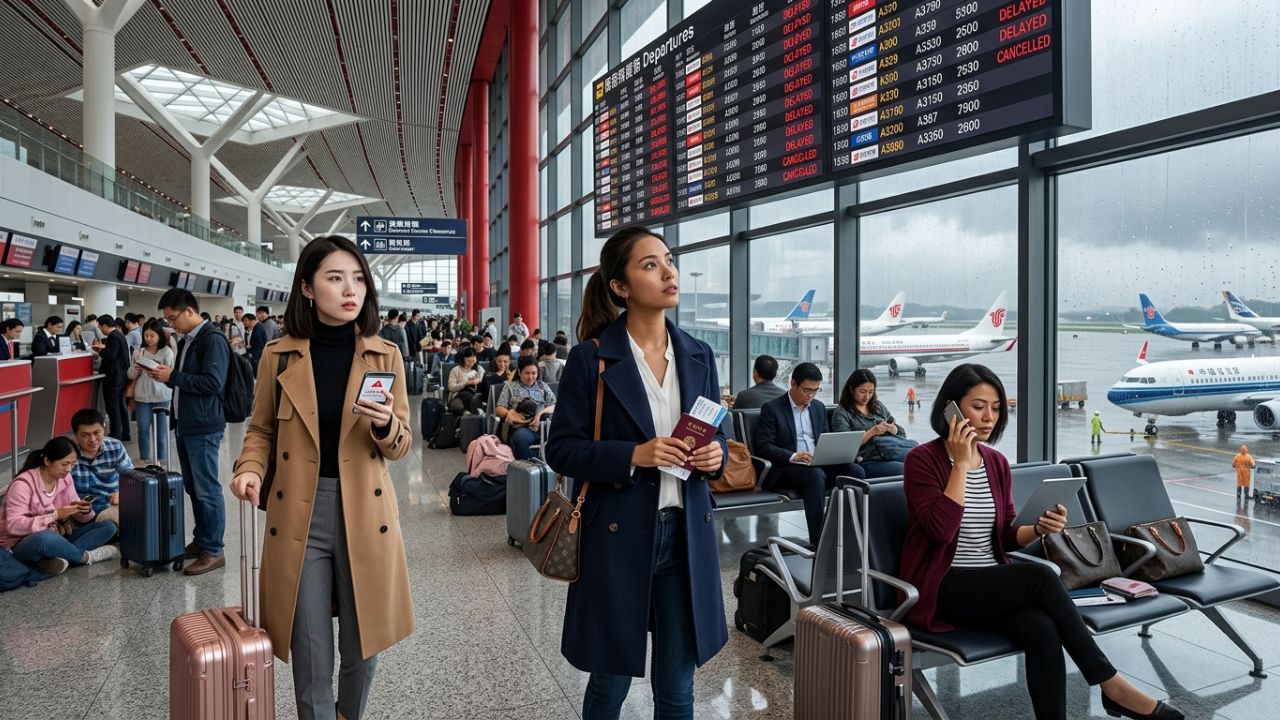
Image generated by AI
In a catastrophic, continental logistical breakdown that has completely destabilized both domestic and international passenger transit, a massive wave of airport disruptions has paralyzed the Chinese aviation network. According to official flight data recorded on June 16, 2026, severe schedule instability triggered an astronomical 2,425 flight delays and 268 outright cancellations across primary commercial gateways. As prominent national operators like Air China, China Eastern, China Southern, and Hainan Airlines scramble to recover their massively backlogged fleets, intense travel chaos is currently tearing through massive mega-hubs in Beijing, Shanghai, Chengdu, Chongqing, and Guangzhou. With thousands of passengers facing missed connections, ruined itineraries, and severe terminal congestion, this sprawling wave of flight cancellations represents the premier headline in today's breaking airline news and essential global aviation updates.
By introducing direct passenger coordination and dynamic scheduling backups, the regional aviation hubs target growing passenger demand across vital commerce sectors. The choice to coordinate flight departures in phases helps to manage gate capacity, supporting the country's broader regional transportation network.
Context: The Collapse of the Chinese Air Corridor
For the thousands of corporate professionals and tourists relying on the precision scheduling of the Chinese aviation grid, the current operational reality has degenerated into an absolute nightmare.
The widespread flight disruptions aggressively exposed the delicate interconnectedness of China's transit infrastructure. When an aircraft is delayed at a primary hub like Beijing Capital early in the day, subsequent legs of that aircraft’s tight rotation cycle are inevitably compromised. This structural dependency explains why smaller regional gateways like Hohhot and Guiyang were plunged into operational difficulties alongside the country’s largest mega-airports. The sheer volume of 2,693 combined disruptions meant that mounting queues rapidly overwhelmed ground handling teams and customer service agents processing alternative transport arrangements. Because air travel is the literal lifeblood of Chinese business connectivity, consecutive delays of this magnitude deeply damage international consumer confidence and threaten the attendance of massive global trade expos hosted in these commercial engines.
To view live flight schedules, specific domestic carrier route maps, or alternative connection options, travelers must consult official Chinese aviation directories. For direct booking access, specific baggage rules, and immediate rebooking portals, passengers should check the official Air China or China Eastern portals. To explore live flight tracking and monitor the exact severity of the rolling airspace closures, passengers can consult the official FlightAware tracking service.
Section-Wise Breakdown of the Continental Meltdown
The Capital Gridlock: Beijing PEK and PKX
The primary northern hub, Beijing Capital International Airport, faced the most extensive delay log of the day, recording an incredible 405 flights delayed and 58 services cancelled entirely. The capital’s newer mega-hub, Beijing Daxing International Airport, was similarly crippled, recording 225 delays and 60 total cancellations. This dual-airport breakdown completely gridlocked the broader Beijing metropolitan area for diplomatic and business travelers.
The Eastern Commercial Engine: Shanghai PVG and SHA
As a critical international gateway, Shanghai Pudong International Airport saw 249 flights delayed and 12 flights cancelled. Its secondary, domestically focused counterpart, Shanghai Hongqiao International Airport, logged 185 delays and 16 cancellations, leaving thousands of corporate commuters stranded in terminal concourses.
The Southern and Western Hubs: Guangzhou and Chengdu
Situated as the vital southern gateway, Guangzhou Baiyun International Airport registered the absolute highest overall number of delays in the country, with a staggering 479 flights delayed alongside 35 cancellations. In the western interior, Chongqing Jiangbei International Airport recorded 179 delays and 10 cancellations, while Chengdu Shuangliu International Airport suffered 143 flight delays and 8 complete cancellations.
The Regional and Coastal Arteries
The disruption severely impacted regional and coastal connectivity. Hangzhou Xiaoshan International Airport suffered 252 delays and 27 cancellations. On the southern island province, Haikou Meilan International Airport recorded 101 delays and 15 cancellations. Northern routes from Hohhot Baita International Airport faced 91 delays and 14 cancellations. Commuters at Guiyang Longdongbao International Airport met 59 delays and 7 cancellations, while Nanchang Changbei International Airport logged 57 delays and 6 complete cancellations.
Technical Roster: Chinese Disruption Matrix
To ensure absolute factual accuracy regarding the specific airports driving this massive continental aviation failure, the following table details the exact operational metrics generated by the breakdown:
| Major Airport Location | Total Disruptions | Key Operational Impact & Severity Metric |
|---|---|---|
| Beijing Capital (PEK) | 405 Delays, 58 Cancellations | Severe disruption for diplomatic and corporate travel |
| Beijing Daxing (PKX) | 225 Delays, 60 Cancellations | Massive gridlock across the newer capital mega-hub |
| Shanghai Pudong (PVG) | 249 Delays, 12 Cancellations | Critical international long-haul connections heavily disrupted |
| Shanghai Hongqiao (SHA) | 185 Delays, 16 Cancellations | High-frequency domestic corporate routes paralyzed |
| Guangzhou Baiyun (CAN) | 479 Delays, 35 Cancellations | Highest national delay volume, shattering southern logistics |
| Hangzhou Xiaoshan (HGH) | 252 Delays, 27 Cancellations | Significant eastern commercial friction recorded |
| Chongqing Jiangbei (CKG) | 179 Delays, 10 Cancellations | Western interior travel corridor severely compromised |
| Chengdu Shuangliu (CTU) | 143 Delays, 8 Cancellations | Regional Sichuan connectivity throttled by late aircraft |
| Haikou Meilan (HAK) | 101 Delays, 15 Cancellations | Southern island province tourism pipelines severed |
| Hohhot Baita (HET) | 91 Delays, 14 Cancellations | Northern regional schedules subjected to rolling gridlock |
| Guiyang Longdongbao (KWE) | 59 Delays, 7 Cancellations | Southwestern commuters heavily delayed in terminal |
| Nanchang Changbei (KHN) | 57 Delays, 6 Cancellations | Eastern regional hub suffers notable operational friction |
Passenger Impact: Stranded Across the Continent
For the everyday passengers currently trapped inside China's major terminals, the logistical reality is rapidly deteriorating.
The immediate impact of 2,693 rolling disruptions is the total destruction of complex, multi-city itineraries. For international visitors executing tight domestic connections between Beijing and Shanghai, the fear of becoming stranded leads directly to canceled hotel bookings and missed tours. Furthermore, the corporate travel sector is highly sensitive to these systemic shocks. When corporate commuters face hundreds of delays en route to trade expos in Guangzhou or Chengdu, expensive hotel bookings are missed, event attendance drops drastically, and international business confidence is rapidly eroded. The financial premium paid by leisure travelers for holiday packages feels utterly compromised when significant portions of their trip are spent sleeping on the floor of a congested terminal.
Industry Analysis: The Fragility of Precision Scheduling
Aviation industry analysts view the 2,693-flight disruption wave across China as a stark demonstration of the deep structural fragility inherent in mega-hub reliance.
Analysts note that the Chinese aviation network operates on a brutally tight precision scheduling model. Because aircraft rotation cycles are compressed to maximize profitability, there is absolutely no margin for error. When operational safety protocols throttle departures in Beijing, the aircraft required to service the routes in Guangzhou are instantly trapped on the northern seaboard. This forces major operators like Air China and China Southern into a brutal cycle of rolling delays that lasts deep into the night. Analysts warn that repetitive disruptions of this magnitude force carriers and tourism boards to dedicate substantial financial and marketing resources just to reassure the global traveling public that operational stability has been fully restored.
Actionable Advice for Surviving Chinese Flight Disruptions
If you are a traveler relying on Air China, China Eastern, or Hainan Airlines during this massive continental disruption wave, execute this extreme survival checklist immediately:
- Leverage the Airline App: Do not stand in the physical customer service line. Monitor your carrier’s mobile application, enable push notifications, and utilize the digital self-service portal to instantly secure alternative rebooking options.
- Demand Hotel Vouchers Before Exiting: Under standard aviation guidelines, if your delay extends overnight due to factors within the airline's control, complimentary hotel accommodation and transport must be provided. Locate the duty manager before you leave the secure airside zone.
- Secure Official Delay Documentation: To successfully lodge a claim for missed connections through an independent travel insurance policy, you must request an official “Flight Delays/Cancellation Certificate” from the airline’s airport desk. Retain all physical boarding passes.
- Understand Refund Rights: If a flight is cancelled entirely or subjected to a severe delay, passengers generally retain the legal right to cancel their ticket and claim a full refund of the unused portion. However, if you accept an alternative rebooked flight, the right to a refund for the original ticket is completely forfeited.
FAQ: Chinese Airport Flight Disruptions 2026
How severe is the current operational breakdown across Chinese airports?
The Chinese aviation network suffered a catastrophic collapse, officially recording an astronomical 2,425 flight delays and 268 outright cancellations across its primary hubs.
Which specific airports and airlines are most affected by this travel chaos?
The disruption wave heavily impacted Air China, China Eastern, China Southern, and Hainan Airlines. Guangzhou Baiyun recorded the highest delays (479), while Beijing Capital and Daxing suffered massive combined cancellations (118).
What should passengers do to secure hotels or refunds for these delays?
Passengers must locate airline duty managers to secure complimentary hotel vouchers for overnight delays. To claim a refund or travel insurance payout, passengers must acquire an official “Flight Delays/Cancellation Certificate” directly from the airline desk.
The Breaking Point of the Continental Grid
The massive wave of 2,693 flight disruptions ravaging China's primary mega-hubs proves definitively that the nation's transit infrastructure is operating under immense, unsustainable stress in 2026. By entirely devastating the highly scheduled, interconnected operations of Air China, China Eastern, and China Southern, this operational meltdown has ruthlessly exposed the fragility of precision aircraft rotation. As airlines desperately attempt to reposition their fleets and clear the massive backlog of stranded corporate and leisure passengers, travelers must accept a brutal reality: navigating Chinese airspace requires extreme itinerary flexibility, aggressive digital contingency planning, and comprehensive travel insurance to survive unexpected, rolling flight cancellations.
Key Takeaways
- Catastrophic Continental Breakdown: China's aviation network was paralyzed by 2,425 rolling flight delays and 268 outright cancellations.
- Guangzhou Absorbs Heaviest Delays: Guangzhou Baiyun International Airport logged the highest national delay volume, suffering 479 delays and 35 cancellations.
- Beijing Corridors Gridlocked: Beijing Capital and Daxing airports combined for a devastating 630 delays and 118 outright flight cancellations.
- Tourism Sector Threatened: Massive schedule instability directly threatens international consumer confidence, impacting major trade expos and complex leisure itineraries.
- Insurance Documentation Vital: Passengers must secure official "Flight Delays/Cancellation Certificates" from airline staff to successfully claim refunds and insurance payouts.
Related Travel Guides
Severe Travel Chaos Paralyzes Australia Across Major Airlines
Severe Travel Chaos Sweeps the Middle East Across Major Hubs
Chinese Domestic Flight Delays and Air China Compensation Strategies on Reddit
Disclaimer
This article is for informational and educational purposes only. It does not constitute legal, financial, or professional advice. While we strive to provide accurate and up-to-date information, travel policies, regulations, and conditions change rapidly. Always verify information with official sources before making travel decisions. Nomad Lawyer makes no representations about the accuracy, reliability, completeness, or suitability of the information provided. Readers should consult qualified professionals for advice specific to their circumstances. The views expressed in this article are those of the author and do not necessarily reflect the views of Nomad Lawyer.
Kunal K Choudhary
Co-Founder & Contributor
A passionate traveller and tech enthusiast. Kunal contributes to the vision and growth of Nomad Lawyer, bringing fresh perspectives and driving the community forward.
Learn more about our team →