
China and Global Powers Linked to Nepal's 2026 Transboundary Disasters and Glacial Collapses
Global experts link industrial emissions and upstream infrastructure projects by China and other powers to catastrophic flash floods and glacial collapses in Nepal's Himalayan regions.

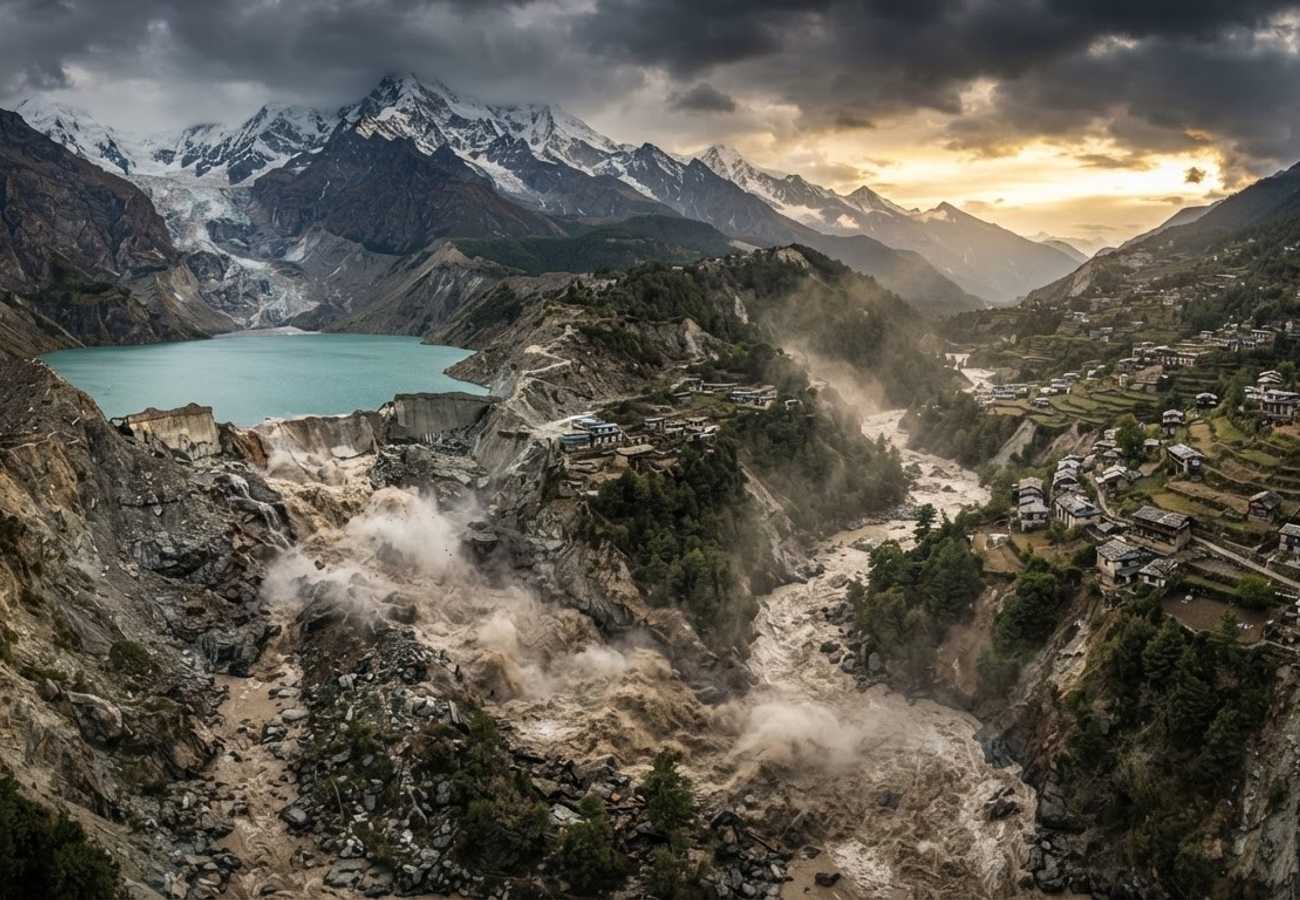
Image generated by AI
The recent surge in catastrophic glacial collapses and flash floods along the Nepal-Tibet border is being attributed to a combination of tectonic volatility and systemic pressures from global superpowers.
Our analysis of reports from global experts indicates that while natural tectonic activity is the baseline cause, the scale of recent disasters is being amplified by industrial emissions and high-risk infrastructure projects. The fragility of the Himalayan borders has turned these environmental shifts into human catastrophes for mountainous communities and travelers.
Recent devastation has concentrated along the Bhotekoshi and Trishuli rivers. These events are characterized by Glacial Lake Outburst Floods (GLOFs) and massive glacier-collapse avalanches.
The crisis is driven by three primary vectors:
- Cryospheric Instability: The Hindu Kush Himalayan region is warming significantly faster than the global average, leading to permafrost thaw and destabilized rock slopes.
- Upstream Alterations: Infrastructure and industrial expansion on the Tibetan plateau (China) have modified local hydrology and sediment transport.
- Developmental Pressure: Rapid road construction and river-basin interventions, often funded by international financial institutions and executed by regional firms, have over-steepened slopes.
Regional Impact Breakdown
The following table outlines the specific contribution mechanisms and their direct impacts on the Nepali landscape:
| Entity | Primary Contribution Mechanism | Main Disaster Impact on Nepal |
|---|---|---|
| Industrialized Economies | High cumulative carbon emissions | Accelerated glacier melt and permafrost thaw |
| China | Upstream Tibetan regional projects | Transboundary flash floods and river flow changes |
| India | Tectonic subduction & engineering investments | Seismic activity and slope destabilization |
| International Finance | Development loans and aid funding | Unplanned valley urbanization and hazard exposure |
Passenger Rights & Advisory
For travelers currently in or planning trips to the Himalayan regions of Nepal, the risk profile has shifted from "seasonal" to "systemic."
For the affected traveler, this means:
- Evacuation Rights: If your tour operator or airline cancels a trip due to these "natural" disasters, check if the event is classified as "Force Majeure." Under most international travel laws, you are entitled to a refund of unused services, though "acts of God" may limit additional compensation.
- Insurance Limitations: Our analysis of current policy trends suggests that "standard" travel insurance may not cover GLOFs or flash floods if the region was under a government-issued warning at the time of booking. Ensure your policy specifically covers "natural catastrophe evacuation."
- Safety Protocols: Avoid overnight stays in narrow river valleys or near the base of steep, recently constructed road networks. These areas are currently high-risk zones for debris flows.
Actionable Steps:
- Monitor the National Disaster Risk Reduction and Management Authority (NDRRMA) portal for real-time alerts.
- Verify the ecological resilience metrics of your trekking or tour provider.
- Maintain a digital copy of your passport and insurance policy in a cloud-based folder for rapid emergency processing.
The transition from reactive relief to proactive risk management is now a necessity. The current model of "economic output over ecological safety" is failing. When international financial institutions prioritize energy production and tourism corridors without rigorous high-altitude hazard mapping, they effectively place tourists and residents in the path of predictable disasters.
The lack of cross-border data sharing between Tibet and Nepal remains a critical failure. Until there is a transparent, real-time exchange of upstream water level data, downstream communities will remain vulnerable to sudden, catastrophic surges.
The Himalayan slopes can no longer sustain aggressive industrialization without a total overhaul of transboundary accountability.
Related Travel Guides
Disclaimer
This article is for informational and educational purposes only. It does not constitute legal, financial, or professional advice. While we strive to provide accurate and up-to-date information, travel policies, regulations, and conditions change rapidly. Always verify information with official sources before making travel decisions. Nomad Lawyer makes no representations about the accuracy, reliability, completeness, or suitability of the information provided. Readers should consult qualified professionals for advice specific to their circumstances. The views expressed in this article are those of the author and do not necessarily reflect the views of Nomad Lawyer.
Kunal K Choudhary
Co-Founder & Contributor
A passionate traveller and tech enthusiast. Kunal contributes to the vision and growth of Nomad Lawyer, bringing fresh perspectives and driving the community forward.
Learn more about our team →