Canada Travel Surge 2026: 54 Visa-Free Nations, Airport Gateways & Cultural Guide


Few travelers realize that the only direct German attack on North American soil during World War II unfolded not along coastal shipping lanes, but right in Conception Bay at Newfoundland's Bell Island, where U-boats torpedoed iron ore carriers in 1942. That dramatic coastal frontier sits alongside 4.6 kilometers of fortified stone ramparts in Québec City and alpine sanctuaries in the Rockies, creating a diverse terrain of heritage and wilderness now experiencing unprecedented international interest. Supported by streamlined entry policies spanning 54 visa-free partner countries as of September 2026—including Slovakia, the United States, Japan, South Korea, France, Germany, and the United Kingdom—international visitors are arriving in historic numbers.
Data compiled by Statistics Canada and Destination Canada confirms that international arrivals hit 6.8 million in July 2026 (a 6.3 percent jump over 2025) before climbing to 6.9 million arrivals in August 2026, marking a 4.3 percent year-on-year increase. Across the wider economy, where national nominal GDP stands at roughly $2.51 trillion USD according to the International Monetary Fund, the visitor economy provides a 1.8 percent direct economic contribution, with overseas and transborder travelers spending $7.2 billion in the first quarter of 2026 alone.
The Global Transit Shift: 54 Nations Unlocking Northern Corridors
The expansion of frictionless mobility across 54 sovereign territories is transforming how international explorers access Canada's regional destinations. The list of visa-exempt jurisdictions covers European partners such as Andorra, Austria, Belgium, Bulgaria, Croatia, Cyprus, Czechia, Denmark, Estonia, Finland, France, Germany, Greece, Hungary, Iceland, Ireland, Italy, Latvia, Liechtenstein, Lithuania, Luxembourg, Malta, Monaco, Netherlands, Norway, Poland, Portugal, Romania, San Marino, Slovakia, Slovenia, Spain, Sweden, Switzerland, United Kingdom, and Vatican City. Across the Asia-Pacific and Americas, eligible travelers arrive seamlessly from Australia, Brunei, Hong Kong, Japan, New Zealand, Papua New Guinea, Samoa, Singapore, Solomon Islands, South Korea, Taiwan, Barbados, The Bahamas, Chile, and the United States, alongside Gulf partners including Qatar and the United Arab Emirates, plus Israel.
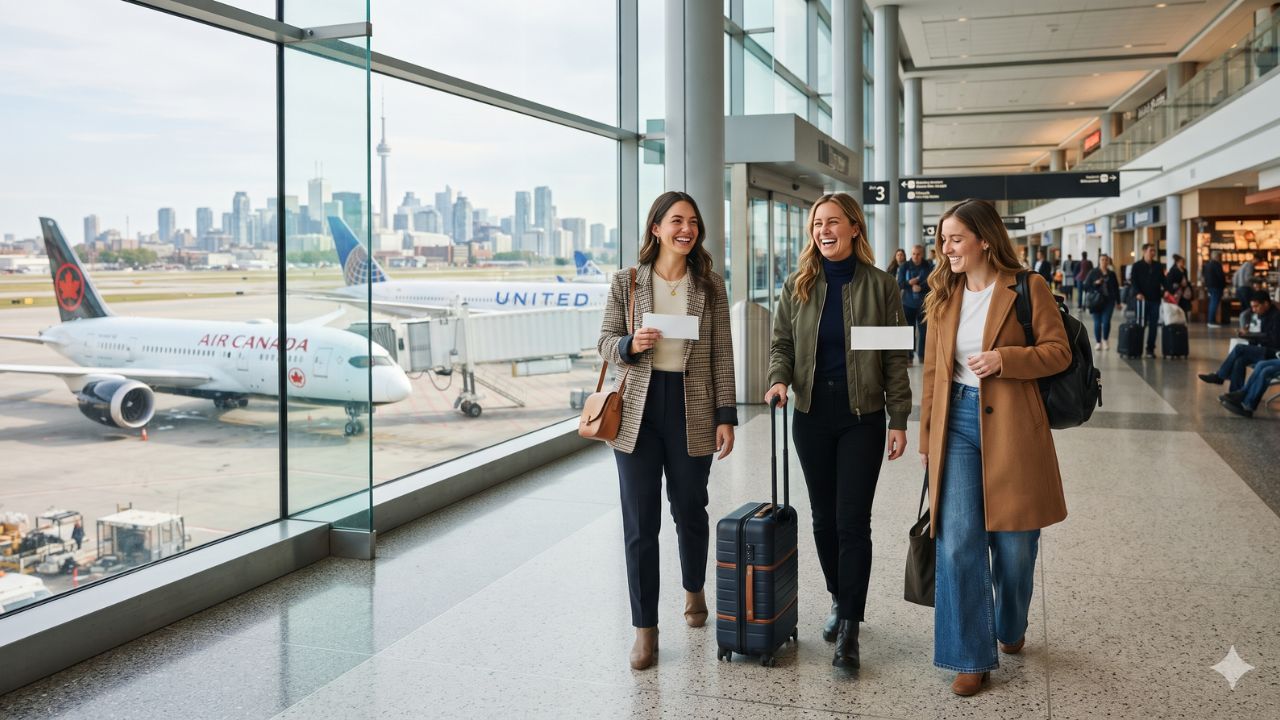
Handling this massive influx is a network of powerhouse aviation hubs that posted record volumes throughout 2025 and 2026. Toronto Pearson International Airport anchors national operations as the primary gateway, having processed approximately 47.3 million passengers in 2025 across domestic, transborder, and long-haul international terminals. On the Pacific coast, Vancouver International Airport handled 26.4 million travelers in 2025, acting as the primary transpacific bridge to East Asia and Oceania. In French Canada, Montréal–Trudeau International Airport welcomed 20.3 million passengers, while western alpine traffic funneled through Calgary International Airport with nearly 18 million travelers and Edmonton International Airport registering 8.1 million flyers.
Domestic and international airline competition has intensified alongside passenger records. Air Canada generated approximately C$22.4 billion in 2025 revenue, anchoring global connectivity through its Star Alliance network. Calgary-based WestJet generated an estimated C$5 billion to C$6 billion by capturing mountain leisure and transborder sun routes. Leisure specialist Air Transat secured roughly C$3 billion in estimated revenue connecting Canadian gateways with European and Caribbean destinations. Meanwhile, fleet expansions from Porter Airlines propelled its earnings to an estimated C$1.5 billion to C$2 billion, while ultra-low-cost carrier Flair Airlines produced between C$500 million and C$1 billion catering to budget-conscious road warriors.
| Entity / Route | Metrics | Operational Status |
|---|---|---|
| Canadian Aviation Gateway | 2025 Passenger Volume | Strategic Regional Function |
| Toronto Pearson (YYZ) | 47.3 Million | National & Transatlantic Hub |
| Vancouver International (YVR) | 26.4 Million | Asia-Pacific Gateway |
| Montréal–Trudeau (YUL) | 20.3 Million | Francophone & European Gateway |
| Calgary International (YYC) | Nearly 18.0 Million | Rocky Mountain Adventure Base |
| Edmonton International (YEG) | 8.1 Million | Northern Alberta & Arctic Hub |
What Makes Canadian Heritage and Wild Frontiers Different
Beyond headline statistics, Canada's appeal rests in the rare juxtaposition of four centuries of preserved urban fortification and remote maritime outposts. In Québec City, the Fortifications of Québec National Historic Site represents the only preserved fortified city walls north of Mexico. Stretching 4.6 kilometers around Old Québec, these stone bastions frame panoramic views of the St. Lawrence River. Directly above the cliffs of Cap Diamant stands La Citadelle, an imposing star-shaped military fortification constructed between 1820 and 1831 based on French defensive engineering. It remains an active operational garrison and the official home of the Royal 22e Régiment since 1920.
A short walk through the cobblestones of the Old Port leads to the Musée de la Civilisation. Designed by architect Moshe Safdie, the museum integrates contemporary architecture with seventeenth-century structures, presenting continuous historical records from early European contact in 1535 through modern First Nations self-governance.
On the eastern edge of the continent in Newfoundland and Labrador, Signal Hill towers over the historic harbor of St. John's. At its summit, Cabot Tower—built starting in 1898 to commemorate Queen Victoria's Diamond Jubilee and the 400th anniversary of John Cabot's 1497 landfall—marks the birthplace of modern wireless telecommunications, where Guglielmo Marconi received the very first transatlantic radio signal in 1901. A short ferry crossing into Conception Bay brings travelers to Bell Island, where rusted WWII coastal gun batteries overlook the offshore waters where German submarines sank Allied freighters carrying vital iron ore.
For luxury travelers seeking immersion in natural wonder, legendary grand railway hotels provide bases unmatched anywhere in the world. Fairmont Banff Springs, known as the "Castle in the Rockies" within Banff National Park, pairs nineteenth-century baronial architecture with alpine hot springs. In Québec, Fairmont Château Frontenac stands as one of the most photographed hotels in the world, while urban luxury thrives at the Four Seasons Hotel Toronto in Yorkville, Fairmont Pacific Rim in downtown Vancouver, and The Ritz-Carlton Toronto adjacent to the entertainment district.
Visitor Insider Tips
- Bypassing Old Québec Congestion: Walk the 4.6-kilometer ramparts along the Fortifications of Québec early between 07:30 and 09:00 before tour coaches arrive. Entry to the wall walking path is free year-round, offering optimal photography angles over the Lower Town without crowds.
- Bell Island Subsea & Coastal Exploration: Take the 20-minute vehicle ferry from Portugal Cove to Bell Island near St. John's. Beyond the mine museum, head to the coastal cliffs at Grebes Nest for dramatic Atlantic views; advanced scuba divers can book guided wreck dives on the four sunken 1942 iron ore freighters lying in clear coastal waters.
- Transborder & Domestic Flight Connections: When connecting through Toronto Pearson or Vancouver during peak holiday periods, allocate a minimum of 2.5 hours for domestic-to-international transfers and 3 hours for United States pre-clearance processing.
- Regional Culinary Discoveries: Skip tourist traps around standard poutine joints; seek out authentic regional staples like tourtière in Québec's Lower Town, salt cod cakes and toutons with molasses in Newfoundland outports, and wild Pacific sockeye salmon paired with Okanagan Valley wines in Vancouver.
- Public Transport and Intercity Transit: Use the UP Express train to travel between downtown Toronto's Union Station and Pearson Airport in 25 minutes flat, avoiding highway gridlock. In Vancouver, the automated SkyTrain Canada Line links YVR Airport to downtown waterfront docks in 26 minutes.
Cultural and Environmental Context
The surge in international visitor numbers—with single-month arrivals reaching 6.9 million—presents complex environmental stewardship responsibilities across fragile national park ecosystems and historic urban cores. Parks Canada has instituted rigorous visitor management controls in high-traffic zones like Banff and Lake Louise, mandating public shuttle reservations to reduce private vehicular emissions and wildlife corridor disruptions.
At heritage sites, indigenous collaboration plays an increasingly central role in narrative interpretation. The Musée de la Civilisation in Québec City works directly with Huron-Wendat, Innu, and Mi'kmaq elders to ensure exhibition narratives accurately reflect ancestral territories rather than exclusively focusing on colonial defensive history. On maritime shores, local community trusts across Newfoundland actively preserve delicate coastal seabird nesting grounds while managing heritage tourism around historic mine workings. Responsible travelers are encouraged to utilize scheduled rail connections, support indigenous-owned tourism enterprises, and adhere strictly to Leave No Trace principles across national parks.
FAQ: Visiting Canada 2026
What entry authorization do travelers from the 54 visa-free nations need?
Travelers from visa-exempt countries flying to Canada must secure an electronic Travel Authorization (eTA) online before departure. US citizens only require a valid passport.
What is the best season to explore both cultural cities and national parks?
September through mid-October offers pleasant autumn weather, striking fall foliage across Québec and Ontario, active wildlife in the Rockies, and manageable visitor volumes.
How do I travel efficiently between Toronto, Montréal, and Québec City?
VIA Rail operates frequent passenger rail service along the Quebec City–Windsor Corridor, linking downtown stations directly and eliminating airport security delays.
Are reservations mandatory for visiting popular national parks?
Yes, popular attractions like Moraine Lake and Lake Louise in Banff National Park require advance shuttle bookings or public transit passes from May through October.
[Canada rewards those who look past the postcard views, offering rich cultural depth across centuries-old fortified cities and wild Atlantic shores.]
Related Travel Guides
This article is for informational purposes. Flight routes, passenger regulations, visa rules, and transit advisories are subject to change by airlines and aviation authorities. Readers are advised to verify schedules and travel documentation with relevant carriers and border agencies before departure.
Related Stories
Canada and US Expand Cross-Border Travel as Air Canada and United Airlines Reveal Six New Summer 2027 Routes

Ayodhya Deepotsav 2026 Logistics Guide: Attending the 30 Lakh Lamp Festival in India