
Canada and Alberta Expand High-Speed Internet
Canada and Alberta Expand High-Speed Internet

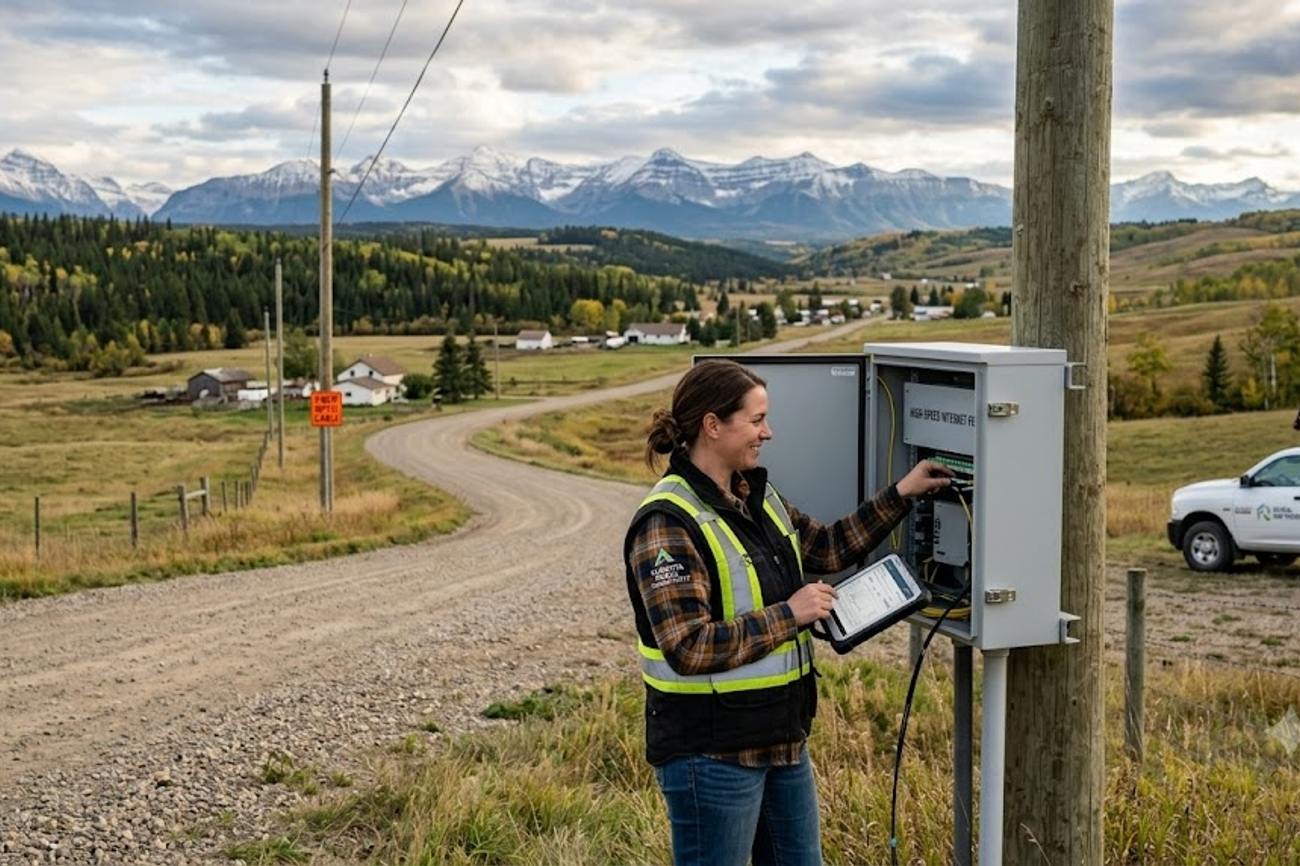
Image generated by AI
1,833 rural Alberta households are the direct beneficiaries of a new $24.8 million infrastructure injection aimed at eliminating the final pockets of digital isolation in the province. This funding, split across two targeted broadband projects, represents the latest tactical move in a massive federal-provincial effort to bridge the gap between urban connectivity and remote wilderness. While the numbers may seem modest compared to the $780 million partnership established in March 2022, they highlight the exponential cost and complexity of reaching the "final mile" of connectivity in Canada's rugged geography.
The High Cost of the Final Two Percent
The current investment is not a standalone initiative but a continuation of a strategic alliance between the Government of Canada and the province of Alberta. To understand the scale of this effort, one must look at the total capital commitment: up to $780 million dedicated to rural, remote, and Indigenous communities. This specific $24.8 million allocation targets areas where the commercial incentive for internet service providers (ISPs) is non-existent due to low population density and prohibitive terrain costs.
Alberta currently maintains a high-speed Internet coverage rate of 98.1% for households. On the surface, this suggests a nearly completed project. However, the remaining 1.9% of the population often resides in the most challenging environments—areas where laying fiber-optic cable or installing satellite arrays requires significant government subsidies to be viable. This is a microcosm of the national struggle; while 97.4% of Canadian households now have high-speed access (a massive jump from 79% in 2014), the final stretch toward universal access is the most expensive per household.
The federal government, operating through the Universal Broadband Fund, has allocated a total of $3.225 billion to ensure no Canadian is left offline. In Alberta specifically, the federal contribution has totaled $554 million since 2015. The goal is a tiered rollout: 98% national coverage by the end of 2026, and a total 100% saturation by 2030.
Connectivity Metrics and Infrastructure Targets
The definition of "high-speed" is not arbitrary. For these projects to be considered successful, the infrastructure must meet the Canada Connectivity Strategy's minimum service thresholds. These benchmarks are designed to support modern data-heavy activities like 4K streaming, telehealth, and cloud-based business operations.
| Metric | Target/Current Value |
|---|---|
| Minimum Download Speed | 50 Mbps |
| Minimum Upload Speed | 10 Mbps |
| Current Alberta Coverage | 98.1% |
| Current National Coverage | 97.4% |
| National Target (2026) | 98% |
| National Target (2030) | 100% |
| Total Universal Broadband Fund | $3.225 Billion |
| Alberta Federal Investment (Since 2015) | $554 Million |
| Current Project Funding | $24.8 Million |
| Households Impacted (Current Project) | 1,833 |
Expert Analysis: The Digital Infrastructure Paradox
For the modern nomad or the rural entrepreneur, this investment is less about "faster browsing" and more about the viability of remote existence. From an aviation and travel perspective, the expansion of broadband into rural Alberta creates a direct cause-and-effect chain that alters the economic geography of the region.
First, there is the "Tourism Discoverability" effect. In the current travel market, a destination that does not exist on a digital map or lacks a real-time booking engine effectively does not exist for the international traveler. By bringing 1,833 homes—many of which are likely small-scale lodges, B&Bs, or adventure outfitters—online, the government is essentially expanding the province's tourism inventory. When a remote lodge can process electronic payments and manage reservations via the cloud, it can compete with urban hotels for the "slow travel" market.
Second, the pricing pressure on rural living is shifting. Historically, the "rural tax" involved not just higher shipping costs but the cost of time—driving hours to a city for a medical appointment or a government filing. The integration of telehealth and e-government services, powered by the 50/10 Mbps standard, reduces the operational cost of living in remote Alberta.
However, a critical nuance exists: infrastructure is not the same as access. The International Telecommunication Union (ITU) frequently notes that the "digital divide" is three-fold: availability, affordability, and literacy. While the $24.8 million solves the availability problem, it does not guarantee that the monthly subscription costs will be affordable for low-income rural residents or that the elderly population will have the devices necessary to utilize the connection. For the traveler, this means that while the "map" says a region is connected, the actual digital experience on the ground may still be fragmented.
Finally, the safety implications cannot be overstated. In remote regions, connectivity is a survival tool. The government's mention of the disproportionate risks faced by Indigenous women, girls, and Two-Spirit individuals highlights that broadband is a security infrastructure. For those navigating the Alberta backcountry, the ability to access emergency services and real-time safety alerts is a prerequisite for sustainable tourism growth.
Key Takeaways
- Targeted Expansion: $24.8 million is being deployed to bring high-speed Internet to 1,833 rural Alberta homes, focusing on the hardest-to-reach 1.9% of the province.
- Strict Performance Standards: To qualify as "high-speed," connections must provide at least 50 Mbps download and 10 Mbps upload speeds.
- Aggressive Deadlines: The Canadian government is aiming for 98% national household coverage by 2026 and total 100% coverage by 2030.
- Tourism Catalyst: Improved connectivity allows rural operators to adopt digital booking, electronic payments, and social media marketing, increasing their visibility to global travelers.
- Broad Financial Backing: This project is a subset of the $3.225 billion Universal Broadband Fund and a $780 million Alberta-specific partnership.
FAQ: Alberta Rural Broadband 2024
What is the minimum speed for "high-speed" internet in rural Alberta? Under the Canada Connectivity Strategy, the target service level is a minimum of 50 Mbps for downloads and 10 Mbps for uploads. This is designed to support remote work, education, and telehealth.
How does this investment affect tourists visiting remote Alberta? It improves the visitor experience by enabling reliable GPS, digital payment options at remote businesses, and better real-time communication with local tour operators and safety services.
When will Canada reach 100% internet coverage? The federal government has set a target date of 2030 to achieve 100% high-speed Internet access for all households across the country.
Who is funding these rural internet projects? The projects are funded through a partnership between the Government of Canada and the Government of Alberta, utilizing resources from the $3.225 billion Universal Broadband Fund.
Digital equity is no longer a luxury; it is the baseline for economic survival in the remote wilderness.
Tags: Alberta Broadband 2024, Universal Broadband Fund, Canada Connectivity Strategy, Rural Alberta Tourism, Digital Divide Canada
Related Travel Guides
Disclaimer
This article is for informational and educational purposes only. It does not constitute legal, financial, or professional advice. While we strive to provide accurate and up-to-date information, travel policies, regulations, and conditions change rapidly. Always verify information with official sources before making travel decisions. Nomad Lawyer makes no representations about the accuracy, reliability, completeness, or suitability of the information provided. Readers should consult qualified professionals for advice specific to their circumstances. The views expressed in this article are those of the author and do not necessarily reflect the views of Nomad Lawyer.
Preeti Gunjan
Contributor & Community Manager
A passionate traveller and community builder. Preeti helps grow the Nomad Lawyer community, fostering engagement and bringing the reader experience to life.
Learn more about our team →