
Canada's Air Travel Collapses: 31 Flights Cancelled, 246 Delayed Across Jazz, Air Canada, WestJet, and Regional Carriers in June 2026
Major Canadian airlines face simultaneous operational meltdown. Jazz, Air Canada, WestJet, and regional carriers cancel 31 flights and delay 246 across Montreal, Toronto, Calgary, and remote Arctic hubs.

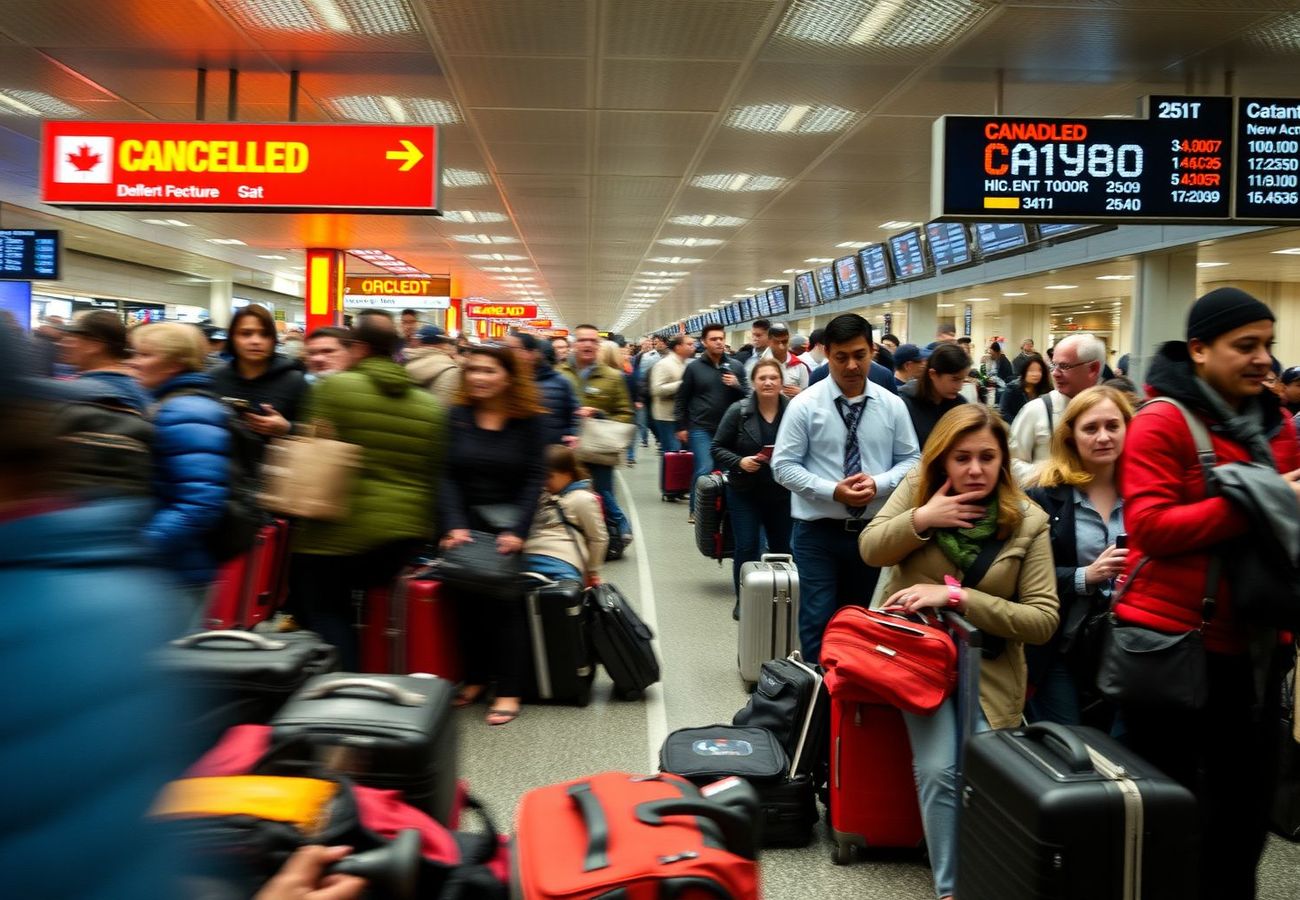
Image generated by AI
Canada's Air Travel System Seizes Up as Multiple Carriers Implode Simultaneously
Canada's aviation sector descended into chaos on June 5, 2026, as Jazz, Air Canada, Air Canada Rouge, WestJet, PAL Airlines, Air Inuit, and other carriers executed a staggering 31 flight cancellations and 246 delays in a single day. The cascading operational collapse rippled through every major Canadian hub—from Montreal-Trudeau and Toronto Pearson to Calgary International, plus remote northern airports serving communities in Puvirnituq and Inukjuak.
What started as isolated technical hiccups mushroomed into a nationwide travel disaster, leaving thousands of passengers stranded and scrambling for rebooking options.
Reddit: "Stuck at YYZ for 8 hours. Jazz just cancelled my connection to Ottawa. Nobody at the counter knows anything." — r/canadianairtravelers
Montreal-Trudeau Takes the Hardest Hit
Montreal-Trudeau International Airport emerged as ground zero for the disruptions, recording 9 cancellations and 92 delays—by far the most severe concentration of chaos in Eastern Canada. The airport's status as a major Air Canada and Jazz hub meant that cascading delays rippled through its connecting flight network within minutes.
Toronto Pearson International, Canada's busiest airport, reported 2 cancellations and 75 delays, while Toronto City Centre Airport recorded 6 cancellations and 24 delays. The dual-airport system meant passengers faced compounded confusion: which terminal operated normally? Which airline could accommodate rebooking?
Calgary International saw 7 cancellations and 37 delays, positioning the Western hub as the third-most-disrupted airport. Ottawa Macdonald-Cartier documented 2 cancellations and 10 delays, confirming the disruptions transcended geography.
Even remote northern airports couldn't escape the contagion. Puvirnituq recorded 3 cancellations and 6 delays, while Inukjuak posted 2 cancellations and 2 delays. For isolated Arctic communities dependent on limited weekly flight frequencies, these suspensions threatened supply chains and essential passenger connections.
Jazz Airlines and Air Canada Shoulder the Operational Burden
Jazz (ACA), Air Canada's regional feeder airline, suffered the worst single-airline disruption with 12 cancellations and 55 delays—nearly half of all cancellations nationwide. Jazz operates the majority of Air Canada's regional routes feeding passengers into major hubs, making its operational failure a domino effect across the entire network.
Air Canada mainline reported 2 cancellations and 77 delays—fewer cancellations but substantially more delays, suggesting systemic bottlenecking rather than operational shutdown. Air Canada Rouge, the carrier's leisure-focused subsidiary, added 2 cancellations and 13 delays.
WestJet, Canada's dominant low-cost carrier, experienced 2 cancellations and 33 delays, primarily affecting Western domestic and transborder routes. Air Inuit, which operates essential Arctic and northern services, faced 4 cancellations and 26 delays. PAL Airlines, another regional carrier, documented 4 cancellations and 8 delays.
The breadth of affected carriers—spanning full-service, low-cost, and specialized regional operators—pointed toward systemic infrastructure strain rather than individual airline failure.
Root Causes: Congestion, Weather, and Cascading Failures
Industry analysts pinpointed three converging factors: elevated summer travel demand, unpredictable weather across multiple regions, and synchronized ground handling constraints at Canada's largest terminals. High passenger volumes compounded airport congestion, while weather fluctuations in Central Canada delayed aircraft repositioning.
Once delays accumulated, the domino effect accelerated. A Jazz flight delay at Montreal cascaded into missed connections at Toronto, triggering secondary cancellations downstream. Aircraft positioned out of sync meant subsequent departure slots vanished—airlines cancelled rather than operate multiple-hour-delayed flights.
For more context on aviation industry pressures, Canadian aviation safety standards and air traffic management protocols regulate airspace utilization during peak periods, but demand occasionally overwhelms infrastructure capacity.
Affected Travelers Face Extended Disruption Windows
Passengers navigating the chaos faced average delay durations of 4-8 hours, with some connections requiring complete rebooking onto next-available flights 48+ hours later. Business travelers and leisure passengers suffered equally—no airline offered premium treatment during system-wide collapse.
The disruptions disproportionately impacted:
- Connecting passengers: Those transiting through Montreal or Toronto faced cascading missed connections, with some rerouted through alternative Canadian airports or U.S. hubs.
- Regional travelers: Arctic communities dependent on Air Inuit and PAL Airlines faced supply delivery delays and healthcare appointment cancellations.
- Western route passengers: WestJet delays affected Calgary-based travelers and transborder traffic to the U.S. Pacific Northwest.
Actionable Steps for Affected Passengers
Travelers caught in the disruption received the following guidance:
Real-time flight status monitoring: Check Air Canada, WestJet, Jazz, Air Inuit, and PAL Airlines websites and mobile applications for live gate changes and rescheduled departure times.
Immediate airline contact: Cancelled passengers must contact airline customer service directly—phone lines and chat support experienced 60+ minute wait times during peak disruption hours.
Alternative airport consideration: Passengers in Eastern Canada should evaluate Ottawa Macdonald-Cartier as a bypass option; Western travelers might consider Edmonton International or U.S. airports like Seattle-Tacoma or Minneapolis-St. Paul.
Essential preparation: Extended waiting times demand accessible water, snacks, phone chargers, and critical documents. Traveling with a physical copy of your itinerary proved invaluable when airline systems experienced slowdowns.
Connecting flight verification: Passengers must independently confirm onward flights remained scheduled—airline rebooking systems lagged behind cancellation waves by hours.
Airline notification enrollment: Most carriers offer SMS or email alerts for gate changes, departure delays, and rescheduled times. Activation takes 60 seconds and prevents surprise delays.
What This Chaos Reveals About Canadian Aviation Infrastructure
The June 2026 disruptions exposed fragilities in Canada's air network. When multiple carriers experience simultaneous operational strain, the system lacks redundancy and surge capacity. Ground handling resources, airport tarmac space, and aircraft positioning suffer bottlenecking.
Unlike the U.S. Federal Aviation Administration's NextGen air traffic modernization, Canadian Nav Canada operates on aging protocols that struggle during simultaneous multi-airport congestion. Equipment failures, weather delays, or labor shortages cascade instantly across the network.
The chaos also demonstrated that Canada's reliance on hub-and-spoke routing (Montreal and Toronto as primary connectors) creates systemic vulnerability. When Eastern Canada experiences disruption, Western routes suffer secondary impacts within hours.
The Path Forward
Nav Canada and major Canadian carriers must implement surge-capacity protocols: pre-positioned spare aircraft, dedicated ground crew surge staffing, and automated rebooking systems that respond in real-time rather than queue-based delays.
Until infrastructure modernization accelerates, summer 2026 travel across Canada carries elevated disruption risk. Passengers should book flights with 4+ hour layovers, purchase travel insurance with disruption coverage, and maintain flexibility on non-essential routes.
The June 5 chaos serves as stark reminder: Canada's air network functions optimally under normal conditions, but stress-testing reveals brittle infrastructure inadequate for sustained demand.
Monitor FlightAware Canada and your airline's official channels continuously during peak travel season—disruption risk remains elevated.
Related Travel Guides
Cockpit Audio Exposes Critical Final Moments Before Fatal UPS Cargo Crash in Kentucky
Disclaimer
This article is for informational and educational purposes only. It does not constitute legal, financial, or professional advice. While we strive to provide accurate and up-to-date information, travel policies, regulations, and conditions change rapidly. Always verify information with official sources before making travel decisions. Nomad Lawyer makes no representations about the accuracy, reliability, completeness, or suitability of the information provided. Readers should consult qualified professionals for advice specific to their circumstances. The views expressed in this article are those of the author and do not necessarily reflect the views of Nomad Lawyer.
Preeti Gunjan
Contributor & Community Manager
A passionate traveller and community builder. Preeti helps grow the Nomad Lawyer community, fostering engagement and bringing the reader experience to life.
Learn more about our team →