
Moderate 4.6 Earthquake Jolts California's Bay Area, Prompting Rapid Seismic Activity Alerts
Early morning terror hit Northern California as a shallow 4.6 magnitude earthquake violently shook the Santa Cruz Mountains, echoing stark tremors directly across San Francisco, Oakland, and Berkeley.

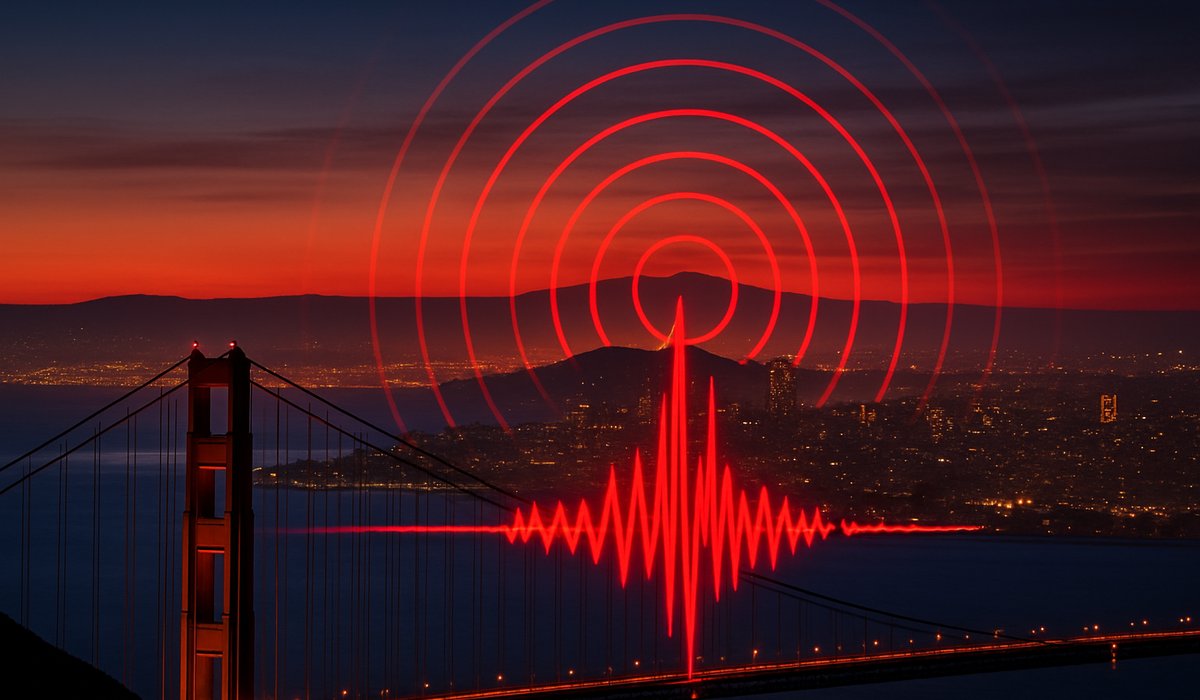
Image generated by AI
Shallow Fault Rupture Delivers 1:41 AM Wake-Up Call to Millions
Reminding the entire tech corridor of its immense geological vulnerability, a sharp, highly noticeable 4.6 magnitude earthquake aggressively jolted Northern California, echoing severe structural shaking straight from the epicenter in the Santa Cruz Mountains deeply into the dense populations of the San Francisco Bay Area. Striking at precisely 1:41 a.m. PST, the tremor violently interrupted sleep cycles across millions of residents and tourists, heavily triggering the United States Geological Survey (USGS) ShakeAlert early warning systems directly to mobile devices right before the primary wave hit.
The epicenter was locked extremely shallow—measured at an approximate depth of only 6.7 miles—directly underneath the small, forested mountain community of Boulder Creek. While a 4.6 magnitude event is medically classified as "moderate" and falls well short of executing catastrophic infrastructural collapse, the razor-thin depth of the crustal failure ensured that the seismic energy transferred with maximum superficial violence, causing violently swinging fixtures, shattering glass, and terrorizing hotel guests hovering in high-rises throughout San Jose, Oakland, and San Francisco.
The Reality of Bay Area Tectonics
The Bay Area is functionally a geographic spiderweb of highly unstable fault lines, heavily dominated by the notorious San Andreas and Hayward faults. When a moderate quake hits regions like Santa Cruz, the psychological damage is often far higher than the physical damage.
For international tourists or out-of-state tech employees visiting Silicon Valley unaccustomed to seismic life, waking up to the walls of a 20-story hotel violently swaying in the dark induces severe panic. Structural engineers have aggressively mandated that modern Bay Area high-rises are explicitly designed to flex and sway like fishing rods to absorb seismic impacts, but the visceral sensation to the traveler is deeply alarming.
Actionable Earthquake Threat Matrix
| Threat Indicator | Regional Detail | Safety Consequence |
|---|---|---|
| Shallow Depth (6.7 miles) | Intense, sudden localized shaking | High risk of falling books, lamps, and glass |
| Epicenter Geography | Santa Cruz Mountains | High likelihood of secondary landslides blocking roads |
| Structural Design | Bay Area High-Rises | Buildings will sway heavily; do not rush the stairs |
What Guests Get
- Immediate technical reassurance — understanding that a 4.6 magnitude quake is meant to feel violent locally, but lacks the raw kinetic energy to actually collapse modern Californian infrastructure.
- Seismic early warning insight — realizing that the loud buzzing alarm that hit their smartphone moments before the shaking was the highly advanced ShakeAlert network doing its job perfectly.
- Evacuation clarity — learning the absolute golden rule of seismic survival: running outside during an earthquake is statistically how you get crushed by falling bricks or glass.
What This Means for Travelers
If you are traveling currently in Northern California: Treat any earthquake above a 4.0 as a highly likely precursor to "aftershocks" over the next 48 hours. If you are staying in the Santa Cruz mountains or driving highways 17 or 9, be relentlessly aware of potential landslides or falling rock faces. Tremors severely loosen the soil, and spring rains can instantly pull mudshots down onto the asphalt, trapping rental cars.
The Hotel Safety Protocol: If you are staying in a multi-story hotel in San Francisco or San Jose and an earthquake violently hits, Drop, Cover, and Hold On. Roll out of bed, drop beneath the heavy desk in your room, and grip the leg. Do absolutely not run into the dark hallway towards the elevator or the stairs. The stairs are structurally inflexible and highly dangerous during an active shake. Wait until the swaying entirely stops before evacuating.
FAQ: Surviving California Earthquakes
Why did my phone go off before the earthquake hit? The USGS operates "ShakeAlert," a grid of hyper-sensitive sensors deep underground. Because digital signals travel at the speed of light, and seismic waves travel slowly through rock, the system can instantly beam a warning to your phone giving you 5 to 15 seconds to brace yourself before the actual physical shaking arrives at your location.
Can a 4.6 earthquake cause a tsunami in California? No. It requires a massive geological displacement (generally above a 7.0 magnitude) occurring entirely offshore under massive oceanic columns to trigger a true tsunami wave.
Is this "The Big One"? No. A 4.6 magnitude is a highly routine release of geological pressure. However, seismologists perpetually warn that the Bay Area is mathematically overdue for a catastrophic failure above 7.0 (The Big One) on the Hayward or San Andreas fault lines.
Related Travel Guides
The Tourist's Guide to Surviving a California Earthquake
Disclaimer
This article is for informational and educational purposes only. It does not constitute legal, financial, or professional advice. While we strive to provide accurate and up-to-date information, travel policies, regulations, and conditions change rapidly. Always verify information with official sources before making travel decisions. Nomad Lawyer makes no representations about the accuracy, reliability, completeness, or suitability of the information provided. Readers should consult qualified professionals for advice specific to their circumstances. The views expressed in this article are those of the author and do not necessarily reflect the views of Nomad Lawyer.
Raushan Kumar
Founder & Lead Developer
Full-stack developer with 11+ years of experience and a passionate traveller. Raushan built Nomad Lawyer from the ground up with a vision to create the best travel and law experience on the web.
Learn more about our team →