
Bryce Canyon Flash Flood Rescue 2026: Analysis of National Park Hazards and Visitor Safety
Eleven visitors were rescued from Bryce Canyon National Park after monsoon flooding trapped hikers on popular trails, highlighting the lethal risks of slot canyons in US National Parks.

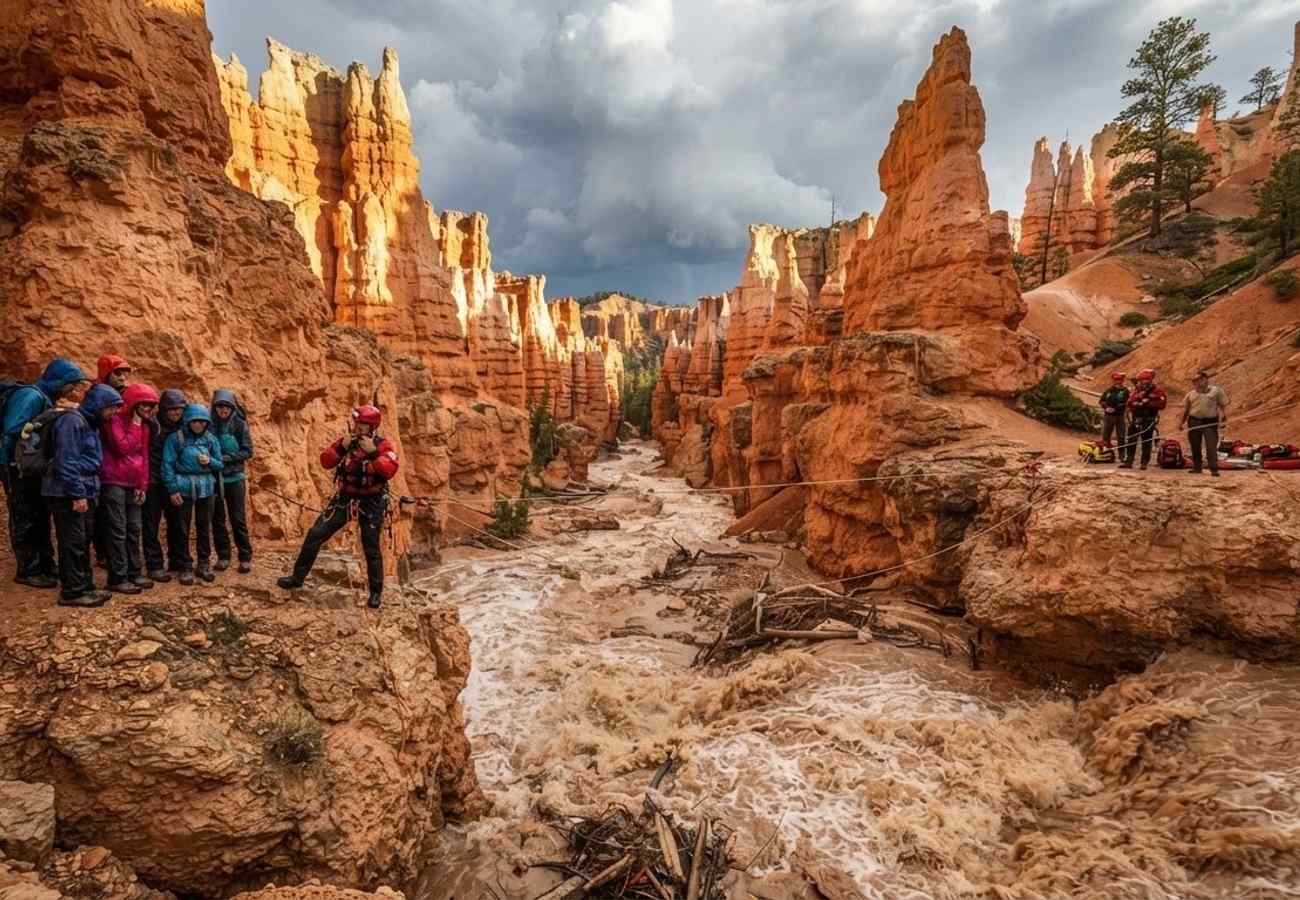
Image generated by AI
Eleven visitors were stranded at Bryce Canyon National Park during the Southwest monsoon season, requiring a multi-agency rescue operation. This incident underscores a persistent, lethal threat in the American Southwest where upstream weather can trigger deadly floods in clear-sky zones.
Bryce Canyon Emergency Operation Details
At approximately 2:30 p.m. on August 28, 2026, sudden flash flooding trapped 11 visitors across four separate adult groups in Bryce Canyon National Park, Utah. The surge occurred during the peak of the Southwest monsoon season, rendering several high-traffic hiking routes impassable.
The disruption centered on four primary trails:
- Fairyland Loop
- Navajo Loop
- Queen’s Garden
- Peek-a-Boo Loop
The rescue operation involved 15 to 20 emergency personnel, including Garfield County search and rescue teams, emergency medical services, and the National Park Service (NPS). Rescuers maintained a holding pattern until water levels receded to safe thresholds. While no hikers were swept away, the exposure led to two cases of hypothermia requiring hospitalization; the remaining nine visitors were released following medical evaluation.
The Mechanics of Canyon Hazards
Our analysis of the topography indicates that flash floods in desert parks are uniquely deceptive. The NPS confirms that storms occurring miles upstream can channel massive volumes of water into narrow canyons, creating "walls of water" even when the sky directly above the hiker remains clear.
In August and September, southern Utah experiences volatile weather patterns. These afternoon thunderstorms transform dry washes into high-velocity debris flows, carrying rocks and vegetation that destroy trail infrastructure and eliminate escape routes.
Historical Mortality and Statistical Risk Analysis
While the 2026 Bryce Canyon incident ended without fatalities, historical data reveals a pattern of high-impact tragedies in protected US landscapes.
Major Documented Flash Flood Fatalities
| Incident | Year | Location | Deaths |
|---|---|---|---|
| Lawn Lake Dam Failure | 1982 | Rocky Mountain National Park, CO | 3 |
| The Narrows Flood | 2014 | Zion National Park, UT | 1 |
| Keyhole Canyon Flood | 2015 | Zion National Park, UT | 7 |
| Havasu Creek Flood | 2024 | Grand Canyon Region, AZ | 1 |
| Total | 12 |
Risk Probability Breakdown
Based on NPS mortality data (2014–2019) and annual visitation figures, the statistical probability of a flash flood death is low, but the severity of each event is extreme.
- Annual National Park Visits: 300+ million
- Total Recorded Deaths (2014–2019): 2,149 (all causes)
- Flash Flood Share of Total Deaths: Approximately 0.5%
- Estimated Death Rate: 0.004 deaths per 100,000 visits (approx. 0.000004%)
Passenger Advisory: Safety and Liability
For the traveler, these statistics are misleading because risk is not evenly distributed. The danger is concentrated in "slot canyons" and tributary areas. If you are planning a visit to Zion, Bryce, or the Grand Canyon during monsoon season, our analysis of NPS guidelines suggests the following mandatory protocol:
Pre-Hike Verification
- Weather Monitoring: Check the National Weather Service (NWS) forecast specifically for the entire watershed, not just the trailhead.
- Ranger Consultation: Official park alerts often update faster than digital apps. Confirm trail status with on-site personnel.
Immediate Response Actions
- Elevate Immediately: If you hear a distant roar or see water rising, move to the highest available ground. Do not attempt to "outrun" the water along the trail.
- Avoid Water Crossings: Never attempt to cross moving water, even if it appears shallow. Debris flows can undermine the ground beneath your feet.
The Bryce Canyon incident highlights a growing tension between increasing national park visitation and the unpredictability of climate-driven weather events. As "adventure tourism" pushes more inexperienced hikers into technical terrains like slot canyons, the reliance on real-time alert systems becomes a critical failure point.
The 2015 Keyhole Canyon disaster remains the benchmark for these risks, proving that even experienced groups can be overwhelmed in minutes. The industry trend is moving toward more aggressive "closed-trail" policies during monsoon peaks to prevent the high cost of emergency SAR (Search and Rescue) operations.
Stay alert, stay high, and never trust a clear sky in a narrow canyon.
Related Travel Guides
Disclaimer
This article is for informational and educational purposes only. It does not constitute legal, financial, or professional advice. While we strive to provide accurate and up-to-date information, travel policies, regulations, and conditions change rapidly. Always verify information with official sources before making travel decisions. Nomad Lawyer makes no representations about the accuracy, reliability, completeness, or suitability of the information provided. Readers should consult qualified professionals for advice specific to their circumstances. The views expressed in this article are those of the author and do not necessarily reflect the views of Nomad Lawyer.
Kunal K Choudhary
Co-Founder & Contributor
A passionate traveller and tech enthusiast. Kunal contributes to the vision and growth of Nomad Lawyer, bringing fresh perspectives and driving the community forward.
Learn more about our team →