
Brasília Modernist Architecture and Lake Paranoá: Ultimate UNESCO Destination Guide
Brasília offers a unique city break combining UNESCO-listed modernist architecture by Oscar Niemeyer with lakeside leisure on Lake Paranoá.

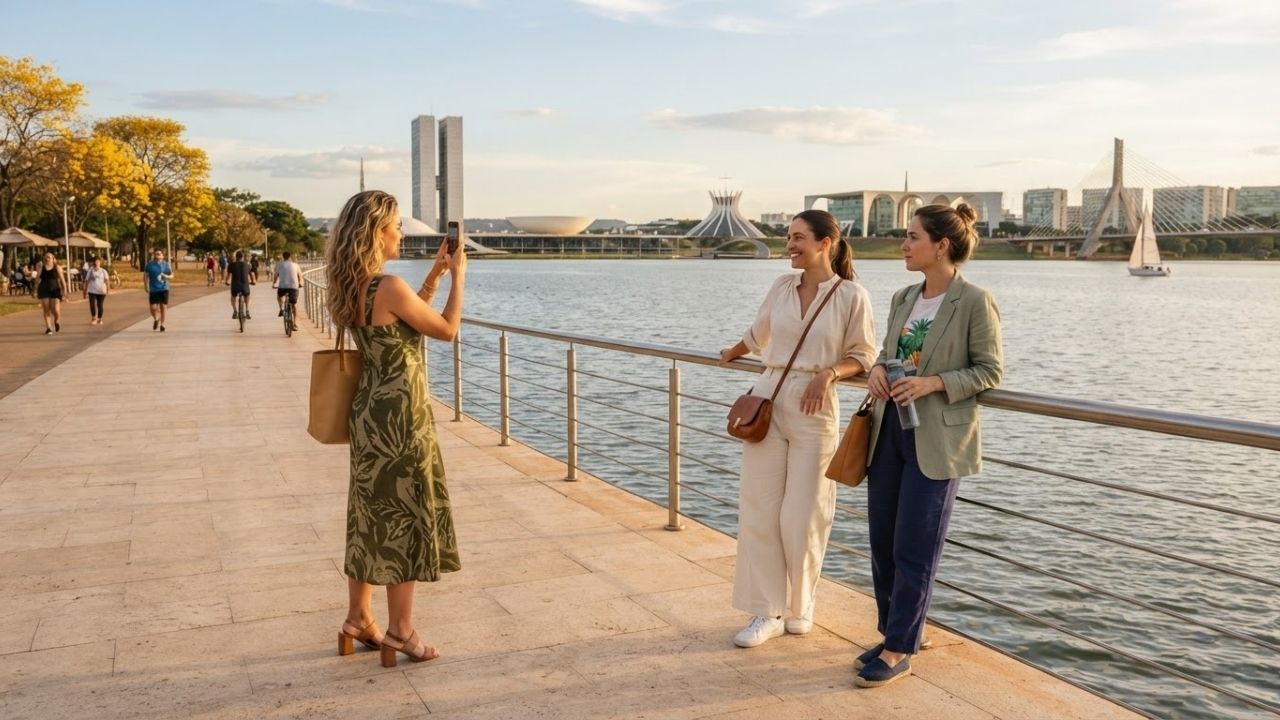
Image generated by AI
Planned from the ground up in 1960 as Brazil’s forward-looking capital, Brasília stands as a UNESCO World Heritage urban masterpiece. Designed by urban planner Lúcio Costa and legendary architect Oscar Niemeyer, the city pairs futuristic concrete civic structures with outdoor recreational activities along Lake Paranoá.
Master Plan of Plano Piloto: Lúcio Costa and Oscar Niemeyer's Blueprint
[BRASÍLIA, Brazil] — Conceived to shift Brazil's administrative seat away from the Atlantic coast into the country’s central interior, Brasília was inaugurated as the national capital in 1960. Unlike historic cities that evolved organically over centuries, Brasília was constructed as a unified urban artwork, earning it a UNESCO World Heritage Site designation for 20th-century town planning.
The central planned core, known as the Plano Piloto, features an urban layout resembling an airplane or a bird in flight. The central Monumental Axis (Eixo Monumental) serves as the primary civic spine, housing federal government branches and cultural institutions. The intersecting Road Axis (Eixo Rodoviário) organizes residential quarters into self-contained superblocks (superquadras) surrounded by green spaces.
Architect Oscar Niemeyer’s signature curved concrete structures contrast with wide lawns and expansive skies, creating an open-air architectural museum for visitors exploring Brazil's Federal District.
Civic Masterpieces: Three Powers Square and Metropolitan Cathedral
The Monumental Axis contains Brasília's most recognizable architectural landmarks, centered around Three Powers Square (Praça dos Três Poderes), which brings together the three branches of Brazilian government:
- National Congress (Legislature): Features twin 28-story office towers positioned between two concrete bowls—an upward-curving dome representing the Chamber of Deputies and a downward-curving dome housing the Senate.
- Palácio do Planalto (Executive): The official workplace of the President of Brazil, supported by elegant white sweeping columns above reflecting pools.
- Supreme Federal Court (Judiciary): Houses the highest judicial body, positioned across the square from the presidential palace.
A short distance away, the Metropolitan Cathedral of Brasília (Catedral Metropolitana de Brasília) redefines religious architecture. Hyperboloid concrete columns curve upward like a crown, leading visitors through a darkened entryway into a sunlit sanctuary filled with vibrant stained-glass panels.
Additional major civic stops include the Itamaraty Palace (Ministry of Foreign Affairs), the TV Tower observation deck, the National Museum of the Republic, the Palácio da Alvorada (official presidential residence), and the Palácio do Jaburu.
The table below provides details on Brasília’s key architectural landmarks, location coordinates, primary designers, and architectural highlights:
| Architectural Landmark | Master Designer / Architect | Primary Function & Zone | Structural & Visual Highlight |
|---|---|---|---|
| National Congress Building | Oscar Niemeyer | Federal Legislature (Monumental Axis) | Twin towers with dual upward & downward curved domes |
| Palácio do Planalto | Oscar Niemeyer | Executive Presidential Office | White arched columns & surrounding reflecting pools |
| Metropolitan Cathedral | Oscar Niemeyer | Roman Catholic Sanctuary | 16 hyperboloid concrete columns & stained-glass interior |
| Supreme Federal Court | Oscar Niemeyer | Federal Judiciary | Modernist glass-and-concrete civic hall |
| Palácio da Alvorada | Oscar Niemeyer | Presidential Residence (Lakeside) | Sculptural white columned facade on Lake Paranoá |
| Itamaraty Palace | Oscar Niemeyer | Foreign Affairs Ministry | Floating concrete arches & indoor botanical gardens |
| TV Tower Observation Deck | Lúcio Costa (Urban Plan) | Telecommunications & Viewpoint | 224-meter tower offering panoramic city views |
Lake Paranoá Water Sports and Urban Park Preserves
While Brasília is recognized for its civic monuments, Lake Paranoá provides a major natural counterweight for leisure and sport. The expansive artificial lake cools the city's dry climate and supports an active waterfront lifestyle.
Boat cruises along Lake Paranoá offer unique photographic perspectives of the Palácio da Alvorada, the Palácio do Jaburu, and the JK Bridge (Ponte Juscelino Kubitschek). The Pontão do Lago Sul waterfront precinct serves as a major hub for lakeside dining, sunset walks, and water sports.
Visitors can participate in stand-up paddleboarding (SUP), kayaking, rowing, wakeboarding, windsurfing, and Hawaiian canoeing.
For land-based nature escapes, Dona Sarah Kubitschek City Park (Parque da Cidade) offers extensive cycling paths and sports fields, while the nearby Brasília National Park (Água Mineral) features natural mineral swimming pools and hiking trails through native Cerrado vegetation.
Practical Travel Logistics: Seasons, Transportation, and Hotel Sectors
Planning a trip to Brasília involves considering regional weather patterns and city layout logistics:
- Principal Gateway: Brasília International Airport (BSB) offers direct connections across South America and international flight hubs.
- Weather Seasons: The dry season (May through September) brings clear blue skies ideal for architectural photography and walking tours. The wet season (October through April) brings lush green foliage punctuated by afternoon rain showers.
- Hotel Neighborhoods: Visitors should book accommodations within the North Hotel Sector (Setor Hoteleiro Norte - SHN) or South Hotel Sector (Setor Hoteleiro Sul - SHS) for convenient access to the Monumental Axis and airport transfers.
- Transportation: Given the wide distances along the Monumental Axis, travelers are advised to utilize ride-hailing services, taxis, or organized city tours to maximize sightseeing efficiency.
Why This Matters for Passengers and Architecture Enthusiasts
For travelers visiting Brazil, Brasília offers a completely different urban experience compared to coastal hubs like Rio de Janeiro or São Paulo. Visitors can spend mornings exploring UNESCO World Heritage modernist buildings by Oscar Niemeyer, enjoy afternoon water sports on Lake Paranoá, and dine at lakeside restaurants along Pontão do Lago Sul. With convenient transit links through Brasília International Airport and dedicated hotel sectors, the capital provides a seamless city break for culture, design, and outdoor leisure.
Frequently Asked Questions
Why is Brasília designated as a UNESCO World Heritage Site?
Brasília was designated a UNESCO World Heritage Site in 1987 because it represents a milestone in 20th-century urban planning, created as a unified modernist artwork by urban planner Lúcio Costa and architect Oscar Niemeyer.
What are the main architectural landmarks to visit in Brasília?
Key architectural stops along the Monumental Axis include the National Congress building, Three Powers Square, the Palácio do Planalto, the Metropolitan Cathedral of Brasília, Itamaraty Palace, and the Palácio da Alvorada.
What outdoor activities are available at Lake Paranoá?
Lake Paranoá offers boat cruises, lakeside dining at Pontão do Lago Sul, and water sports including stand-up paddleboarding, kayaking, wakeboarding, windsurfing, and Hawaiian canoeing.
Related Travel Guides
Brazil Modernist Architecture and UNESCO Heritage Travel Guide
South America Capital City Breaks and Transit Hubs
10 Best Architectural Landmarks in South America, According to Reddit
Disclaimer
This article is for informational and educational purposes only. It does not constitute legal, financial, or professional advice. While we strive to provide accurate and up-to-date information, travel policies, regulations, and conditions change rapidly. Always verify information with official sources before making travel decisions. Nomad Lawyer makes no representations about the accuracy, reliability, completeness, or suitability of the information provided. Readers should consult qualified professionals for advice specific to their circumstances. The views expressed in this article are those of the author and do not necessarily reflect the views of Nomad Lawyer.
Raushan Kumar
Founder & Lead Developer
Full-stack developer with 11+ years of experience and a passionate traveller. Raushan built Nomad Lawyer from the ground up with a vision to create the best travel and law experience on the web.
Learn more about our team →