
Travel Chaos Devastates Boston Logan as JetBlue, Cape Air, and Legacy Carriers Execute 58 Flight Cancellations and 221 Delays: Latest Airline News
A severe operational breakdown paralyzes Boston Logan International Airport, triggering massive flight cancellations and stranding passengers bound for the US, Canada, Europe, Asia, and the Middle East.

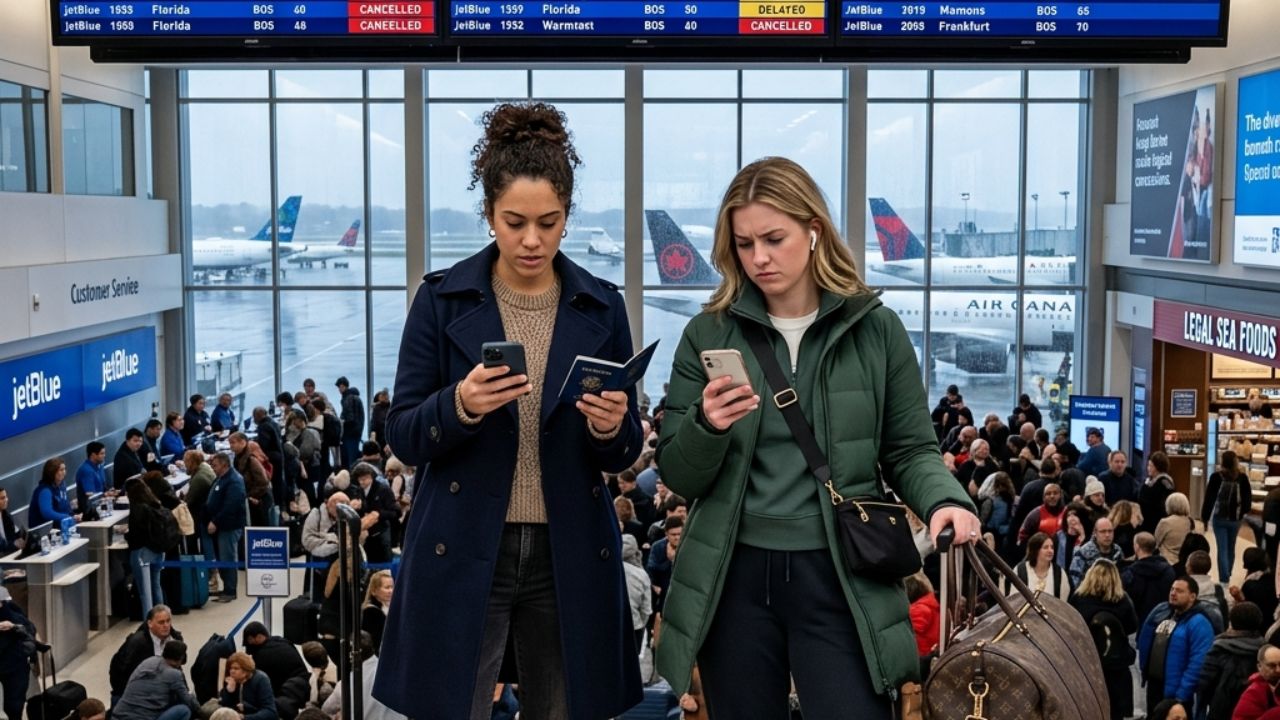
Image generated by AI
A Devastating Operational Breakdown in Massachusetts
While the broader global passenger network frequently battles unpredictable weather events and standard seasonal congestion, a highly localized, fiercely disruptive operational breakdown is currently paralyzing one of the East Coast’s most critical aviation gateways. Delivering highly urgent, breaking airline news, verified flight data confirms that Boston Logan International Airport (BOS) succumbed to a massive, unexpected scheduling collapse on May 30, 2026. While desperate travelers attempt to navigate sudden airport disruptions, these exclusive aviation updates reveal that major legacy carriers—including JetBlue, Cape Air, Air Canada, Lufthansa, and Republic Airways—have been violently forced into massive ground holds, resulting in exactly 58 absolute flight cancellations alongside a staggering 221 rolling delays. By aggressively stalling these critical departures, this localized failure has triggered uncontrollable, sprawling travel chaos, leaving hundreds of passengers entirely stranded and completely severing vital routes connecting Boston to the US, Canada, Europe, Asia, and the Middle East.
Expanded Overview: The Scale of the Boston Gridlock
The sudden execution of these mass delays and cancellations serves as a massive, undeniable example of how rapidly intense weather systems and localized air traffic control spacing can dismantle a major international hub's highly optimized schedule. Historically, Boston Logan operates as the premier, highly efficient mega-hub connecting New England to massive transcontinental and international connection points. However, the sheer impact of today's disruption has completely dismantled that reliability.
This is a highly severe crisis; the ground holds have aggressively expanded far beyond domestic borders to impact massive routes across multiple continents. While smaller regional hops inside New England face the absolute worst of the groundings, international long-haul journeys operated by carriers like Lufthansa, Swiss, Japan Airlines, and Emirates are also feeling the devastating residual pinch. The scheduling chaos has trapped thousands of global commuters, leaving them stranded without alternative flights. Airlines are frantically working to process the massive backlog of rebookings, but terminal gates remain heavily packed with completely exhausted and frustrated crowds.
Section-Wise Breakdown of the Airport Disruptions
Cape Air Takes the Absolute Brunt of Cancellations
The overarching narrative of this massive Boston gridlock is entirely dominated by a single regional airline. Cape Air absorbed the vast majority of the airport’s total cancellations, logging a catastrophic 54 cancelled flights. This brutal volume represents a devastating 39% failure rate of its total scheduled operation today, completely severing the airline's critical New England feeder network. Additionally, the carrier suffered 11 massive delays (an 8% failure rate). Because Cape Air utilizes smaller aircraft that are heavily susceptible to low cloud ceilings and intense localized weather, their network completely buckled under the pressure.
Major Legacy Carriers Paralyzed by Ground Holds
By contrast, the major legacy carriers are successfully keeping their massive aircraft in the air and completely avoiding outright cancellations, though they are taking highly destructive hits to their on-time performance. JetBlue experienced a massive delay footprint with 54 delayed flights (a 22% failure rate), while smartly restricting its absolute cancellations to just 2 flights. American Airlines struggled with a high volume of severe terminal friction, posting 29 delayed flights (a 30% delay rate).
Republic Airways, which operates essential regional feeder networks for major legacy brands, saw 36 flights delayed (23%). United Airlines and Delta Air Lines deeply felt the terrifying pinch of air traffic control spacing constraints, tracking 18 delays (26%) and 17 delays (10%) respectively. Even highly efficient operators like Southwest Airlines saw 12 delays, violently mounting to a 31% failure rate for its localized schedule.
Regional Inbound and Outbound Routes Severed
Geographically, the severe cancellations are almost exclusively isolated to regional airports and highly remote cities across the Northeastern United States, specifically throughout Massachusetts, Maine, Vermont, New Hampshire, and New York. Outbound flights departing Boston to Nantucket Memorial (ACK) saw 5 cancellations (35%). Outbound legs to Hancock County/Bar Harbor (BHB) and Rutland (RUT) were violently cut in half, both posting 3 absolute cancellations (50%).
The inbound data perfectly mirrors this regional paralysis. Flights desperately trying to access Boston from Bar Harbor and Augusta (AUG) were slashed by 3 cancellations each (60% and 50% respectively). Inbound flights from Rutland and Lebanon (LEB) saw a brutal 75% cancellation rate (3 flights each).
Verified Boston Logan Flight Disruption Metrics Table
To fully comprehend the highly severe operational parameters and massive logistical breakdown dictating this network collapse, the following table explicitly details the exact cancellation and delay metrics across the impacted carriers operating at Boston Logan:
| Airline | Cancelled Flights | Delayed Flights |
|---|---|---|
| Cape Air | 54 (39%) | 11 (8%) |
| JetBlue | 2 (0%) | 54 (22%) |
| American Airlines | 0 | 29 (30%) |
| Republic Airways | 0 | 36 (23%) |
| United Airlines | 0 | 18 (26%) |
| Delta Air Lines | 0 | 17 (10%) |
| Southwest Airlines | 0 | 12 (31%) |
| Air Canada | 0 | 5 (50%) |
| Porter Airlines | 0 | 5 (41%) |
| Boutique Air | 0 | 4 (66%) |
| Alaska Airlines | 0 | 3 (18%) |
| Envoy Air | 0 | 3 (27%) |
| Jazz | 2 (25%) | 2 (25%) |
| Lufthansa | 0 | 2 (50%) |
| Swiss | 0 | 2 (50%) |
| PAL Airlines | 0 | 2 (100%) |
(Note: Single-flight delays ranging from 10% to 100% of their limited daily presence were also heavily recorded for Aer Lingus, Frontier, Japan Airlines, LEVEL, TAP Air Portugal, Emirates, Allegiant Air, and Copa Airlines).
Passenger Impact: Stranded Commuters and Emergency Rebooking
For the modern domestic commuter and regional tourist, the passenger impact of these sudden groundings is physically exhausting and highly terrifying. Passengers attempting to access Martha's Vineyard, Nantucket, or remote locations in Maine are suddenly trapped in terminal limbo. Because these cancellations are explicitly weather-related, airlines are heavily urging passengers to process full refund requests digitally via mobile apps rather than physically standing in heavily congested terminal lines.
Travel experts desperately advise affected passengers to immediately pivot to ground and sea infrastructure. For destinations like Nantucket, securing vehicle or passenger space on regional ferry services out of Woods Hole or Hyannis is completely essential. For those heading north to Portland or Augusta, securing seats on the Amtrak Downeaster or regional bus networks is a highly viable alternative to waiting for a delayed aircraft.
Industry Analysis: The Brutal Cost of ATC Spacing
From a macroeconomic and industry operations perspective, this incident highlights a highly terrifying reality for East Coast aviation planners. Travel analysts fiercely note that while intense micro-climate weather initiated the crisis, the resulting 221 delays across massive international carriers like Lufthansa, Emirates, and Japan Airlines point directly to acute air traffic control spacing limitations. When Boston Logan slows down its arrival acceptance rates due to low visibility, the entire global network backs up, instantly generating terminal friction that costs legacy airlines millions in lost operational efficiency and destroyed passenger goodwill.
Conclusion: A Highly Volatile Recovery Phase for Boston
The sudden, highly publicized execution of 58 outright cancellations and 221 massive delays across Boston Logan International Airport is exponentially more than a routine operational hiccup—it represents a massive, highly visible failure of the regional aviation network. By completely severing critical connections across New England and violently delaying international long-haul routes, the disruption has proven how rapidly localized weather can devolve into absolute terminal chaos. As operations teams aggressively attempt to process the backlog of stranded passengers, travelers are urgently advised to completely avoid arriving at the airport without aggressively monitoring their airline's official app for real-time flight status.
Key Takeaways
- Massive Network Gridlock: Boston Logan Airport suffered a highly concentrated wave of exactly 58 flight cancellations and 221 severe delays.
- Cape Air Devastated: Regional operator Cape Air executed a catastrophic 54 cancellations, representing a 39% failure rate for its entire daily schedule.
- JetBlue and Legacy Carriers Stalled: JetBlue absorbed 54 massive delays, while American (29 delays), Republic (36 delays), and United (18 delays) were paralyzed by ATC spacing.
- New England Routes Severed: Critical domestic corridors bound for Nantucket, Bar Harbor, Rutland, and Martha's Vineyard were completely decimated.
- International Operations Delayed: Massive long-haul carriers including Lufthansa, Swiss, Emirates, and Japan Airlines all suffered highly frustrating ground holds.
Disclaimer: The specific flight cancellation counts, delay percentages, and destination impacts presented in this report are based on verified flight tracking data regarding operations at Boston Logan International Airport on May 30, 2026. Official causes for this massive operational breakdown, subsequent network recovery timelines, and passenger compensation procedures are highly volatile and subject to continuous, real-time update. Affected passengers are urgently advised to monitor their specific booking status directly via their airline's official portal.
Disclaimer
This article is for informational and educational purposes only. It does not constitute legal, financial, or professional advice. While we strive to provide accurate and up-to-date information, travel policies, regulations, and conditions change rapidly. Always verify information with official sources before making travel decisions. Nomad Lawyer makes no representations about the accuracy, reliability, completeness, or suitability of the information provided. Readers should consult qualified professionals for advice specific to their circumstances. The views expressed in this article are those of the author and do not necessarily reflect the views of Nomad Lawyer.
Kunal K Choudhary
Co-Founder & Contributor
A passionate traveller and tech enthusiast. Kunal contributes to the vision and growth of Nomad Lawyer, bringing fresh perspectives and driving the community forward.
Learn more about our team →