
Typhoon Champi Grounds Asian Skies: 754 Flight Cancellations and 6,264 Delays Strike Taoyuan, Naha, and Major Hubs
Typhoon Champi packs 191 km/h winds, triggering 754 cancellations and 6,264 flight delays across Taiwan, Okinawa, mainland China, and Southeast Asia.

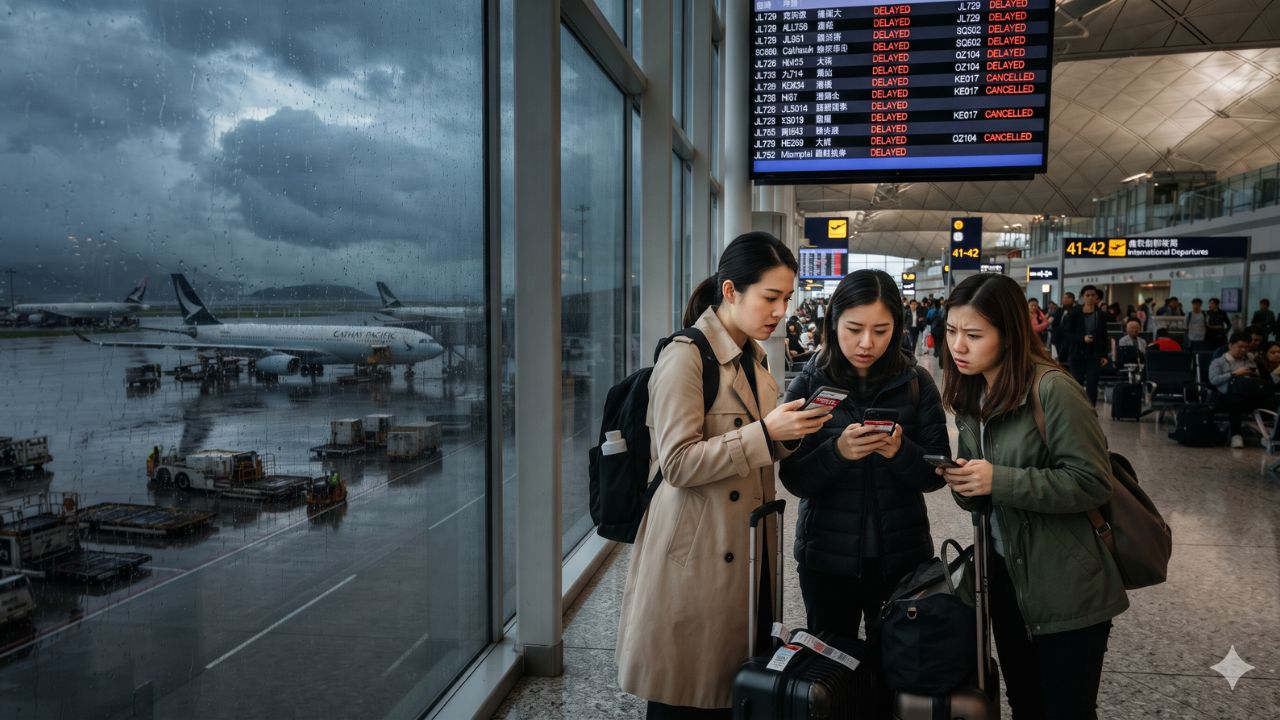
While major continental aviation hubs like Tokyo Haneda and Shanghai Pudong absorbed hundreds of cascading departure delays, the remote southern islands of Japan saw their commercial connections severed entirely as Typhoon Champi drove 754 flight cancellations and 6,264 delays across the Asia-Pacific basin. According to official monitoring bulletins issued by the Korea Meteorological Administration, Typhoon Champi intensified into a ferocious oceanic storm packing maximum sustained winds of approximately 191 km/h. Tracking steadily through the warm waters east of Taiwan before curling north toward the Ryukyu Archipelago, the storm created severe crosswinds, torrential downpours, and zero-visibility squalls that forced airlines to suspend operations en masse.
Compounding the tropical weather crisis, aviation corridors across Southeast Asia and South Asia faced secondary pressures. Regional smoke from agricultural fires in parts of Indonesia choked local airways, while persistent Middle Eastern airspace security restrictions rerouted long-haul services. Across East Asia, the verified figures recorded via FlightAware on 22 October 2026 at 2:58 pm ET USA (10:58 pm GST) painted a picture of severe operational stress, with Taiwan's Taoyuan International Airport registering the single highest concentration of grounded and delayed passenger services.
The Geographic Impact: Airport Disruption Statistics
The operational impact varied sharply depending on regional topography and proximity to Champi's outer rainbands. In Taiwan and Okinawa, direct storm exposure triggered wholesale cancellations. Across mainland China, South Korea, India, and Southeast Asia, air traffic management programs translated the disruptions into massive ground delay programs.
| Airport / Aviation Gateway | Country / Territory | Flight Cancellations | Flight Delays | Operational Environment & Primary Disruption Factors |
|---|---|---|---|---|
| Taoyuan International (TPE) | Taiwan | 80 | 321 | Storm epicenter; severe runway crosswinds and windshear |
| Kaohsiung International (KHH) | Taiwan | 16 | 45 | Southern regional gateway; typhoon feeder bands |
| Taipei Songshan (TSA) | Taiwan | 11 | 27 | Downtown short-haul field; perimeter wind restrictions |
| Naha Airport (OKA) | Okinawa, Japan | 65 | 86 | Island hub; severe marine gales and gale-force gusts |
| Miyako Airport (MMY) | Okinawa, Japan | 34 | 1 | Outlier island; pre-emptive schedule cancellations |
| Ishigaki Airport (ISG) | Okinawa, Japan | 34 | 2 | Yaeyama Islands; apron ground stops and tiedown procedures |
| Tokunoshima Airport (TKN) | Amami, Japan | 14 | 0 | Regional turboprop links cancelled ahead of gale arrival |
| Shimojishima Airport (SHI) | Okinawa, Japan | 9 | 0 | Low-cost carrier gateway; complete ramp shutdown |
| Tokyo Haneda (HND) | Japan | 21 | 279 | Domestic schedule compression and flow control holdbacks |
| Narita International (NRT) | Japan | 11 | 171 | Long-haul flow restrictions and transpacific reroutings |
| Fukuoka Airport (FUK) | Japan | 9 | 127 | Kyushu hub; slot metering from western arrivals |
| Tianshan Airport | Mainland China | 10 | 305 | Extensive flow-control holdbacks across internal sectors |
| Shanghai Pudong (PVG) | Mainland China | 17 | 204 | Coastal airspace congestion and weather rerouting |
| Shanghai Hongqiao (SHA) | Mainland China | 5 | 124 | Domestic trunkline slot rationing |
| Beijing Capital (PEK) | Mainland China | 9 | 156 | Northern air traffic control metering |
| Beijing Daxing (PKX) | Mainland China | 6 | 138 | Domestic schedule pushbacks |
| Guangzhou Baiyun (CAN) | Mainland China | 4 | 133 | Pearl River Delta airway flow restrictions |
| Shenzhen Baoan (SZX) | Mainland China | 4 | 100 | Southern coastal corridor congestion |
| Hong Kong International (HKG) | Hong Kong SAR | 26 | 241 | Regional transfer banks impacted by Taiwan routing holds |
| Incheon International (ICN) | South Korea | 12 | 238 | Yellow Sea oceanic waypoint metering |
| Gimhae International (PUS) | South Korea | 3 | 70 | Coastal Busan weather holding patterns |
| Indira Gandhi International (DEL) | Delhi, India | 8 | 194 | Airway spacing constraints and eastern sector backlog |
| Chhatrapati Shivaji Maharaj (BOM) | Mumbai, India | 8 | 169 | Peak-hour apron congestion and delayed inbound arrivals |
| Kempegowda International (BLR) | Bengaluru, India | 13 | 139 | Downline aircraft rotation delays |
| Kolkata (CCU) | India | 4 | 44 | Bay of Bengal airway sequencing |
| Ahmedabad (AMD) | India | 5 | 41 | Secondary connection holdbacks |
| Kochi (COK) | India | 7 | 32 | Middle East transit flight adjustments |
| Suvarnabhumi Airport (BKK) | Bangkok, Thailand | 3 | 241 | Southeast Asian regional transfer bank delays |
| Soekarno-Hatta (CGK) | Jakarta, Indonesia | 17 | 233 | Localized wildfire smoke and seasonal weather holds |
| Kuala Lumpur International (KUL) | Malaysia | 5 | 197 | Downline aircraft turnaround delays |
| Ninoy Aquino International (MNL) | Manila, Philippines | 3 | 113 | Northern Luzon oceanic corridor avoidance routes |
How Airlines Absorbed the Operational Blow
Commercial carriers faced disparate operational realities across their networks. Island-hopping operators and regional carriers experienced catastrophic percentage-based schedule reductions, whereas major network airlines deployed tactical flow controls that generated widespread delays rather than outright flight scrubbings.
High-Impact Island and Regional Operators
Japan Transocean Air absorbed the most severe proportional cut of any carrier, canceling 37 flights—representing 45% of its entire scheduled day—alongside 10 delays (12%). Similarly, Japan Air Commuter grounded 14 services (20% of operations) while recording five delays (7%). In Pakistan, Airblue cancelled nine flights (19%) and delayed 10 (21%). Jordan Aviation scrubbed two flights (20%) with three delays (30%), while AirAsia Cambodia suffered three cancellations (30%) with zero delays.
Taiwan's frontline carriers took heavy blows in their home territory: EVA Air recorded 16 cancellations (6%) and 87 delays (37%), while China Airlines logged four cancellations (1%) and 81 delays (38%). Regional operator Mandarin Airlines noted two cancellations (1%) and 19 delays (18%).
Major Trunk Carriers and Hub Airlines
China Eastern posted the largest sheer volume of groundings among all tracked carriers, logging 60 cancellations (2%) and 309 delays (12%). Fellow state carriers also saw significant strain: China Southern recorded 12 cancellations (0% rounded) and 242 delays (10%), while Air China logged 14 cancellations (0% rounded) and 158 delays (8%).
Cathay Pacific dealt with 18 cancellations (4%) and 119 delays (28%) at its Hong Kong fortress hub. Across the East China Sea, Japan Airlines recorded 16 cancellations (2%) and 181 delays (23%), All Nippon Airways registered seven cancellations (1%) and 86 delays (15%), and its regional affiliate ANA Wings posted 25 cancellations (7%) and 37 delays (11%). Skymark registered seven cancellations (3%) and 48 delays (25%), while Jetstar Japan cancelled five flights (4%) with 33 delays (32%), and StarFlyer noted two cancellations (2%) and four delays (5%).
South Korea's Korean Air weathered seven cancellations (1%) and 91 delays (22%), while low-cost operator Jin Air saw five cancellations (2%) and 67 delays (34%). Hong Kong Airlines documented six cancellations (7%) and 19 delays (23%), and budget offshoot Hong Kong Express recorded four cancellations (2%) and 36 delays (25%).
In India, Akasa Air absorbed 27 cancellations (10%) and 20 delays (7%), SpiceJet recorded nine cancellations (9%) and 44 delays (44%), and Star Air logged three cancellations (7%) and 12 delays (30%). Air India Express posted two cancellations (0% rounded) and 82 delays (18%).
In Southeast Asia, Batik Air recorded 13 cancellations (4%) and 72 delays (24%), Garuda Indonesia logged three cancellations (1%) and 60 delays (24%), and Citilink recorded two cancellations (0% rounded) and 31 delays (12%). Malaysia's AirAsia experienced two cancellations (0% rounded) and 93 delays (20%), Vietnam Airlines recorded four cancellations (0% rounded) and 62 delays (15%), and the Philippines' PAL Express registered four cancellations (2%) and 47 delays (27%).
International carriers transiting Asian airspace also absorbed downline friction: Saudia recorded 14 cancellations (2%) and 121 delays (23%), Royal Jordanian logged 13 cancellations (9%) and two delays (1%), Air Arabia posted nine cancellations (3%) and 64 delays (27%), Turkish Airlines recorded two cancellations (0% rounded) and 150 delays (9%), Pegasus Airlines registered one cancellation (0% rounded) and 137 delays (19%), Emirates reported one cancellation (0% rounded) and 95 delays (18%), and Etihad Airways recorded one cancellation (0% rounded) and 93 delays (28%).
Additional regional carriers affected included Chengdu Airlines (nine cancellations / 2%, 64 delays / 18%), Spring Airlines (eight cancellations / 1%, 85 delays / 14%), XiamenAir (eight cancellations / 1%, 62 delays / 9%), Tianjin Airlines (eight cancellations / 2%, 41 delays / 13%), Shenzhen Airlines (seven cancellations / 0% rounded, 50 delays / 6%), Sichuan Airlines (five cancellations / 0% rounded, 99 delays / 14%), Lucky Air (four cancellations / 2%, 12 delays / 7%), Zhejiang Loong (three cancellations / 1%, 36 delays / 14%), Tibet Airlines (three cancellations / 1%, 30 delays / 15%), Pakistan International Airlines (three cancellations / 3%, 21 delays / 27%), Colorful Guizhou (three cancellations / 2%, four delays / 3%), Shanghai Airlines (two cancellations / 0% rounded, 47 delays / 14%), China United Airlines (two cancellations / 0% rounded, 38 delays / 16%), and China Express Airlines (one cancellation / 0% rounded, 136 delays / 31%).
Visitor Insider Tips
When powerful tropical weather systems enter the western Pacific, standard tourist logic fails. Here is the operational advice experienced travelers rely on across Taiwan and the Ryukyu Islands:
- Switch to High-Speed Rail for Domestic Taiwan Travel: If domestic flights between Taipei Songshan and Kaohsiung or Tainan are grounded, do not waste hours waiting at airport check-in counters. Walk straight to the Taiwan High Speed Rail (THSR) booking desks. Trains run on elevated tracks engineered with wind deflection walls and continue operating safely long after regional turboprops are halted.
- Utilize Shinkansen Trunk Lines Across Japan: When southern island flights into Fukuoka or Kagoshima are scrubbed, the Sanyo and Tokaido Shinkansen bullet trains provide continuous ground connectivity linking Kyushu to Osaka and Tokyo. Book reserved ordinary car seats via the SmartEX app before standard lines fill up with displaced domestic flyers.
- Understand Island Stranding Protocols in Okinawa: In outer islands like Ishigaki and Miyako, airlines tie down planes and cease all turnarounds when sustained winds exceed gale thresholds. If local authorities declare a typhoon alert, head immediately to local supermarkets to stock bottled water and food, as convenience store resupply ferries cease running 24 to 48 hours before sea conditions peak.
- Deploy Digital Rebooking via Airline Mobile Portals: During mass irregular operations, physical airport queues at Taoyuan or Haneda can stretch over four hours. Open your airline app or official WhatsApp support line using airport Wi-Fi to rebook directly, as digital systems pull from open inventory faster than overwhelmed gate personnel.
Cultural and Environmental Context
Typhoon readiness is an ingrained cultural discipline across maritime East Asia. In Taiwan, municipal authorities enact formal typhoon days (typhoon holidays), closing schools, administrative departments, and non-essential businesses to clear road arteries for emergency responders and utility crews. Building designs feature reinforced storm shutters and deep subterranean drainage canals engineered to withstand torrential runoff.
Similarly, in Okinawa and the Yaeyama archipelago, traditional stone walls and red-tiled roofs (kawara) cemented with white lime plaster were originally developed to endure Category 4 and 5 typhoons. While commercial aviation faces severe disruptions during these weather events, local communities exhibit remarkable resilience, rapidly reopening transport arteries and local markets once storm centers track northward toward the open Pacific.
FAQ: Navigating Asia Flight Disruptions 2026
What caused the massive flight cancellations across Taiwan and Japan?
Typhoon Champi generated sustained winds of 191 km/h, creating dangerous crosswinds, heavy rainfall, and severe windshear that forced airlines to suspend departures across Taiwan, Okinawa, and coastal Japanese gateways.
What should I do if my flight is delayed or cancelled at Taoyuan Airport?
Check your flight status through your airline's digital app before heading to the terminal. If cancelled, request rebooking or refunds online, and consider taking the Taiwan High Speed Rail for domestic journeys.
Are passenger rights protections available for weather-related flight delays in Asia?
Under international air transport guidelines, typhoons represent extraordinary meteorological events (force majeure), exempting carriers from cash compensation. However, airlines typically provide complimentary rebooking or ticket refunds.
How can I reach mainland Japan if my flight from Okinawa is cancelled?
Aviation is the only viable commercial link between Okinawa and mainland Japan. When flights are suspended, travelers must remain in their hotels until airport authorities declare ramps safe and airlines schedule recovery flights.
When the Pacific's mightiest storms close the skies, true travel wisdom lies in pausing with the island rhythms until the winds relent.
Related Travel Guides
- Beyond the Summer Beach: Wizz Air Unlocks Málaga, Granada, and Asturias with £26.99 Winter Flights from London
- The PAMOJA Visa Revolution: How Tanzania, Kenya, and Uganda Are Uniting East African Travel for AFCON 2027
- Spain's Wilderness Frontier: How Garajonay, Doñana, and Teide Are Pioneering High-Value Nature Escapes
Disclaimer
This article is for informational and educational purposes only. It does not constitute legal, financial, or professional advice. While we strive to provide accurate and up-to-date information, travel policies, regulations, and conditions change rapidly. Always verify information with official sources before making travel decisions. Nomad Lawyer makes no representations about the accuracy, reliability, completeness, or suitability of the information provided. Readers should consult qualified professionals for advice specific to their circumstances. The views expressed in this article are those of the author and do not necessarily reflect the views of Nomad Lawyer.
Raushan Kumar
Founder & Lead Developer
Full-stack developer with 11+ years of experience and a passionate traveller. Raushan built Nomad Lawyer from the ground up with a vision to create the best travel and law experience on the web.
Learn more about our team →