
Berlin vs. Hamburg: Germany’s Strategic Pivot Toward Leisure Aviation
Berlin Brandenburg (BER) and Hamburg Airport are diverging strategies. While BER scales international breadth, Hamburg dominates the private leisure market.

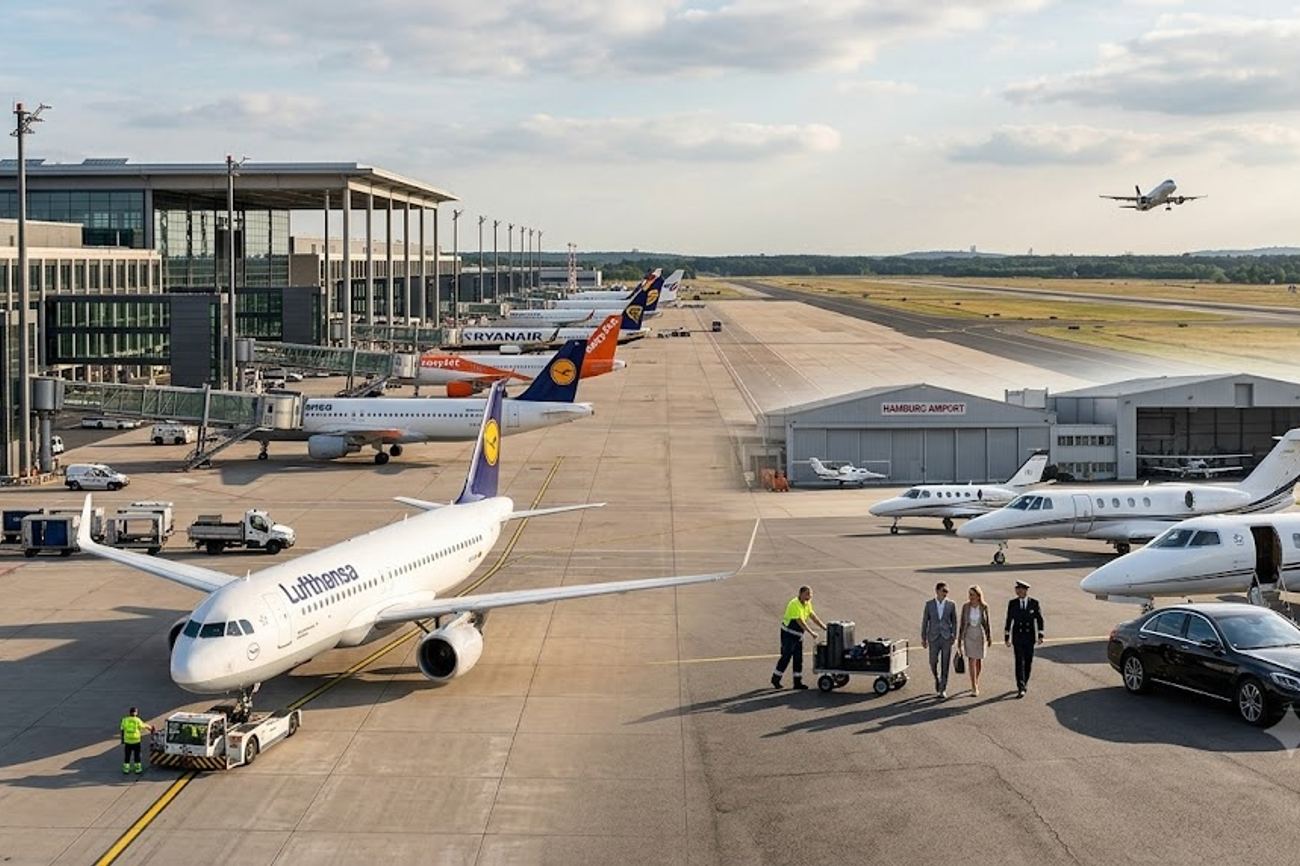
Image generated by AI
Divergent Strategies in German Aviation
The traditional hierarchy of German aviation is shifting. While Frankfurt and Munich remain the primary global hubs, Berlin Brandenburg (BER) and Hamburg Airport are no longer just regional players. They are now competing for a growing market of point-to-point leisure travelers and selective international growth.
The competition is not a simple race for passenger volume. Instead, it is a clash of philosophies: Berlin is pursuing sheer international breadth, while Hamburg is refining its relevance as a specialized leisure hub.
BER: Scaling Global Reach and Volume
Berlin Brandenburg Airport continues to leverage its size to build a comprehensive international canvas. In 2025, BER handled 26.1 million passengers—a 2.3% increase over 2024—with aircraft movements exceeding 193,000.
For the Summer 2026 season (March 29 to October 24), BER has deployed a formidable network:
- Scale: 80 airlines serving 155 destinations across 55 countries.
- North American Expansion: Air Canada has introduced non-stop service to Montréal.
- European Growth: Volotea is adding Florence, while Wizz Air is executing its largest expansion at BER to date.
- Wizz Air Impact: The carrier is increasing seat capacity by 90% year-on-year, adding or expanding links to Bratislava, Tuzla, Cluj-Napoca, and Timișoara.
Berlin’s strategy ensures it does not rely on a single corridor, offering travelers diverse pathways spanning Scandinavia, Eastern Europe, and North America.
Hamburg: The Specialist Leisure Gateway
Hamburg Airport is proving that smaller scale can be a competitive advantage. While it handled 14.8 million passengers in 2025, the composition of that traffic is unique: approximately 77% of passengers travel for leisure or private purposes.
Hamburg has achieved a recovery rate of roughly 86% of its 2019 traffic levels—the strongest recovery among major German airports outside of the Frankfurt and Munich hubs.
The Summer 2026 schedule reinforces this leisure-first identity with targeted additions:
- North Africa & Middle East: easyJet has added Marrakech, and Royal Jordanian has launched direct service to Amman.
- Mediterranean & SE Europe: AJet introduces Bodrum, Condor restores Kalamata, and Wizz Air adds Podgorica.
- Northern Europe: airBaltic adds Tallinn (completing links to all three Baltic capitals), while Norwegian and SAS expand/restore Oslo and Stockholm services.
Analyzing the Holiday Corridor
The contrast between the two airports is most evident in their "beach route" architecture. Both airports prioritize the Mediterranean, but they do so differently.
In 2025, BER saw massive volumes to top sun destinations, with Palma de Mallorca leading at over 906,000 passengers, followed by Antalya with approximately 728,400. Berlin integrates these massive leisure flows into a broader, multi-purpose international network.
Hamburg operates with higher concentration. Its 2025 summer schedule featured roughly 70 weekly flights to Mallorca and 40 weekly services to Antalya. By focusing on high-demand holiday markets, Hamburg maximizes its utility for northern German travelers without needing the massive infrastructure of BER.
Comparative Airport Metrics
| Indicator | Berlin Brandenburg (BER) | Hamburg Airport (HAM) |
|---|---|---|
| 2025 Passenger Volume | 26.1 million | 14.8 million |
| 2025 Annual Growth | 2.3% | Broadly stable |
| Summer 2026 Airlines | 80 | $\approx$ 55 (annually) |
| Direct Network | 155 destinations | $\approx$ 120 destinations (annually) |
| Primary Traffic Profile | Broad international mix | Strong private-travel (77%) |
| 2026 Key Additions | Montréal, Florence, Eastern Europe | Marrakech, Bodrum, Kalamata, Amman |
| City Center Rail Link | $\approx$ 23 mins from Hauptbahnhof | $\approx$ 25 mins from Hauptbahnhof |
Key Takeaways
- Volume vs. Value: BER wins on scale (26.1M passengers), but Hamburg wins on leisure specialization (77% private travel).
- Strategic Expansion: Berlin is targeting long-haul and Eastern European growth (e.g., Montréal, Wizz Air expansion), while Hamburg is filling gaps in the Mediterranean and Middle East.
- Recovery Trends: Hamburg shows the strongest post-pandemic recovery among Germany's non-hub airports, reaching 86% of 2019 levels.
- Network Design: BER offers a "universal" gateway; Hamburg offers a "curated" holiday experience.
FAQ
Which airport is better for holiday travel in Germany? It depends on the destination. BER offers a wider variety of global destinations and higher frequency to major hubs like Mallorca. Hamburg offers a more specialized, convenient experience for leisure travelers in Northern Germany, particularly for new routes to North Africa and the Baltics.
How has Wizz Air impacted Berlin Brandenburg? Wizz Air is aggressively expanding at BER, increasing its Summer 2026 seat capacity by 90% and focusing heavily on Eastern European connectivity.
What is the passenger growth at BER? Berlin Brandenburg saw a 2.3% increase in passenger traffic in 2025, reaching a total of 26.1 million.
Related Travel Guides
Disclaimer
This article is for informational and educational purposes only. It does not constitute legal, financial, or professional advice. While we strive to provide accurate and up-to-date information, travel policies, regulations, and conditions change rapidly. Always verify information with official sources before making travel decisions. Nomad Lawyer makes no representations about the accuracy, reliability, completeness, or suitability of the information provided. Readers should consult qualified professionals for advice specific to their circumstances. The views expressed in this article are those of the author and do not necessarily reflect the views of Nomad Lawyer.
Kunal K Choudhary
Co-Founder & Contributor
A passionate traveller and tech enthusiast. Kunal contributes to the vision and growth of Nomad Lawyer, bringing fresh perspectives and driving the community forward.
Learn more about our team →