
Breaking Airline News: Massive Flight Cancellations at Beijing Daxing Spark Terrifying Travel Chaos Across Asia
Breaking airline news: Amidst a terrifying era of severe operational fragility, Beijing Daxing is slammed by 19 flight cancellations and 102 severe delays, triggering extreme travel chaos across China.

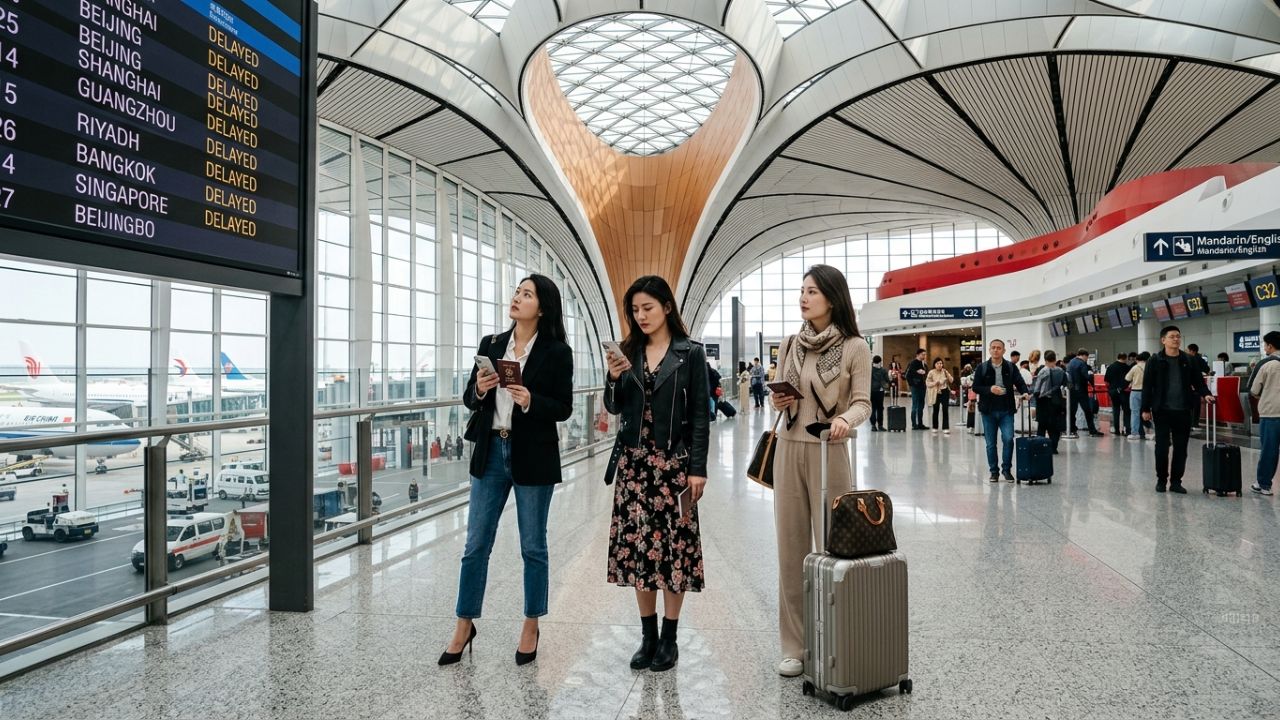
Image representing the intense strategic crisis as China Eastern and China United Airlines violently trigger a wave of flight cancellations at Beijing Daxing, plunging travelers into extreme airport disruptions and travel chaos.
Breaking Airline News: Massive Flight Cancellations at Beijing Daxing Spark Terrifying Travel Chaos Across Asia
As paralyzing terminal bottlenecks, terrifying airspace congestion, and catastrophic operational fragility violently threaten to completely shatter the global transit grid, a massive disruption has just struck one of Asia’s busiest aviation hubs. In a harrowing demonstration of how quickly highly optimized flight schedules can collapse into total anarchy, operational disruptions have violently intensified across Beijing Daxing International Airport today. Official tracking data has recorded a terrifying 19 flight cancellations and a staggering 102 severe flight delays within, into, or out of the massive facility. While legacy carriers desperately attempt to recover their broken schedules, China Eastern Airlines and China United Airlines have emerged as the primary catalysts for this meltdown, plunging thousands of domestic and international travelers into extreme travel chaos. For passengers attempting to execute connecting itineraries across China, Saudi Arabia, and critical Asian routes, this massive wave of airport disruptions guarantees terrifying rebooking delays, sudden itinerary deletions, and massive out-of-pocket expenses.
In a brutal demonstration of how desperately vulnerable modern commercial aviation remains to systemic strain, the figures emerging from Beijing Daxing highlight a significant day of highly irregular, crisis-level operations. While an isolated cancellation can be mitigated, an elevated delay figure of 102 flights highlights massive, widespread scheduling pressure that violently ripples through airline networks. Because the concentration of these severe delays spans across multiple major carriers, aviation analysts warn that this is not an isolated carrier-specific issue; it is a broader, systemic operational collapse. Travelers relying on Beijing Daxing as a strategic transfer point are now trapped in a terrifying web of missed connections, scrambling to secure alternative routing before the entire regional network freezes.
Expanded Overview: The Epicenter of the Disruption
The terrifying crisis of overwhelming passenger stress currently testing Beijing Daxing brutally exposes the severe limitations of airline recovery protocols. Once a massive hub begins hemorrhaging flights, the cascading effects are unstoppable.
Section-Wise Breakdown: The Airline Meltdowns
To fully comprehend the massive logistical fallout of this operational crisis, corporate travel planners must review exactly how specific carriers failed to maintain schedule integrity.
The China Eastern Meltdown Among all carriers operating at the airport today, China Eastern Airlines experienced an absolutely catastrophic disruption profile. The carrier aggressively accounted for 12 of the airport’s 19 total cancellations—a staggering 63.2% of all canceled flights. Compounding this terrifying failure, China Eastern also reported 35 delayed flights, the absolute highest delay count recorded. With a massive 16% delay rate, the airline is facing severe operational pressures that threaten total network continuity.
China United and Air China: Collapsing Schedules China United Airlines violently fueled the travel chaos by recording the second-highest level of disruption, suffering 6 canceled flights and 13 delayed flights (accounting for 31.6% of all cancellations). Shockingly, China Eastern and China United Airlines combined were responsible for 18 of the 19 total cancellations. Meanwhile, flag carrier Air China reported 1 canceled flight and 6 delayed flights (a 9% delay rate), proving that even the most robust legacy networks are currently experiencing severe operational friction.
The Delay Epidemic: China Southern & XiamenAir While China Southern Airlines successfully avoided outright cancellations, passengers were subjected to massive scheduling agony, enduring 26 severe flight delays (an 8% delay rate). Even more terrifying is the data from XiamenAir; despite zero cancellations, the carrier reported 15 delayed flights, resulting in a staggering 25% delay rate. This proves that while aircraft may eventually fly, passengers are being subjected to grueling, prolonged airport captivity.
Localized Gridlock: Saudia & Regional Carriers Smaller operators were not immune to the chaos. Saudia recorded a 100% delay rate on its affected operations. Beijing Airlines suffered 2 delays (a 40% delay rate), while Hebei Airlines and Beijing Capital Airlines both suffered 2 delays each, proving that the disruption is infecting every corner of the tarmac.
Beijing Daxing Operational Disruption Matrices
To ensure travel planners can aggressively track the specific metrics defining this massive operational crisis, the following matrices detail the verified strategic data.
Airport-Wide Statistics
| Metric | Total Disrupted Flights |
|---|---|
| Total Flight Cancellations | 19 |
| Total Flight Delays | 102 |
Airline-Specific Flight Cancellation and Delay Data
| Airline | Cancelled (#) | Cancelled (%) | Delayed (#) | Delayed (%) |
|---|---|---|---|---|
| China Eastern | 12 | 5% | 35 | 16% |
| China United Airlines | 6 | 4% | 13 | 10% |
| Air China | 1 | 1% | 6 | 9% |
| China Southern Airlines | 0 | 0% | 26 | 8% |
| XiamenAir | 0 | 0% | 15 | 25% |
| Hebei Airlines | 0 | 0% | 2 | 5% |
| Saudia | 0 | 0% | 1 | 100% |
| Beijing Airlines | 0 | 0% | 2 | 40% |
| Beijing Capital Airlines | 0 | 0% | 2 | 6% |
Industry Analysis: The Core Drivers of Disruption
Aviation analysts tracking this massive travel chaos attribute the systemic collapse at Beijing Daxing to three primary, highly destructive drivers:
- Severe Weather Constraints: Thunderstorms, low visibility, strong crosswinds, and heavy rainfall in departure corridors trigger massive air traffic flow restrictions.
- Air Traffic Management (ATC) Chokeholds: When airspace congestion exceeds operational capacity, severe departure sequencing limitations and arrival slot restrictions violently delay traffic throughout the entire day.
- Aircraft Rotation & Crew Shortages: A single morning delay triggers massive chain reactions, destroying crew duty time limitations and creating terminal gate allocation conflicts, inevitably forcing airlines to strategically cancel flights to prevent total network collapse.
Passenger Impact: Aggressive Survival Tactics
For the thousands of travelers attempting to confidently navigate the rapidly degrading corridors of Beijing Daxing, extreme vigilance is mandatory. Passengers on canceled flights currently face agonizing rebooking delays, as alternative seats on major Chinese routes fill instantly. Missed connections are actively triggering terrifying overnight stays and massive secondary travel costs for hotels and ground transfers.
To survive this ongoing travel chaos, stranded travelers must aggressively demand written disruption information from gate agents, explicitly clarifying if the delay is weather-related or an airline-specific fault. Passengers must retain all boarding passes and baggage receipts, and aggressively check refund eligibility while documenting all out-of-pocket expenses.
Conclusion: The Economic Ripple Effect
As the extremely critical Chinese aviation network continues to face terrifying strain from unprecedented operational volatility, the massive disruptions at Beijing Daxing serve as an absolute warning. The economic ripple effect of 102 delays extends far beyond the runway, violently destroying business productivity, delaying time-sensitive cargo, and crippling inbound tourism momentum. Until legacy carriers like China Eastern can successfully inject massive operational redundancy back into their fleets, passengers traversing Asia must remain hyper-vigilant, actively preparing to confront sudden flight cancellations and extreme travel chaos.
Beijing Daxing Disruption FAQs
- Q: How many flights were cancelled at Beijing Daxing International Airport today?
- A: A total of 19 flights were cancelled within, into, or out of the airport on June 12, 2026.
- Q: How many flights were delayed today?
- A: The airport recorded a massive 102 delayed flights.
- Q: Which airline had the most cancellations?
- A: China Eastern Airlines reported the highest number of cancellations with 12 flights cancelled.
- Q: Which airline had the most delays?
- A: China Eastern Airlines also reported the highest delay count with 35 delayed flights.
- Q: Did China Southern Airlines cancel any flights?
- A: No. China Southern Airlines recorded zero cancellations, although it suffered 26 delays.
- Q: Which airline had the highest delay percentage?
- A: Saudia recorded a 100% delay rate, while XiamenAir reported a significant 25% delay rate.
- Q: Can passengers receive refunds for cancelled flights?
- A: Refund eligibility heavily depends on specific airline policies, fare conditions, and the exact circumstances surrounding the cancellation. Travelers must aggressively contact their airline directly.
- Q: Will delays continue into tomorrow?
- A: Future operations remain highly volatile and depend on weather conditions, ATC decisions, aircraft availability, and airline recovery efforts.
Related Travel Guides
Disclaimer
This article is for informational and educational purposes only. It does not constitute legal, financial, or professional advice. While we strive to provide accurate and up-to-date information, travel policies, regulations, and conditions change rapidly. Always verify information with official sources before making travel decisions. Nomad Lawyer makes no representations about the accuracy, reliability, completeness, or suitability of the information provided. Readers should consult qualified professionals for advice specific to their circumstances. The views expressed in this article are those of the author and do not necessarily reflect the views of Nomad Lawyer.
Kunal K Choudhary
Co-Founder & Contributor
A passionate traveller and tech enthusiast. Kunal contributes to the vision and growth of Nomad Lawyer, bringing fresh perspectives and driving the community forward.
Learn more about our team →