Beaver Supermoon 2026 Puts European Astrotourism in Focus: A Comprehensive Guide Across Sweden and 16 Captivating Night Sky Destinations

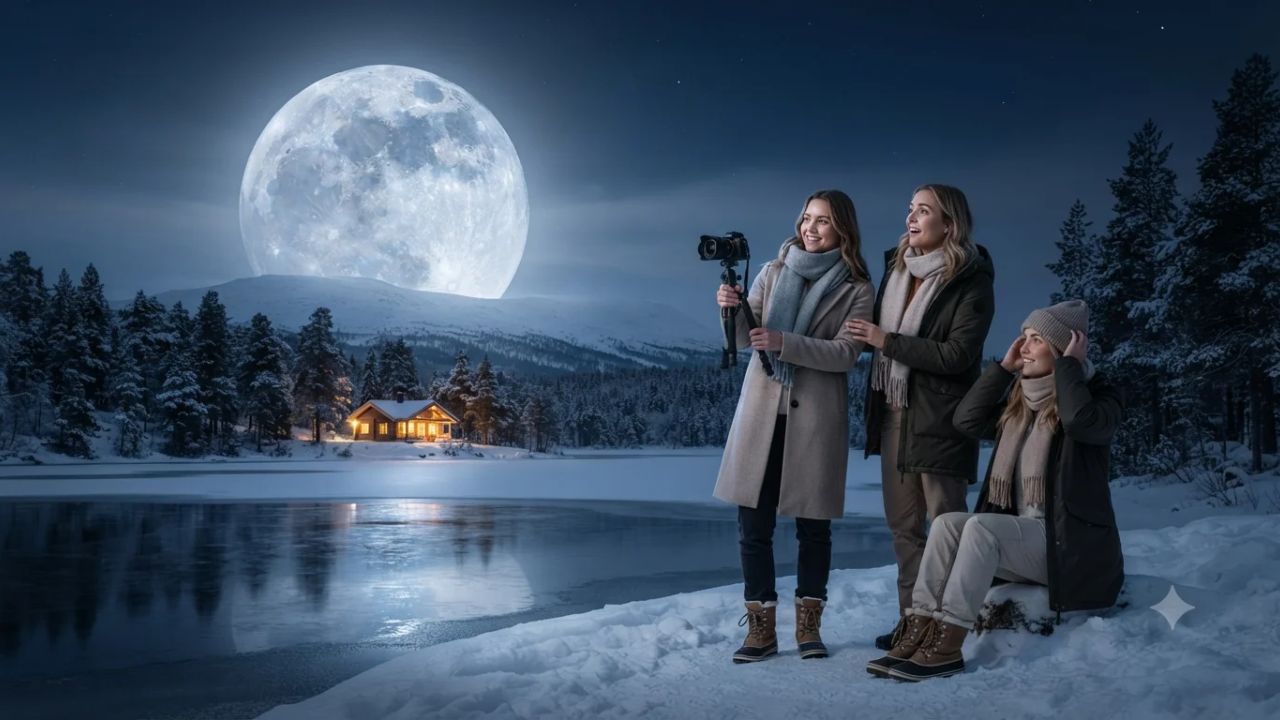
The Beaver Supermoon of November 2026 has ignited widespread interest in European astrotourism, drawing travellers across seventeen nations into Arctic wildernesses, Alpine passes, Atlantic dark sky reserves, and historic Mediterranean coastlines to witness Earth's natural satellite at its grandest orbital proximity.
Reaching peak astronomical fullness at 14:54 UTC on November 24, 2026, the Beaver Supermoon represents one of the most accessible celestial occurrences on the international travel calendar. Occurring when the lunar orbit brings the Moon near its closest approach to Earth—a gravitational alignment known to astrophysicists as perigee—the phenomenon causes the lunar disk to appear up to 14 percent larger and 30 percent brighter than an ordinary apogee full moon. From the snow-laden boreal forests of Swedish Lapland to the dramatic basalt cliffs of Ireland and the ancient limestone monasteries of Greece, night sky enthusiasts and casual holidaymakers alike have stepped outside to witness the glowing sphere illuminating Europe's diverse geographical topography.
The international response to the Beaver Supermoon illustrates a broader structural shift within global tourism: the rapid ascendancy of astrotourism and dark sky recreation. As light pollution continues to obscure the cosmos for more than 80 percent of the world's population, natural nighttime environments have become rare, sought-after travel sanctuaries. Unlike conventional daytime sightseeing, lunar observation demands zero specialized equipment, requires no costly admission tickets, and encourages low-impact, sustainable exploration in rural and peripheral destinations that often struggle for footfall during the late autumn shoulder season.
The Celestial Mechanics of the Beaver Supermoon
Understanding the visual splendour of a supermoon requires examining the elliptical nature of the Moon's orbital path around Earth. Rather than tracing a perfect circle, the Moon travels along an eccentric oval trajectory with an average distance of approximately 384,400 kilometres. Over the course of its 27.3-day sidereal orbit, this distance fluctuates dramatically:
- Perigee (Nearest Approach): The Moon approaches as close as roughly 356,400 to 363,300 kilometres from Earth's center.
- Apogee (Farthest Point): The Moon retreats to approximately 405,400 to 406,700 kilometres away.
When a full moon coincides with perigee—or falls within 90 percent of its absolute closest orbital point—astronomers designate it a "perigean full moon," popularly known as a supermoon.
LUNAR ORBITAL DYNAMICS: PERIGEE VS. APOGEE
| Column 1 |
|---|
| [ELLIPTICAL ORBIT] |
| (Apogee: ~405,500 km) (Perigee: ~356,500 km) |
| [MOON] [MOON] |
| (Smallest) (Largest) |
| \ / |
| \ / |
| +-----------------> [EARTH] <-------------+ |
| - Apparent Size Difference: Up to 14% larger at Perigee |
| - Apparent Brightness Difference: Up to 30% brighter at Perigee |
| - Optical Phenomenon: Enhanced "Moon Illusion" when rising near horizon |
The name "Beaver Supermoon" traces its origins to traditional Native American and colonial North American folklore, codified in the Old Farmer's Almanac. November was historically the time when trappers set beaver traps before swamps froze over, and when beavers busily secured their winter lodges with mud and timber. Concurrently, European historical traditions referred to this lunation as the Frost Moon, the Oak Moon, or the Mourning Moon, marking the definitive transition from late autumn harvest into deep winter freeze.
Compounding the physical size increase is the celebrated "Moon Illusion"—a psychological and optical trick of human perception. When the Moon sits low on the horizon, framed against terrestrial landmarks such as mountain ridges, castle spires, or forest canopies, the human brain perceives it as significantly larger than when it rides high overhead against an empty, featureless sky.
| Astronomical Parameter | Beaver Supermoon (November 24, 2026) | Apogee "Micromoon" Baseline | Comparative Variance |
|---|---|---|---|
| Orbital Position | Near Perigee (~363,000 km) | At Apogee (~406,000 km) | ~43,000 km closer to Earth |
| Peak Fullness Time | 14:54 UTC | Variable | Exact solar-lunar opposition |
| Apparent Disk Diameter | ~33.5 arcminutes | ~29.4 arcminutes | +14% visual diameter |
| Reflective Surface Illuminance | Maximum luminous output | Baseline minimum | +30% night illuminance |
| Subsequent Supermoon Date | December 24, 2026 (01:28 UTC) | N/A (Winter Solstice season) | Final supermoon of 2026 |
Sweden: Arctic Silence and Coastal Reflections
Sweden stands at the vanguard of Nordic astronomical travel, providing pristine sub-Arctic wildernesses, exceptionally low population density, and expansive protected national parks where artificial ambient light is virtually nonexistent.
Abisko National Park and Kiruna: The Arctic Sky Laboratory
Located 200 kilometres north of the Arctic Circle in Swedish Lapland, Abisko National Park is globally celebrated for its microclimate. Surrounded by the Scandinavian mountain range, Abisko sits within a rain-shadow depression known locally as the "Blue Hole of Abisko." While adjacent coastal Norwegian fjords may be blanketed in dense overcast cloud, Abisko frequently maintains crystalline, cloudless skies.
At the Aurora Sky Station atop Mount Nuolja, accessible via chairlift, visitors witness the Beaver Supermoon casting an ethereal silver radiance across snow-covered peaks and frozen lakes. While moonlight of this intensity can wash out faint green auroral bands, the interplay between bright moonlight reflecting off pristine Arctic snow and high-latitude auroral ribbons creates an extraordinary photographic spectacle rarely matched on Earth. Further southeast in Kiruna, travellers combine lunar landscape photography with dog-sledding expeditions through ancient pine forests and visits to the world-famous Icehotel in Jukkasjärvi.
Stockholm Waterfront and Archipelago
Travellers who prefer urban convenience experience the Beaver Supermoon along the historic waterfronts of Stockholm. The Swedish capital, built across fourteen islands where Lake Mälaren empties into the Baltic Sea, provides dramatic viewing perches. From the cliffs of Monteliusvägen on Södermalm, onlookers watch the amber-toned supermoon rise across the spires of Gamla Stan (Old Town) and reflect across the calm waters of Riddarfjärden, demonstrating that astrotourism can thrive within accessible city environments.
SWEDEN ASTRONOMICAL TRAVEL PROFILE
| Entity / Route | Metrics | Operational Status |
|---|---|---|
| Region | Key Viewing Hubs | Unique Visual Environment |
| Swedish Lapland | Abisko, Kiruna, Torneträsk | Pristine snowfields, Aurora- |
| moon dual displays, Arctic tundra | ||
| Central Dalarna | Lake Siljan, Mora | Frozen lake reflections, dense |
| boreal pine forest silhouettes | ||
| Stockholm Region | Monteliusvägen, Skansen, | Baltic Sea island waterfronts, |
| Archipelago islets | historic Baroque city spires |
United Kingdom: From Highland Glens to Dark Sky Reserves
The United Kingdom possesses some of the most rigorously protected International Dark Sky Places in western Europe. With November bringing early sunsets around 16:00 GMT, evening celestial viewing integrates effortlessly into winter countryside itineraries.
- Northumberland Dark Sky Park: Spanning over 1,400 square kilometres of protected moorland and Kielder Forest, Northumberland is England's premier dark sky destination. The Kielder Observatory hosts dedicated lunar observation evenings where visitors utilize high-powered telescopes to inspect lunar impact craters like Copernicus and Tycho in blinding, razor-sharp detail.
- The Lake District National Park: In Cumbria, the Beaver Supermoon rises above iconic glacial waters. Photographers congregate along the shores of Derwentwater and Ullswater, capturing the illuminated moon suspended between the dark silhouettes of Catbells and Helvellyn.
- The Scottish Highlands and Cairngorms: Scotland offers raw, mountainous expanses where artificial lighting vanishes completely. In the Cairngorms National Park, the supermoon bathes snow-dusted heather plateaus and Caledonian pine forests in dramatic contrast, with the dark waters of Loch an Eilein mirroring the glowing disk.
- Urban London Viewpoints: Within the capital, elevated public vantage points—such as Primrose Hill, Greenwich Park beside the Royal Observatory, and Parliament Hill on Hampstead Heath—allow thousands of Londoners to observe the supermoon rising behind the silhouettes of St Paul's Cathedral and the Canary Wharf skyline.
France: Pyrenean High Observatories and Provençal Countryside
France blends scientific astronomical heritage with world-class hospitality, presenting diverse topographies for late-autumn night sky exploration.
The Pic du Midi de Bigorre
Perched at an elevation of 2,877 metres in the French Pyrenees, the Pic du Midi is an internationally recognized icon of high-altitude astronomy. Accessible via a two-stage cable car from La Mongie, the summit features a working astronomical observatory, a museum, and overnight accommodation for visitors. Sitting above the atmospheric inversion layer, guests at Pic du Midi gaze out over a sea of clouds illuminated from above by the brilliant Beaver Supermoon, with the jagged Pyrenean ridgeline stretching endlessly into Spain. The surrounding Pyrenees East Dark Sky Reserve covers 3,000 square kilometres, safeguarding pristine darkness across 251 surrounding communes.
Provence and the Mercantour
In southern France, the limestone plateaus of the Luberon and Haute-Provence offer crisp, stable autumnal air and minimal humidity. The region around Forcalquier and the Plateau de Valensole provides rolling rural landscapes where stone bories (dry-stone huts) and dormant lavender fields form timeless foreground compositions. Concurrently, the Mercantour National Park in the Maritime Alps offers high Alpine glacial valleys where hikers on guided snowshoe excursions witness the supermoon illuminating dramatic granite cirques.
FRANCE NIGHT SKY VIEWING SPECTRUM
| Entity / Route | Metrics | Operational Status |
|---|---|---|
| Destination | Altitude / Character | Recommended Foreground Feature |
| Pic du Midi | 2,877 m High Alpine | Sea of clouds, observatory dome |
| Plateau de Valensole | 500 m Rolling Limestone | Ancient stone huts, oak groves |
| Mercantour Reserve | 1,500–2,400 m Glacial | Snow-capped crags, larch woods |
| Paris Riverbanks | Lowland Riverine | Seine bridges, Notre-Dame choir |
Spain: Volcanic Ridges and Windmills of La Mancha
Spain has emerged as a global powerhouse in astrotourism, driven by proactive regional governments certifying vast landscapes under the international Starlight Foundation criteria.
La Palma and the Canary Islands
The volcanic island of La Palma, designated the world's first Starlight Reserve in 2012, is a mecca for astronomers. Rising steeply from the Atlantic to 2,426 metres at the Roque de los Muchachos, La Palma sits beneath the clean, unpolluted trade wind inversion. While professional observatories study deep space on moonless nights, the Beaver Supermoon transforms the island’s volcanic caldera—the Caldera de Taburiente—into a dramatic lunar landscape, where black basalt sands and volcanic cones glow under celestial light.
Consuegra and Extremadura
On the Spanish mainland, the windswept ridge of the Cerro Calderico in Consuegra, Castile-La Mancha, offers one of the most distinctive photographic backdrops in Europe. Here, twelve whitewashed sixteenth-century windmills—celebrated in Miguel de Cervantes' Don Quixote—stand in a dramatic line above the plains. When the Beaver Supermoon rises behind these historic mills and the adjacent Castle of Consuegra, history and astronomy converge. Further west, Monfragüe National Park in Extremadura, a designated Starlight Reserve, provides oak savannahs and dramatic quartzite river gorges along the Tagus River where rare black storks and Spanish imperial eagles roost beneath the moonlit sky.
Portugal: Alqueva Dark Sky Reserve and Medieval Monsaraz
In Portugal’s southern Alentejo region, the Dark Sky Alqueva Reserve represents an international benchmark in sustainable astrotourism. Certified in 2011 as the world’s very first Starlight Tourism Destination, Alqueva encompasses over 3,000 square kilometres surrounding the massive Alqueva Lake, the largest artificial reservoir in western Europe.
The medieval fortified hilltop village of Monsaraz serves as the cultural focal point of the reserve. With its whitewashed stone houses, cobblestone alleyways, and imposing 14th-century castle battlements, Monsaraz overlooks the vast, silent waters of Alqueva. During the Beaver Supermoon, visitors gather along the castle ramparts to watch the lunar reflection ripple across the lake, casting a mirror-like sheen across olive groves and cork oak savannahs (montados). Local astronomy centers, such as the Dark Sky Observatory in Reguengos de Monsaraz, offer educational workshops and binocular sessions guiding visitors through lunar geography.
EUROPEAN STARLIGHT CERTIFIED REGIONS
| Entity / Facility | Delays | Cancellations | Details |
|---|---|---|---|
| Country | Destination | Year Certified | Key Defining Attribute |
| Portugal | Dark Sky Alqueva | 2011 | Lake basin, medieval ruins |
| Spain | La Palma Island | 2012 | Volcanic high peak clouds |
| Spain | Monfragüe, Extremadura | 2016 | River canyon, oak savannah |
| France | Pic du Midi / Pyrenees | 2013 | High-altitude observatory |
| Ireland | Kerry Dark Sky Reserve | 2014 | Atlantic ocean backdrop |
Germany: Forest Canopies, National Parks, and Alpine Lakes
Germany provides an integrated public rail network that allows travellers to transition smoothly from urban centers to remote, protected nature reserves for evening observation.
- Eifel National Park Dark Sky Wilderness: Located in North Rhine-Westphalia, just an hour's drive from Cologne and Aachen, the Eifel Dark Sky Park protects nocturnal habitats from light spill. Astronomy enthusiasts gather at the former estate of Vogelsang to observe the supermoon rising over the Urft Dam and broadleaf forests.
- The Black Forest (Schwarzwald): In Baden-Württemberg, elevated ridges such as the Feldberg (1,493 m) and the tranquil waters of Lake Titisee and Lake Schluchsee provide striking settings. The dark evergreen canopies of fir and spruce frame the bright lunar disk, creating quintessential German Romantic landscape imagery.
- Bavarian Alpine Foothills: Around Berchtesgaden and Lake Königssee, towering limestone massifs such as the Watzmann reflect the supermoon’s brilliance into glassy Alpine waters, with the historic pilgrimage church of St. Bartholomew silhouetted along the shore.
Italy: Tuscan Hills, Dolomite Crags, and Classical Antiquity
Italy offers an unmatched synthesis of sublime topography and centuries-old architectural heritage, creating evocative settings for night photography during the Beaver Supermoon.
- Val d'Orcia, Tuscany: South of Siena, the UNESCO-listed cultural landscape of the Val d'Orcia features rolling clay hills, winding farm lanes flanked by iconic columnar Italian cypresses, and isolated Renaissance chapels like the Cappella della Madonna di Vitaleta. Under the brilliant supermoon, the undulating hills take on a sculptural quality reminiscent of Renaissance paintings.
- The Dolomites (South Tyrol and Veneto): The pale, fossilized limestone of the Dolomites—specifically around the Tre Cime di Lavaredo, the Sella Pass, and Val di Funes—glows with extraordinary luminosity under direct moonlight. The phenomenon of alpenglow gives way after dusk to an eerie, silver illumination that makes high Alpine peaks appear self-luminous.
- Rome and Classical Ruins: In the heart of the Eternal City, public viewing areas like the Pincio Terrace above Piazza del Popolo and the Giardino degli Aranci atop the Aventine Hill allow visitors to witness the supermoon rising directly behind the dome of St. Peter's Basilica, the Colosseum, and the Roman Forum.
MEDITERRANEAN & ALPINE VIEWING MATRIX
| Entity / Route | Metrics | Operational Status |
|---|---|---|
| Country | Viewing Environment | Atmospheric / Terrain Factor |
| Italy | Tuscan cypress ridges | Soft autumn mist in river valleys |
| Dolomite limestone crags | High-altitude snow reflection | |
| Switzerland | High Alpine peaks & lakes | Pure glacial air, sharp clarity |
| Austria | Tyrolean mountain valleys | Frost-covered pasture reflections |
| Greece | Aegean volcanic calderas | Stable maritime evening air |
Switzerland and Austria: High Alpine Majesty and Mirrored Lakes
In the heart of Central Europe, Switzerland and Austria leverage their dramatic mountain geography and world-class alpine transport to provide spectacular lunar vantage points.
Switzerland: The Matterhorn and Alpine Panoramas
In the car-free mountain resort of Zermatt, the iconic pyramidal fang of the Matterhorn (4,478 m) provides one of the most recognizable horizons in the world. As the Beaver Supermoon ascends the eastern sky, its light casts sharp, angular shadows across the Matterhorn’s North Face. Observers gathered around the frozen shores of Lake Stellisee or on the terraces of Gornergrat (accessible via the Gornergrat cogwheel railway) witness an awe-inspiring celestial scene. Around Interlaken, the supermoon creates glittering ribbons across the surfaces of Lake Thun and Lake Brienz, framed by the snow-covered trinity of the Eiger, Mönch, and Jungfrau.
Austria: Tyrol, Salzburg, and Innsbruck
In Austria, the Tyrolean Alps offer alpine settings where crisp autumn temperatures freeze mountain streams into natural ice sculptures. In Innsbruck, the Nordkette cable car whisks visitors from the historic imperial city center directly to the Seegrube viewing platform at 1,905 metres in under twenty minutes. From here, onlookers watch the supermoon illuminate the Inn Valley below, with the peaks of the Karwendel Nature Park glowing above. In Salzburg, the ramparts of Hohensalzburg Fortress provide a sweeping 360-degree vista of the Baroque Old Town and the northern limestone Alps bathed in moonlight.
Norway and Finland: The Arctic Wonder of the Far North
Northern Scandinavia presents an extraordinary environment where late November days feature mere hours of twilight before descending into the polar night, making the Beaver Supermoon an essential natural light source across vast Arctic landscapes.
Norway: Tromsø, Lofoten, and Senja
Norway’s jagged coastline, punctuated by thousands of fjords and islands, provides dramatic sea-and-mountain vistas. In the Lofoten archipelago, traditional red and ochre fishermen's cabins (rorbuer) along the shoreline of Reine and Hamnøy sit beneath towering, sheer-faced granite peaks like Reinebringen. When the supermoon rises over the Vestfjorden, its light illuminates the surging Arctic Ocean and snowy ledges. Further north in Tromsø, the "Gateway to the Arctic," the supermoon casts a brilliant halo over the Arctic Cathedral and the Tromsøysundet strait, allowing travellers to observe mountain topography in astonishing clarity without daylight.
Finland: Finnish Lapland and Wilderness Lakes
Across Finnish Lapland, the landscape is defined by vast boreal taiga forests, undulating fells (tunturi), and thousands of interconnected freshwater lakes. In Inari, the cultural heart of the indigenous Sámi people, Lake Inari—sacred in local tradition—serves as an expansive outdoor amphitheatre. As the lake begins to freeze in late November, sheets of newly formed black ice act as a giant polished mirror, reflecting the brilliant disk of the Beaver Supermoon. In Rovaniemi, on the Arctic Circle, travellers on evening snowmobile or reindeer-sleigh excursions navigate through snow-draped spruce forests illuminated entirely by celestial moonlight.
ARCTIC SCANDINAVIA NIGHT TRAVEL
| Entity / Route | Metrics | Operational Status |
|---|---|---|
| Feature | Norway (Fjords & Coasts) | Finland (Lakes & Taiga) |
| Primary Terrain | Sheer granite sea cliffs | Gentle fells, vast taiga |
| Water Dynamic | Tidal saltwater fjords | Freezing freshwater lakes |
| Transport Access | Hurtigruten, coastal roads | Forest trails, snowmobile runs |
| Cultural Heritage | Coastal fishing hamlets | Sámi reindeer traditions |
Iceland: Volcanic Desolation and Glacial Lagoons
Iceland’s otherworldly geology offers an extraordinary setting for lunar observation. Here, the Beaver Supermoon illuminates landscapes sculpted by volcanic eruptions, shifting tectonic plates, and creeping glaciers.
- Thingvellir National Park: Situated along the Golden Circle, Thingvellir is the historic site of the world's oldest parliament (the Althing) and the visible rift valley between the North American and Eurasian tectonic plates. The supermoon casts dramatic shadows deep into the volcanic fissures and illuminates the dark waters of Lake Thingvallavatn.
- The Reykjanes Peninsula: Featuring recent volcanic eruption fields, black basalt lava beds, and geothermal steam vents glowing in the cold night air, Reykjanes offers raw, untamed terrain within easy reach of Keflavík International Airport.
- Jökulsárlón Glacier Lagoon: On Iceland’s southeast coast, massive icebergs calved from the Breiðamerkurjökull glacier drift silently through a deep lagoon before washing ashore onto the black sands of the Diamond Beach. The Beaver Supermoon’s light refracts through thousands of crystalline ice sculptures, transforming them into luminous blue and white diamonds against the pitch-black volcanic sand.
Greece: Aegean Calderas and Monastic Pinnacles
In southern Europe, Greece combines mild Mediterranean autumnal weather with ancient historical monuments and dramatic maritime geography.
- Santorini (Thira): During late November, the summer crowds vanish from Santorini, leaving the whitewashed villages of Oia and Fira in peaceful tranquility. Perched 300 metres above the submerged volcanic caldera, observers watch the Beaver Supermoon rise above the Aegean Sea, illuminating the caldera basin and the sheer volcanic cliffs in soft pastel tones.
- Meteora Monasteries: In Thessaly, massive sandstone pillars rise vertically from the Plain of Pineios. Atop these ancient rock formations sit the historic Eastern Orthodox monasteries of Meteora. Under the light of the supermoon, the towering stone pillars resemble an enchanted landscape from mythology, with the illuminated monastic walls appearing suspended between earth and heaven.
- Athens and Cape Sounion: In the Greek capital, panoramic perches such as Mount Lycabettus and Philopappos Hill provide sweeping views of the Parthenon atop the Acropolis bathed in golden architectural illumination, backed by the silvery glow of the rising supermoon. At Cape Sounion, 70 kilometres south, the marble columns of the 5th-century BC Temple of Poseidon stand sentinel above the Aegean waters, providing a breathtaking foreground for lunar photography.
GREECE HISTORIC NIGHT SITES
| Entity / Route | Metrics | Operational Status |
|---|---|---|
| Location | Ancient Monument | Visual Panorama |
| Cape Sounion | Temple of Poseidon (444 BC) | High Aegean sea cliff view |
| Meteora | Monasteries of the Holy Rock | 400-metre vertical pillars |
| Athens | Acropolis & Parthenon | Classical city skyline vista |
| Santorini | Caldera cliff settlements | Volcanic drowned crater rim |
Ireland, Netherlands, Czechia, and Croatia: Broadening Horizons
The remaining European nations showcase an astonishing range of landscapes that illustrate the continental breadth of night sky exploration:
Ireland: The Wild Atlantic Way and Kerry Dark Sky Reserve
On the Iveragh Peninsula in County Kerry, the Kerry International Dark Sky Reserve is celebrated for having zero light pollution across 700 square kilometres between the MacGillycuddy's Reeks mountains and the Atlantic Ocean. The Beaver Supermoon illuminates ancient prehistoric stone circles, coastal headlands, and the jagged offshore islands of Skellig Michael.
The Netherlands: Wadden Sea Horizons and Lauwersmeer
The low-lying, flat topography of the Netherlands provides completely unobstructed, panoramic horizons. Dark Sky Park Lauwersmeer and the West Frisian island of Terschelling offer rare dark sky refuges in densely populated northwest Europe. Here, visitors capture the supermoon rising over vast tidal mudflats and coastal sand dunes, with reflections shimmering across shallow coastal waters.
Czechia: Bohemian Switzerland and Medieval Prague
In Czechia, the Pravčická brána—the largest natural sandstone arch in Europe, located in Bohemian Switzerland National Park—forms an extraordinary natural frame for the full moon. In Prague, onlookers gather along the Vltava River embankments to watch the supermoon rise behind the statues of Charles Bridge and the towers of Prague Castle.
Croatia: The Dalmatian Coast and Dubrovnik
Croatia’s Adriatic coastline offers crystal-clear coastal air and ancient Venetian architecture. From Mount Srđ, rising sharply above Dubrovnik, visitors view the walled medieval city illuminated from above, with the supermoon casting a wide, glittering path across the deep blue waters of the Adriatic Sea toward the island of Lokrum.
CROSS-CONTINENTAL COMPARATIVE OVERVIEW
| Entity / Route | Metrics | Operational Status |
|---|---|---|
| Country | Primary Hub / Reserve | Landscape Category |
| Ireland | Kerry Dark Sky Reserve | Atlantic coastal cliffs & moors |
| Netherlands | Lauwersmeer Dark Sky Park | Tidal salt marshes & sandy dunes |
| Czechia | Bohemian Switzerland | Ancient sandstone rock labyrinths |
| Croatia | Dubrovnik & Dalmatian Coast | Medieval limestone fortifications |
Tidal Dynamics and Coastal Safety Considerations
While the Beaver Supermoon is primarily celebrated as an astronomical and visual delight, its gravitational influence has direct physical consequences on Earth's marine environments that travellers must take into account.
Tides are generated by the gravitational pull of the Moon and the Sun acting on Earth’s oceans. When the Sun, Earth, and Moon form a direct line during a full moon (a condition known as syzygy), their gravitational forces combine to produce spring tides, characterized by higher-than-average high tides and lower-than-average low tides.
When this alignment coincides with lunar perigee—as occurs during a supermoon—the gravitational pull increases by an additional 20 to 30 percent. This produces what oceanographers and the National Oceanic and Atmospheric Administration (NOAA) term Perigean Spring Tides, colloquially known as "king tides."
PERIGEAN SPRING TIDES: OCEANIC MECHANICS
| Column 1 |
|---|
| [SUN] <==================> [EARTH] <==================> [MOON] |
| (At Perigee) |
| - Gravitational Forces Align: Sun and Moon pull in tandem |
| - Perigee Amplification: Gravitational pull increases by 20–30% |
| - Result: Dramatically higher high tides & significantly lower low tides |
| - Meteorological Risk: Minor onshore winds can transform tides into flooding |
Essential Coastal Safety Precautions for Night Travellers
- Check Local Tide Tables: Coastal photographers and strollers must consult official local hydrographic tide charts. High tides during a supermoon typically peak one to two days after the exact astronomical full moon.
- Beware of Cut-Off Risks on Tidal Causeways: Popular European tidal islands—such as Mont Saint-Michel in Normandy, St Michael’s Mount in Cornwall, and Holy Island (Lindisfarne) in Northumberland—experience rapid water ingress. Travellers must adhere strictly to safe crossing times and avoid venturing onto causeways as tides turn.
- Avoid Low-Lying Coastal Promenades in Storm Conditions: If an autumn low-pressure storm system or strong onshore winds coincide with perigean high tides, coastal sea walls, footpaths, and harbour piers can be submerged by sudden storm surges and dangerous sneaker waves.
- Use Established Beach Access Points: Navigating coastal sand dunes, slippery seaweed-covered rocks, or eroding cliff edges in the dark carries severe fall risks. Carry a reliable headlamp with a red-light mode to preserve night vision while walking.
How the Beaver Supermoon Drives Sustainable European Astrotourism
The widespread travel interest sparked by the Beaver Supermoon highlights how nature-based astronomical events support regional tourism economies without requiring expensive capital investment.
Traditionally, European tourism experiences sharp seasonal polarization. High summer brings overwhelming overcrowding to Mediterranean beaches, historic city centers, and alpine hiking hubs, straining local infrastructure and natural habitats. Conversely, late November is historically a quiet, low-revenue shoulder period, when beach resorts have closed and ski resorts have yet to open fully.
Astrotourism operates on a fundamentally different dynamic:
- Shoulder-Season Economic Vitality: Celestial phenomena like supermoons, meteor showers, and planetary oppositions occur year-round, drawing visitors during autumn and winter when rural hotels, guesthouses, and restaurants welcome business.
- Geographic Decentralization: Quality night sky observation demands dark environments, naturally steering visitors away from congested urban centers and into rural villages, national parks, and peripheral communities.
- Zero Heavy Infrastructure Burden: Unlike mega-resorts or theme parks, dark sky tourism requires no concrete developments or environmental destruction. In fact, it actively incentivizes communities to reduce light pollution, retrofit energy-efficient downward-facing lighting, and preserve natural nocturnal ecosystems.
- Accessible and Democratic: Observing the Moon requires no specialized admission ticket, expensive permit, or professional gear. Any traveller with an unobstructed view of the eastern horizon can participate freely.
SUSTAINABLE ASTROTOURISM VALUE CHAIN
| Entity / Route | Metrics | Operational Status |
|---|---|---|
| Economic Dimension | Traditional Peak Tourism | Astrotourism Model |
| Seasonal Timing | Concentrated (Jul–Aug) | Year-round (Autumn/Winter) |
| Geographic Focus | Dense urban / beach hubs | Rural, dark sky reserves |
| Capital Investment | High (Hotels, transit) | Low (Sky, dark lighting) |
| Environmental Impact | High resource strain | Conservation-centric |
| Equipment Barrier | Often high | Low (Eyes, binoculars) |
Essential Night Sky Photography and Viewing Advice
Photographing the Beaver Supermoon requires understanding exposure balance. Because the full moon is a sunlit rock orbiting in dark space, its surface is exceptionally bright. Beginners frequently overexpose the Moon into a washed-out white circle.
LUNAR PHOTOGRAPHY SETUP GUIDE
| Entity / Route | Metrics | Operational Status |
|---|---|---|
| Setting / Gear | Recommended Configuration | Technical Rationale |
| Focal Length | 200 mm to 600 mm telephoto | Magnifies lunar disk scale |
| Aperture | f/8 to f/11 | Maximum lens sharpness |
| ISO Sensitivity | ISO 100 to 200 | Eliminates digital noise |
| Shutter Speed | 1/125s to 1/250s | Freezes lunar orbit motion |
| Support | Heavy, sturdy tripod | Eliminates vibration blur |
| Focus Mode | Manual Focus via Live View | Pinpoint crater clarity |
Key Technical Strategies
- Capture the Moonrise: The most captivating photographs occur during the 15 to 30 minutes following moonrise, when the sky still retains deep blue nautical twilight and the brightness of the Moon roughly balances the ambient exposure of terrestrial landmarks.
- Incorporate Terrestrial Foregrounds: Position yourself several kilometres away from a distinctive architectural or geological landmark—such as a castle, windmill, mountain peak, or lighthouse—and shoot with a long telephoto lens (300 mm to 600 mm). The optical compression will make the Moon appear gargantuan behind the foreground object.
- Use the "Looney 11" Rule: When the Moon is high in a dark sky, set your aperture to f/11 and match your shutter speed to the reciprocal of your ISO (e.g., at ISO 100, shoot at 1/100s or 1/125s) to preserve crisp surface detail in the maria and impact craters.
- Smartphone Photography: When using modern smartphones, tap and hold on the Moon to lock focus, then drag the exposure slider downward to reveal surface crater details. Many flagship smartphones now feature dedicated night astro-modes that capture composite exposures automatically.
Comprehensive Frequently Asked Questions About the Beaver Supermoon
What exactly is a Beaver Supermoon, and why is it called that?
The Beaver Supermoon is the full moon that occurs in November when the Moon is near perigee (its closest approach to Earth in its elliptical orbit). The name originates from Native American and colonial North American folklore, codified in the Old Farmer's Almanac, commemorating the season when trappers placed beaver traps before waterways froze and when beavers finalized their winter lodges.
What was the precise date and time of the November 2026 Beaver Supermoon?
According to NASA astronomical records, the Beaver Supermoon achieved peak astronomical fullness at 14:54 UTC on November 24, 2026. Because full moons appear completely illuminated to the naked eye for approximately twenty-four hours before and after the exact alignment, prime viewing across Europe extended across the evenings of November 24 and 25.
How much larger and brighter does a supermoon appear compared to an ordinary full moon?
A supermoon occurring at perigee can appear up to 14 percent larger in apparent diameter and up to 30 percent brighter in luminous flux compared to a micromoon occurring at apogee (the Moon's farthest point from Earth).
Do I need a telescope or special equipment to observe the Beaver Supermoon?
No. The supermoon is completely accessible to the unaided human eye. While a small pair of binoculars (such as 7x50 or 10x50) or a basic amateur telescope will reveal intricate details of lunar impact craters and dark basaltic plains (maria), no equipment is necessary to enjoy the dramatic visual spectacle.
Why does the Moon look so huge when it is rising over the horizon?
This visual effect is known as the "Moon Illusion." It is a psychological trick of human perception. When the Moon rises near the horizon, our brains compare its size to familiar terrestrial objects—trees, buildings, hills—and perceive it as substantially larger than when it is positioned high overhead in an empty sky, even though its physical size on the sky remains constant.
When is the next supermoon following the November 2026 event?
The final supermoon of 2026 occurs on Christmas Eve, December 24, 2026, reaching peak fullness at 01:28 UTC. This festive celestial event will provide another prime opportunity for winter astrotourism across Europe and worldwide.
What are Perigean Spring Tides, and are they dangerous?
Perigean Spring Tides (also known as king tides) occur when the gravitational pulls of the Sun and Moon align during a full moon that coincides with lunar perigee. This produces higher-than-average high tides and lower low tides. While not inherently dangerous, they can cause localized coastal flooding if combined with strong onshore winds or low-pressure storm systems. Travellers should always consult local tide tables before exploring coastal beaches and tidal causeways.
Where is the best place in Sweden to view the Beaver Supermoon?
Abisko National Park in Swedish Lapland is widely regarded as one of the premier locations due to its unique microclimate (the "Blue Hole of Abisko"), which frequently produces clear skies even when surrounding coastal areas are overcast. For urban travellers, the Monteliusvägen cliff promenade in Stockholm offers a spectacular setting over the city's historic waterways and spires.
What is an International Dark Sky Reserve?
An International Dark Sky Reserve is a designated public or private land area possessing exceptional or distinguished nocturnal environments and starry nights that is specifically protected for scientific, natural, educational, cultural, and public enjoyment. Notable European reserves include Dark Sky Alqueva in Portugal, the Kerry Dark Sky Reserve in Ireland, the Pic du Midi Reserve in France, and the Northumberland Dark Sky Park in England.
How does astrotourism benefit local European communities?
Astrotourism drives economic vitality during the late autumn and winter shoulder seasons, when traditional summer tourism has subsided. It encourages travellers to visit rural and regional communities, supports local guesthouses and restaurants, and provides an economic incentive for municipalities to reduce light pollution and protect nocturnal ecosystems.
Related Travel Guides
This article is for informational purposes. Flight routes, passenger regulations, visa rules, and transit advisories are subject to change by airlines and aviation authorities. Readers are advised to verify schedules and travel documentation with relevant carriers and border agencies before departure.
Related Stories

Botswana Unlocks Next-Generation Safari Travel with Starlink Mobile: Direct-to-Cell Satellite Connectivity Across the Okavango and Kalahari