
Australia High-Speed Rail Is Quietly Changing Intercity Travel Forever As Electric Trains Take Over Long-Haul Trips
Australia High-Speed Rail Is Quietly Changing Intercity Travel Forever As Electric Trains Take Over Long-Haul Trips

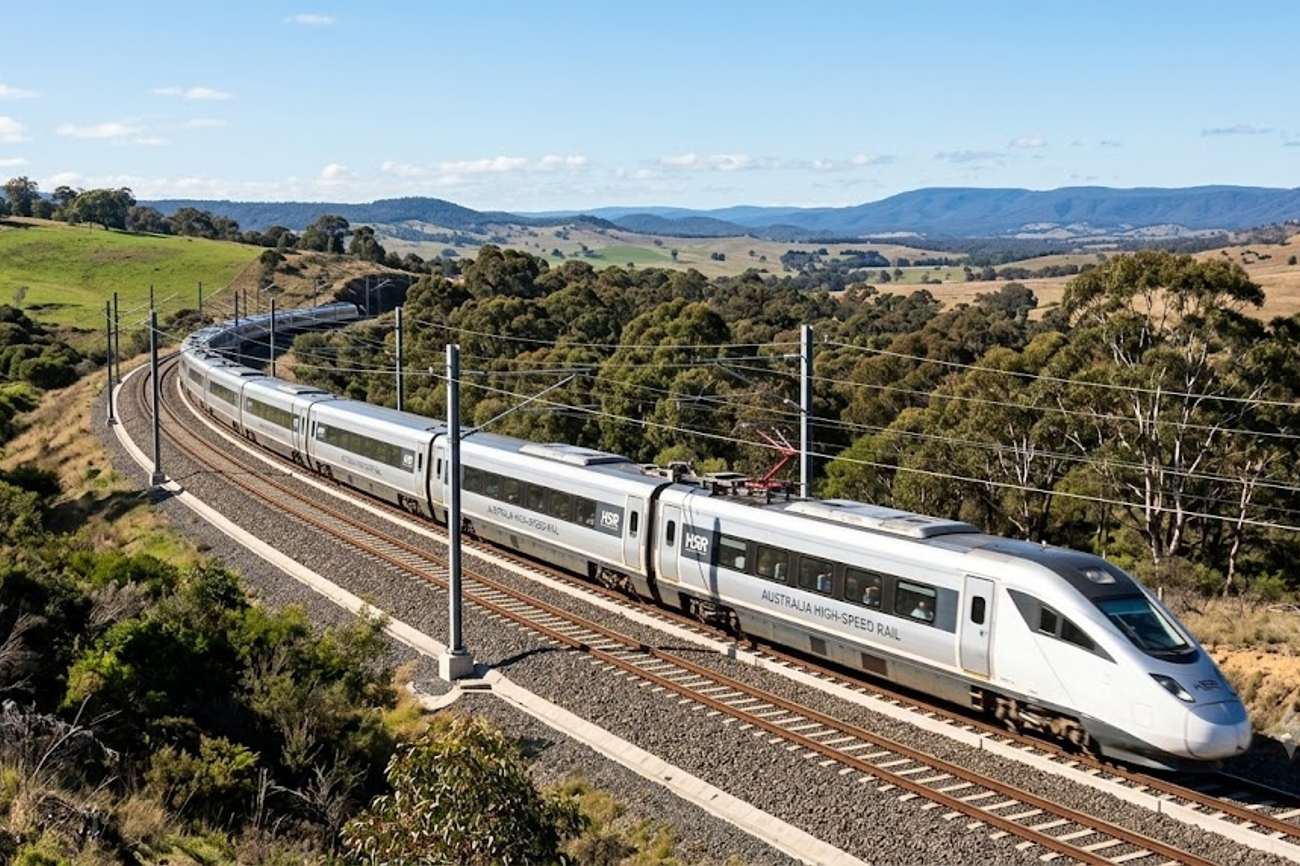
Image generated by AI
[Sydney, May 2024] — Australia is launching a massive overhaul of its eastern transport corridor with the development of a 1,700-kilometre high-speed electric rail network designed to slash travel times and decouple regional mobility from fossil-fuel-dependent aviation. The project, governed by the High Speed Rail Authority Act 2022, will implement bullet trains capable of operational speeds reaching 320 kilometres per hour, effectively linking South East Queensland, New South Wales, and Victoria.
The initiative is a direct response to the saturation of domestic flight paths and clogged highway systems. By establishing a dedicated, isolated rail infrastructure, the High Speed Rail Authority aims to divert millions of passengers from short-haul flights to zero-emission electric transit. This strategic shift aligns with the mandates of the Climate Change Act 2022, which requires a 43 percent reduction in national emissions by 2030.
The Catalyst for High-Speed Rail
The primary driver for this infrastructure pivot is the inefficiency of current interstate transit. For decades, the "economic spine" of Australia's East Coast has relied on a combination of slow regional trains and high-emission short-haul flights. The Sydney-to-Melbourne air corridor is currently one of the most congested passenger routes globally.
By introducing a rail system that operates independently of heavy freight traffic, the government intends to eliminate the unpredictability of current schedules. The project utilizes advanced civil engineering, including deep-underground tunnel borings to bypass the difficult geologies of the Hawkesbury River and coastal terrain, ensuring that trains can maintain maximum velocity without safety compromises.
Impacted Corridors and Markets
The rollout is divided into strategic stages to prioritize the most congested population centers.
| Project Phase | Primary Route/Connection | Key Hubs Included | Estimated Travel Impact |
|---|---|---|---|
| Stage 1 | Sydney $\rightarrow$ Newcastle | Sydney Central, Parramatta, Western Sydney International Airport, Central Coast, Newcastle | 150 mins $\rightarrow$ 60 mins |
| Southern Expansion | Sydney $\rightarrow$ Melbourne | Canberra, Albury-Wodonga, Melbourne | Downtown-to-Downtown < 3 hours |
| Northern Expansion | Sydney $\rightarrow$ Brisbane | Coffs Harbour, Gold Coast, Brisbane | High-frequency regional access |
The network specifically targets the "commuter belt" of New South Wales. Residents of the Central Coast will see travel times to downtown Sydney or Newcastle drop to approximately 30 minutes, fundamentally changing the residential viability of these regions.
Practical Traveler Advisory and Strategic Insights
For the average passenger, this represents a total shift in the logistics of domestic travel. The "airport experience"—characterized by security queues, check-in delays, and expensive suburban transfers—is replaced by seamless city-center departures.
Passenger Impact Analysis:
- Time Savings: The journey from Sydney Central to Newcastle is being reduced by 90 minutes.
- Reliability: Because the lines are isolated from freight, the "ripple effect" of cargo delays will no longer impact passenger schedules.
- Cost and Accessibility: The decentralization of housing means travelers can live in more affordable regional hubs like Goulburn, Maitland, or Wollongong while maintaining a sub-one-hour commute to major financial districts.
- Stress Reduction: The removal of aviation-related anxiety (security, boarding, flight delays) is a core pillar of the project's quality-of-life goals.
Financial Framework and Construction
The scale of the project requires a complex, multi-tiered funding model. The federal government has already provided a $659.6 million baseline allocation for the initial two-year planning phase. However, the capital requirements for construction are substantial.
The projected costs for the initial Sydney-to-Newcastle link are as follows:
- Stages 1A and 1B: $61.2 billion
- Stage 1C: $32.4 billion
- Total Initial Corridor Investment: $93.6 billion
To fund the remaining sections of the 1,800-kilometre network, the government is utilizing "land value capture." By re-zoning land around new stations, the Australian Government expects to generate between $48 billion and $140 billion in revenue from increased property values. To mitigate risk, the project employs a Hybrid Incentivised Target Cost system and public-private partnerships.
Sustainability is baked into the procurement. Contractors are mandated to use green steel produced via hydrogen energy and low-carbon geopolymer concrete. Furthermore, all tunneling and earthmoving equipment must be electric to minimize the Scope 3 carbon footprint.
The Transition to Net Zero
The rail network is a cornerstone of Australia's environmental strategy. Unlike regional aircraft, these electric train sets produce zero direct Scope 1 operational emissions. Power will be sourced through long-term Power Purchase Agreements (PPAs) fueled by 100 percent renewable wind, solar, and battery assets.
Industry data suggests that when total travel time between two cities drops below the three-hour mark, high-speed rail typically captures 70 to 80 percent of the passenger market from airlines. This shift will not only reduce carbon output but will also free up critical runway slots at Sydney Kingsford Smith Airport and the upcoming Western Sydney International Airport for high-value international freight and long-haul flights.
FAQ: Australia High-Speed Rail 2024
How much faster will the trip from Sydney to Newcastle be? The current 150-minute regional journey will be reduced to a 60-minute express commute. Travel between the Central Coast and major hubs will drop to roughly 30 minutes.
Will this replace flights between Sydney and Melbourne? The goal is to capture 70-80% of the passenger traffic. By providing downtown-to-downtown transit in under three hours, the rail network removes the need for airport transfers and security.
How is the government paying for a $93.6 billion project? Funding combines direct federal outlays, public-private partnerships, and land value capture, which leverages increased property values around new stations to raise up to $140 billion.
Is the construction itself environmentally friendly? Yes. The project mandates the use of green steel, low-carbon geopolymer concrete, and electric-powered heavy machinery to minimize the construction carbon footprint.
The era of the short-haul flight on the East Coast is facing a systemic challenge from the rail.
Related Travel Guides
- Jamaica Resort Giants Intercept Millions In Global Travel Funds Driven To Empower Families In Ocho Rios And St. Elizabeth
- Camiguin’s Tourism Explosion Begins as Philippine Island Plans for 824,000 Visitors by 2028
- North Dakota and North Carolina 2025-26 Tourism Surge: Outdoor Adventures Compete for America’s Holiday Makers
Disclaimer
This article is for informational and educational purposes only. It does not constitute legal, financial, or professional advice. While we strive to provide accurate and up-to-date information, travel policies, regulations, and conditions change rapidly. Always verify information with official sources before making travel decisions. Nomad Lawyer makes no representations about the accuracy, reliability, completeness, or suitability of the information provided. Readers should consult qualified professionals for advice specific to their circumstances. The views expressed in this article are those of the author and do not necessarily reflect the views of Nomad Lawyer.
Kunal K Choudhary
Co-Founder & Contributor
A passionate traveller and tech enthusiast. Kunal contributes to the vision and growth of Nomad Lawyer, bringing fresh perspectives and driving the community forward.
Learn more about our team →