Auckland Dual Cruise Ship Arrivals Highlight Global Port Infrastructure Demands Across New Zealand, Pacific, and Europe

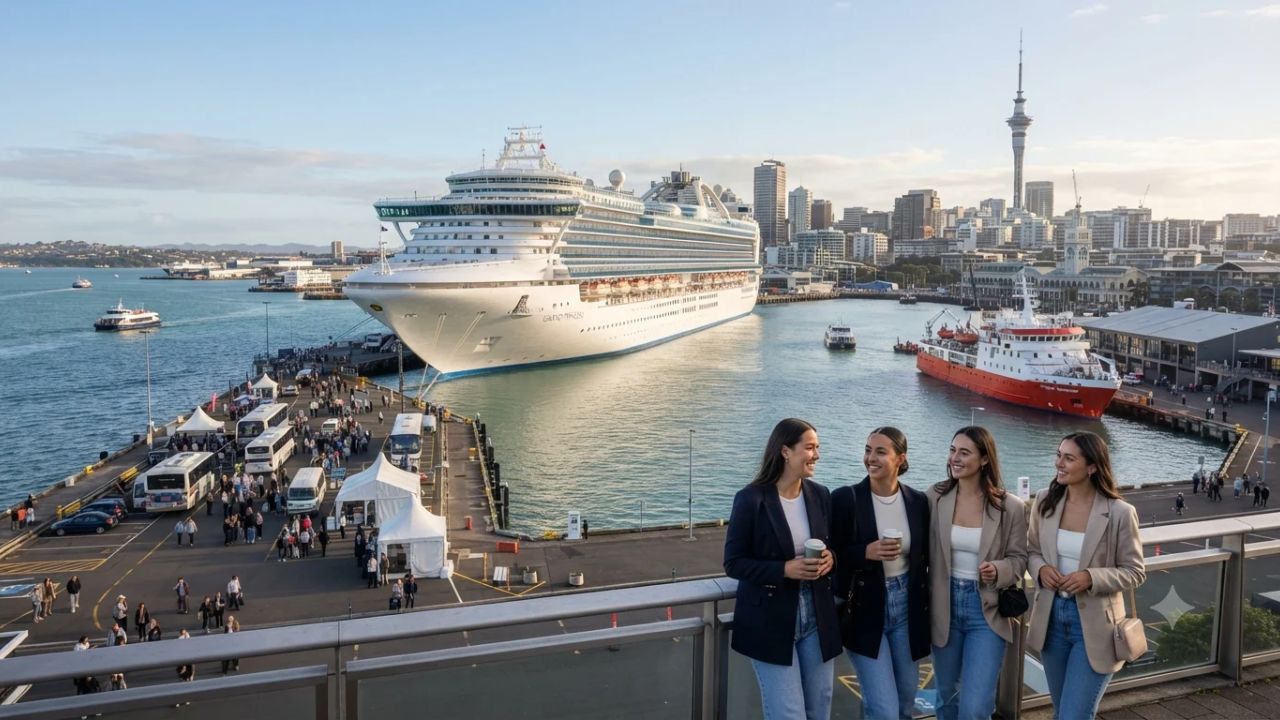
AUCKLAND, New Zealand — The simultaneous arrival of an expedition vessel and a 2,600-guest mega-ship at the Port of Auckland has spotlighted the contrasting infrastructure demands shaping global cruise travel, as maritime destinations across New Zealand, Vanuatu, Fiji, and Spain modernize wharves, expand remote landing facilities, and accelerate berth electrification.
The contrasting dockings recorded on Thursday, November 12, 2026, provide a live-action case study in modern maritime port management. Within forty minutes of each other, the 140-passenger polar expedition vessel Heritage Adventurer tied up at Princes Wharf, while the 107,517-gross-ton Grand Princess, carrying 2,610 lower berths, secured lines alongside Queens Wharf. Accommodating both ships within Auckland's central Waitematā Harbour illustrated how coastal gateways must simultaneously handle boutique eco-tourism and mass-scale passenger logistics while safeguarding commercial ferry channels, municipal biosecurity protocols, and waterfront urban environments.
       PORT OF AUCKLAND DUAL CRUISE BERTHING (12 NOVEMBER 2026)

  [ WAITEMATĀ HARBOUR / RANGITOTO CHANNEL APPROACH ]
                         |
                         +-----------------------------+
                         |                             |
                         v                             v
           [ PRINCES WHARF BERTH ]           [ QUEENS WHARF BERTH ]
           • Heritage Adventurer             • Grand Princess
           • Arrival: 05:39 NZDT             • Arrival: 06:15 NZDT
           • Category: Expedition            • Category: Ocean Mega-Liner
           • Length: 124 Metres              • Length: 289 Metres
           • Gross Tonnage: 8,378 GT         • Gross Tonnage: 107,517 GT
           • Published Guests: 140           • Lower Berths: 2,610
           • Previous: Vanuatu               • Previous: Picton
           • Next: Tauranga                  • Next: Bay of Islands (Paihia)
                         |                             |
                         +--------------+--------------+
                                        |
                                        v
  [ CENTRAL WATERFRONT MULTIMODAL TRANSPORT & FERRY BASIN INTERFACE ]
The Auckland Contrast: Expedition Boutique vs Mega-Liner Operations
The physical and operational disparity between the two vessels docked along Auckland’s downtown quays illustrates the fragmentation of modern cruise shipping:
- Heritage Adventurer (Princes Wharf): Operating under New Zealand’s Heritage Expeditions, the 124-metre vessel represents high-yield, low-footprint expedition cruising. Designed with an ice-strengthened hull for sub-Antarctic and tropical expedition voyaging, the ship arrived directly from an extended voyage through the Melanesian archipelago in Vanuatu. Its 140 guests disembark with minimal street-level disruption, transferring into specialized nature tours or regional domestic flights.
- Grand Princess (Queens Wharf): Operated by Princess Cruises (a subsidiary of Carnival Corporation & plc), the 289-metre vessel carries 18.6 times the passenger capacity of its harbor neighbor. Arriving on a round-the-country circuit from Picton in the Marlborough Sounds, the ship requires extensive shoreside support: hundreds of contracted tour motor coaches, complex luggage staging areas, palletized container provisioning, and coordinated border inspections for thousands of arriving international passengers.
| Operational & Marine Dimension | Heritage Adventurer (Princes Wharf) | Grand Princess (Queens Wharf) | Multiplier / Disparity Factor |
|---|---|---|---|
| Vessel Classification | Polar-class expedition adventure vessel | Large-scale ocean passenger resort liner | Boutique vs Mass Market |
| Published Guest Capacity | 140 passengers | 2,610 lower berths (3,100+ max) | 18.6x Capacity Multiplier |
| Vessel Overall Length (LOA) | 124.0 metres | 289.6 metres | 2.33x Hull Length |
| Gross Tonnage (GT) | 8,378 gross tons | 107,517 gross tons | 12.8x Volumetric Mass |
| Vessel Breadth (Beam) | 18.0 metres | 36.0 metres (Post-Panamax) | 2.0x Channel Width |
| Arrival Timestamp (Lines Fast) | 05:39 NZDT (12 Nov 2026) | 06:15 NZDT (12 Nov 2026) | 36-Minute Arrival Interval |
| Scheduled Departure Time | 19:05 NZDT (To Tauranga) | 18:30 NZDT (To Bay of Islands) | Coordinated Evening Departures |
| Immediate Prior Destination | Port Vila / Luganville, Vanuatu | Picton (Queen Charlotte Sound), NZ | International vs Domestic Call |
This co-location demonstrates that modern cruise destinations cannot apply a one-size-fits-all infrastructure model. While mega-liners require high-capacity quays, elevated passenger gangways, and massive bus staging aprons, expedition ships prioritize operational flexibility, bespoke shoreside immersion, and efficient regulatory turnaround.
Auckland’s Waterfront Bottleneck: Ferry Logistics and the 2026–2036 Cruise Plan
The physical layout of Auckland’s downtown port precinct presents complex spatial challenges. The cruise quays at Queens Wharf and Princes Wharf sit directly adjacent to the Downtown Ferry Terminal, which handles tens of thousands of daily commuter movements connecting the central business district (CBD) with Devonport, Waiheke Island, Half Moon Bay, and the North Shore.
According to technical assessments conducted under the Auckland Council’s Port Precinct Framework Plan:
- Berth Length Limitations: Queens Wharf can accommodate passenger vessels up to approximately 300 metres in length. Princes Wharf can accept vessels up to 320 metres only when specific tidal, weather, and dolphin mooring arrangements are deployed.
- Ferry Navigational Conflicts: When large vessels like the Grand Princess conduct 180-degree swinging maneuvers within the inner harbor basin assisted by port tugs, commercial commuter ferry movements must be temporarily paused or diverted, creating commuter bottlenecks during morning and evening rush hours.
                  AUCKLAND CENTRAL WATERFRONT CONFLICT ZONE

  [ WAITEMATĀ HARBOUR BASIN ]
              |
              +---> [ SWINGING BASIN: CRUISE TURNING MANEUVERS ]
              |     (Ferry routes temporarily held during ship docking)
              |
  +-----------+-----------+--------------------+---------------------+
  | PRINCES WHARF         | DOWNTOWN FERRY     | QUEENS WHARF        |
  | 320m Max Berth        | BASIN              | 300m Max Berth      |
  | (Heritage Adventurer) | 12 Commuter Pontoons| (Grand Princess)   |
  | Commercial / Hotel    | High-Frequency CBD | Shed 10 Terminal    |
  +-----------------------+--------------------+---------------------+
              |                                          |
              v                                          v
  [ DOWNTOWN AUCKLAND COMMERCIAL CORE / QUAY STREET / BRITOMART TRANSPORT ]
To resolve these growing pains, regional development agency Tātaki Auckland Unlimited released the Auckland Cruise Plan 2026–2036 in August 2026. The 10-year strategic framework shifts focus from chasing raw passenger volumes toward maximizing visitor yield, improving shoreside infrastructure, and mitigating urban disruption:
- Disproportionate Economic Impact: The plan reveals that while Auckland accounts for only 15% of total New Zealand cruise passenger port visits, the city captures 39% of all cruise tourism spending nationwide.
- Financial Baseline: During the 2023–24 season, cruise traveler and crew spending injected NZ$201 million directly into the Auckland regional economy, supporting NZ$244.6 million in regional GDP and sustaining 3,780 local jobs.
- Shed 10 Modernization: Municipal authorities advanced a major redevelopment proposal for Shed 10 on Queens Wharf in late 2026. The plan enhances customs, biosecurity screening, baggage handling, and universal accessibility, targeting full operational delivery by October 2027.
| Economic & Operational Indicator | Auckland Cruise Footprint (2023–24 Baseline) | National New Zealand Share |
|---|---|---|
| Direct Passenger & Crew Spending | NZ$201.0 Million | 39.0% of Total National Spend |
| Regional GDP Contribution | NZ$244.6 Million | Major Urban Tourism Engine |
| Employment Supported | 3,780 Full-Time Equivalent Jobs | Retail, Hospitality, Transport, Maritime |
| Total Passenger Movements | ~195,000 Port Movements | 15.0% of National Port Calls |
| Average Spend per Transit Guest | ~$285 NZD | High Retail and Dining Capture |
| Average Spend per Turnaround Guest | ~$850 NZD (Including Pre/Post Hotels) | Premium Economic Stimulus |
Four Global Port Models: New Zealand, Vanuatu, Fiji, and Spain
Auckland's infrastructure challenge mirrors broader operational shifts occurring across the Pacific and European maritime sectors. Transport authorities in Vanuatu, Fiji, and Spain are similarly balancing diverse ship sizes, environmental mandates, and local community needs.
       FOUR GLOBAL CRUISE PORT INFRASTRUCTURE STRATEGIES

  [ NEW ZEALAND: Auckland ]              [ VANUATU: Remote Outer Islands ]
  • High-Yield Urban Turnarounds         • Decentralized Expedition Access
  • Downtown Berth & Ferry Separation    • Decentralized Sanitation & Eco-Ramps
  • Shed 10 Terminal Modernization       • 159 Large Calls vs 37 Expedition

  [ FIJI: Suva & Lautoka ]               [ SPAIN: Cádiz & Barcelona ]
  • Cargo-Cruise Operational Balance     • High-Voltage Berth Electrification
  • Kings Wharf Industrial Rehabilitation• FuelEU Maritime Mandate (2030)
  • Harbor Traffic Management (VTMS)     • 16 MVA Shore Power (Zero Emissions)
| Destination & Port | Verified Infrastructure Baseline | Primary Operational Challenge | Strategic Long-Term Priority |
|---|---|---|---|
| New Zealand (Auckland) | 2 Central Quays (Princes & Queens Wharves); Shed 10 Terminal | Waterfront spatial limits; commuter ferry conflicts in basin | Maximizing high-yield passenger turnarounds and Shed 10 upgrades |
| Vanuatu (Port Vila & Outer Isles) | 4 Primary Deepwater Ports; 12 Provincial Expedition Anchorages | Fragile remote island ecology; lack of basic shore facilities | Low-impact community infrastructure (e.g., Loh Island Sanitation Block) |
| Fiji (Suva & Lautoka) | Kings Wharf (Suva, 492m quay); Queens Wharf (Lautoka) | Multi-use quays shared with international container cargo | Lautoka Port Master Plan 2026–2053; Harbour Traffic Management Systems |
| Spain (Cádiz & Barcelona) | Dedicated multi-terminal complexes; Alfonso XIII & Terminal G | High urban maritime air emissions and auxiliary engine noise | Cold-ironing shore power installations (16 MVA to 24 MVA capacity) |
1. Vanuatu: Decentralized Infrastructure for Fragile Coral Atolls
In the South Pacific, the Republic of Vanuatu illustrates the dual nature of cruise tourism. Official forecasts from the Vanuatu Ministry of Trade and Commerce confirm 159 large-ship calls across four primary deepwater ports in 2027: Port Vila, Mystery Island, Lelepa Island, and Luganville.
Concurrently, Vanuatu has scheduled 37 expedition cruise calls across 12 remote anchorages spread throughout all six provinces, with 80% located far from commercial urban centers. Large-ship ports require organized tender platforms and crowd control. Remote islands, however, need basic eco-friendly infrastructure that protects village life.
A practical example emerged on October 22, 2026, when authorities opened the Loh Cruise Sanitation Block in the remote Torres Islands. Funded by New Zealand’s Pacific Tourism Recovery and Resilience programme, the facility provides solar lighting, hygienic toilets, handwashing stations, and rainwater harvesting tanks. This targeted intervention enables expedition vessels like the Heritage Adventurer to bring adventurous travelers ashore without straining local drinking water supplies or compromising village hygiene.
2. Fiji: Reconciling International Freight with Cruise Tourism
Fiji faces a different operational balance: its primary cruise berths are also the nation’s commercial supply lifelines. According to Fiji Ports Corporation Limited (FPCL), Suva’s Kings Wharf handles 60% of national cargo imports, while Lautoka Port handles the remaining 40%. Kings Wharf features a 492-metre linear quay with a 12-metre draft, requiring port dispatchers to coordinate arriving passenger vessels alongside container ships, bulk fuel tankers, and regional inter-island ferries.
To resolve these bottlenecks, the Fijian Government launched the Lautoka Port Master Plan on March 20, 2026, executing structural wharf rehabilitation, navigation channel dredging, and container yard expansions. Projections indicate Lautoka’s annual cruise visits could expand from 30 calls in 2024 to between 40 and 50 calls by 2053. In addition, the installation of a high-tech Vessel Traffic Management System (VTMS) in Suva Harbour provides real-time radar and transponder tracking, ensuring cruise liners navigate busy reefs and commercial channels safely.
3. Spain: Accelerating Cold-Ironing and Berth Shore Power
In the Mediterranean, Spain demonstrates the environmental frontier of cruise port development. As the European Union prepares to enforce the FuelEU Maritime Regulation—which mandates zero-emissions at berth for covered passenger vessels by 2030—Spanish ports are heavily investing in cold-ironing shore power (Onshore Power Supply, OPS).
On March 18, 2026, the Port Authority of the Bay of Cádiz (APBC) inaugurated Spain's first commercial shore-power installation for cruise vessels at Muelle Alfonso XIII. Backed by an initial €8.25 million partnership with utility provider Endesa (including €2.7 million in EU recovery funds), the facility delivers 16 MVA of electrical capacity (expandable to 24 MVA). The system allows ships to shut down auxiliary diesel generators while docked, cutting an estimated 5,000 tonnes of carbon dioxide emissions annually.
Following Cádiz, the Port of Barcelona awarded a €10.4 million contract in April 2026 to electrify its upcoming Terminal G on the Adossat Quay, scheduled for completion in 2027. These capital projects demonstrate that in developed cruise markets, port competitiveness is increasingly judged by environmental compliance rather than simple berth length.
       CÁDIZ COMMERCIAL SHORE-POWER SYSTEM ARCHITECTURE

  [ HIGH-VOLTAGE SUBSTATION ] ===> [ 16 MVA / 24 MVA TRANSFORMER ]
                                                  |
                                                  v
  [ BERTH OPS CABLE REEL ] =======> [ DOCKED CRUISE SHIP CONNECTION ]
  • Muelle Alfonso XIII (Cádiz)     • Auxiliary Diesel Generators STOPPED
  • Clean Grid Energy Delivered     • 5,000 Tonnes Annual CO2 Abated
  • Zero Fumes / Zero Urban Noise   • Meets FuelEU Maritime 2030 Mandates
Why Passenger Headcount Fails to Measure Real Economic Value
The simultaneous presence of Grand Princess and Heritage Adventurer in Auckland challenges the common assumption that larger passenger headcounts automatically deliver greater local economic prosperity.
While mega-liners deliver thousands of visitors within single daytime windows, the economic value per passenger often tells a different story:
- Mass-Market Cruise Profile: Large ships often operate on tightly scheduled port calls (typically 8 to 10 hours). Passengers frequently book pre-packaged ship excursions where revenue is divided among cruise lines, international tour wholesalers, and local operators. When thousands of guests disembark simultaneously, downtown pedestrian corridors experience acute crowding, public transport systems face strain, and independent local restaurants receive limited patronage as guests return onboard for prepaid meals.
- Expedition Cruise Profile: Although carrying fewer passengers, expedition guests spend significantly more per capita in destination ports. Handlers and guests frequently stay in high-end boutique hotels before departure, utilize independent specialty retailers, hire private transport, and purchase premium cultural experiences.
              ECONOMIC IMPACT: EXPEDITION VS MEGA-LINER

  [ EXPEDITION CRUISE MODEL: Heritage Adventurer ]
  • Volume: 140 Passengers | High Per Capita Spend (~$650–$1,200 NZD/Day)
  • Dispersion: Regional Outer Island Anchorages, Remote Village Economies
  • Footprint: Low Carbon / Negligible Urban Street Congestion

  [ MEGA-LINER CRUISE MODEL: Grand Princess ]
  • Volume: 2,610 Passengers | Lower Per Capita Spend (~$150–$280 NZD/Day)
  • Dispersion: Concentrated Along Downtown Wharves and Mass Tour Bus Routes
  • Footprint: High Infrastructure Strain / Heavy Coach Fleet Demand
Auckland's data proves that homeporting turnarounds—where voyages begin or conclude—deliver far greater economic value than simple transit stops. A turnaround passenger spends roughly three times more than a day-visitor, driving room nights in downtown hotels, restaurant dining, and airport shuttle traffic. Consequently, forward-looking ports are designing terminals to facilitate efficient baggage and customs flows for turnaround passengers, rather than simply expanding concrete piers for short-stay mega-liners.
Biosecurity, Environmental Compliance, and Maritime Clearances
Operating in the pristine waters of New Zealand and the wider South Pacific requires strict adherence to environmental and biosecurity regulations:
1. New Zealand’s World-Leading Biofouling Standards
Under strict standards enforced by New Zealand’s Ministry for Primary Industries (Biosecurity New Zealand), all international commercial and cruise vessels entering territorial waters must provide verifiable proof of hull cleanliness before arrival:
- Craft Risk Management Standard (CRMS): Vessels must demonstrate continuous hull maintenance, underwater diver inspections, or recent dry-dock hull anti-fouling recoating.
- Enforcement Protocols: Ships found with non-compliant biofouling (such as invasive algae, mussels, or barnacles) are routinely denied entry to sensitive marine sanctuaries (like Fiordland National Park) or directed offshore for hull cleaning, disrupting passenger itineraries.
2. Digital Border Clearances: The New Zealand Traveller Declaration (NZTD)
All arriving cruise passengers must complete the digital New Zealand Traveller Declaration (NZTD) before landing. The system requires travelers to declare biosecurity risk goods—including fresh produce, wooden souvenirs, camping equipment, and animal products—preventing the introduction of destructive agricultural pests like the fruit fly or brown marmorated stink bug.
       NEW ZEALAND MARITIME ENTRY COMPLIANCE FRAMEWORK
 +-------------------------------------------------------------------+
 | 1. BIOFOULING AUDIT: Verifiable Hull Cleaning (MPI Standards)     |
 | 2. DIGITAL NZTD: Pre-Arrival Digital Border & Biosecurity Pass    |
 | 3. MARITIME SAFETY: Tug Escorts & Harbor Radar Vessel Tracking    |
 | 4. SEWAGE & WASTE: Zero Blackwater Discharge in Inshore Waters    |
 +-------------------------------------------------------------------+
Strategic Guidance for Travel Agents, Tour Planners, and Cruise Operators
The ongoing evolution of cruise infrastructure across New Zealand, the Pacific, and Europe requires travel trade professionals to adapt booking advice and tour design:
- Distinguish Between Direct-Berth and Tender Ports: When booking South Pacific itineraries, verify whether ships will dock directly alongside a deepwater wharf (such as Queens Wharf in Auckland or Kings Wharf in Suva) or anchor offshore requiring tender boat transfers (such as Mystery Island in Vanuatu or Paihia in the Bay of Islands). Tender operations are highly weather-dependent and can be cancelled due to high sea swells.
- Account for Auckland Airport Transfer Windows: For passengers disembarking mega-liners like Grand Princess at Queens Wharf during morning turnaround windows, advise booking outbound international flights from Auckland Airport (AKL) no earlier than 13:30. Traffic congestion across the State Highway 20 motorway corridor, combined with baggage claim and customs processing at Shed 10, requires generous travel buffers.
- Incorporate Port Sustainability Credentials into Client Advice: Modern cruise passengers increasingly value environmental sustainability. Inform eco-conscious travelers about ports with active shore-power capabilities (such as Cádiz and Barcelona) and cruise lines that utilize low-impact expedition landing protocols in sensitive Pacific archipelagos.
- Prepare Clients for Remote Pacific Realities: Travelers booking expedition voyages to the outer provinces of Vanuatu or Fiji should be informed that landing facilities may consist of basic eco-blocks (like the Loh Island facility) or wet zodiac beach landings. Packing dry bags, sturdy water shoes, and personal medications is essential.
Frequently Asked Questions
Why were the simultaneous cruise arrivals in Auckland on November 12, 2026, significant?
On the morning of November 12, 2026, Auckland hosted two contrasting vessels: the boutique polar expedition ship Heritage Adventurer (140 guests, 124m length) at Princes Wharf and the large ocean liner Grand Princess (2,610 lower berths, 289m length) at Queens Wharf. The arrival within 40 minutes demonstrated the contrasting spatial, logistical, and environmental demands placed on urban ports managing both small eco-expeditions and mass-market mega-ships.
What is Auckland’s long-term plan for cruise port infrastructure?
Under the Auckland Cruise Plan 2026–2036 introduced by Tātaki Auckland Unlimited, the city is prioritizing high-value passenger turnarounds, enhanced passenger facilities, and reduced urban disruption. Key initiatives include modernizing the historic Shed 10 terminal on Queens Wharf by October 2027 to improve customs and biosecurity screening, while addressing navigational conflicts with downtown commuter ferries in Waitematā Harbour.
How does cruise port development differ in Vanuatu and Fiji compared to New Zealand?
In Vanuatu, infrastructure focuses on decentralized, low-impact facilities for remote outer islands—such as the newly opened Loh Island Cruise Sanitation Block in the Torres Islands—enabling expedition ships to visit remote communities sustainably without requiring mega-docks. In Fiji, ports like Suva and Lautoka must balance cruise passenger berths with critical commercial cargo operations, prompting the launch of the Lautoka Port Master Plan 2026–2053 and advanced harbor vessel traffic management systems.
What environmental infrastructure improvements are European ports like Cádiz implementing?
European cruise ports are accelerating the installation of Onshore Power Supply (OPS), or shore-power systems, to comply with the European Union’s FuelEU Maritime regulation requiring zero emissions at berth by 2030. On March 18, 2026, Cádiz inaugurated Spain’s first commercial cruise shore-power system with 16 MVA capacity, allowing compatible vessels to shut down auxiliary diesel engines and cut approximately 5,000 tonnes of carbon emissions annually. Barcelona is constructing a similar system at Terminal G for 2027.
Related Travel Guides
- Greece Cruise Tourism Shifts West as Corfu Tops One Million Passengers While Piraeus Falls 19% Amid Middle East Tensions
- VIA Rail Canada Updates Guide Dog and Service Animal Documentation Rules with 48-Hour Verification and 5-Year Approval Validity
- Spain Nationwide Rail Strike Disrupts AVE, Cercanías, and Rodalies Services as Renfe Cancels 24% of High-Speed Trains
- Norway Gjøvik Railway Suspends Train Services Between Roa and Gjøvik Following Signalling Communication Fault as Vy Deploys Buses
This article is for informational purposes. Flight routes, passenger regulations, visa rules, and transit advisories are subject to change by airlines and aviation authorities. Readers are advised to verify schedules and travel documentation with relevant carriers and border agencies before departure.
Related Stories
TUI Cruises Unveils Nine-Ship Mein Schiff Summer 2028 Programme Across Northern Europe, Mediterranean, and Atlantic
Spain’s Port of Motril Welcomes Windstar Star Legend on Landmark Spanish Mystery Cruise After 18-Year Absence