
Assam Completes Full Rail Electrification Drive to Deliver Smarter and More Efficient Train Services
Assam Completes Full Rail Electrification Drive to Deliver Smarter and More Efficient Train Services

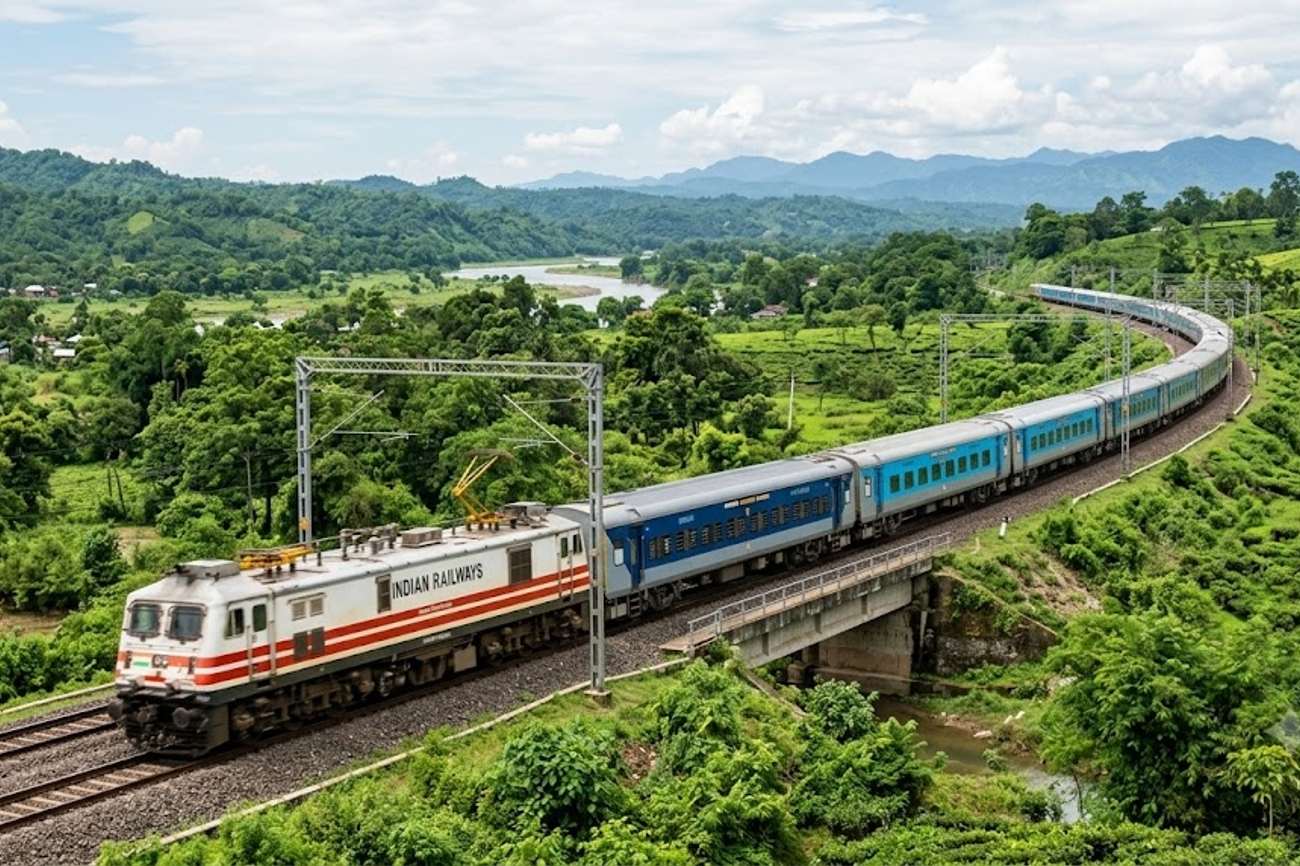
Image generated by AI
2,589 route kilometres of Broad Gauge track now operate under a fully electric system in Assam, marking the end of a massive infrastructure overhaul in one of India's most geographically challenging regions. This transition eliminates the systemic reliance on diesel locomotives across the state, removing the operational bottleneck of traction changes that previously slowed transit times and increased costs.
The Lumding–Badarpur Engineering Hurdle
The final piece of this infrastructure puzzle was the 169-kilometre Lumding–Badarpur Hill section. While the majority of the state's plains were relatively straightforward to electrify, this specific corridor presented a complex engineering puzzle due to its mountainous terrain. The completion of this segment was not merely a matter of laying overhead wires; it required a comprehensive overhaul of the regional power architecture.
To sustain high-voltage traction in these remote highlands, engineers had to activate a critical transmission link between the Haflong grid facility and the New Haflong traction facility. This power bridge ensures that electric locomotives can maintain consistent torque and speed while navigating the steep gradients of the hill section. For the Northeast Frontier Railway, this represents the removal of the last major physical barrier to a seamless, electrified transit corridor across the state.
Operational Metrics and Network Integration
The shift to a 100% electrified Broad Gauge (BG) network fundamentally alters the logistics of moving people and goods through the gateway to Northeast India. Under the previous hybrid system, trains frequently had to stop to swap diesel engines for electric ones, or vice versa, depending on the section of the track. These "traction changes" are notorious for causing scheduling delays and increasing labor costs.
| Metric | Detail |
|---|---|
| Total Electrified BG Network | 2,589 route kilometres |
| Final Completed Section | Lumding–Badarpur Hill (169 km) |
| Key Infrastructure Link | Haflong Grid to New Haflong Traction Facility |
| Primary Regulatory Body | Indian Railways |
| Network Scope | Full Broad Gauge (BG) coverage within Assam |
By integrating the entire state into the electric grid, the railway authority can now deploy modern electric locomotives across the entire route. This increases the "turnaround" speed of rolling stock and allows for more aggressive scheduling of both passenger and freight services.
Expert Analysis: The Logistics of Regional Hegemony
For travelers and logistics firms operating in Northeast India, the electrification of Assam is not just an environmental win—it is a strategic economic shift. Assam serves as the primary transit artery for the "Seven Sister" states. When a bottleneck exists in Assam, the ripple effects are felt in Arunachal Pradesh, Nagaland, Manipur, Mizoram, Tripura, and Meghalaya.
The direct consequence of removing diesel-electric swaps is a reduction in "dwell time" at stations. For the high-value freight moving from the ports of mainland India toward the northeast, every hour saved in traction switching translates to lower operational overhead. Furthermore, electric locomotives generally offer superior acceleration and braking performance on gradients compared to their diesel counterparts, which is a critical advantage on the Lumding–Badarpur Hill section.
From a pricing perspective, this shift creates a long-term downward pressure on operational costs. Diesel is a volatile commodity subject to global market swings and high transportation costs to reach remote depots. By shifting to the electrical grid, the International Air Transport Association (IATA) and other transport analysts often note that energy costs become more predictable. For the end traveler, this efficiency should theoretically stabilize ticket pricing and improve the reliability of arrival times.
Moreover, this project aligns with the broader national mandate to decarbonize the transport sector. By eliminating thousands of liters of diesel consumption daily, Assam is transitioning from a carbon-heavy transit hub to a sustainable corridor. This is particularly vital for the region's burgeoning eco-tourism sector, where the "green" credentials of the journey are becoming as important as the destination.
Key Takeaways
- Seamless Transit: The removal of locomotive swaps between diesel and electric power across 2,589 km of track will significantly reduce transit delays.
- Engineering Milestone: The 169-km Lumding–Badarpur Hill section was the final and most difficult segment to electrify due to mountainous terrain.
- Power Infrastructure: The project relied on a new high-voltage connection between the Haflong grid and the New Haflong traction facility.
- Economic Catalyst: Full electrification enhances the movement of freight and passengers, strengthening Assam's role as the gateway to Northeast India.
- Sustainability Shift: The transition reduces dependence on fossil fuels and lowers the overall carbon footprint of the regional rail network.
FAQ: Assam Railway Electrification 2024
Will train tickets become cheaper now that the lines are electric? While electrification reduces operational costs for the railway, ticket prices are regulated by the government. However, increased efficiency may lead to more frequent services and better availability, which can indirectly lower costs through increased competition and capacity.
How does this affect travel time to Northeast India? Travelers can expect a reduction in total journey time. The elimination of time-consuming locomotive changes at traction transition points means trains can maintain a more consistent speed across the entire state of Assam.
Is the entire railway network in Northeast India now electric? No. This project completes the Broad Gauge electrification specifically within the state of Assam. Other sections in neighboring Northeastern states may still be undergoing upgrades as part of the national modernization program.
What is a "Broad Gauge" network? Broad Gauge refers to the width between the rails. In India, this is typically 1,676 mm. Electrifying the Broad Gauge network ensures that the primary, heavy-duty lines used for long-distance travel and freight are modernized.
The silence of the electric motor replaces the roar of diesel, signaling a new era of connectivity for the Northeast.
Tags: Northeast Frontier Railway, Lumding-Badarpur Route, Assam Infrastructure 2024, Indian Railways Electrification, Haflong Traction Facility
Related Travel Guides
- United States Unveils Colorado Mountain Travel Revolution With Proposed High Speed Train Reaching 90 Miles Per Hour
- Spain High-Speed Rail Passenger Numbers Plunge 21% in 2026 Following Major Network Disruptions Across Key Tourism Routes
- Indian Railways Updates RailOne App to Launch Multi-Passenger Family Season Tickets Across Suburban and Regional Commuter Networks
Disclaimer
This article is for informational and educational purposes only. It does not constitute legal, financial, or professional advice. While we strive to provide accurate and up-to-date information, travel policies, regulations, and conditions change rapidly. Always verify information with official sources before making travel decisions. Nomad Lawyer makes no representations about the accuracy, reliability, completeness, or suitability of the information provided. Readers should consult qualified professionals for advice specific to their circumstances. The views expressed in this article are those of the author and do not necessarily reflect the views of Nomad Lawyer.
Preeti Gunjan
Contributor & Community Manager
A passionate traveller and community builder. Preeti helps grow the Nomad Lawyer community, fostering engagement and bringing the reader experience to life.
Learn more about our team →