
The Twin Vortices of Asian Airspace: Super Typhoon Champi and Red Sea Security Alerts Trigger 2,689 Flight Disruptions
Asian aviation faces dual crises on 24-25 October 2026 as Super Typhoon Champi and Saudi security alerts generate 367 cancellations and 2,322 delays across 24 regional airports.

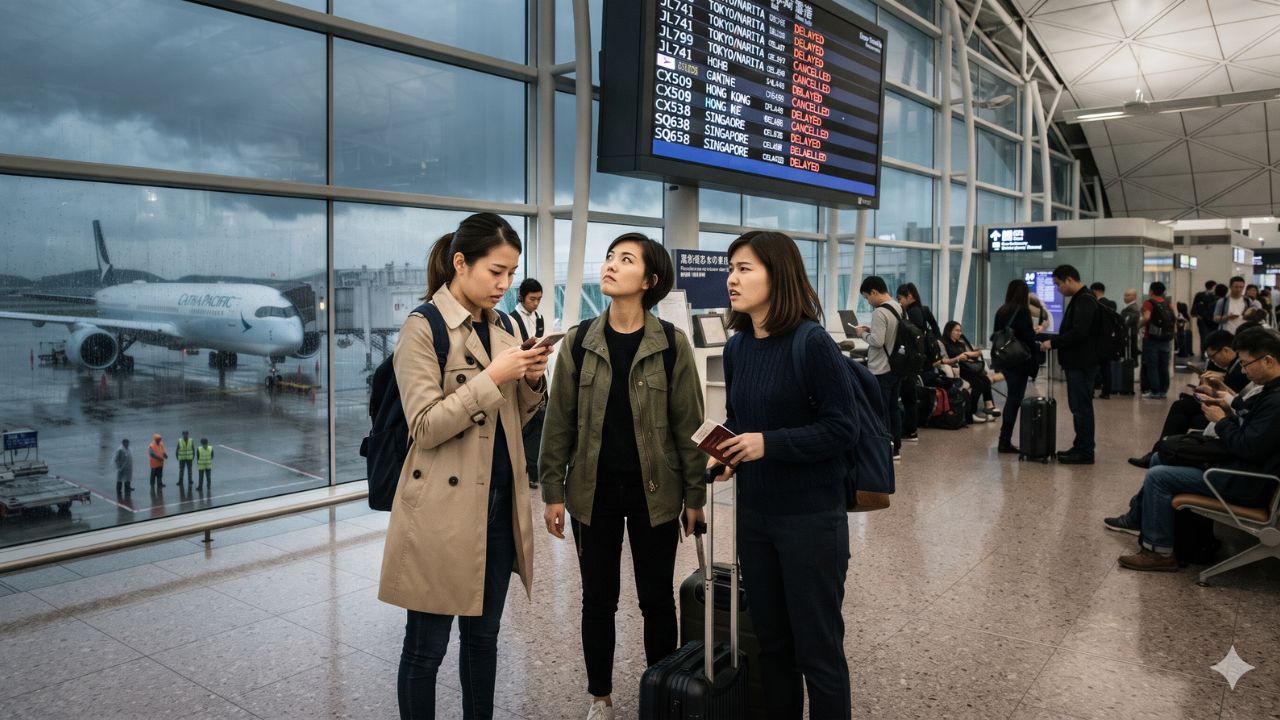
While King Khaled International Airport in Riyadh suffered a near-total operational freeze with 77 outright flight cancellations against just a single recorded delay as regional drone strikes prompted emergency airspace closures, more than 5,000 miles to the east, Taipei's Taoyuan International Airport suffered the opposite nightmare—logging 375 flight delays and a punishing 52% arrival delay rate as Super Typhoon Champi battered the western Pacific. Verified aviation data captured on October 24, 2026, at 1:46 pm ET (11:16 pm IST) reveals an extraordinary fracture across Asian commercial aviation, tallying 2,322 flight delays and 367 cancellations across 24 primary gateways. The compounding crisis stems from two completely separate shocks striking the continent simultaneously: an intensifying meteorological emergency across eastern China, Taiwan, and Japan, alongside escalating cross-border drone and missile attacks launched by Yemen's Iran-aligned Houthi rebels targeting civilian aviation hubs in Saudi Arabia.
From the gale-swept runways of Shanghai Pudong to the high-security terminals of Jeddah and the congested domestic corridors of Jakarta and Mumbai, international airlines spent the weekend scrambling aircraft rotations, managing exhausted flight crews, and rerouting long-haul connections.
The Dual Anatomy of Asia's Flight Gridlock
The operational breakdown across Asia divided the continent into two distinct emergency zones:
1. East Asian Skies: Super Typhoon Champi
In East Asia, Super Typhoon Champi exerted massive atmospheric pressure across the maritime corridor connecting Taiwan, the Ryukyu Islands, and mainland China’s eastern seaboard. Aviation advisories issued by the Central Weather Administration warned of torrential squalls and severe low-altitude wind shear.
At Taoyuan International Airport in Taipei, air traffic controllers were forced to widen arrival spacing, triggering 375 delayed flights alongside 14 cancellations, with 48% of departures and 52% of arrivals falling behind schedule. In mainland China, Shanghai Pudong International Airport absorbed 208 delays and 51 cancellations—the second-highest cancellation count in the dataset—while domestic relief hub Shanghai Hongqiao added 107 delays and 11 cancellations. Flight flow-control restrictions cascaded outward, affecting regional departures across Beijing, Hangzhou, Xiamen, Kunming, Fuzhou, Ningbo, and Zhoushan.
2. Arabian Peninsula Skies: Red Sea Security Groundings
Simultaneously, commercial aviation in the Middle East faced direct security disruption. Cross-border drone and missile strikes launched by Yemen-based Houthi militants prompted civil aviation authorities to enforce precautionary ground stops and route diversions across Saudi Arabia.
King Khaled International Airport in Riyadh recorded 77 outright cancellations, representing the highest single cancellation tally in Asia, while logging just one recorded delay—reflecting a deliberate strategy by carriers to cancel rotations early rather than hold passengers in departure halls. At King Abdulaziz International Airport in Jeddah, 195 delays and 31 cancellations disrupted vital passenger routes, with a 29% arrival delay rate and 26% departure delay rate snarling Umrah pilgrimage traffic. Secondary impacts were recorded across King Fahd International in Dammam.
3. South and Southeast Asian Bottlenecks
In India and Indonesia, high-density hubs felt immediate knock-on effects from disrupted overseas aircraft rotations:
- Jakarta Soekarno-Hatta (CGK): Handled 236 delays (a 21% arrival and 19% departure delay rate) and 14 cancellations as domestic trunk routes absorbed regional delays.
- Indira Gandhi International (DEL), Delhi: Logged 194 delays and five cancellations, with connecting passengers missing westward connections into the Gulf.
- Chhatrapati Shivaji Maharaj (BOM), Mumbai: Handled 151 delays and nine cancellations.
- Secondary Indian Hubs: Flow delays spread outward into Bengaluru, Ahmedabad, Kochi, and Navi Mumbai.
- Sabiha Gökçen (SAW), Istanbul: Logged 113 delays and six cancellations across Turkish low-cost networks.
Airline Operational Breakdown: Carriers Under Heavy Fire
Airline statistics reveal dramatic variations in how individual carriers managed the weekend disruption:
- China Eastern Airlines: Bore the heaviest overall volume burden, logging 204 delayed flights (a 9% delay rate) alongside 75 cancellations (3%), driven by coastal weather bottlenecks across its primary Shanghai hubs.
- Saudia: Suffered the steepest proportional impact across the region. The Saudi flag carrier canceled 72 flights—an extraordinary 17% of its scheduled operations—while delaying 94 departures (22%), reflecting extensive emergency ground holds.
- Air China: Managed weather flow restrictions effectively, recording 88 delays (5%) while keeping cancellations to just 13 flights.
- Batik Air: Absorbed significant Indonesian domestic friction, logging 51 delays (a 17% delay rate) and 14 cancellations (4%).
- Akasa Air: Recorded an elevated cancellation rate across Indian routes, grounding 34 flights (representing 14% of its scheduled operations) alongside 23 delays (9%).
Comprehensive Flight Disruption Tracker: 24 Asian Hubs and Key Airlines Hit by Champi and Security Alerts
The following record outlines the verified delay and cancellation tallies captured on 24 October 2026:
| Airport / Carrier Entity | Regional Base | Flight Delays | Flight Cancellations | Delay / Cancellation Percentages | Primary Operational Driver |
|---|---|---|---|---|---|
| Taoyuan International (TPE) | Taipei, Taiwan | 375 delays | 14 cancellations | 52% Arr Delay / 48% Dep Delay | Super Typhoon Champi crosswinds & arrival spacing |
| Soekarno-Hatta (CGK) | Jakarta, Indonesia | 236 delays | 14 cancellations | 21% Arr Delay / 19% Dep Delay | High-density domestic & international bottlenecks |
| Shanghai Pudong (PVG) | Shanghai, China | 208 delays | 51 cancellations | 14% Arr Delay / 12% Dep Delay | Coastal rainbands; 2nd-highest cancellations |
| King Abdulaziz (JED) | Jeddah, Saudi Arabia | 195 delays | 31 cancellations | 29% Arr Delay / 26% Dep Delay | Airspace security holds & pilgrimage travel congestion |
| Indira Gandhi (DEL) | Delhi, India | 194 delays | 5 cancellations | 13% Arr Delay / 15% Dep Delay | Knock-on schedule delays on Middle East corridors |
| Guangzhou Baiyun (CAN) | Guangzhou, China | 158 delays | 8 cancellations | Regional flow delays | Northern departure hold programs |
| Chhatrapati Shivaji (BOM) | Mumbai, India | 151 delays | 9 cancellations | Elevated domestic delays | Inbound aircraft rotation delays |
| Sabiha Gökçen (SAW) | Istanbul, Türkiye | 113 delays | 6 cancellations | Moderate network delays | Regional connecting flow restrictions |
| Shanghai Hongqiao (SHA) | Shanghai, China | 107 delays | 11 cancellations | Severe domestic delays | Secondary Shanghai weather diversions |
| King Khaled (RUH) | Riyadh, Saudi Arabia | 1 delay | 77 cancellations | Highest regional cancellations | Emergency security groundings from drone strikes |
| China Eastern Airlines | Mainland China | 204 delays | 75 cancellations | 9% Delay / 3% Cancellation | Highest total delay and cancellation counts |
| Saudia | Saudi Arabia | 94 delays | 72 cancellations | 22% Delay / 17% Cancellation | Highest proportional schedule cancellation rate |
| Air China | Mainland China | 88 delays | 13 cancellations | 5% Delay / Minimal cancel | Moderate domestic holding delays |
| Batik Air | Indonesia | 51 delays | 14 cancellations | 17% Delay / 4% Cancel | Heavy Indonesian archipelagic schedule pressure |
| Akasa Air | India | 23 delays | 34 cancellations | 9% Delay / 14% Cancel | Elevated domestic cancellation rate across Indian routes |
Visitor Insider Tips
When weather and geopolitics simultaneously challenge Asian air routes, local transit knowledge provides vital protection:
- Pivot to High-Speed Rail Networks Immediately: If your domestic flight across Taiwan or Saudi Arabia is delayed or grounded, abandon airport terminals promptly. In Taiwan, the Taiwan High Speed Rail runs directly from Taoyuan Station down the western spine to Tainan and Kaohsiung in under 90 minutes, completely unaffected by the crosswinds grounding aircraft. In Saudi Arabia, travelers stranded between Jeddah, Makkah, and Madinah can board the Haramain High Speed Railway, which operates electric bullet trains at 300 km/h unaffected by airspace closures.
- Check Separate-Ticket Transfer Risks: If you booked self-transfers on separate tickets (e.g., flying an Akasa Air domestic flight into Delhi or Mumbai to catch an Emirates or Saudia long-haul departure), note that airlines bear zero legal liability for missed onward flights booked under different confirmation codes. If your domestic leg is delayed, contact your international airline before the scheduled departure window to explore rebooking options before you are marked as a "no-show."
- Monitor Airline Operational Alerts in Native Languages: Chinese carriers (China Eastern, Air China) and Taiwanese airlines (EVA Air, China Airlines) routinely publish detailed operational weather waivers on their Chinese-language homepages and WeChat mini-programs up to four hours before English-language global portals update. Use browser translation tools to check native-language carrier advisories for free rebooking windows.
- Document Delays for Insurance and Rights Claims: Save timestamped screenshots of flight-status monitors and preserve physical boarding passes. While extreme weather and military drone strikes are classified as extraordinary circumstances that exempt carriers from cash compensation, airlines remain legally bound to provide duty of care—including meal vouchers, access to communication, and hotel accommodations during extended overnight delays.
Cultural and Environmental Context
The simultaneous disruption of Asian airspace highlights the delicate relationship between human mobility and environmental vulnerability. In East Asia, typhoons are an inescapable ecological reality of the autumn monsoon. Coastal communities across Taiwan and Zhejiang have spent centuries engineering sea defenses, typhoon-resistant architecture, and advanced civil emergency systems that minimize loss of life. Modern aviation, however, operates on thin margins where safety regulations mandate wide buffers against atmospheric turbulence.
In the Middle East, the crisis reflects deep geopolitical friction that directly impacts sacred cultural journeys. The airports of Jeddah and Madinah serve as spiritual gateways for millions of Muslim pilgrims undertaking Umrah. When military alerts shutter air routes, the disruption fractures journeys planned over lifetimes.
Furthermore, the environmental consequence of rolling airspace holds is severe. Hundreds of aircraft circling in holding stacks or diverting to secondary airfields burn hundreds of thousands of gallons of supplementary aviation kerosene, adding tons of carbon emissions to atmospheric warming. Showing patience with frontline airport staff honors the dedication of crews working to guide travelers safely through turbulent skies.
FAQ: Asia Air Travel Disruptions October 2026
What caused the widespread flight disruptions across Asia on 24-25 October 2026?
Disruptions were triggered by two simultaneous crises: severe weather from Super Typhoon Champi across Taiwan and eastern China, alongside emergency airspace closures in Saudi Arabia following cross-border Houthi drone strikes.
Which Asian airport recorded the highest cancellations?
King Khaled International Airport in Riyadh recorded the highest number of cancellations with 77 grounded flights, while Taipei Taoyuan logged the highest delay total with 375 delayed flights.
Which airlines experienced the largest schedule disruptions?
China Eastern recorded the highest total number of delays (204) and cancellations (75), while Saudia suffered the highest proportional damage, canceling 17% and delaying 22% of its schedule.
How can travelers travel across Taiwan when flights are grounded by typhoons?
Travelers can utilize the Taiwan High Speed Rail (THSR) network, which operates electric bullet trains along sheltered overland corridors between Taipei, Taoyuan, Taichung, and Kaohsiung during weather that grounds aircraft.
When typhoons churn the ocean and conflict shadows the desert, the wise voyager respects the sky and finds shelter in the ancient hospitality of the land.
Related Travel Guides
- The Propeller Renaissance in the Balkans: How Air Serbia Is Expanding Its Fleet to Dominate Regional Skies
- Dawn of Australia's 24-Hour Gateway: Jetstar Launches First Passenger Flight from Western Sydney to the Gold Coast
- Inside Delta's Secret Flying Clubhouse: The Custom Airbus A321neo Built for 7-Foot NBA Giants
- Typhoon Champi Paralyzes Asian Skies: 1,090 Flight Cancellations and 4,878 Delays Strike Shanghai, Taipei, and Okinawa
Disclaimer
This article is for informational and educational purposes only. It does not constitute legal, financial, or professional advice. While we strive to provide accurate and up-to-date information, travel policies, regulations, and conditions change rapidly. Always verify information with official sources before making travel decisions. Nomad Lawyer makes no representations about the accuracy, reliability, completeness, or suitability of the information provided. Readers should consult qualified professionals for advice specific to their circumstances. The views expressed in this article are those of the author and do not necessarily reflect the views of Nomad Lawyer.
Raushan Kumar
Founder & Lead Developer
Full-stack developer with 11+ years of experience and a passionate traveller. Raushan built Nomad Lawyer from the ground up with a vision to create the best travel and law experience on the web.
Learn more about our team →