ASEAN and South Korea Accelerate Cross-Border QR Payments and Tourism Quality Standards to Expand Bilateral Travel to 20 Million Visitors


The Association of Southeast Asian Nations (ASEAN) and the Republic of Korea have launched a comprehensive bilateral tourism modernization initiative aimed at expanding two-way travel exchanges from 13 million to more than 20 million visitors annually. Finalized during the second ASEAN-Korea Roundtable in Tourism held in Jakarta, Indonesia, from November 4 to 7, 2026, the multilateral agreement establishes cross-border digital QR payments, unified consumer protection standards, sustainable hotel certifications, and cyber-resilient border processing as the core pillars of Asian travel integration. With Southeast Asia recording approximately 147 million international arrivals in 2025—including 42% originating from intra-regional travel—and the broader ASEAN Plus Three bloc capturing 244 million foreign visits, South Korea's 9.6 million annual travelers to Southeast Asia are set to experience direct local-currency mobile payment connectivity. Under this expanding digital architecture, innovations such as Cambodia’s Visa-backed Bakong Tourist App connecting 4.5 million merchants and Thailand’s bi-directional QR links have already driven cross-border digital transactions up by over 300% in Thailand and 550% in Malaysia, fundamentally dismantling the operational frictions that have historically complicated multi-country Asian journeys.
The strategic convergence between Seoul and Southeast Asian capitals marks a decisive transition from promotional marketing toward operational integration. Rather than treating sovereign payment systems, licensing databases, and environmental standards as isolated national responsibilities, the Jakarta framework coordinates financial regulators, central banks, and tourism ministries. By addressing the root causes of traveler inconvenience—such as exploitative foreign exchange fees, predatory pricing scams, opaque online travel agency listings, and digital payment barriers at independent street stalls—the partnership is establishing a unified travel corridor designed to retain economic value within local communities.
The Jakarta Roundtable: A Strategic Blueprint for Frictionless Regional Travel
The second ASEAN-Korea Roundtable in Tourism convened senior government officials, central bank representatives, tourism authorities, academics, and hospitality executives across Southeast Asia and South Korea. Organized under the auspices of the ASEAN-Korea Centre and hosted by Indonesia’s Ministry of Tourism, the four-day conference focused on transforming conceptual policy declarations into legally enforceable operational standards.
Delegates structured discussions around four central operational priorities: travel safety and physical border facilitation; technical systems designed to eliminate consumer friction; professional tourism workforce accreditation; and mutual understanding of cultural diversity across linguistic and culinary traditions.
ASEAN-KOREA TOURISM ROUNDTABLE 2026: OPERATIONAL PILLARS
| Column 1 | Column 2 | Column 3 | Column 4 | Column 5 | Column 6 | Column 7 |
|---|---|---|---|---|---|---|
| Facilitation & | Consumer Friction | Workforce & | Cultural | |||
| Border Security | Elimination | Professional | Diversity | |||
| Biometric gates | Interoperable QR | Accreditation | Religious | |||
| e-Visa resilience | Anti-gouging laws | Green skills | diets |
| Governance Dimension | Strategic Baseline (2025–2026) | Target Operational Benchmark | Primary Beneficiary Group |
|---|---|---|---|
| Bilateral Two-Way Visitor Volume | ~13 million annual visitor exchanges | >20 million annual visitor exchanges | Regional airlines, hotel operators, rural tour guides |
| ASEAN Inbound Market Scale | 147 million foreign tourist arrivals (2025) | Expanded capacity with 42%+ intra-regional share | Southeast Asian municipal and provincial economies |
| ASEAN Plus Three Inbound Scale | 244 million arrivals (ASEAN, Korea, China, Japan) | Streamlined multi-destination visa and transit links | International long-haul and regional multi-hub travelers |
| South Korea Outbound to ASEAN | >9.6 million annual South Korean departures | Direct local-currency mobile payment across all member states | Korean independent travelers, package tour participants |
| Tourism Economic Contribution | 8% of ASEAN GDP; 12% of total regional employment | Higher retained net earnings via reduced currency leakages | Micro-, small-, and medium-sized enterprises (MSMEs) |
A primary catalyst behind this institutional urgency is the rapid growth of intra-Asian tourism. Data reviewed during the Jakarta summit revealed that intra-ASEAN travelers accounted for 42% of total regional arrivals in 2023, up significantly from 36% in 2019. When paired with South Korea's steady outbound flow of 9.6 million visitors to Southeast Asian destinations, the economic case for removing physical cash dependencies and banking obstacles becomes undeniable.
Indonesia’s Ministry of Tourism emphasized that reaching the 20 million bilateral exchange target requires dismantling non-tariff barriers that deter modern travelers. Younger, mobile-first travelers from South Korea and urban ASEAN hubs expect uninterrupted digital payment capabilities, transparent pricing structures, and verifiable sustainability credentials whenever they cross international borders.
Fintech Integration: Direct Local-Currency QR Settlement Across Borders
The most tangible breakthrough highlighted at the Jakarta roundtable is the rapid interoperability of cross-border Quick Response (QR) code payments. Historically, international travelers navigating Southeast Asia faced substantial friction: carrying large volumes of physical cash, incurring steep credit card foreign transaction markups (typically 3% to 5%), and paying inflated spreads at airport currency exchange kiosks.
Central banks across the region are resolving this challenge by linking national payment switches through standardized EMVCo QR code protocols. This infrastructure allows travelers to scan merchant QR codes using their domestic mobile banking applications, settling transactions instantly in local currencies at mid-market exchange rates.
| Payment Initiative | Participating Institutions | Launch Date | Merchant Reach & Mechanics |
|---|---|---|---|
| Bakong Tourist App (Cambodia) | National Bank of Cambodia & Visa | 22 January 2025 | Connects foreign Visa cards to KHQR; unlocks ~4.5 million merchants |
| Cambodia–Korea Cross-Border QR | National Bank of Cambodia, PPCB & Jeonbuk Bank | 29 August 2024 | Korean JBB Mobile App scans KHQR across >3.3 million Cambodian merchants |
| Thailand–Cambodia Bi-Directional QR | Bank of Thailand & National Bank of Cambodia | Active Bilateral Link | Thai apps scan KHQR; Cambodian apps scan Thai PromptPay QR |
| Thailand–Malaysia Interoperability | Bank of Thailand & Bank Negara Malaysia | Active Bilateral Link | PromptPay and DuitNow QR mutual scanning across retail networks |
| Regional Multi-Lateral Linkages | Bank Indonesia, MAS (Singapore), BNM, BOT | Ongoing Integration | Connects national switches across Singapore, Indonesia, Thailand, Malaysia |
Cambodia’s Bakong System: Eliminating Foreign Bank Account Barriers
Cambodia has emerged as an unexpected leader in regional financial technology through its blockchain-based Bakong payment network. On January 22, 2025, the National Bank of Cambodia launched the Bakong Tourist App in direct partnership with Visa. International visitors can download the application prior to arrival, register via digital identity verification, and link their foreign-issued Visa credit or debit cards.
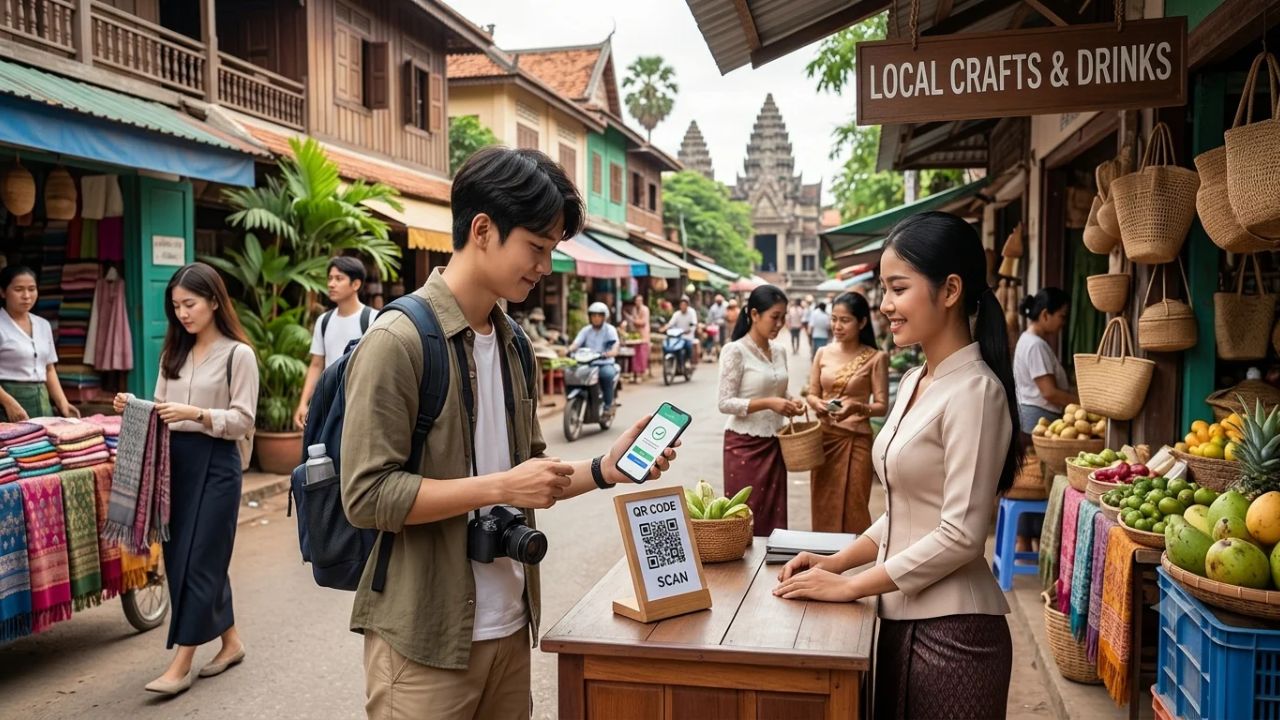
Travelers transfer funds directly into their digital Bakong wallet, allowing them to pay Cambodian vendors by scanning standardized KHQR codes. At launch, the National Bank of Cambodia confirmed access to approximately 4.5 million merchants nationwide, enabling tourists to pay for everything from street-side iced coffee in Phnom Penh to temple entrance guides in Siem Reap without needing to open a Cambodian bank account or carry US dollar bills.
In parallel, Cambodia established a direct bilateral payment channel with South Korea on August 29, 2024, involving the National Bank of Cambodia, Phnom Penh Commercial Bank (PPCB), and South Korea’s Jeonbuk Bank (JBB). Under Phase 1 of this arrangement, South Korean tourists visiting Cambodia use their domestic JBB Mobile App to scan KHQR codes at more than 3.3 million merchant locations, with funds debited directly from their Korean won accounts in real time.
Thailand and Malaysia: Documenting Triple-Digit Digital Payment Growth
Thailand has similarly pioneered cross-border financial connectivity under the Bank of Thailand's digital blueprint. The kingdom maintains a fully reciprocal QR payment arrangement with Cambodia: Cambodian travelers scan Thai PromptPay QR codes using their domestic mobile banking apps, while Thai vacationers scan Cambodian KHQR codes using Thai banking platforms.
The macroeconomic impact of these bilateral linkages is expanding rapidly. According to an International Monetary Fund (IMF) financial technology study published in January 2026, cross-border QR transaction volume in Thailand grew by more than 300% during 2024 compared to 2023. Malaysia achieved an even steeper adoption curve, logging a 550% surge in cross-border QR transactions over the identical timeframe through its DuitNow infrastructure.
This exponential growth confirms that international travelers rapidly abandon physical cash and high-fee credit cards when secure, frictionless QR alternatives are made accessible at everyday retail counters.
Micro-Merchant Inclusion and Implementation Bottlenecks
Despite remarkable technical progress, delegates at the Jakarta roundtable acknowledged that digital payment access remains uneven. While upscale shopping malls, international hotel chains, and established restaurants in capital cities readily process cross-border QR transactions, severe structural bottlenecks persist at the grassroots level.
Thousands of informal street food vendors, rural homestay operators, tuk-tuk drivers, and handicraft artisans face regulatory hurdles that prevent them from participating fully in national QR networks.
CROSS-BORDER QR TRANSACTION PIPELINE & BOTTLENECKS
| Operational Challenge | Root Regulatory or Structural Cause | Field Impact on Foreign Visitors | Proposed Policy Solution |
|---|---|---|---|
| :--- | :--- | :--- | :--- |
| Merchant Registration Ceilings | Anti-money laundering (AML) and business licensing rules | Small vendors cannot display merchant-grade QR codes | Simplified digital micro-merchant registration tiers |
| Transaction Volume Caps | Regulatory limits on non-commercial personal accounts | QR payments fail when vendors exceed daily intake limits | Dynamic tourist-season ceiling adjustments for vendors |
| Tax Transparency Hesitancy | Fear that digital ledgers will trigger back-tax assessments | Micro-retailers insist on cash to avoid tax audits | Formal tax incentives and zero-fee processing periods |
| Hardware & Network Instability | Spotty 4G/5G mobile connectivity in remote rural provinces | Payment app timeouts during temple and nature tours | Offline QR authentication and local telecom upgrades |
| Consumer Foreign Exchange Spreads | Hidden conversion spreads applied by issuing home banks | Travelers face unexpected fee markups on bank statements | Mandated pre-transaction exchange rate disclosures |
| ASEAN Regional Standard | Core Evaluation Criteria | Operational Objectives | Traveler Protection Benefit |
|---|---|---|---|
| ASEAN Green Hotel Standard | Energy conservation, wastewater recycling, non-toxic products | Reduces carbon and plastic intensity of resort properties | Transparent eco-verification; avoids greenwashing |
| Community-Based Tourism (CBT) | Community ownership, cultural integrity, fair wage distribution | Keeps tourism revenue within rural villages and tribes | Guarantees authentic, respectful cultural immersion |
| Clean Tourist City Standard | Urban waste collection, public green spaces, air quality | Enhances safety and sanitation across provincial capitals | Ensures healthy, clean urban environments |
| Food & Beverage Services | Food handling hygiene, cold-chain storage, kitchen cleanliness | Prevents foodborne illnesses across dining establishments | Delivers reliable food safety in street food zones |
| Public Restroom Standard | Sanitation facilities, accessible cubicles, water recycling | Upgrades comfort along major intercity transit corridors | Guarantees dignified, hygienic transit stops |
| Ecotourism & Heritage | Low-impact trail design, wildlife preservation, guide ethics | Safeguards fragile national parks and ancient monuments | Prevents over-commercialization of heritage sites |
The ASEAN Community-Based Tourism Standard plays a central role in distributing tourist spending into remote rural interiors. By mandating that certified CBT enterprises remain owned, managed, and staffed by resident community members, the standard prevents outside commercial conglomerates from capturing local revenue streams while ensuring that indigenous cultural traditions are protected from commercial exploitation.
Complementing regional efforts, Thailand showcased its domestic Tourism Authority of Thailand (TAT) STARs (Sustainable Tourism Assessment Rating) initiative. This voluntary audit system assesses hospitality businesses against the United Nations’ 17 Sustainable Development Goals (SDGs). Establishments achieving high STARs ratings receive direct promotional amplification through TAT’s global marketing channels, providing international travelers with an objective guide to environmentally verified hotels and tour operators.
Consumer Protection: Eliminating Dual Pricing and Predatory Scams
A critical topic addressed during the Jakarta sessions was restoring consumer confidence by stamping out predatory pricing, unregulated tour intermediaries, and exploitative dual-pricing practices.
Delegates from the ASEAN-Korea Centre presented South Korea’s rigorous legal framework for tourism consumer protection as an operational model for Southeast Asia. Under South Korean municipal law, businesses that engage in price gouging, unauthorized tourist surcharges, or deceptive pricing face severe administrative penalties, including mandatory operating suspensions and substantial monetary fines.
| Regulatory Domain | Current Market Vulnerability | ASEAN-Korea Recommended Standard | Enforcement Mechanism |
|---|---|---|---|
| Tourist Price Gouging | Unregulated markups at markets, taxis, and popular attractions | Strict price transparency mandates with visible rate cards | Heavy administrative fines and operating license suspensions |
| Dual-Pricing Structures | Unannounced premium rates charged exclusively to foreign visitors | Universal standard pricing displayed clearly in local currency | Consumer complaint hotlines with on-the-spot police arbitration |
| Unlicensed OTA Listings | Bogus tour operators and unregistered hotels on digital platforms | Mandatory cross-referencing with national business registries | Automatic delisting of unverified operators by digital travel agencies |
| Taxi & Transport Overcharging | Refusal to use electronic meters; arbitrary flat-rate demands | Expansion of app-based booking and mandatory e-meters | Vehicle impoundment and driver permit revocations |
| Cancellation Opacity | Vague refund conditions during severe weather or travel delays | Harmonized regional refund and booking cancellation rules | Legally binding standard merchant processing agreements |
A major concern raised by Indonesia’s Ministry of Tourism involves discrepancies between official government licensing registries and listings hosted by global Online Travel Agencies (OTAs). Unregistered, unlicensed tour guides, unregulated speedboat charters, and substandard villas frequently market their services on international digital platforms, undercutting legitimate operators and putting traveler safety at risk.
The roundtable called for binding agreements between ASEAN tourism ministries and multinational OTAs. Under the proposed protocols, digital booking platforms will be legally required to verify business tax identification numbers and municipal tourism licenses against official government databases before activating property or tour listings.
Cybersecurity Safeguards and Digital Border Infrastructure
As travel across Southeast Asia becomes increasingly dependent on digital payments, electronic visas, and automated airport gates, cybersecurity has emerged as a top-tier national security priority. Both Cambodian and Indonesian delegations warned that digitizing tourism infrastructure creates complex vulnerabilities that hostile actors or criminal syndicates could exploit.
DIGITAL TOURISM CYBERSECURITY & RESILIENCE GRID
| Entity / Route | Metrics | Operational Status |
|---|---|---|
| FINANCIAL SWITCH INTEGRITY | BORDER & IMMIGRATION SYSTEMS | |
| • End-to-end payload encryption | • Redundant cloud server arrays | |
| • Distributed denial-of-service | • Biometric SmartGate firewalls | |
| mitigation on QR payment hubs | • Secure encrypted e-Visa hubs |
| Digital System | Core Vulnerability | Operational Failure Consequence | Mandated Cybersecurity Safeguard |
|---|---|---|---|
| Cross-Border QR Switches | Man-in-the-middle payment interception; fake QR overlays | Unauthorized fund diversions and traveler account compromise | Dynamic encrypted QR payloads and merchant terminal verification |
| Electronic Visa (e-Visa) Portals | Ransomware attacks; database exfiltration; phishing mirrors | Exposure of passport numbers and credit card information | Zero-trust cloud architecture with multi-factor authentication |
| Airport Biometric SmartGates | Network timeouts and biometric sensor server crashes | Massive terminal overcrowding, missed flights, border gridlock | Localized offline backup processing and redundant power grids |
| Hotel PMS & Guest Databases | Data scraping on unencrypted property management systems | Identity theft and unauthorized lodging credit card charges | Mandatory ISO/IEC 27001 data protection certification |
Cambodia emphasized the necessity of shielding interbank switches—such as Bakong—against distributed denial-of-service (DDoS) attacks and counterfeit QR sticker manipulation. Central banks are deploying dynamic QR generation systems, where QR codes displayed on merchant terminals regenerate every 60 seconds with encrypted transaction payloads, preventing fraudulent interception.
Indonesia underscored the vulnerability of civil aviation infrastructure. A single network failure or ransomware breach affecting electronic immigration systems can bring major international airports—such as Jakarta-Soekarno-Hatta or Bali-Ngurah Rai—to a complete standstill, stranding tens of thousands of travelers in unmanageable queues. The Jakarta framework mandates the establishment of dedicated Computer Emergency Response Teams (CERT) specifically assigned to monitor and defend regional tourism, immigration, and transport databases.
Why This Matters: De-Dollarization and the Frictionless Asian Travel Corridor
The strategic collaboration between ASEAN and South Korea represents far more than a routine collection of tourism agreements; it signifies a structural realignment in international travel economics. For over half a century, Western credit card schemes and the US dollar served as the mandatory intermediary for Asian travel, extracting billions of dollars annually in currency conversion spreads, cross-border settlement fees, and banking commissions.
By building direct, interoperable local-currency QR networks, Asian nations are executing a practical de-dollarization of everyday tourism transactions:
- Direct Value Retention: When a South Korean tourist pays a Cambodian fruit vendor or Thai artisan via direct won-to-riel or won-to-baht QR settlement, intermediary fees drop from 4% to under 0.5%. That saved margin stays directly inside the local host economy.
- Protection Against Macroeconomic Volatility: Local-currency payment mechanisms shield travelers and small business owners from sharp fluctuations in Western foreign exchange markets, ensuring predictable retail pricing.
- Equal Protection for Global Visitors: Harmonizing consumer laws across borders ensures that international tourists enjoy the identical legal protections against price gouging and fraud that domestic residents take for granted.
- Resilience Through Diversification: Expanding intra-regional Asian tourism buffers Southeast Asian economies against periodic downturns or geopolitical realignments in long-haul Western outbound markets.
The success of this ambitious initiative will ultimately depend on how effectively member states enforce licensing compliance on digital booking platforms, bridge the digital divide for micro-merchants, and harden critical digital infrastructure against cyber disruption. Nonetheless, the Jakarta blueprint provides a compelling model for how regional travel blocs can leverage financial technology and unified standards to deliver safer, more equitable, and thoroughly frictionless international journeys.
Frequently Asked Questions
What were the primary outcomes of the second ASEAN-Korea Roundtable in Tourism in Jakarta?
The second ASEAN-Korea Roundtable in Tourism, held in Jakarta from November 4 to 7, 2026, established an operational roadmap to expand two-way tourist exchanges from 13 million to more than 20 million visitors annually. Key deliverables included expanding cross-border digital QR payment interoperability, standardizing regional tourism quality and green hotel criteria, harmonizing consumer protection laws to prevent tourist price gouging, and establishing joint cybersecurity protocols to protect digital border and immigration systems.
How does Cambodia's Bakong Tourist App work for foreign visitors?
Introduced on January 22, 2025, by the National Bank of Cambodia in collaboration with Visa, the Bakong Tourist App allows international travelers to download the platform prior to arrival, register their digital identity, and link their foreign-issued Visa credit or debit cards. Travelers can top up their digital wallet and pay participating Cambodian merchants by scanning standardized KHQR codes across approximately 4.5 million retail locations nationwide, completely eliminating the need to open a local Cambodian bank account or carry large sums of physical currency.
How fast are cross-border QR payments expanding across Southeast Asia?
Cross-border QR payments are experiencing exponential growth across Southeast Asia. According to an International Monetary Fund study published in January 2026, Thailand recorded an increase of more than 300% in cross-border QR transaction volume in 2024 compared to 2023. Malaysia achieved a 550% surge over the identical period through its DuitNow network. This rapid adoption is fueled by standardized EMVCo QR codes that allow travelers to scan local merchant codes directly using their domestic mobile banking apps at transparent mid-market exchange rates.
What measures are being taken to eliminate tourist price gouging and dual pricing?
Drawing on South Korea’s rigorous consumer protection model, ASEAN nations are working to implement strict price transparency mandates. The framework calls for heavy administrative fines and business license suspensions for merchants who engage in deceptive pricing or unauthorized tourist surcharges. In addition, the partnership is establishing joint oversight mechanisms with major Online Travel Agencies (OTAs) to verify property licenses against official government databases, ensuring that unverified, unlicensed operators are automatically removed from digital booking platforms.
Related Travel Guides
- Saint Lucia Wins Most Innovative Tourism Campaign as British Airways Expands Winter Airlift
- Austria Joins European Nations in Deploying Smart Tourism Hubs and AI Dispersal Systems
- Spain Allocates €42 Million to Rural and Experiential Tourism as Inbound Arrivals Expand
- Siem Reap Angkor International Airport Launches Digital Immigration Smart Gates
This article is for informational purposes. Flight routes, passenger regulations, visa rules, and transit advisories are subject to change by airlines and aviation authorities. Readers are advised to verify schedules and travel documentation with relevant carriers and border agencies before departure.
Related Stories

South Korea Chinese Group Tours Plunge to $45 as Beijing Embassy Issues Severe Warning Over Forced Shopping and Itinerary Cuts
Grant County Awarded $39,550 Wisconsin State Tourism Grant to Pioneer Research-Driven Destination Marketing Across Driftless Communities