
Severe Travel Chaos Sweeps the Northeast: American Airlines Flight 5282 Diverts to Philadelphia Amid Rising Airport Disruptions: Latest Airline News
As unexpected operational friction triggers massive travel chaos, an American Airlines regional jet bounds for White Plains is forced into an emergency diversion to Philadelphia, stranding passengers.

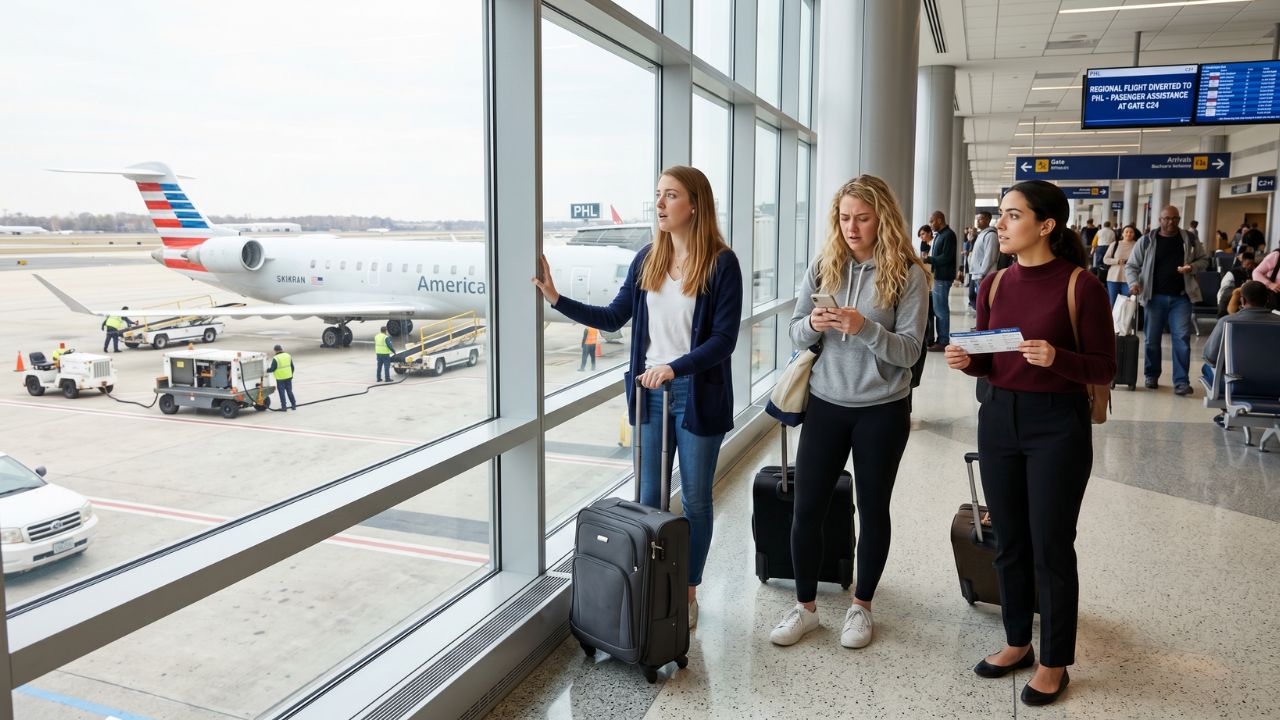
Image generated by AI
A highly disruptive, unexpected flight diversion has actively triggered severe travel chaos across the densely populated Northeastern United States aviation corridor, serving as a stark reminder of the fragile nature of regional transit networks. Reported on June 19, 2026, PSA Airlines Flight 5282 (operating as American Airlines Flight JIA5282) suddenly abandoned its scheduled route from Washington to White Plains on June 18, officially diverting to Philadelphia International Airport. As sudden airport disruptions and the continuous threat of rolling flight cancellations continue to plague US domestic travel, this specific operational anomaly has drawn intense nationwide attention. The sudden grounding of the Mitsubishi CRJ-701ER forced passengers to endure an agonizing four-hour delay, completely destroying meticulously planned business itineraries and onward connections. As the regional aviation network struggles to absorb the cascading impacts of this unexpected route change, the dramatic diversion of Flight JIA5282 is driving today's most crucial headline in breaking airline news and essential global aviation updates.
By introducing direct passenger coordination and dynamic scheduling backups, the regional aviation hubs target growing passenger demand across vital commerce sectors. The choice to coordinate flight departures in phases helps to manage gate capacity, supporting the country's broader regional transportation network.
Context: The Reality of Northeastern Gridlock
For the domestic aviation industry, the sudden diversion of Flight JIA5282 perfectly illustrates how quickly localized operational challenges can instantly paralyze a routine commuter journey.
Historically, the Washington-to-White Plains route serves as a highly utilized, heavily trafficked corridor for corporate travelers, government officials, and high-net-worth individuals bypassing the massive congestion of the major New York mega-hubs. When a regional journey like this experiences sudden travel chaos, the ripple effects are severe. Although American Airlines has not immediately released a detailed public explanation detailing the precise technical or environmental trigger for the diversion, operational data confirms that the aircraft safely abandoned its approach into Westchester County and sought immediate refuge in Philadelphia. Diversions in this congested corridor are typically implemented when flight crews—battling highly volatile operational factors such as sudden adverse weather conditions, crushing air traffic congestion, strict airport restrictions, or unforeseen technical concerns—determine that continuing to the planned destination severely compromises aviation safety. Because Philadelphia (PHL) is one of the busiest and most robustly equipped airports in the region, it frequently serves as the mandatory diversion point to safely absorb disrupted traffic.
To view live flight schedules, verify the active delay status of your specific regional domestic itinerary, or to track active airspace restrictions across the Northeast, travelers must consult official aviation directories. For direct updates regarding how this massive travel chaos affects specific route abandonments and current flight cancellations, travelers should aggressively utilize the official portals of American Airlines. To explore live flight tracking and monitor the exact severity of the cascading bottlenecks at major US hubs, passengers can consult the official FlightAware tracking service.
Section-Wise Breakdown: Anatomy of a Diversion
Departure: Washington Reagan National (DCA)
The journey began routinely at Washington Reagan National Airport (DCA), an airport notorious for its strict slot controls and highly congested departure queues. Operating under the American Airlines regional banner, the PSA Airlines crew initiated departure shortly after 9:00 a.m. on June 18, 2026. Initially, the short commuter hop was scheduled to operate efficiently within the highly controlled Northeastern airspace corridor, directly targeting the suburban New York market.
The Disruption: Abandoning White Plains (HPN)
As the aircraft progressed toward White Plains Airport (HPN), an unforeseen operational variable triggered an immediate route change. Rather than initiating final approach into Westchester County—where passengers expected to arrive shortly after 10:30 a.m.—the flight crew executed an abrupt diversion. The aircraft was aggressively vectored away from the New York metropolitan area, officially aborting its original destination.
The Resolution: Grounded in Philadelphia (PHL)
The flight successfully executed a safe landing at Philadelphia International Airport. However, the operational resolution completely devastated passenger schedules. Travelers found themselves arriving in Philadelphia almost four hours later than their originally anticipated arrival time in New York. While the safe landing successfully protected passengers from whatever hazard triggered the diversion, it instantly stranded them in the wrong state, forcing American Airlines ground teams to scramble to arrange onward ground transportation and emergency rebooking.
Technical Roster: American Airlines Diversion Data
To ensure absolute factual accuracy regarding the exact parameters of this massive systemic disruption and the specific aircraft involved in the regional flight diversion, the following matrix details the verified operational data:
American Airlines Flight JIA5282 Diversion Matrix
| Flight Data | Verified Incident Metrics |
|---|---|
| Operating Airline | PSA Airlines (Operating for American Airlines) |
| Flight Number | JIA5282 (Flight 5282) |
| Aircraft Type & Registration | Mitsubishi CRJ-701ER (CRJ700) / Tail: N515AE |
| Planned Route | Washington Reagan (DCA) to White Plains (HPN) |
| Departure Time | Shortly after 9:00 a.m. (June 18, 2026) |
| Scheduled Arrival | Shortly after 10:30 a.m. |
| Diversion Location | Philadelphia International Airport (PHL) |
| Total Passenger Delay | Arrived in Philadelphia nearly 4 hours behind schedule |
Passenger Impact: The Corporate Connecting Nightmare
For the passengers trapped aboard the diverted CRJ700, the unexpected landing in Philadelphia guaranteed a highly stressful, heavily compromised business day.
The immediate passenger impact of this structural travel chaos is the complete eradication of carefully orchestrated daily schedules. Regional routes such as Washington-to-White Plains are disproportionately utilized by business travelers who rely on absolute punctuality for critical meetings, onward transportation, and scheduled appointments in the New York suburbs. A four-hour delay—exacerbated by arriving at a completely different airport—destroys those plans. Travelers arriving unexpectedly in Philadelphia were forced into immediate logistical triage, requiring urgent assistance regarding rebooking options, emergency ground transportation (such as securing Amtrak tickets or expensive rental cars to reach New York), or alternative travel plans. The massive inconvenience highlights how a single operational hiccup can strand passengers in highly congested terminals, competing for a limited number of customer service agents to salvage their disrupted day.
Industry Analysis: The Vulnerability of Regional Networks
Aviation industry analysts view the sudden diversion of Flight 5282 as definitive proof that regional airline operations in the United States operate on incredibly fragile margins.
Analysts note that regional carriers like PSA Airlines operate thousands of flights annually, connecting smaller communities with major hubs while maintaining incredibly tight schedules and high aircraft utilization rates. Aircraft such as the Mitsubishi CRJ-701ER play a critical role within the network, providing efficient service on shorter routes that cannot physically support larger mainline jets. However, these dense regional operations require razor-thin coordination among flight crews, dispatchers, and air traffic controllers. When unexpected challenges arise in the heavily congested Northeastern airspace, airlines have virtually zero margin for error. Diversions, while relatively uncommon compared to the overall volume of daily flights, demonstrate that the US aviation system is hardwired to prioritize safety over schedule performance. The four-hour delay proves that when a regional jet falls out of sequence, the recovery process is agonizingly slow, generating massive downstream airport disruptions.
Actionable Advice for Navigating Flight Diversions
While standard passengers cannot control unexpected technical diversions or sudden ATC restrictions, you can execute this strategic survival checklist to actively manage the travel chaos when your flight diverts:
- Pre-Book Alternative Ground Transport: If you are diverted to a major regional hub like Philadelphia while attempting to reach New York (White Plains), do not wait for the airline to organize a bus. Immediately use your mobile device upon landing to book a high-speed Amtrak ticket or secure a rental car. The fastest passengers to pivot to ground transport will escape the airport disruptions first.
- Understand Your Rebooking Rights: If a diversion strands you far from your final destination, airlines typically coordinate onward travel. However, if the delay exceeds several hours and the airline cannot accommodate you, legally demand confirmation regarding reimbursement policies for out-of-pocket emergency transportation costs.
- Bypass the Diversion Desk Queue: When a flight diverts, every passenger on board will instantly swarm the single customer service desk at the new airport. Do not join the line. Immediately call the airline’s dedicated customer service number while still sitting on the plane to secure priority rebooking or hotel accommodations before the physical crowd panics.
FAQ: American Airlines Flight JIA5282 Diversion
Why did PSA Airlines Flight 5282 divert to Philadelphia?
While a specific technical or weather-related cause was not immediately released, the crew determined it was no longer safe or practical to continue to White Plains, successfully diverting the aircraft to Philadelphia International Airport to ensure passenger safety.
Which aircraft and route were affected by this travel chaos?
The incident involved a Mitsubishi CRJ-701ER (CRJ700) operated by PSA Airlines for American Airlines, which was scheduled to fly from Washington Reagan National Airport (DCA) to White Plains Airport (HPN).
How long were passengers delayed by the diversion?
Passengers experienced severe travel chaos, arriving in Philadelphia almost four hours later than their originally anticipated 10:30 a.m. arrival time in White Plains, New York.
The Reality of Combating Northeast Airspace Saturation
The sudden diversion of Flight JIA5282 proves definitively that the congested Northeastern aviation corridor remains entirely susceptible to catastrophic, localized travel chaos. By forcing a routine commuter flight into a four-hour emergency diversion, the incident demonstrates the extreme volatility of modern regional scheduling. As American Airlines and PSA desperately attempt to recover displaced passengers and aircraft, travelers must accept a critical new reality: surviving short-haul domestic flights requires aggressive digital rebooking tactics, a thorough understanding of alternative ground transportation networks, and a ruthless willingness to adapt to sudden, systemic airport disruptions the moment an aircraft alters its course.
Key Takeaways
- Massive Regional Disruption: American Airlines Flight JIA5282 experienced severe travel chaos, diverting from its intended destination and stranding passengers in the wrong state.
- The Affected Route: The flight was operating from Washington Reagan National Airport (DCA) and was scheduled to arrive at White Plains Airport (HPN).
- The Diversion Point: The Mitsubishi CRJ-701ER safely abandoned its approach to New York and diverted to Philadelphia International Airport (PHL).
- Severe Passenger Delays: The unexpected operational disruption caused passengers to arrive at their diverted location nearly four hours behind schedule.
- Business Travel Devastation: The sudden diversion of the early morning commuter flight (departing shortly after 9:00 a.m.) completely destroyed daily corporate itineraries and onward connections.
Related Travel Guides
Massive Travel Chaos Paralyzes Chicago O'Hare with 1,425 Disruptions
Disclaimer
This article is for informational and educational purposes only. It does not constitute legal, financial, or professional advice. While we strive to provide accurate and up-to-date information, travel policies, regulations, and conditions change rapidly. Always verify information with official sources before making travel decisions. Nomad Lawyer makes no representations about the accuracy, reliability, completeness, or suitability of the information provided. Readers should consult qualified professionals for advice specific to their circumstances. The views expressed in this article are those of the author and do not necessarily reflect the views of Nomad Lawyer.
Kunal K Choudhary
Co-Founder & Contributor
A passionate traveller and tech enthusiast. Kunal contributes to the vision and growth of Nomad Lawyer, bringing fresh perspectives and driving the community forward.
Learn more about our team →