American Airlines AI Rebooking Errors Trigger Corporate Duty-of-Care Crisis: AURA Algorithm, Premature Seat Cancellations, and DOT Rights

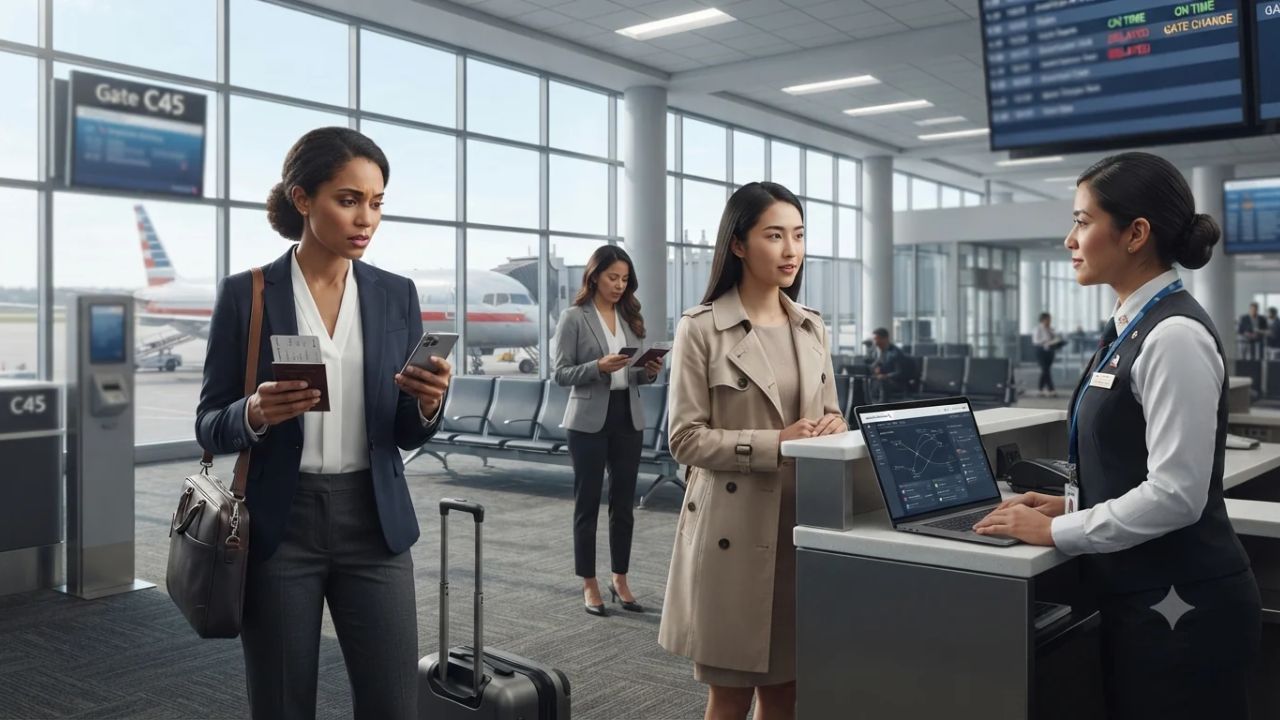
The rapid integration of machine learning and predictive artificial intelligence across commercial aviation disruption management has reached a contentious inflection point following widespread operational conflicts generated by American Airlines’ automated rebooking algorithms. The carrier’s proprietary Automated ReAccommodation (AURA) engine and Connect Assist predictive tracking systems—originally engineered to relieve customer service desks by autonomously reassigning passengers delayed on inbound feeder flights—have ignited deep duty-of-care anxieties across the global corporate travel sector. Ground-level reports reveal an escalating pattern where algorithmic systems calculate a probabilistic likelihood of a missed connection, unilaterally cancel the passenger’s confirmed seat on their connecting flight, and release that inventory to standby travelers, only for the original passengers to sprint through the terminal, arrive at their boarding gates well before door closure, and discover their tickets invalidated. This premature seat forfeiture not only strangles tight business itineraries and exposes enterprise employers to severe travel risk liabilities, but also clashes directly with United States Department of Transportation (DOT) regulations governing involuntary denied boarding and statutory passenger protections.
Commercial air travel has entered an era where operational disruption is no longer managed by gate agents wielding green-screen terminal keyboards, but by high-speed algorithmic engines processing hundreds of data variables per second. When convective summer squalls, air traffic management ground stops, or winter de-icing bottlenecks delay inbound flights, carriers face the daunting task of rebooking tens of thousands of displaced passengers across constrained domestic and international networks. Under traditional manual operations, displaced travelers queued for hours at airport customer service counters, resulting in missed alternative connections and overwhelmed ground personnel. American Airlines sought to solve this operational friction by deploying automated disruption platforms designed to anticipate missed connections, search available seat inventory across subsequent flights, and execute automatic re-accommodation before travelers even touch the tarmac.
However, the mathematical models governing these predictive rebooking suites operate on statistical probabilities rather than physical certainties. By treating predicted arrival delays as predetermined facts, the algorithms trigger automated cancellations prematurely. When an inbound aircraft makes up time in the air, navigates short runway taxi routes, or parks at a gate immediately adjacent to the outbound connection, passengers routinely beat the algorithm’s pessimistic forecast. Arriving breathless at the departure gate ten to fifteen minutes before scheduled pushback, these travelers are confronted by gate agents who are powerless to reverse the automated reallocation of their seats to revenue standbys or higher-tier frequent flyers. For corporate organizations whose personnel travel on rigid, high-value schedules, this disconnect between algorithmic prediction and physical reality transforms a manageable tight connection into a catastrophic duty-of-care failure.
========================================================================================
ALGORITHMIC REBOOKING ARCHITECTURE VS. GROUND REALITY: OPERATIONAL SCORECARD
========================================================================================
Operational Dimension     Algorithmic Prediction Model      Physical Terminal Reality
----------------------------------------------------------------------------------------
Primary Software Engine   Automated ReAccommodation (AURA)  Airport Gate Agent / Boarding Scanner
Predictive Data Input     Inbound ETA, Runway Taxi, MCT     Actual Walking Speed, In-Flight Time Made Up
Decision Trigger Point    30 to 60 Minutes Before Inbound   T-15 Minutes (Standard Domestic Door Close)
Action Taken On Seat      Auto-Cancels Confirmed Ticket     Passenger Arrives at Gate Prior to Close
Seat Reallocation Status  Released to Standby / Cleared Up  Confirmed Flyer Displaced Without Consent
Corporate TMC Syncing     Delayed / Out-of-Sync PNR Logs   Employer Tracking Completely Severed
Duty-of-Care Compliance   Severe Blind Spot Created        Traveller Stranded / Security Untracked
DOT Regulatory Status     Probable 14 CFR 250 Involuntary   Passenger Denied Boarding on Valid Ticket
                          Denied Boarding Infraction        Eligible for Mandatory Cash Redress
========================================================================================
Source: Commercial Aviation Technology Review & Corporate Travel Safety Audits, Nov 2026.
========================================================================================
The Anatomy of Algorithmic Rebooking: AURA and Connect Assist Explained
To understand how high-speed automation produces gate-level failures, corporate travel managers must examine the mechanical architecture of modern airline disruption platforms. American Airlines has been at the forefront of automated passenger servicing, investing heavily in algorithmic platforms designed to automate irregular operations (IROPS).
========================================================================================
AMERICAN AIRLINES PREDICTIVE REBOOKING COMPONENT ARCHITECTURE
========================================================================================
System Component        Operational Role               Data Feeds & Variables Evaluated
----------------------------------------------------------------------------------------
AURA                    Automated ReAccommodation      PSS inventory, seat availability, fare
(Disruption Engine)     Core engine that searches      class, corporate contract codes, elite
                        and issues replacement tickets status, connection window viability
Connect Assist          Terminal Trajectory Predictor  Real-time ADS-B radar, taxi-in duration,
(Predictive Tracking)   Calculates whether a flyer     gate distance matrix, minimum connection
                        can physically traverse hub    time (MCT), security rescreening delays
Hub Gate Matrix         Dynamic Walking Speed Index    Assumed pedestrian speed (avg. 1.0 m/s),
(Terminal Modeling)     Measures gate-to-gate transit  terminal tram intervals, bus transfer times
Inventory Release       Automatic Seat Forfeiture      Triggered when estimated transit time
(Standby Clearing)      Clears passenger from PNR      exceeds remaining time before departure
========================================================================================
1. Predictive Disruption Mechanics
The core philosophy behind AURA and Connect Assist is proactive intervention. When an inbound flight experiences an air traffic delay or mechanical hold at its departure station, the software continuously recalculates the passenger's connection window at the downstream hub—such as Dallas/Fort Worth (DFW), Charlotte Douglas (CLT), Chicago O'Hare (ORD), or Miami (MIA).
- The Minimum Connection Time (MCT) Benchmark: Every commercial airport and airline maintains published MCT standards—typically 30 to 45 minutes for domestic connections and 60 to 90 minutes for international transfers. If an incoming delay compresses the available transfer window below the MCT threshold, the predictive algorithm flags the connection as "broken."
- Autonomous Rerouting: Rather than waiting for the passenger to arrive at the hub and consult an agent, AURA automatically scans the carrier's forward schedule. It selects the next available flight with open inventory, rebooks the reservation, splits the Passenger Name Record (PNR), and issues a digital notification to the passenger’s mobile smartphone.
2. The Premature Seat Cancellation Flaw
The fundamental flaw in this automated chain lies in the timing of seat forfeiture. In traditional operations, a passenger’s seat on a departing flight is not forfeited until the official boarding cutoff—typically 10 to 15 minutes prior to scheduled departure.
- Under the automated predictive logic, however, Connect Assist concludes mid-flight that the traveler cannot make the gate.
- To optimize network load factors and seat utilization, AURA automatically cancels the passenger's confirmed seat segment on the outbound leg.
- That vacated seat is immediately released back into the general inventory pool. It is instantly scooped up by the gate agent's automated standby clearance sequence, which assigns it to a standby revenue passenger, a non-revenue employee, or an upgrading elite frequent flyer.
- When the inbound aircraft lands ahead of the delayed projection—perhaps aided by favorable tailwinds, an expeditious runway taxi, or arrival at a gate adjacent to the connection—the traveler sprints through the concourse and arrives at the gate while boarding is still actively underway.
- Upon scanning their mobile boarding pass, the gate scanner flashes red with an error indicating an invalidated or rebooked ticket. By then, their seat has physically boarded with another traveler, leaving gate staff unable to restore their original booking.
========================================================================================
SEQUENCE OF AN ALGORITHMIC REBOOKING FAILURE
========================================================================================
Time / Milestone   Algorithmic System Action          Passenger Ground Reality
----------------------------------------------------------------------------------------
T - 90 Minutes     Feeder flight departs 25 min late; Passenger sits in seat 4A; pilot
                   Connect Assist models tight DFW run notes tailwind will recover 10 mins
T - 45 Minutes     Algorithm projects 18-minute transit Inbound aircraft clears airspace holds;
                   MCT standard requires 35 minutes   flight time shortened by favorable vector
T - 30 Minutes     AURA triggers auto-rebooking:      Passenger prepares carry-on luggage;
                   Cancels Seat 12B on outbound 1422; anticipates brisk 7-minute concourse walk
                   Rebooks flyer onto flight 6 hrs late
T - 20 Minutes     Cancelled Seat 12B given to standby Outbound flight 1422 still boarding;
                   Revenue standby passenger boards   inbound aircraft arrives at gate B14
T - 12 Minutes     AURA marks itinerary complete;     Passenger arrives at gate B22 (door open);
                   sends push notification of change  scanner rejects pass; seat is gone
========================================================================================
Why Corporate Travel Is Uniquely Vulnerable to Algorithmic Rebooking
While an automated itinerary change represents an annoying inconvenience for a leisure vacationer heading to a beach resort, it can prove catastrophic for enterprise corporate travelers. Corporate mobility is governed by rigid time constraints, complex multi-stakeholder commitments, and strict risk management obligations that automated algorithms are fundamentally incapable of evaluating.
========================================================================================
CORPORATE TRAVEL RISK VULNERABILITY MATRIX
========================================================================================
Risk Category             Business Travel Impact          Algorithmic Blind Spot
----------------------------------------------------------------------------------------
Schedule Criticality      Missed executive board meetings,Algorithms optimize purely for
                          court hearings, client pitches  earliest seat arrival, ignoring meeting
                          and surgical operations         schedules and non-fungible commitments
Ground Logistics Failure  Stranded at midnight; rental carNo awareness of ground transport
                          desks closed; off-site security operating hours, hotel guarantee limits,
                          contracts broken                or executive chauffeur transfers
Personal Welfare & Safety Involuntary overnight layovers; Pushes travelers into high-risk late
                          unvetted hotels; transit througharrivals; ignores traveler vulnerability,
                          unsecured urban centers         fatigue limits, and accommodation safety
Special Assistance Loss   Wheelchair escorts, dietary,    Rebooking often wipes out special service
                          and physical accessibility      requests (SSRs) attached to original
                          arrangements detached           confirmed itinerary
Regulatory & Visa Risks   Cross-border rerouting via thirdReroutes international flyers without
                          countries triggering transit    validating passport nationality against
                          visas or tax nexus thresholds   transit country immigration rules
========================================================================================
1. Non-Fungible Business Commitments
Unlike general tourism, business travel operates on non-fungible milestones. A corporate executive traveling to deliver an investor presentation, a litigator flying to an evidentiary hearing, an engineer dispatched to repair a factory outage, or a consultant leading an executive workshop cannot simply arrive on the "next available flight" six hours later or the following morning:
- When AURA unilaterally bumps a traveler from a 2:00 PM connection to an 8:30 PM flight, the business purpose of the trip is frequently destroyed.
- The financial loss extends far beyond the cost of the airline ticket, encompassing lost contracts, disrupted commercial negotiations, and squandered corporate expenditures on venue rentals and client engagements.
2. Disruption of Ground Logistics and Executive Protection
Business itineraries rely on tightly integrated supply chains of ground transportation, corporate hotels, and security protocols:
- A traveler rescheduled from an afternoon flight to an arrival after midnight often encounters closed rental car counters, locked hotel doors with cancelled reservations classified as "no-shows," and the absence of pre-screened corporate drivers.
- In higher-risk international destinations, forcing a business traveler into an unplanned overnight transit or an unvetted midnight taxi ride introduces severe physical safety hazards, directly compromising the enterprise’s travel risk posture.
3. International Transit Visa and Regulatory Traps
When automated disruption algorithms operate across international hub networks, the legal ramifications multiply:
- If a traveler flying from North America to Latin America or Europe is automatically rerouted through an intermediate hub in a third country (such as Canada, the United Kingdom, or a Schengen member state) due to domestic weather, the algorithm rarely assesses the traveler’s nationality or passport requirements.
- A corporate traveler who does not hold a transit visa for the alternative transit nation can face immediate detention by immigration authorities, involuntary deportation, or severe carrier fines upon arrival at the international connection point.
The Duty-of-Care Crisis: TMC Desynchronization and Employer Liability
The most profound danger posed by unilateral algorithmic rebooking lies in the breakdown of corporate Duty of Care. Under global legal frameworks, corporate governance doctrines, and international standards such as ISO 31030:2021 (Travel Risk Management), employers have an affirmative legal and ethical responsibility to safeguard the health, safety, and security of personnel traveling on business.
========================================================================================
DUTY-OF-CARE INFORMATION BREAKDOWN: AIRLINE PSS VS. CORPORATE TMC
========================================================================================
Data Layer          Corporate TMC Record (GDS)         Airline Internal Engine (PSS/AURA)
----------------------------------------------------------------------------------------
Passenger PNR       Confirmed: DFW -> ORD (Flt 1422)   Active: DFW -> MSP -> ORD (Flt 2891)
Current Location    Believed to be in flight to ChicagoUncertain; rebooked on later departure
Hotel Integration   Pre-booked downtown Chicago hotel  Orphaned; traveler stuck in Dallas
Ground Security     Executive car waiting at ORD       Driver waiting for passenger who never arrives
Emergency SOS       System pings Chicago location      Traveler stranded at DFW gate with no room
Incident Tracking   Risk dashboard shows traveler safe False sense of security for risk manager
========================================================================================
1. PNR Desynchronization Across GDS and TMC Platforms
When corporate travel is booked through enterprise Travel Management Companies (TMCs) such as American Express Global Business Travel (Amex GBT), BCD Travel, CWT, or Navan, the reservation is created within a Global Distribution System (GDS) like Sabre, Amadeus, or Travelport:
- The corporate tracking dashboard reads the GDS Passenger Name Record (PNR) to maintain a live, 24/7 map of where employees are located around the globe.
- When an airline’s internal algorithmic suite (such as AURA operating directly on American Airlines’ proprietary Passenger Service System) alters an itinerary, that change frequently fails to push an immediate, synchronous update back into the GDS.
- Instead, the airline system creates an internal division of the PNR. To the corporate security operations center (GSOC), the employee is recorded as boarding their scheduled flight to Chicago. In reality, the employee has been bumped, their seat given away, and their routing diverted through Minneapolis or held overnight in Dallas without the employer's knowledge.
2. Legal Exposure Under ISO 31030 and Common Law Negligence
If an emergency—such as an active shooter incident, a structural facility fire, a natural disaster, or severe civil unrest—occurs at an airport or transit hub while a corporate traveler is displaced by an unrecorded algorithmic rebooking, the employer’s ability to render emergency assistance is completely severed:
- Corporate travel security teams dispatch emergency medical, extraction, or legal resources based on GDS itinerary data.
- If an employee is injured or stranded in an unrecorded location because an airline algorithm unilaterally altered their journey without alerting the TMC, the employer faces acute liability for failing to maintain effective duty-of-care oversight.
- Simultaneously, the airline exposes itself to third-party tort claims from enterprise clients for tortious interference with business operations and gross negligence in passenger tracking.
========================================================================================
CORPORATE DUTY-OF-CARE LIABILITY AUDIT CHECKLIST (ISO 31030)
========================================================================================
Audit Vector            Standard Requirement              Algorithmic Disruption Impact
----------------------------------------------------------------------------------------
Locational Awareness    Real-time tracking of traveler    FAILED: PNR out-of-sync; risk desk
                        coordinates and flight segments   unaware of passenger's true location
Medical & Support AccessInstant dispatch of assistance    FAILED: Traveler stranded without
                        during transit emergencies        accommodation or medical protocol
Communication Channel   Bi-directional verified contact   DEGRADED: Push notifications sent to
                        between employer and traveler     traveler mobile, bypassing corporate desk
Vulnerability Screening Assessment of traveler fatigue,  IGNORED: Algorithms treat executives
                        gender risk, and medical needs    as fungible cargo units without profile
----------------------------------------------------------------------------------------
Compliance Verdict: Uncontrolled algorithmic rebooking directly violates ISO 31030 standards.
========================================================================================
The Legal and Regulatory Quagmire: DOT 14 CFR Part 250 and Involuntary Denied Boarding
Beyond corporate liability, the practice of cancelling confirmed seats before gate closure places airlines in precarious regulatory territory under United States federal aviation law.
========================================================================================
U.S. DOT INVOLUNTARY DENIED BOARDING (IDB) COMPENSATION MATRIX (14 CFR PART 250)
========================================================================================
Delay Category (Domestic) Arrival Time Window             Statutory Compensation Rate
----------------------------------------------------------------------------------------
Minor Delay               Arrival within 1 hour of sched. No compensation required
Moderate Delay            Arrival 1 to 2 hours late       200% of one-way fare (up to $775)
Severe Delay              Arrival over 2 hours late       400% of one-way fare (up to $1,550)
International Multiplier  Arrival over 4 hours late       400% of one-way fare (up to $1,550)
----------------------------------------------------------------------------------------
Statutory Criteria: Confirmed reservation, ticket presented, checked in on time, and
present at the boarding gate prior to carrier's established minimum gate cutoff time.
========================================================================================
1. Department of Transportation (DOT) Protections
Under federal regulations codified in 14 CFR Part 250, passengers who hold confirmed reservations on scheduled commercial flights are legally protected against arbitrary seat deprivation:
- To qualify for Involuntary Denied Boarding (IDB) protections, a traveler must possess confirmed space, have complied with the carrier’s ticketing and check-in deadlines, and present themselves at the departure gate before the established gate cutoff (typically 15 minutes before departure for domestic flights).
- When a traveler arrives at the gate at T-18 minutes, finds the boarding door open, and is turned away because their seat was cancelled by an algorithm mid-transit and reassigned to a standby flyer, that traveler has experienced an Involuntary Denied Boarding.
- Under DOT rules, carriers cannot evade IDB compensation mandates by arguing that their software predicted the passenger would miss the flight. The physical presence of the passenger at the gate prior to cutoff legally establishes their compliance with the Contract of Carriage.
2. Mandatory Cash Compensation Mandates
When an airline involuntarily denies boarding to a qualifying passenger:
- The carrier must provide an immediate written statement explaining passenger rights and the priority rules governing boarding denial.
- If the airline’s alternate transportation delays the passenger’s final arrival by more than two hours on a domestic itinerary (or four hours internationally), the airline must pay cash compensation equal to 400% of the passenger's one-way fare, up to a statutory ceiling of $1,550 (adjusted periodically for inflation).
- Corporate travelers flying on premium refundable fares or expensive last-minute tickets represent the highest compensation bracket. Premature algorithmic cancellations on corporate accounts directly expose airlines to substantial cash penalties on every gate-level failure.
3. Contract of Carriage Legal Contradictions
Airlines frequently point to standard clauses in their Conditions of Carriage granting them the operational discretion to substitute carriers, change aircraft, or alter schedules during irregular operations.
- However, aviation consumer protection attorneys emphasize that nothing in the standard contract authorizes a carrier to cancel a confirmed contract of carriage based on a speculative forecast while the passenger is actively in transit and capable of meeting their gate deadline.
- Unilateral algorithmic cancellations executed without traveler consent prior to official gate cutoffs constitute an actionable breach of contract, leaving carriers exposed to both private litigation and federal enforcement actions by the DOT’s Office of Aviation Consumer Protection.
Four Non-Negotiable Guardrails for Responsible Aviation Automation
The solution to algorithmic disruption failures is not the abandonment of predictive technology, but the implementation of rigorous, human-centered architectural constraints. Predictive artificial intelligence provides immense value in scanning complex route networks and identifying scarce inventory, but it must operate as an advisory tool rather than an unchecked decision-maker.
========================================================================================
PROPOSED SYSTEM ARCHITECTURE: FOUR CORE OPERATIONAL GUARDRAILS
========================================================================================
Guardrail Pillar        Technical Implementation       Operational Outcome
----------------------------------------------------------------------------------------
1. Dual-State Holding   "Ghost Booking" / Soft Hold    Original confirmed seat preserved;
   (Consent Protection) Backup seat reserved on later  alternative seat held in escrow until
                        flight; original kept active   T-15 door close or flyer confirmation
2. Real-Time Webhooks   Bi-directional NDC/GDS APIs    Instantaneous PNR sync across Sabre,
   (TMC Synchronization)Push events sent to TMCs       Amadeus & Travelport; risk desks alerted
3. Multi-Criteria AI    Comprehensive Vector Weighting Algorithm factors meeting schedules,
   (Context-Aware AI)   Evaluates passenger profile,   special assistance flags, and safe
                        visa status, and ground risks  ground arrival windows before rebooking
4. Rapid Gate Reversal  One-Click Gate Override        Gate agents empowered to reinstate
   (Human-in-the-Loop)  Priority standby reinstatement ticket immediately if traveler arrives
                        and audit log transparency     before door close; audit trail logged
========================================================================================
1. Guardrail One: Dual-State "Shadow Reservation" and Consent-Based Rebooking
Airlines must abandon the destructive practice of automatically releasing confirmed seats prior to gate cutoff times:
- The "Ghost Hold" Mechanism: When Connect Assist projects a tight or broken connection, AURA should place a provisional "soft hold" on an alternative downstream seat without altering the passenger’s primary confirmed booking.
- The Inviolable T-15 Rule: The passenger’s original seat must remain strictly protected until the official gate cutoff threshold (e.g., T-15 minutes). Only if the flight boarding door closes without the passenger scanning through may the system release the original seat and confirm the backup itinerary.
- In-App Passenger Agency: Travelers must be granted the digital authority through mobile applications to review predicted transit times, decline automated rerouting, and attempt the sprint to the gate on their own initiative.
2. Guardrail Two: Bi-Directional Webhook Synchronization with Corporate TMCs
Algorithmic disruption engines must not operate within closed proprietary airline silos:
- Airline IT architectures must implement modern New Distribution Capability (NDC) and direct-connect API webhooks that transmit instantaneous disruption alerts to corporate TMCs and risk platforms.
- When an itinerary is modified or a soft hold is initiated, automated alerts must populate the corporate traveler tracking dashboard simultaneously.
- This ensures corporate risk managers know the traveler’s exact operational status, hotel reservations can be automatically modified, and ground transport can be proactively rescheduled.
3. Guardrail Three: Context-Aware Multi-Criteria Rebooking Algorithms
Airline machine learning models must evolve beyond simplistic "earliest available departure" algorithms:
- Passenger Profile Weighting: Rebooking systems must ingest corporate PNR indicators, corporate loyalty codes, and Special Service Requests (SSRs) to identify travelers requiring physical assistance or strict schedule adherence.
- Ground Logistics Awareness: Algorithms must evaluate whether a suggested arrival time pushes a passenger into an unmonitored midnight arrival, closed transit operations, or an unsecured overnight layover.
- Immigration Verification: For international connecting flights, the system must cross-reference traveler citizenship with destination and transit visa mandates before issuing replacement boarding passes.
4. Guardrail Four: Transparent Audit Logs and Frictionless Gate Reversals
When an algorithmic error occurs, frontline human personnel must possess the tools and authority to resolve the failure immediately:
- Airlines must equip gate agents with a one-click "Algorithmic Reversal Override" that instantly restores a displaced passenger’s boarding credentials if they reach the podium before final door closure.
- If the original seat has already been mistakenly assigned to a standby passenger, the airline’s internal priority hierarchy must automatically grant the confirmed passenger precedence, returning the standby traveler to the waitlist.
- Full digital audit logs detailing every automated decision, predictive probability calculation, and inventory release must be maintained for DOT regulatory review and corporate client service level agreements.
========================================================================================
WORKFLOW COMPARISON: FLAWED PREDICTIVE SYSTEM VS. GUARDRAILED AUTOMATION
========================================================================================
Current Flawed Workflow                  Proposed Guardrailed Workflow
----------------------------------------------------------------------------------------
Inbound flight delay detected            Inbound flight delay detected
          │                                        │
          ▼                                        ▼
Algorithm models missed connection       Algorithm models potential connection risk
          │                                        │
          ▼                                        ▼
AURA auto-cancels confirmed outbound     AURA places SOFT HOLD on later backup flight;
seat and gives it to standby             ORIGINAL SEAT REMAINS FULLY PROTECTED
          │                                        │
          ▼                                        ▼
Passenger arrives at gate at T-15        Simultaneous webhook notifies TMC & traveler
          │                                        │
          ▼                                        ▼
Scanner flashes red; seat is gone;       Passenger arrives at gate at T-15; pass scans
involuntary denied boarding occurs       green; passenger boards confirmed seat;
                                         backup soft hold automatically released
========================================================================================
Corporate Travel Policy Adaptations: How Enterprises Can Protect Personnel
Until commercial airlines implement comprehensive technical guardrails, enterprise travel buyers and risk managers must proactively fortify their internal corporate travel policies to shield personnel from algorithmic displacement.
========================================================================================
ENTERPRISE TRAVEL RISK MITIGATION STRATEGIES
========================================================================================
Strategy Area           Corporate Policy Action        Operational Benefit
----------------------------------------------------------------------------------------
Buffer Optimization     Enforce 60-90 min domestic MCT Insulates business travelers from
                        in corporate booking tools     tight connection algorithms entirely
Direct Routing Bias     Prioritize point-to-point      Eliminates hub connection exposure and
                        nonstop flights over hubs      multi-leg algorithmic failure risks
TMC Tracking IntegrationMandate all flights booked     Ensures 24/7 visibility and automated
                        through designated corporate TMCrebooking support via human agents
Mobile Notification SyncRequire corporate travelers    Ensures travelers detect algorithmic
                        to enable push notifications   rebooking attempts before arriving at hub
Airline SLA Negotiation Negotiate contractual clauses  Imposes commercial penalties on airlines
                        penalizing algorithmic drops   for involuntary passenger displacement
========================================================================================
1. Expanding Corporate Connection Buffers
Corporate travel managers should recalibrate their online booking tools (such as Concur, Deem, or Navan) to enforce larger connection buffers:
- While an airline’s published minimum connection time at DFW or CLT may be 35 minutes, corporate travel policies should mandate a minimum connection window of 60 to 75 minutes for all business-critical trips.
- By artificially widening the scheduled connection window, corporate travelers are rarely flagged as "at-risk" by predictive tracking engines, drastically reducing the likelihood of automated seat cancellations.
2. Prioritizing Nonstop Flights and Alternate Ground Transit
Where available, enterprises should encourage travelers to book nonstop direct flights, even if they carry a moderate fare premium over connecting itineraries:
- Eliminating connecting hubs completely removes exposure to predictive rebooking algorithms and minimum connection time calculations.
- For short-haul regional corridors (such as the Northeast Corridor between New York and Washington, D.C., or high-speed rail lines in Europe and Asia), corporate travel policies should actively mandate rail transit over air travel to guarantee schedule reliability and avoid airport disruption bottlenecks.
3. Establishing Dedicated TMC Rapid-Response Channels
Corporate travel departments must ensure their travelers have instant access to human TMC travel counselors during transit:
- If a traveler receives a smartphone notification indicating that an algorithm has rebooked their flight while their inbound leg is descending, they should immediately signal their dedicated corporate TMC agent via chat or phone.
- Experienced travel agents can access GDS direct-terminal commands to verify seat statuses, intervene with airline desk supervisors, and advocate on the traveler’s behalf before the gate agent surrenders the seat to standby passengers.
Frequently Asked Questions
What is American Airlines' AURA software and what is its purpose?
Automated ReAccommodation (AURA) is American Airlines’ proprietary software system designed to automate passenger rebooking during flight delays, cancellations, and irregular operations (IROPS). Its purpose is to rapidly scan available seat inventory across the airline’s network and automatically rebook displaced travelers without requiring them to wait in long lines at airport customer service desks.
What is Connect Assist and how does it interact with AURA?
Connect Assist is American Airlines’ predictive passenger tracking tool that monitors incoming flight arrival times, runway taxi speeds, and airport gate-to-gate walking distances. When Connect Assist calculates that a delayed inbound traveler will have insufficient time to traverse the terminal and make their connecting flight, it triggers AURA to execute an automated rebooking onto a later departure.
Why are passengers losing their confirmed seats before boarding ends?
The conflict arises because the predictive software cancels confirmed outbound seat reservations based on mathematical probabilities while passengers are still in transit. If an inbound flight makes up time in the air or arrives at an adjacent gate, the traveler may reach the departure gate before door closure, only to find that their confirmed seat was already cancelled by the algorithm and given away to a standby flyer.
Does premature algorithmic seat cancellation qualify as Involuntary Denied Boarding under DOT rules?
Yes. Under United States Department of Transportation regulations (14 CFR Part 250), if a passenger holds a confirmed reservation, meets ticketing and check-in deadlines, and presents themselves at the boarding gate before the carrier's published gate cutoff time (typically 15 minutes before domestic departure), denying them boarding because their seat was released to another traveler constitutes an Involuntary Denied Boarding.
How much cash compensation is an airline required to pay for Involuntary Denied Boarding?
Under U.S. DOT rules, if an airline involuntarily denies boarding to an eligible passenger and alternative transportation delays their arrival by more than two hours for domestic flights (or four hours for international flights), the airline must pay cash compensation equal to 400% of the passenger's one-way fare, up to a statutory cap of $1,550.
How does algorithmic rebooking undermine corporate Duty of Care?
When an airline’s internal system unilaterally changes an itinerary, the modification frequently fails to sync instantaneously with Global Distribution Systems (GDS) used by corporate Travel Management Companies (TMCs). As a result, corporate tracking dashboards show inaccurate traveler coordinates, leaving employers unable to locate, contact, or provide emergency support to employees stranded or rerouted into unexpected cities.
What is the "Ghost Hold" or dual-state reservation safeguard?
A "ghost hold" or dual-state reservation is a recommended technical guardrail where an automated rebooking system reserves a backup seat on a later flight while keeping the passenger’s original confirmed seat fully protected. The original seat is only surrendered if the passenger fails to scan through the boarding gate by the official door cutoff time (T-15 minutes).
Can corporate travelers opt out of automated algorithmic rebooking?
Currently, most airline predictive rebooking systems operate automatically across all ticket classes without an explicit opt-out mechanism. However, corporate travel managers can reduce exposure by mandating wider connection times in booking tools, booking nonstop flights, and utilizing dedicated corporate TMC channels to reverse automated itinerary changes in real time.
What should a business traveler do if their seat is given away before the gate closes?
If a traveler arrives at the gate before the published cutoff and finds their seat forfeited:
- Note the exact time and take a photograph of the gate departure screen showing the door open.
- Demand an Involuntary Denied Boarding (IDB) written rights notice from the gate supervisor.
- Request immediate priority standby reinstatement or supervisor re-accommodation on the next flight or a competitor airline.
- Contact their corporate Travel Management Company (TMC) immediately to record the incident and adjust hotel and ground bookings.
- File a formal complaint with the U.S. Department of Transportation’s Office of Aviation Consumer Protection.
How does ISO 31030 apply to airline disruption management?
ISO 31030 is the international benchmark for Travel Risk Management (TRM). It requires corporate organizations to evaluate travel hazards, maintain accurate situational awareness of traveling personnel, and implement rapid-response crisis mechanisms. Algorithmic rebooking systems that alter flight paths without notifying corporate TMCs create severe operational blind spots that directly compromise an organization's ISO 31030 compliance.
Strategic Outlook: Balancing Algorithmic Efficiency with Passenger Rights
The controversy surrounding American Airlines’ predictive rebooking systems illuminates a broader structural tension in modern aviation: the friction between automated efficiency and individual consumer agency. In an interconnected global air network operating near capacity, predictive software and automated disruption engines are indispensable tools for managing macro-level network shocks. Without automation, widespread severe weather events would paralyze airport terminals and strand tens of thousands of travelers indefinitely.
However, operational velocity must never be achieved by trampling passenger contractual rights or compromising corporate duty of care. Algorithms are probabilistic estimation engines; they do not possess eyes on the ground, nor do they understand the profound professional and personal consequences of a forfeited seat. By adopting consent-based holding mechanisms, integrating real-time API webhooks with corporate travel platforms, and preserving frontline human authority at the boarding podium, the global airline industry can harness the immense speed of artificial intelligence while maintaining the accountability, transparency, and safety that modern travelers demand.
Related Travel Guides
- Corporate Traveler Launches CT Pay Across Five Global Markets: Slashing Invoices by 96% in $1.7-Trillion Business Travel Sector
- Lukomir Village Travel Guide: Hiking Bosnia’s Highest Highland Settlement, Via Dinarica Trails, and Medieval UNESCO Stećci
- Delta Air Lines Flight Delays Sweep Across USA as Technical Glitch Hits Holiday Travel: Weight and Balance Breakdown at Atlanta Hub
- Thailand Loy Krathong 2026 Generates 6-Billion-Baht Boost as Ministry Expands Flights and Regulates Fares
This article is for informational purposes. Flight routes, passenger regulations, visa rules, and transit advisories are subject to change by airlines and aviation authorities. Readers are advised to verify schedules and travel documentation with relevant carriers and border agencies before departure.
Related Stories
Thai Airways Issues Urgent Brussels–Bangkok Travel Advisory: TG935 Cancelled Amid Nationwide Belgian ATC Strike
Delta Air Lines Flight Delays Sweep USA: Weight and Balance Automation Glitch Disrupts Pre-Thanksgiving Travel Across Major Hubs