Air Tahiti Nui Equips Boeing 787-9 Fleet with Free Starlink Wi-Fi from 2027: French Polynesia Travel Guide

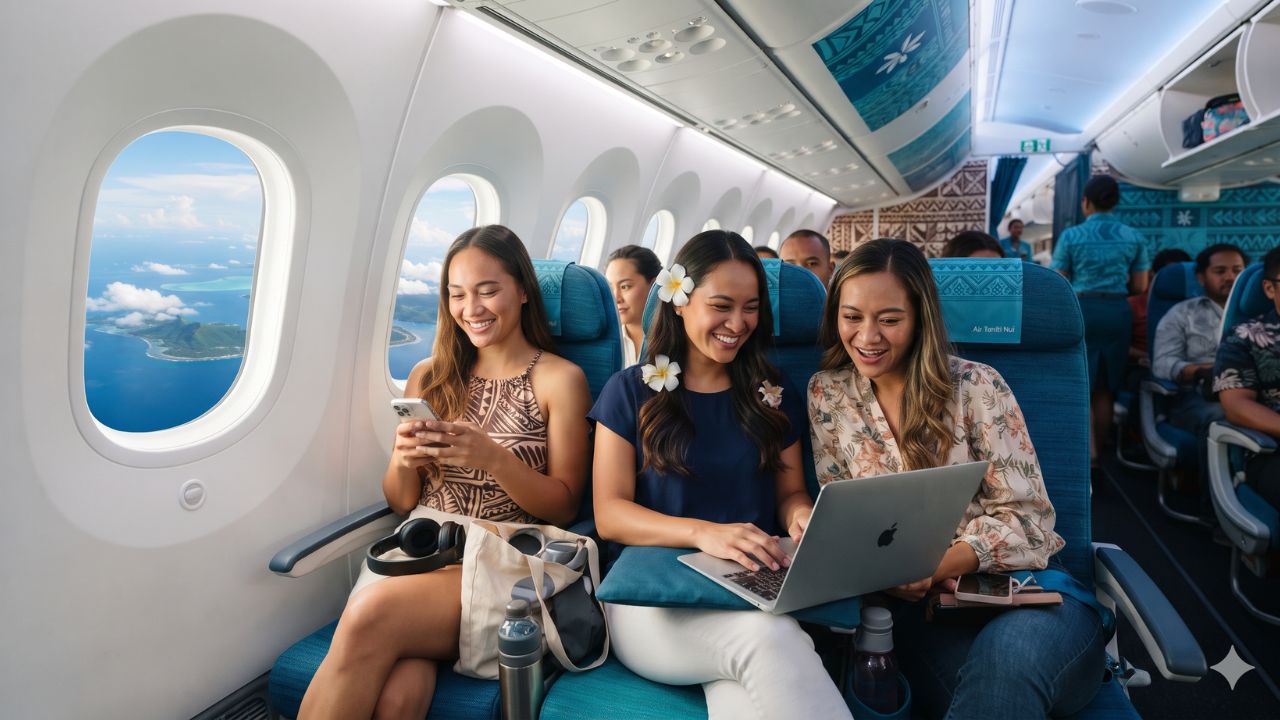
PAPEETE, Tahiti — Crossing the vast, remote expanse of the South Pacific Ocean will no longer mean enduring hours of digital isolation, as French Polynesia’s flag carrier Air Tahiti Nui officially confirmed an agreement with SpaceX to equip its entire Boeing 787-9 Dreamliner fleet with free, high-speed Starlink satellite Wi-Fi beginning in 2027. The long-term technological partnership will bring low-latency, broadband connectivity to every passenger cabin across the airline's four long-range widebody aircraft, completely eliminating the connectivity blackouts that have historically characterized transpacific flight corridors. By providing complimentary, gate-to-gate internet access with latency as low as 25 to 30 milliseconds to all travelers regardless of ticket class, the boutique carrier aims to redefine the remote long-haul passenger experience between Tahiti, North America, Europe, Asia, and Australasia.
+----------------------------------------------------------------------------------------------------+ | KEY TAKEAWAYS: AIR TAHITI NUI FLEETWIDE STARLINK DEPLOYMENT (2027) | +----------------------------------------------------------------------------------------------------+ | • Fleetwide Free Broadband: All four Boeing 787-9 Tahitian Dreamliners will feature complimentary | | high-speed Starlink Wi-Fi across Poerava Business, Moana Premium, and Moana Economy cabins. | | • Ground-Like Latency: SpaceX's low-Earth orbit (LEO) constellation delivers ultra-low latency of | | 25–30 ms, enabling live streaming, real-time gaming, VPN remote work, and multi-party video. | | • Ocean Void Elimination: Starlink's space-laser inter-satellite routing ensures seamless coverage | | across thousands of nautical miles of open Pacific Ocean devoid of terrestrial ground stations. | | • Flagship Long-Haul Corridors: High-speed connectivity will transform journeys on non-stop | | Papeete routes to Los Angeles, Seattle, Tokyo Narita, Auckland, and one-stop flights to Paris. | | • Competitive Boutique Advantage: Levels the technological playing field against mega-alliances | | and low-cost transpacific competitors, reinforcing Tahiti's allure for high-value tourism. | +----------------------------------------------------------------------------------------------------+
====================================================================================================
               AIR TAHITI NUI TRANSPACIFIC STARLINK CONNECTIVITY CORRIDOR
====================================================================================================

      NORTH AMERICA & EUROPE                        ASIA & OCEANIA
    (Los Angeles / Seattle / Paris)               (Tokyo Narita / Auckland)
                 \                                     /
                  \                                   /
                   +---------------------------------+
                                     |
                       [ AIR TAHITI NUI BOEING 787-9 ]
                           "Tahitian Dreamliner"
                                     |
                                     v
                       [ STARLINK PHASED-ARRAY RADOME ]
                   Fuselage-Mounted Low-Drag Phased-Array Antenna
                                     |
               +---------------------+---------------------+
               |                                           |
               v                                           v
     [ STARLINK LEO SATELLITES ]                 [ OPTICAL LASER CROSSLINKS ]
      Orbital Altitude: ~550 km                   Space-to-Space Optical Routing
      Latency: 25 - 30 Milliseconds               Bypasses Ground Station Absence
      Bandwidth: Up to 250+ Mbps                  Zero Pacific Ocean Blindspots
               |                                           |
               +---------------------+---------------------+
                                     |
                                     v
                       [ FA'A'Ā INTL AIRPORT (PPT) ]
                         Papeete, French Polynesia
====================================================================================================
Transpacific Connectivity Over the Oceanic Void: Air Tahiti Nui’s Strategic Leap
Operating scheduled commercial passenger flights from the remote archipelago of French Polynesia presents some of the most demanding geographic and navigational realities in modern civil aviation. Located in the south-central Pacific Ocean, approximately 4,000 kilometers south of Hawaii and more than 6,000 kilometers from mainland Australia and the west coast of the United States, Tahiti is surrounded by vast oceanic emptiness. For decades, passenger aircraft departing Fa'a'ā International Airport in Papeete have flown for hours across oceanic sectors where terrestrial radio towers, radar stations, and cellular repeaters do not exist.
Historically, this geographic isolation extended directly into the passenger cabin. While transcontinental flights over North America or Europe could rely on ground-based air-to-ground (ATG) cellular towers or geostationary satellites positioned over populated landmasses, long-haul flights across the South Pacific suffered from chronic inflight connectivity deficits. Legacy satellite systems frequently lost signals over the central Pacific basin, leaving passengers subjected to sluggish text-only messaging, buffering errors, or complete communication blackouts for eight to twelve hours at a stretch.
By finalizing a fleet-wide deployment contract with SpaceX for Starlink Aviation, Air Tahiti Nui is executing a strategic leap that transforms this historic vulnerability into a premier competitive asset. Scheduled to commence installations across its four Boeing 787-9 Dreamliners in 2027, the airline will offer continuous, high-throughput broadband from the moment passengers take their seats in Papeete until the aircraft rolls to a halt at Los Angeles, Seattle, Tokyo, Auckland, or Paris.
The initiative represents an essential evolution in passenger service philosophy. Rather than treating inflight internet as an ancillary revenue center monetized through restrictive data caps and exorbitant hourly vouchers, Air Tahiti Nui is treating digital connectivity as an indispensable public utility of modern travel. In an era when international travelers expect seamless continuity between their personal, professional, and entertainment lives, eliminating digital isolation over the South Pacific elevates the entire Tahitian travel experience.
From an aeronautical standpoint, flying long-haul sectors out of French Polynesia requires adhering to rigorous Extended-range Twin-engine Operational Performance Standards (ETOPS). Because diversion airfields such as Christmas Island (Kiritimati), Rarotonga, Easter Island, or Honolulu are situated thousands of nautical miles apart, aircraft must maintain continuous satellite-based Automatic Dependent Surveillance-Broadcast (ADS-B) and Future Air Navigation System (FANS) datalinks. Equipping the aircraft with Starlink's high-speed architecture reinforces the broader transition toward digital flight decks, where pilots and dispatchers can access real-time weather radar data, turbulence-tracking algorithms, and optimized oceanic jet stream tracks, directly enhancing operational flight efficiency and passenger safety.
The SpaceX Starlink Architecture: Low-Earth Orbit Physics Versus Legacy GEO Satellites
To understand why the Air Tahiti Nui agreement represents a fundamental transformation in airborne communications, it is necessary to examine the physics that differentiate low-Earth orbit (LEO) satellite constellations from legacy geostationary (GEO) satellite networks. For decades, commercial airlines seeking oceanic coverage depended on geostationary satellites operated by commercial conglomerates such as Inmarsat, Intelsat, or Viasat.
Geostationary satellites operate in fixed equatorial orbits at a colossal altitude of approximately 35,786 kilometers (22,236 miles) above the Earth's surface. While a single GEO satellite can broadcast across an entire continental hemisphere, the immense physical distance that radio frequency signals must travel imposes severe mechanical constraints. A data packet transmitted from an aircraft cabin must travel 35,786 kilometers into deep space, be processed by the satellite transponder, travel another 35,786 kilometers down to a terrestrial ground station, and then execute the reverse journey to return the requested web data.
====================================================================================================
               SATELLITE ARCHITECTURE: GEOSTATIONARY (GEO) VS STARLINK (LEO)
====================================================================================================

  PERFORMANCE PARAMETER         LEGACY GEOSTATIONARY SYSTEMS          SPACEX STARLINK AVIATION (LEO)
----------------------------------------------------------------------------------------------------
  Orbital Altitude              ~35,786 km (Equatorial Plane)         ~550 km (Multi-Inclination Mesh)
  Propagation Delay             Over 71,500 km Round-Trip             Approximately 1,100 km Round-Trip
  Signal Latency                600 to 900 Milliseconds               25 to 30 Milliseconds (Near-Fiber)
  Available Plane Bandwidth     5 to 20 Mbps Shared Cabin-Wide        Up to 250+ Mbps Dedicated Throughput
  Antenna Architecture          Heavy Mechanically Steered Gimbal     Electronically Steered Phased-Array
  Oceanic Mesh Routing          Requires Direct Ground Gateway Visibility Laser Crosslinks Route in Deep Space
  Application Support           Static Web Pages, Basic Messaging     Live 4K Streaming, VPN, Cloud Gaming
====================================================================================================
This staggering 71,500-kilometer round-trip journey creates an unavoidable physical latency of 600 to 900 milliseconds. In practical terms, this latency renders high-bandwidth, interactive applications virtually unworkable. Enterprise virtual private networks (VPNs) frequently drop connections due to timing timeouts, two-way audio conversations suffer from disorienting speech lag, cloud document collaboration stutters, and online video streaming buffers endlessly.
In sharp contrast, SpaceX’s Starlink network operates as a dense mega-constellation of thousands of mass-produced satellites orbiting in low-Earth orbit at altitudes between 540 and 570 kilometers—more than 60 times closer to Earth than geostationary satellites. Because radio signals travel at the speed of light, reducing orbital altitude from 35,786 kilometers to 550 kilometers slashes round-trip transmission latency down to a brisk 25 to 30 milliseconds.
This level of responsiveness mirrors standard high-speed home fiber broadband connections. When an Air Tahiti Nui passenger clicks a link, initiates a high-definition video call, or downloads a large corporate attachment at 38,000 feet above the South Pacific, the network responds with instantaneous precision, making the user experience indistinguishable from ground-based Wi-Fi.
Inter-Satellite Laser Links: Overcoming the South Pacific Ground Station Deficit
While low-Earth orbit satellites solve the physics of latency, operating an LEO network over the Pacific Ocean presents an equally daunting challenge: the absence of landmasses to host ground gateway stations. Standard satellite communication networks require a "bent-pipe" architecture, where a satellite must maintain simultaneous line-of-sight visibility with both the aircraft in the sky and a terrestrial ground station (teleport) connected to the global fiber-optic internet backbone.
In the middle of the Pacific Ocean, where thousands of miles of water separate island chains, ground stations simply cannot be built. If an LEO satellite flying over open water cannot see a ground station, it cannot route internet traffic back to Earth, resulting in an oceanic dead zone.
====================================================================================================
                    SPACE-LASER OPTICAL MESH ROUTING ACROSS THE PACIFIC
====================================================================================================

  [ Air Tahiti Nui B787-9 ]
             |
             | (Ku/Ka-Band Up/Downlink)
             v
  [ Starlink Satellite Alpha ]  ---(Space Optical Laser Link)--->  [ Starlink Satellite Beta ]
   (Directly Above Aircraft)                                         (In Deep Space Vacuum)
                                                                               |
                                                                               | (Optical Laser Link)
                                                                               v
  [ Terrestrial Fiber Backbone ] <---------------------------------- [ Starlink Satellite Gamma ]
   (Ground Station in California / Hawaii)                            (Within Sight of Land Gateway)
====================================================================================================
SpaceX overcomes this oceanic barrier through its deployment of optical inter-satellite laser links (space lasers). Every Gen-2 Starlink satellite operating in orbit is equipped with optical laser transceivers capable of transmitting data directly to neighboring satellites across the vacuum of space at speeds of up to 100 gigabits per second. Because light travels approximately 30 to 40 percent faster through the vacuum of space than it does through terrestrial fiber-optic glass cables, inter-satellite laser routing delivers extraordinary transmission efficiency.
When an Air Tahiti Nui Dreamliner cruising between Papeete and Los Angeles communicates with a Starlink satellite directly overhead, the data packet is beamed via laser from satellite to satellite across the constellation mesh until it reaches a satellite positioned within line of sight of a ground gateway on the North American continent or in Hawaii. This optical mesh eliminates the need for mid-ocean island ground stations, providing Air Tahiti Nui passengers with unbroken, gigabit-speed connectivity across every nautical mile of its transpacific and polar flight tracks.
Democratizing Inflight Broadband: Free Gate-to-Gate Access Across Every Travel Class
The most passenger-centric dimension of the Air Tahiti Nui announcement is the airline’s commitment to offering free, unlimited in-flight Wi-Fi to every traveler on board, across all three travel classes. Historically, international airlines that invested in satellite Wi-Fi treated the technology as an exclusive luxury or a revenue-generating luxury. Full-flight passes regularly retailed between $20 and $40, or access was restricted exclusively to elite frequent flyers and passengers purchasing premium business class tickets.
Air Tahiti Nui’s fleet-wide democratization of connectivity dismantles this tiered hierarchy. Beginning with the 2027 rollout, every guest flying aboard the Tahitian Dreamliner—whether seated in the lie-flat luxury of Poerava Business, the expanded comfort of Moana Premium, or the standard seating of Moana Economy—will enjoy unconstrained broadband access without opening a credit card portal or viewing advertising countdowns.
====================================================================================================
                     AIR TAHITI NUI THREE-CLASS CABIN INCLUSION PROFILE
====================================================================================================

  CABIN CLASS             SEAT COUNT & CONFIGURATION          STARLINK INCLUSION & CAPABILITIES
----------------------------------------------------------------------------------------------------
  Poerava Business        30 Lie-Flat Seats (2-2-2 Layout)    • 100% Complimentary Gate-to-Gate Broadband
                          Rockwell Collins Diamond Suites      • Multi-Device Support (Laptop + Phone)
                          78-inch Bed / 16-inch Touchscreen    • Corporate VPN & Secure Teleconferencing

  Moana Premium           32 Recliner Seats (2-3-2 Layout)    • 100% Complimentary Gate-to-Gate Broadband
                          Zodiac Aerospace Z535 Architecture   • Simultaneous HD Video Streaming
                          38-inch Pitch / 13-inch Touchscreen  • Cloud Gaming & Collaborative Workspace

  Moana Economy           232 Slimline Seats (3-3-3 Layout)   • 100% Complimentary Gate-to-Gate Broadband
                          Zodiac Aerospace Z300 Seating        • Social Media Video Uploads & Messaging
                          31-inch Pitch / 11.6-inch Display    • Full Access for Every Passenger Aboard
====================================================================================================
The service will operate on a "gate-to-gate" basis, meaning passengers will not have to wait until the aircraft climbs above 10,000 feet for Wi-Fi to activate, nor will connections shut down during descent. Travelers can join the onboard network while the aircraft is taxiing out from the gate in Papeete, maintain active communication during takeoff and climb, work or stream throughout the cruise phase, and stay connected until the aircraft arrives at the international terminal gate at its destination.
By removing financial barriers to access, the carrier supports a comprehensive suite of modern digital activities:
- Remote Professional Work: Business executives, remote professionals, and creative entrepreneurs can maintain unbroken enterprise workflows, accessing secure corporate cloud environments, updating shared project repositories, and conducting live video conferences from 38,000 feet.
- High-Definition Streaming and Gaming: Passengers are no longer confined to the static pre-recorded films loaded onto seatback in-flight entertainment (IFE) hard drives. Travelers can stream live sports broadcasts, uncompressed 4K series from Netflix, Disney+, or YouTube, or engage in interactive multiplayer cloud gaming.
- Personal and Family Connection: Leisure travelers embarking on once-in-a-lifetime Polynesian honeymoons or bucket-list island vacations can share real-time departure videos, exchange high-resolution photographs, and stay in constant touch with loved ones via WhatsApp, iMessage, and social media platforms throughout their transoceanic flight.
The Tahitian Dreamliner Fleet: Aircraft Configurations and Radome Engineering
The physical platform for this technological upgrade is Air Tahiti Nui’s dedicated fleet of four Boeing 787-9 Dreamliners. Introduced between 2018 and 2019 to replace the airline’s legacy fleet of aging Airbus A340-300 quad-jets, the Tahitian Dreamliners represent the modern backbone of French Polynesian civil aviation. Each aircraft carries a registration honoring the geography and cultural navigation heritage of the islands: F-OMUA (Fakarava), F-ONUI (Tupaia), F-OVAA (Bora Bora), and F-OTOA (Tetiaroa).
Engineered with advanced composite fuselages, fuel-efficient General Electric GEnx-1B engines, higher cabin pressurization (equivalent to an altitude of 6,000 feet), and higher ambient humidity levels, the 787-9 provides an exceptionally smooth and quiet passenger environment. Integrating Starlink’s hardware onto these advanced composite airframes requires specialized aeronautical modification.
====================================================================================================
                   STARLINK AVIATION AIRCRAFT HARDWARE ARCHITECTURE
====================================================================================================

  HARDWARE COMPONENT            SPECIFICATION & AERONAUTICAL CHARACTERISTICS
----------------------------------------------------------------------------------------------------
  Fuselage Antenna Terminal     Electronically Steered Phased-Array Aero Terminal (No Moving Parts)
  Antenna Dimensions & Profile  Low-Profile Aerodynamic Radome Mounted on Crown of Boeing 787-9
  Aerodynamic Drag Impact       Near-Zero Drag Penalty (<0.2% Fuel Impact vs >1.5% for Bulky GEO Radomes)
  Beam Steering Speed           Microsecond Electronic Steering (Tracks LEO Satellites Instantly)
  Onboard Server & Router       High-Capacity Dual Server Architecture with Redundant Power Feeds
  Cabin Wireless Distribution   High-Density Wi-Fi 6 Access Points Positioned Throughout Fuselage
====================================================================================================
Unlike legacy satellite installations that require bulky, bulbous radomes housing heavy mechanical gimbal antennas that physically rotate to track geostationary satellites, Starlink utilizes an ultra-low-profile, electronically steered phased-array antenna. The phased-array antenna contains thousands of microscopic transmit-and-receive elements that steer radio beams electronically in microseconds without any moving parts.
This solid-state architecture delivers immense operational advantages for Air Tahiti Nui. The thin, aerodynamic profile of the Starlink antenna reduces parasitic aerodynamic drag to near-zero levels, eliminating the noticeable fuel burn penalties associated with large, teardrop-shaped GEO satellite radomes. In parallel, the absence of mechanical motors and gearboxes dramatically reduces mechanical maintenance overhead, preventing out-of-service delays during tight aircraft turnarounds in Papeete. Inside the cabin, the system interfaces with high-density Wi-Fi 6 wireless access points distributed along the Dreamliner's ceiling panels, ensuring uniform signal distribution across all 294 passenger seats.
Aeronautical certification of the Starlink phased-array terminal onto the Boeing 787-9 requires securing rigorous Supplemental Type Certificates (STC) from both the US Federal Aviation Administration (FAA) and the European Union Aviation Safety Agency (EASA). Because the 787 Dreamliner’s fuselage is constructed from carbon-fiber reinforced polymer (CFRP) rather than conventional sheet aluminum, structural engineers must install specialized titanium backing doublers beneath the composite skin to distribute aerodynamic loads without compromising the structural envelope. In addition, the antenna incorporates integrated lightning-diversion strips and automated thermal dissipation circuits, guaranteeing uninterrupted electronic operation during high-altitude transpacific crossings where external ambient temperatures routinely plunge below minus 55 degrees Celsius.
Competitive Dynamics in the Pacific: How Boutique Carriers Counter Global Mega-Alliances
The decision to invest in fleet-wide free Starlink broadband represents a calculated tactical move in a fiercely competitive transpacific operating environment. For decades, Air Tahiti Nui enjoyed relatively protected market conditions as the primary long-haul carrier connecting French Polynesia with the wider world. However, the past seven years have brought an influx of intense commercial competition into Papeete.
Global airline giants, including United Airlines, Delta Air Lines, and Air France, alongside low-cost long-haul disruptor French Bee, have launched aggressive flight schedules connecting California (San Francisco and Los Angeles) directly with Tahiti. These massive legacy carriers possess vast domestic connecting networks, multi-billion-dollar frequent flyer programs, and deep corporate sales channels that boutique flag carriers cannot match in scale.
====================================================================================================
                TRANSPACIFIC CONNECTIVITY COMPETITIVE MATRIX (CALIFORNIA TO TAHITI)
====================================================================================================

  AIRLINE               AIRCRAFT PROFILE      WIFI INFRASTRUCTURE            PRICING MODEL
----------------------------------------------------------------------------------------------------
  Air Tahiti Nui        Boeing 787-9          SpaceX Starlink LEO (2027)     100% FREE Across All Cabins;
                        (Boutique Flagship)   25-30 ms Latency / 250+ Mbps   Gate-to-Gate Unrestricted

  United Airlines       Boeing 787-9          Starlink Deployment Planned    Currently Paid Tiered Vouchers;
                        (Legacy Mega-Carrier) (Announced Multi-Year Rollout) Transitioning to Free MileagePlus

  Delta Air Lines       Boeing 767-300ER      Viasat GEO Satellite Wi-Fi     Free for SkyMiles Members;
                        (SkyTeam Alliance)    Higher Latency (600+ ms)       Subject to Oceanic Buffering

  Air France            Boeing 777-200ER      Anuvu / Intelsat GEO Systems   Free Messaging Only;
                        (French Flagship)     High Latency over Pacific      Paid Surfing / Streaming Passes

  French Bee            Airbus A350-900       Inmarsat GX Aviation (GEO)     Paid Tiered Data Packages;
                        (Low-Cost Long-Haul)  Variable Oceanic Speeds        Strict Megabyte Data Caps
====================================================================================================
To defend its market share, Air Tahiti Nui must distinguish itself through product excellence and cultural hospitality. By partnering with SpaceX to deliver free, ultra-high-speed Starlink Wi-Fi across every seat, Air Tahiti Nui neutralizes the scale advantage of global alliances. While competing legacy carriers on the Pacific route charge for high-speed streaming passes or offer sluggish geostationary connections prone to oceanic buffering, Air Tahiti Nui offers a superior digital experience included in the base airfare.
This strategy aligns with a growing global aviation trend where forward-thinking carriers—including Hawaiian Airlines, Qatar Airways, and airBaltic—are leveraging Starlink to leapfrog legacy airline technology. For a boutique carrier operating four widebody jets, the fleet-wide conversion can be completed rapidly, enabling Air Tahiti Nui to achieve complete fleet modernization long before massive mega-carriers can retrofit their fleets of hundreds of older planes.
High-Yield Tourism and Digital Nomads: Economic Dividends for French Polynesia
The macroeconomic reverberations of Air Tahiti Nui’s Starlink rollout extend far beyond airline balance sheets; they directly support the economic foundation of French Polynesia. Tourism represents the primary economic engine of the territory, generating more than 10 to 12 percent of French Polynesia’s gross domestic product and employing tens of thousands of citizens across Tahiti, Moorea, Bora Bora, Huahine, Raiatea, and the Tuamotu atolls.
Historically, French Polynesia’s tourism profile was dominated by traditional luxury honeymooners and retirees taking once-in-a-lifetime trips. However, the post-pandemic evolution of work patterns has created a lucrative new demographic: high-net-worth digital nomads, remote corporate executives, and creative entrepreneurs. These high-spending travelers possess the financial freedom to book extended multi-week or multi-month stays in luxury overwater bungalows, private island villas, and boutique eco-lodges.
====================================================================================================
                 ECONOMIC IMPACT: CONNECTED AVIATION & TAHITIAN TOURISM
====================================================================================================

  TOURISM SEGMENT        TRANSIT INFLUENCE OF FREE STARLINK            ECONOMIC BENEFIT TO TAHITI
----------------------------------------------------------------------------------------------------
  Luxury Leisure &       Real-time social media sharing from flight;   Amplifies global destination reach;
  Honeymooners           Zero travel anxiety regarding family contact  Drives direct bookings to outer atolls

  Corporate Executives & Eliminates "lost workdays" during transit;    Attracts high-spending remote workers;
  Digital Nomads         Enables full productive days over Pacific     Extends average length of stay (14-30 days)

  Incentive & Conference Seamless corporate group coordination;        Boosts high-yield MICE group bookings;
  Business Travel (MICE) Live presentation editing en route to PPT     Spurs mid-week luxury hotel occupancy
====================================================================================================
For this elite demographic, uninterrupted digital connectivity is a non-negotiable prerequisite for travel. An executive managing global investment portfolios or leading multinational teams cannot afford to be unreachable for 24 hours while transiting between Europe or North America and Tahiti. By guaranteeing uninterrupted, high-speed connectivity throughout the flight, Air Tahiti Nui eliminates the concept of the "lost travel day."
Travelers can depart Los Angeles or Seattle in the late evening or morning, conduct an entire day’s business at 38,000 feet, and step off the plane in Papeete ready to immerse themselves in Polynesian island culture without a backlog of urgent emails. Additionally, the ability to upload high-definition video content and live-stream directly from the aircraft creates an organic social media marketing engine, showcasing the turquoise lagoons and coral atolls of Tahiti to millions of prospective travelers worldwide.
This digital capability integrates seamlessly with destination marketing strategies developed by Tahiti Tourisme. To encourage extended stays and decentralize tourism beyond the primary islands of Tahiti, Moorea, and Bora Bora, territorial tourism planners are promoting remote work hideaways in the Tuamotu and Marquesas archipelagos. When visitors know that their transpacific flights offer flawless enterprise connectivity, they are significantly more inclined to book extended three- to four-week itineraries, combining active professional responsibilities with scuba diving in Fakarava's UNESCO biosphere reserve or exploring ancient archaeological marae in Hiva Oa. Free inflight broadband effectively reframes the journey from a passive transit barrier into the productive first day of a Polynesian sabbatical.
Technical Benchmark: Inflight Connectivity Systems on Transpacific Corridors
To provide an analytical perspective on how Starlink compares to other commercial inflight connectivity technologies deployed across the Pacific, the following technical benchmark evaluates the four primary satellite systems currently operating on transoceanic airline routes.
| Satellite Technology & Provider | Constellation Orbital Class | Typical Operational Latency | Usable Bandwidth Per Airframe | Primary Oceanic Signal Vulnerability | Passenger Pricing Model on Major Airlines |
|---|---|---|---|---|---|
| SpaceX Starlink Aviation (Air Tahiti Nui, Hawaiian, Qatar) |
Low-Earth Orbit (LEO) ~550 km Altitude |
25 to 30 Milliseconds (Real-time responsive) |
Up to 250 - 350 Mbps (High-density phased array) |
None (Space optical laser crosslinks bypass absence of ground stations) | 100% Free across all cabins on adopting carriers |
| Viasat-3 / Global Xpress (Delta, American, Lufthansa) |
Geostationary Orbit (GEO) ~35,786 km Altitude |
600 to 800 Milliseconds (High propagation lag) |
30 to 80 Mbps (Shared beam capacity) |
Equatorial look-angle limits; Rain fade during tropical cloud transit | Freemium for loyalty members; Paid hourly passes for non-members |
| Panasonic Avionics Ku-Band (United, ANA, Singapore) |
Geostationary Orbit (GEO) ~35,786 km Altitude |
700 to 950 Milliseconds (High propagation lag) |
10 to 40 Mbps (Mechanically steered) |
Oceanic coverage gaps between satellite footprints; High buffer rates | Paid tiered data vouchers ($15-$35 per flight) or messaging-only tiers |
| Intelsat / 2Ku (Air France, Virgin Atlantic) |
Geostationary Orbit (GEO) ~35,786 km Altitude |
650 to 850 Milliseconds (High propagation lag) |
15 to 50 Mbps (Dual flat-panel phased array) |
Satellite handoff drops; Reduced throughput over polar oceanic routes | Paid browsing/streaming passes; Free limited text messaging |
The empirical data demonstrates why Starlink is rapidly emerging as the gold standard for long-haul transoceanic aviation. By combining microscopic 25-millisecond latency with dedicated high-throughput capacity and optical space-laser mesh routing, Starlink delivers a generational performance leap that legacy geostationary architectures cannot match.
Field Guide for Long-Haul Voyagers: Navigating Air Tahiti Nui Services and 2027 Horizons
For international travelers planning future journeys to French Polynesia, understanding the timeline of Air Tahiti Nui’s fleet-wide digital upgrade will help optimize travel plans and cabin expectations.
====================================================================================================
                        PASSENGER PLANNING & DIGITAL PREPARATION CHECKLIST
====================================================================================================

 [ ] Understand the 2027 Timeline: The Starlink service is scheduled for progressive rollout across
     2027; flights operating through 2026 continue to utilize existing legacy satellite systems.

 [ ] Multi-Device Readiness: Prepare smartphones, tablets, and laptops; the Starlink network will
     support simultaneous connections across personal electronics without extra fees.

 [ ] Enterprise VPN Compatibility: Starlink's low 25-30 ms latency supports corporate VPN tunnels,
     remote desktop protocols, and secure cloud databases without unexpected timeouts.

 [ ] Streaming Without Pre-Loading: When flying on Starlink-equipped airframes in 2027, streaming
     services (Netflix, YouTube, Spotify) can be accessed live, reducing need for offline downloads.

 [ ] One-Stop Paris Routing: Travelers utilizing Air Tahiti Nui's flagship Papeete–Los Angeles–Paris
     corridor can maintain continuous connectivity across the entire 22-hour transcontinental trek.
====================================================================================================
Navigating the Multi-Year Rollout Timeline
Prospective passengers must note that the Starlink Wi-Fi upgrade is an announced fleet-wide program scheduled for implementation across 2027. Travelers flying aboard Air Tahiti Nui during 2026 will continue to experience the carrier’s existing Panasonic Ku-band satellite system, which offers paid tiered data passes and limited complimentary messaging for Poerava Business guests. The airline will progressively cycle each of its four Dreamliners into heavy maintenance facilities during 2027 to install the fuselage-mounted phased-array radomes, ensuring that the entire fleet is fully upgraded without causing major disruptions to its scheduled flight network.
The Flagship Papeete to Paris Experience
One of the most remarkable beneficiaries of the Starlink upgrade will be Air Tahiti Nui’s flagship service connecting Papeete with Paris Charles de Gaulle (CDG) via an intermediate technical and commercial stop at Los Angeles (LAX) or Seattle (SEA). Covering a total distance of more than 15,700 kilometers, this route represents one of the longest scheduled one-stop domestic flights in world aviation, logging approximately 22 hours of total transit time.
For passengers undertaking this transcontinental journey across two oceans and the North American landmass, continuous free high-speed Wi-Fi transforms the experience. Travelers will be able to work an entire European or American business day, stream entertainment, and stay connected with family across multiple time zones, turning what was once an exhausting test of endurance into a productive and enjoyable voyage.
With its visionary commitment to fleet-wide free Starlink satellite broadband, Air Tahiti Nui is bridging the vast distances of the South Pacific. By uniting warm Polynesian hospitality with cutting-edge aerospace communications, the Tahitian flag carrier ensures that paradise is no longer a world away, but seamlessly connected to the global digital landscape.
Related Travel Guides
- European Flight Bomb Threats: 7 Emergency Landings, Military Escorts, and EU261 Rights
- Malaysia Enters Northeast Monsoon Season: AirAsia Issues Urgent KLIA Terminal 2 Travel Advisory
- Qatar Airways Launches Landmark Doha to Bogotá and Caracas Flights with Boeing 777-200LR
- Qatar Airways Leads Global Connectivity Focus at 59th AACO AGM in Doha
This article is for informational purposes. Flight routes, passenger regulations, visa rules, and transit advisories are subject to change by airlines and aviation authorities. Readers are advised to verify schedules and travel documentation with relevant carriers and border agencies before departure.
Related Stories

Qatar Airways Launches Landmark Doha to Bogotá and Caracas Flights: Boeing 777-200LR Unlocks South American Corridors

Qatar Airways Puts Global Air Connectivity in Focus as Arab Aviation Leaders Gather for 59th AACO AGM in Doha