
Air India Transports 431 Donated Corneas Across India in 2025-2026 Healthcare Logistics Partnership
Air India and the Eye Bank Association of India have transported 431 donated corneas between April 2025 and March 2026, utilizing priority aviation logistics to combat corneal blindness.

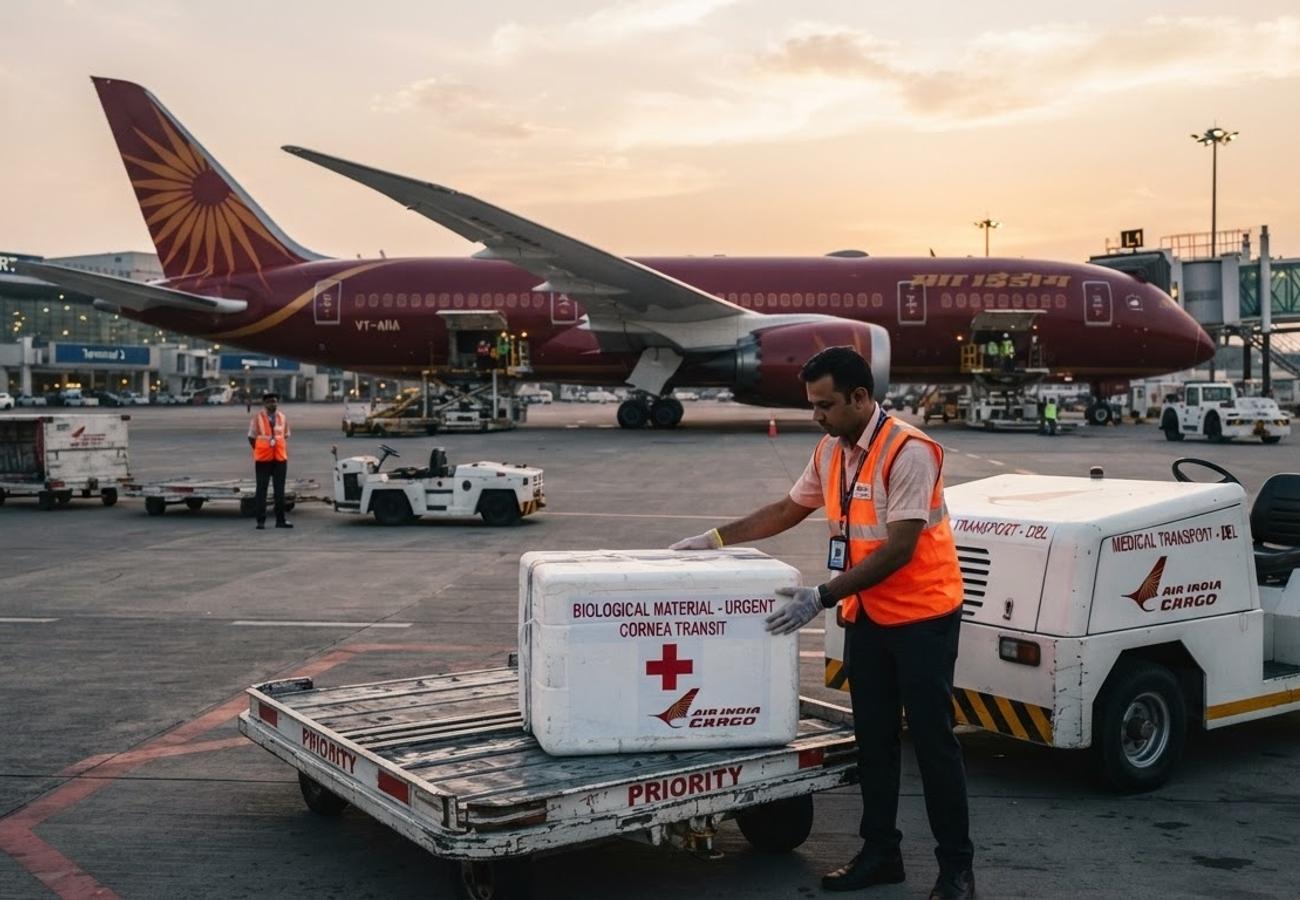
Image generated by AI
Air India has successfully transported 431 donated corneas between April 2025 and March 2026, providing free transport and priority handling to facilitate sight-restoring surgeries across India.
Aviation Logistics in Critical Healthcare Delivery
The integration of commercial aviation into the medical supply chain is becoming a vital component of India's healthcare infrastructure. Through a strategic partnership with the Eye Bank Association of India (EBAI), Air India has transitioned its domestic flight network into a specialized lifeline for the transport of corneal tissue.
Corneal tissue is highly time-sensitive. The distance between a donor and a recipient in a country as geographically vast as India often presents a significant barrier to successful transplantation. By removing transportation costs and implementing priority handling protocols, Air India has reduced the logistical friction that often hinders the delivery of these biological materials.
Cornea Transport Volume and Route Specifications
The operational window from April 2025 to March 2026 demonstrates the scale of this logistics effort. The following table outlines the key parameters of the partnership:
| Parameter | Specification |
|---|---|
| Reporting Period | April 2025 – March 2026 |
| Total Corneas Transported | 431 |
| Primary Partner | Eye Bank Association of India (EBAI) |
| Transport Cost | Free of Charge (FOC) |
| Handling Priority | High/Special Priority |
| Key Route Example | Hyderabad (RIEB/LV Prasad Eye Institute) $\rightarrow$ Bhubaneswar (DDEB) |
Traveler Logistics Guide: Navigating Medical Transit in India
From a ground-level perspective, the movement of critical medical supplies like corneal tissue relies on a complex coordination between eye banks, airport ground staff, and airline crews. For those managing medical logistics or traveling for urgent healthcare procedures in India, the following guidelines apply:
1. Coordination with Eye Banks The chain of custody begins at the eye bank, such as the Ramayamma International Eye Bank (RIEB) in Hyderabad. Logistics coordinators must ensure that insulated containers are certified for air travel and that all documentation for biological shipments is completed prior to arrival at the terminal.
2. Navigating Airport Priority Medical shipments under this program utilize priority handling. For other medical travelers or couriers, it is advisable to use the Digi Yatra biometric system at major Indian airports to expedite movement through security, allowing more time for the coordination of ground-to-air transfers.
3. Optimal Connection Windows When arranging medical transfers, avoid peak transit hours (typically 06:00–09:00 and 18:00–21:00) to ensure that ground handling staff can prioritize specialized cargo without the interference of maximum passenger congestion.
4. Customs and Regulatory Compliance While domestic transport is streamlined, any medical tissue moving across borders must comply with strict national health regulations and maritime or aviation registries. Always verify the current requirements of the Ministry of Health and Family Welfare.
Infrastructure Impact Assessment
The ability to move 431 corneas in a single year highlights a shift in how national carriers view their role in regional connectivity. This initiative addresses a critical gap in India's healthcare system, where the demand for corneal tissue consistently outweighs the available supply.
By optimizing the "last-mile" delivery via air, the partnership ensures that the advanced medical capabilities of institutes like the LV Prasad Eye Institute can be extended to patients in distant cities like Bhubaneswar. This reduces the necessity for patients to travel long distances for surgery, instead bringing the necessary biological material to the patient's local healthcare provider.
This model suggests a future where aviation networks are permanently integrated into national health strategies, potentially expanding to other time-critical biologicals such as organs or rare blood types.
Connecting donor generosity with medical precision, aviation is proving to be as much about saving lives as it is about moving passengers.
Related Travel Guides
Disclaimer
This article is for informational and educational purposes only. It does not constitute legal, financial, or professional advice. While we strive to provide accurate and up-to-date information, travel policies, regulations, and conditions change rapidly. Always verify information with official sources before making travel decisions. Nomad Lawyer makes no representations about the accuracy, reliability, completeness, or suitability of the information provided. Readers should consult qualified professionals for advice specific to their circumstances. The views expressed in this article are those of the author and do not necessarily reflect the views of Nomad Lawyer.
Raushan Kumar
Founder & Lead Developer
Full-stack developer with 11+ years of experience and a passionate traveller. Raushan built Nomad Lawyer from the ground up with a vision to create the best travel and law experience on the web.
Learn more about our team →