
A-12 Avenger II Stealth Bomber: Navy's $5 Billion Flying Dorito Gamble
The A-12 Avenger II stealth bomber promised to revolutionize Navy carrier aviation in the 1980s, but cost overruns and technical failures grounded the $5 billion program in 1991, leaving lasting gaps in military aviation capabilities.

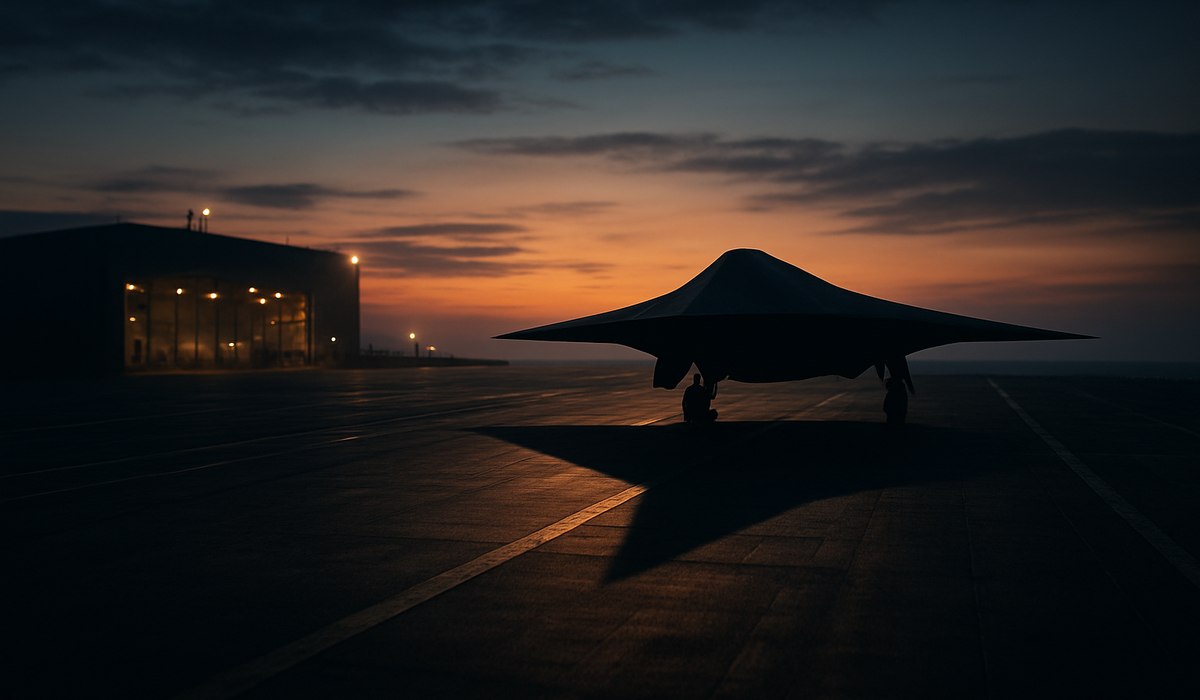
Image generated by AI
The Navy's Ambitious Stealth Vision That Never Took Flight
The A-12 Avenger II, nicknamed "The Flying Dorito" for its distinctive triangular shape, represented one of the most audacious defense initiatives of the Cold War era. Between 1983 and 1991, the U.S. Navy and contractors McDonnell Douglas (now Boeing) and General Dynamics invested $5 billion into this revolutionary stealth attack aircraft. The program was cancelled in 1991 due to mounting cost overruns, weight issues, and fundamental design challenges that proved insurmountable despite nearly a decade of intensive development.
This stealth bomber was conceived to replace the aging A-6 Intruder and deliver unprecedented carrier-based strike capabilities during an era when the Soviet threat seemed permanent. However, engineering ambitions collided with budget constraints and technical reality, ultimately grounding what many aviation experts considered a visionary platform before any prototype ever flew.
The Navy's Stealth Dream: Birth of the Flying Dorito
In 1983, the Air Force successfully introduced the F-117 Nighthawk, the world's first operational stealth aircraft. This breakthrough ignited Navy ambitions for equivalent technology. The Advanced Tactical Aircraft (ATA) program was established to develop a carrier-compatible stealth attack platform that could revolutionize naval aviation.
The A-12 Avenger II design featured a flying wing configuration measuring just over 37 feet in length with a remarkable 70-foot wingspan. This triangular silhouette, reminiscent of the Frito-Lay snack, earned the aircraft its "Flying Dorito" moniker among military personnel and aviation enthusiasts. The design proved so efficient that two aircraft could operate simultaneously from adjacent carrier catapults.
McDonnell Douglas and General Dynamics won the development contract in 1988, edging out competitors and promising the Navy's first flight by December 1990. Initial procurement plans were staggering: the Navy wanted 620 aircraft, the Marines requested 238, and the Air Force considered 400 variants to replace retiring F-111s. This represented a transformational shift in how the military would conduct deep-strike operations in contested airspace.
From Promise to Problems: Why the A-12 Failed
The A-12 Avenger II faced cascading technical and financial difficulties that ultimately proved fatal to the program. Weight issues emerged early during development, as engineers struggled to achieve the stealth characteristics while maintaining structural integrity for carrier operations. The first-flight target of December 1990 slipped repeatedly, eroding confidence within the Pentagon and Congress.
Cost overruns spiraled beyond control. What began as an ambitious modernization effort evolved into an expensive proposition that demanded increasing congressional appropriations each fiscal year. By 1991, the program had consumed $5 billion without producing a single flying prototype. Additionally, designers confronted fundamental challenges integrating autonomous landing systems for carrier deck operations—a technological hurdle that seemed decades away from practical resolution.
Vice Admiral Richard Dunleavy expressed cautious optimism in March 1990, stating the aircraft "will be a good airplane." However, his assessment proved premature. Within eighteen months, Pentagon leadership under Secretary Dick Cheney (later Vice President) concluded the A-12 represented an expensive investment without corresponding strategic justification as the Cold War rapidly concluded.
The $5 Billion Question: What Went Wrong
The A-12 Avenger II cancellation in January 1991 represented one of modern defense's largest program terminations. Several interconnected factors contributed to this dramatic decision.
Cost escalation stood foremost. Annual budget increases suggested the aircraft would ultimately cost significantly more than initial projections, consuming resources across the Navy's entire modernization agenda. Cheney, focused on fiscal discipline following the Cold War's conclusion, viewed the program as an unsustainable financial burden.
Technological obstacles proved more formidable than anticipated. The flying wing design, while aerodynamically elegant, created integration challenges for carrier-based operations. Engineers struggled with landing systems, structural weight distribution, and stealth material application—problems without clear solutions.
Strategic context shifted dramatically. The Soviet Union's collapse between 1989 and 1991 fundamentally altered threat assessments. Policymakers questioned whether advanced carrier strike capabilities justified such massive expenditures. Operation Desert Storm, occurring during the program's final months, demonstrated that existing platforms combined with precision munitions achieved decisive results without requiring new stealth systems.
Payload compromises also undermined the aircraft's utility. The A-12 could carry only 5,150 pounds of ordnance compared to the A-6 Intruder's 18,000 pounds. This significant reduction meant the stealth bomber would essentially perform surgical strikes rather than sustained bombing campaigns—a capability offset by emerging cruise missile technology.
The Pentagon ultimately determined that the F/A-18 Super Hornet, despite lacking stealth characteristics, offered superior operational flexibility and cost-effectiveness for the Navy's mission requirements.
Legacy and Lessons: How the Avenger II Changed Military Aviation
The A-12 Avenger II's cancellation profoundly shaped subsequent defense policy and aircraft development strategies. The program failure demonstrated that technological ambition alone cannot justify extraordinary expense without corresponding strategic necessity.
Modern defense procurement now emphasizes incremental development, demonstrated capabilities before full production commitment, and rigorous cost-control mechanisms. The F-35 Joint Strike Fighter program, itself beset by similar cost controversies decades later, directly inherited lessons from the A-12's collapse. Developers learned that even visionary designs require achievable milestones and realistic timelines.
The cancellation left significant operational gaps in naval aviation lasting until recent years. The Navy lacked a dedicated stealthy, long-range strike platform capable of penetrating advanced air defense systems. This vulnerability influenced decades of strategic planning and contributed to debates about unmanned systems, eventually leading to the successful X-47B demonstrator program that proved autonomous carrier operations were feasible.
Technology advocates point to the A-12 as cautionary evidence that engineering excellence cannot overcome fiscal and strategic reality. Yet proponents contend that abandoning revolutionary concepts entirely limits military innovation. The resolution emerged through unmanned platforms, which eventually delivered stealth capabilities without demanding the complex integration requirements that plagued the manned A-12 program.
Key Data: A-12 Avenger II Program Specifications
| Specification | Details |
|---|---|
| Program Duration | 1983-1991 (8 years development) |
| Total Cost | $5 billion (1980s dollars) |
| Contractors | McDonnell Douglas, General Dynamics |
| Planned Production | 620 Navy, 238 Marine Corps, 400 Air Force variants |
| Aircraft Length | 37 feet |
| Wingspan | 70+ feet |
| Maximum Payload | 5,150 pounds ordnance |
| Design Type | Flying wing stealth configuration |
| Target First Flight | December 1990 (not achieved) |
| Cancellation Date | January 1991 |
| Cancellation Decision | Secretary Dick Cheney, Pentagon leadership |
What This Means for Aerospace and Defense Tourism
While the A-12 Avenger II never reached operational status, understanding its history provides valuable context for contemporary aviation enthusiasts and defense industry observers:
-
Museum Exhibits: Several aerospace museums, including the National Air and Space Museum and the Naval Aviation Museum, feature A-12 documentation, design mockups, and engineering analysis. Visitors can examine how stealth principles evolved from conceptual designs to operational reality.
-
Engineering Education: Defense contractors and military academies frequently reference
Raushan Kumar
Founder & Lead Developer
Full-stack developer with 11+ years of experience and a passionate traveller. Raushan built Nomad Lawyer from the ground up with a vision to create the best travel and law experience on the web.
Learn more about our team →