
Australia's Regional Aviation Boom: Ten New 737 MAX Routes Poised to Launch in 2026
Breaking airline news and aviation industry updates for 2026.

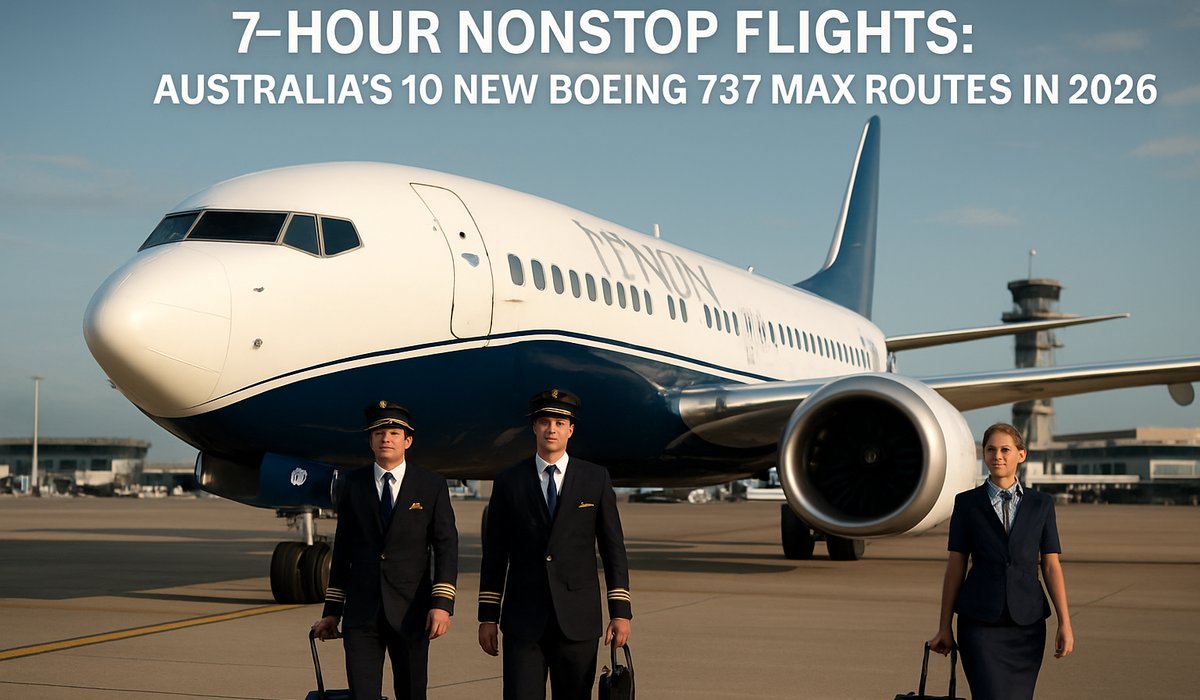
Image generated by AI
Australia's Regional Aviation Boom: Ten New 737 MAX Routes Poised to Launch in 2026
Narrowbody aircraft expansion signals shift in long-haul travel patterns across Indo-Pacific corridor
Narrowbody Aircraft Reshaping Australian Aviation Landscape
Australia's geographical isolation has traditionally confined travelers to lengthy wide-body aircraft journeys, but a significant operational shift is underway. The introduction of ten new Boeing 737 MAX 8 routes—each exceeding seven hours of block time—marks a pivotal moment in regional aviation, enabling carriers to serve previously challenging medium-haul markets with greater efficiency and frequency.
The development underscores how modern narrowbody technology has fundamentally altered the economics of regional long-haul flying. Aircraft such as the 737 MAX 8, equipped with extended range capabilities and improved fuel efficiency, now make routes viable that would have required larger, costlier wide-body deployment just a decade ago.
Existing Operations Demonstrate Market Viability
The aviation sector has already demonstrated strong demand for narrowbody long-haul services from Australia. Singapore Airlines operates an extended service to Cairns, while Virgin Australia maintains regular Bali connections. Perhaps most notably, the unique Guangzhou-to-Darwin route highlights the commercial potential of narrowbody aircraft across the Indo-Pacific region, despite flight durations approaching or exceeding the seven-hour threshold.
These established operations provide proof of concept for carriers planning 2026 expansions. They illustrate passenger willingness to accept narrowbody configurations on medium-haul international routes, particularly where frequency and point-to-point connectivity outweigh cabin amenities associated with traditional widebody aircraft.
Strategic Implications for Regional Connectivity
The proliferation of these routes carries broader implications for Australia's aviation infrastructure and travel costs. By deploying high-capacity narrowbody aircraft rather than lower-density wide-body options, carriers can increase flight frequency to regional destinations, potentially reducing jet fuel surcharges and baggage charges tied to longer, less-frequent operations.
However, airlines maintain the ability to adjust ancillary fees—including baggage allowances and seat selection charges—based on route profitability and market positioning. The competitive dynamics of these new routes will ultimately determine whether increased capacity translates to lower fares or enhanced margins for operators.
Market Outlook
The 2026 route announcements reflect confidence in post-pandemic demand recovery and growing middle-class travel appetite across the Indo-Pacific. For Australian travelers and regional carriers, the expansion represents enhanced connectivity to Indonesia, Southeast Asia, and southern China without the operational costs associated with wide-body deployments.
FAQ: 737 MAX Routes and Regional Aviation
What is the difference between narrowbody and wide-body aircraft on long-haul routes? Narrowbody aircraft like the 737 MAX 8 seat 150-200 passengers versus 300+ on wide-bodies, but offer better fuel efficiency and lower operating costs per flight. This allows airlines to increase frequency on medium-haul routes.
How do jet fuel prices affect airline baggage charges? Rising fuel costs directly increase carrier expenses, prompting airlines to optimize ancillary revenues through baggage fees, seat charges, and other services to maintain profitability on regional routes.
Why is Australia expanding narrowbody long-haul routes in 2026? Modern aircraft efficiency, proven passenger demand for frequency over cabin size, and regional economic growth across Southeast Asia and China make these routes commercially viable for the first time.
Will 737 MAX expansion reduce travel costs from Australia? Increased competition and flight frequency may lower fares, though airlines typically adjust baggage allowances and ancillary fees to protect margins on newer routes.
Which regions will benefit most from Australia's new 737 MAX routes? Indonesia, Singapore, Southeast Asia, and southern China stand to gain enhanced connectivity, particularly for business and leisure travelers seeking frequent point-to-point options.
Related Travel Guides
External Resources
Disclaimer
This article is for informational and educational purposes only. It does not constitute legal, financial, or professional advice. While we strive to provide accurate and up-to-date information, travel policies, regulations, and conditions change rapidly. Always verify information with official sources before making travel decisions. Nomad Lawyer makes no representations about the accuracy, reliability, completeness, or suitability of the information provided. Readers should consult qualified professionals for advice specific to their circumstances. The views expressed in this article are those of the author and do not necessarily reflect the views of Nomad Lawyer.
Raushan Kumar
Founder & Lead Developer
Full-stack developer with 11+ years of experience and a passionate traveller. Raushan built Nomad Lawyer from the ground up with a vision to create the best travel and law experience on the web.
Learn more about our team →