
Tragedy at Orlando International: Delta Air Lines Ground Crew Member Killed in Fatal Tug Vehicle Accident; Major Flight Cancellations and Travel Chaos as FAA Launches Urgent Safety Probe in May 2026
A 49-year-old Delta Air Lines ground crew member has tragically lost his life following a high-impact tug vehicle collision at Orlando International Airport (MCO). The incident, which occurred on May 7, 2026, led to the immediate suspension of operations, flight diversions, and a federal investigation into ground safety.

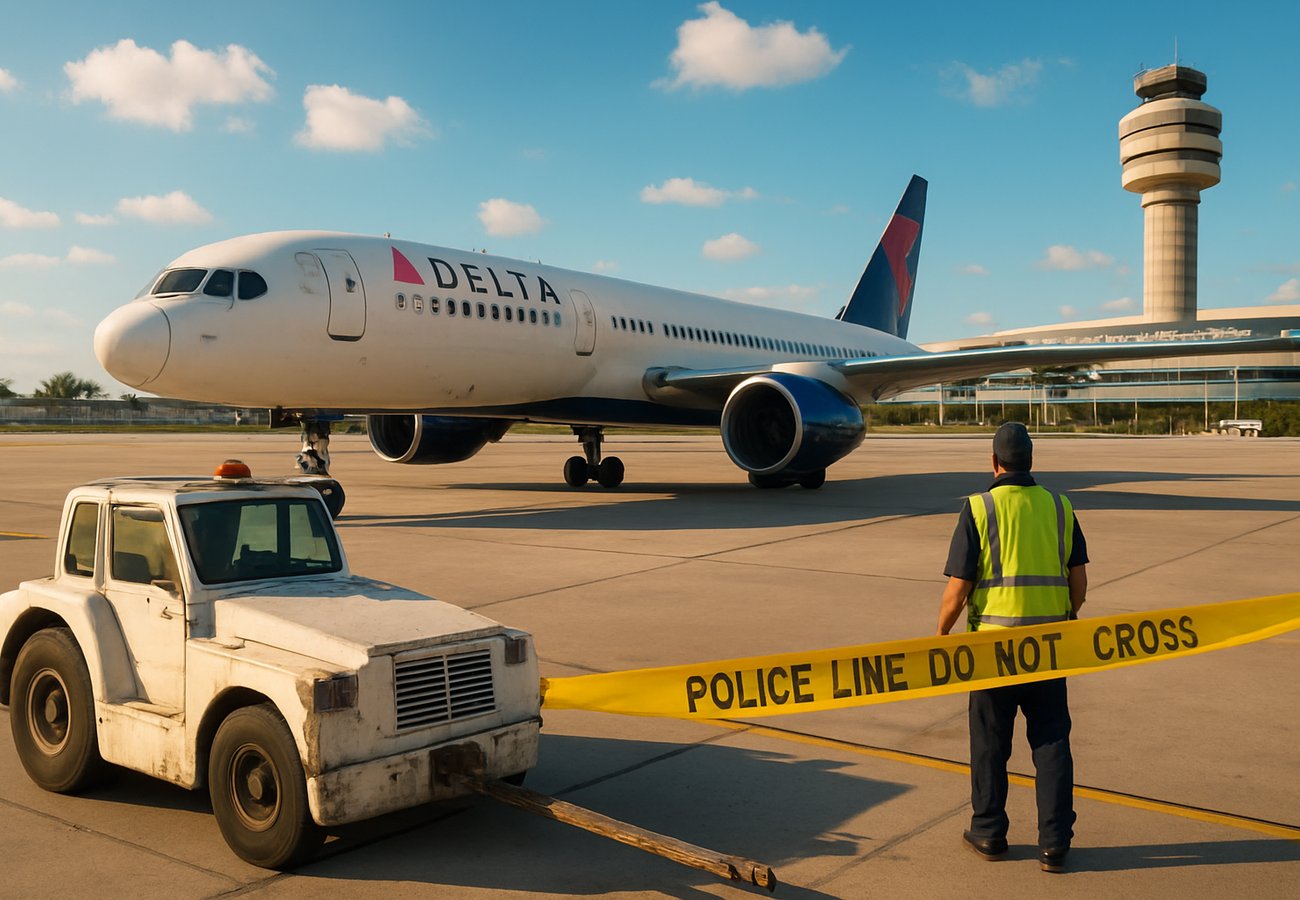
Shattered safety: A fatal collision on the MCO tarmac has triggered a nationwide re-evaluation of ground protocols.
Tragedy Strikes Orlando International: Fatal Delta Air Lines Ground Crew Accident Triggers Massive Operational Suspension; Flight Cancellations and Safety Scrutiny Intensify Following Tarmac Collision
In a heartbreaking development that has sent shockwaves through the global aviation community, a Delta Air Lines ground crew member was tragically killed at Orlando International Airport (MCO) on the evening of May 7, 2026. The 49-year-old employee lost his life after an airport tug vehicle collided with a jet bridge while servicing a Delta Airbus A321. This airline news update confirms that the incident, which occurred just before 11:00 PM, resulted in the immediate cancellation of Flight DL2593 to Minneapolis and a temporary but widespread suspension of operations at MCO. As federal investigators from the FAA descend upon the scene, the tragedy has sparked a critical conversation regarding the "Invisible Dangers" of the tarmac and the systemic travel chaos that follows such a catastrophic failure of ground safety protocols.
The fatality at MCO is not an isolated event but rather a grim reminder of the high-risk environment inhabited by ground workers. For the thousands of travelers at Orlando and beyond, the accident resulted in airport disruptions, flight diversions, and a somber atmosphere as passengers aboard the affected A321 were forced to disembark via airstairs onto a tarmac flooded with emergency responders. With the Ninth Circuit Medical Examiner’s Office confirming "multiple blunt impact injuries" as the cause of death, the aviation industry is now bracing for a rigorous audit of ground vehicle operations across the United States.
Expanded Overview: The Midnight Tarmac Crisis
The accident unfolded during the high-pressure window of late-night departures. While the Airbus A321 was parked at the gate and being prepared for its journey to Minneapolis-St. Paul (MSP), a standard tug vehicle maneuver went horribly wrong. The collision with the jet bridge was so severe that it caused structural damage, rendering the primary exit of the aircraft unusable and leading to the fatal entrapment of the ground worker.
This aviation update highlights the immediate ripple effect across the Florida airspace. As news of the fatality broke, Delta and airport authorities took the unprecedented step of temporarily suspending ground operations. This led to a wave of flight cancellations and left numerous aircraft in the air with no choice but to divert to neighboring airports. For witnesses on the ground, the sight of dozens of emergency vehicles with flashing lights was initially mistaken for a safety drill, only for the pilot to deliver the devastating news that a team member had been lost.
Section-Wise Breakdown: Incident Reconstruction and Impact
The MCO Tarmac: A Fatal Collision
At approximately 10:55 PM on May 7, the tug vehicle—a powerful machine designed to move multi-ton aircraft—collided with the jet bridge structure. The 49-year-old Orlando resident operating or positioned near the vehicle sustained catastrophic injuries. Despite the rapid response from Greater Orlando Aviation Authority emergency teams, the worker was pronounced dead at the scene. The Ninth Circuit Medical Examiner has since officially ruled the death as a result of "multiple blunt impact injuries," underscoring the sheer force involved in the collision.
Flight DL2593: Stranded Passengers and Diversions
Passengers aboard the Minneapolis-bound flight experienced the trauma firsthand. Scott Endsley, a traveler on the aircraft, recalled the confusion as the plane was suddenly returned to the gate and surrounded by police and fire crews. "We thought it was a drill until we saw the expressions on the faces of the ground crew," Endsley remarked. Ultimately, all passengers were deplaned via airstairs and rebooked on alternate flights, while incoming traffic was diverted to avoid the "frozen" terminal environment.
The Federal Probe: FAA and Safety Protocols
The Federal Aviation Administration (FAA) has launched a full-scale investigation into the mechanics of the tug and the adherence to safety banking at the gate. Investigators are examining whether mechanical failure or procedural error led to the pylon/jet bridge collision. This probe will likely look back at the 2025 fatality at Charlotte Douglas (CLT), where a similar tug accident claimed the life of a ground worker, to determine if systemic training gaps are contributing to a rise in tarmac incidents.
Orlando Incident Profile: May 7, 2026
The following table summarizes the critical details of the MCO ground accident.
Delta Air Lines Ground Fatality: Incident Summary
| Metric | Detail | Impact |
|---|---|---|
| Date & Time | May 7, 2026, 11:00 PM | Immediate Operational Halt |
| Location | Orlando Intl Airport (MCO) | Hub-Wide Flight Delays |
| Affected Airline | Delta Air Lines | Operations Suspended at MCO |
| Aircraft Type | Airbus A321 | Flight DL2593 Canceled |
| Casualty Profile | 49-Year-Old Male (Orlando) | Fatal Blunt Force Injuries |
| Primary Vehicle | Airport Tug Vehicle | Jet Bridge Structural Damage |
| Investigative Body | FAA & Local Authorities | Urgent Ground Safety Review |
Passenger Impact: Witnessing the Tarmac Crisis
For the travelers at MCO on the night of May 7, the experience was one of profound distress. Beyond the flight cancellations and the logistical travel chaos of being rebooked, there was the emotional weight of witnessing a fatal emergency response. Delta has committed to providing support not only to the family of the deceased but also to the Orlando-based team and affected passengers.
Diversions to airports like Miami (MIA) and Tampa (TPA) caused secondary delays for thousands, as the "Safety Freeze" at MCO lasted for several hours. Travelers are advised that while operations have resumed, the increased scrutiny on ground maneuvers may lead to minor scheduling adjustments as new safety briefings are implemented across the Delta network.
Industry Analysis: The High Risk of Ground Support Equipment (GSE)
Aviation analysts point out that while air travel has never been safer for the passenger, the ground remains a zone of significant danger. Tug vehicles, despite their relatively small size, possess immense torque and power. "A tug accident is essentially a high-speed collision in a low-speed environment," explains one senior aviation journalist. "When you combine heavy machinery with the tight spaces of a jet bridge, there is zero margin for error."
The 2025 CLT incident and now the 2026 MCO tragedy are forcing a re-evaluation of Ground Support Equipment (GSE) technology. There is growing pressure on airlines to implement proximity sensors and automatic braking systems on all tug vehicles—features that are standard in modern automobiles but have been slow to reach the industrial tarmac environment.
Conclusion: A Somber Reflection on Aviation Safety
The tragic loss of a Delta team member in Orlando is a somber reminder that the miracle of flight is made possible by thousands of individuals working in high-stakes environments every day. As the FAA investigation proceeds, the goal must be more than just finding a cause; it must be about ensuring that no other family has to endure such a loss. The aviation industry is built on a foundation of safety, and this tragedy serves as a call to extend that uncompromising standard to every corner of the airport—from the cockpit to the tug vehicle.
Key Takeaways
- A 49-year-old Delta ground crew member was killed in a tug vehicle accident at Orlando Airport on May 7, 2026.
- Flight DL2593 to Minneapolis was canceled, and passengers were forced to deplane via airstairs.
- The FAA and local authorities have launched a formal investigation into the collision.
- Operations at MCO were temporarily suspended, leading to diversions and widespread travel chaos.
- The Ninth Circuit Medical Examiner confirmed the cause of death as multiple blunt impact injuries.
- Tug vehicle safety is under intense scrutiny, with calls for modern proximity sensors following similar fatal incidents.
- Delta is providing full support to the victim's family and the Orlando ground team.
/article-footer-standard
Related Travel Guides:
Disclaimer
This article is for informational and educational purposes only. It does not constitute legal, financial, or professional advice. While we strive to provide accurate and up-to-date information, travel policies, regulations, and conditions change rapidly. Always verify information with official sources before making travel decisions. Nomad Lawyer makes no representations about the accuracy, reliability, completeness, or suitability of the information provided. Readers should consult qualified professionals for advice specific to their circumstances. The views expressed in this article are those of the author and do not necessarily reflect the views of Nomad Lawyer.
Kunal K Choudhary
Co-Founder & Contributor
A passionate traveller and tech enthusiast. Kunal contributes to the vision and growth of Nomad Lawyer, bringing fresh perspectives and driving the community forward.
Learn more about our team →